Listen, we need to have a serious conversation about the state of your dip. You just spent fourteen dollars on a handful of premium Hass avocados because the global supply chain is a mess and you had a very justifiable craving for tacos. You brought them home, nurtured them on your countertop until they yielded to the gentlest squeeze, and then you spent twenty minutes meticulously mashing them with fresh cilantro, diced jalapeños, and the perfect hit of red onion. You set the bowl down, turn your back to check on your carnitas, and when you look back, your vibrant, emerald-green masterpiece has transformed into a sad, oxidized, unappetizing swamp.
If you are constantly wondering why your homemade guacamole turns brown before your guests even arrive, you are not alone. It is the universal heartbreak of the weekend culinary hobbyist. But I am here to tell you that you do not need a culinary degree, a commercial vacuum sealer, or a pantry full of chemical preservatives to fix this. You just need a basic understanding of plant chemistry and a half-cup of tap water.
I have zero patience for the pretentious, over-complicated nonsense that plagues modern food media. We are going to solve this problem using hard science, clever physics, and absolute practicality. Today, we are going to tear down the traditional kitchen myths that have been ruining your leftovers for decades, and we are going to master the flawless, foolproof magic of the water seal.
The Green Gold Paradox: Why Your Guacamole Betrays You
To defeat the enemy, you must first understand the enemy. The browning of your avocado is not just a vague symptom of “going bad.” It is a highly specific, rapid chemical reaction, and it is entirely preventable once you know what you are looking at.
Meet the Culprit: Polyphenol Oxidase (PPO)
When you slice into an avocado, you are not just cutting through fruit; you are rupturing millions of microscopic plant cells. Inside the chloroplasts and thylakoids of these cells lives an enzyme called polyphenol oxidase, or PPO. In the wild, plants use PPO as a defense mechanism against pests and physical damage. As long as the avocado is whole and the skin is intact, the PPO is safely separated from the outside world.
However, the moment your chef’s knife breaches that skin and you begin mashing the flesh, you expose that enzyme directly to the oxygen in the air. We don’t need to decode pretentious recipe jargon to understand basic chemistry: when PPO meets oxygen, a rapid catalytic reaction begins. The enzyme starts oxidizing the naturally occurring phenolic compounds in the avocado, converting them into highly reactive molecules called quinones.
The Melanin Connection
Here is where it gets visually horrifying. Those reactive quinones do not just sit there; they immediately begin polymerizing—linking together in long chains—to form a dark pigment known as melanin. Yes, this is the exact same pigment that gives color to human skin and hair.
This process, known as enzymatic browning, is responsible for more than 50% of the loss in pre-harvest and post-harvest processing of fruits and vegetables worldwide. It happens incredibly fast. Depending on the specific cultivar of the avocado and the ambient temperature of your kitchen, visible browning can occur within just a few hours. While this brown layer is technically perfectly safe to eat, it looks terrible, and the oxidation process can eventually cause the buttery fats in the avocado to turn bitter and unpalatable.
The Hall of Shame: Why Traditional Kitchen Myths Fail Miserably
If you search the internet for ways to keep your guacamole green, you will be bombarded with a barrage of terrible advice. I have tried them all, usually on a frantic Tuesday night when I just wanted to save my leftovers without wasting a ridiculous amount of time. Let’s systematically dismantle these myths so you can stop ruining your food.
The Lime Juice Delusion
The most common advice is to simply drown the guacamole in extra citrus juice. The theory here is partially based in real science: PPO activity is sensitive to pH levels. By introducing the highly acidic environment of lime or lemon juice (which also contains ascorbic acid, an antioxidant), you can temporarily slow down the enzymatic browning.
But here is the brutal reality: to lower the pH enough to completely halt the enzyme, you have to add so much citrus that you completely destroy the delicate, creamy flavor profile of the avocado. While it’s true that your dinner actually needs acid to balance flavors, nobody wants to eat a bowl of sour, curdled avocado soup. Lime juice is a temporary delay tactic, not a long-term storage solution.
The Plastic Wrap Trap (And a Necessary Rant)
Then there is the classic restaurant trick: pressing a sheet of plastic wrap directly against the surface of the dip to block out the air. Let me be perfectly clear about this: I absolutely despise this method.
First of all, from a purely functional standpoint, modern consumer-grade plastic wrap is remarkably porous. It is designed to breathe slightly, meaning oxygen is still slowly diffusing through the plastic and reaching your food. It might buy you an extra day, but the brown sludge will inevitably appear.
More importantly, I am a huge advocate for banishing toxic kitchen gear from your home. Pressing cheap, flimsy, endocrine-disrupting plastics directly into acidic, high-fat foods is a massive culinary no-go. Fats and acids are notorious for leaching chemical compounds out of cheap plastics. Just like using aerosol cooking sprays is ruining your nonstick pans, wrapping your beautiful, organic produce in mystery polymers is a habit you need to break immediately.
The Avocado Pit Voodoo
I do not know who started the rumor that leaving the avocado pit in the center of the guacamole bowl will magically radiate an anti-browning forcefield, but it needs to stop. Food scientists have debunked this time and time again.
The pit contains absolutely no magical enzymes or chemical inhibitors that stop oxidation. The only reason the flesh directly underneath the pit stays green is because the pit is acting as a physical barrier, blocking oxygen from touching that specific square inch of avocado. The rest of the bowl will still turn brown. It is a useless wives’ tale that does nothing but create a choking hazard in your dip.
The Olive Oil Slick
Some well-meaning cooks suggest pouring a thick layer of olive oil over the top of the guacamole. Yes, oil is an impermeable barrier that will block oxygen. But let’s look at the economics and the sensory impact. Good olive oil is incredibly expensive. Pouring a quarter-cup of it over your leftovers is a waste of money. Furthermore, when you put olive oil in the refrigerator, it solidifies into a cloudy, unappetizing gel. When you try to stir it back into the guacamole the next day, it dramatically alters the texture, making your dip feel heavy, greasy, and completely unbalanced.
The Science of the Mighty Avocado: A Lipid Density Profile
So, if acid ruins the flavor, plastic wrap is toxic and porous, the pit is a myth, and oil is a greasy mess, what is the everyday home cook supposed to do? You use water.
I know what you are thinking. Pouring water over a bowl of guacamole sounds like a recipe for a soggy, watery disaster. But to understand why it works flawlessly, mastering the true art of the kitchen means working smarter and understanding the physical composition of your ingredients. We need to talk about lipid density.
High Fat, Low Water: The Anatomy of a Hass
The avocado is a botanical anomaly. While most fruits are primarily composed of carbohydrates and sugars, the avocado tree channels an immense amount of metabolic energy into producing lipids. In fact, producing lipids requires more than twice the energy required for carbohydrate production.
The mesocarp (the fleshy edible part) of a mature avocado is spectacularly high in fat, containing up to 25% lipids on a fresh mass basis. These fats are primarily healthy, lipophilic monounsaturated fatty acids like oleic acid, palmitic acid, and linoleic acid. This incredibly dense lipid profile is exactly what gives the avocado its luxurious, buttery texture that humans crave.
The Hydrophobic Nature of Your Dip
Because the avocado is absolutely loaded with these fatty acids, the resulting guacamole is inherently hydrophobic. As any middle school science student will tell you, oil and water do not mix. The fat molecules in the avocado actively repel water molecules.
When you pour a layer of water over a densely packed bowl of high-fat guacamole, the water cannot penetrate the surface. The dip acts as a waterproof barrier against the liquid. This hydrophobic principle is exactly why your cheap plastic containers stay greasy no matter how hard you scrub them; the lipophilic fats cling to the plastic and violently repel the dishwater. In the case of our guacamole, this hydrophobic repulsion is our greatest asset. The water simply sits passively on top, completely unable to soak into the dense, fatty matrix below.
The Magic of the Water Seal: Why It Actually Works
Now that we know the water won’t turn our dip into soup, we need to understand why it stops the browning so effectively. It all comes down to cutting off the supply chain to our old enemy, polyphenol oxidase.
The Impermeable Oxygen Barrier
For PPO to convert phenolic compounds into brown melanin, it requires a constant supply of oxygen. Water is a spectacular, naturally occurring, chemical-free barrier against atmospheric oxygen. While oxygen can technically dissolve in water, the rate at which oxygen diffuses through a layer of liquid water is exponentially slower than how it moves through the air.
By pouring a solid layer of water over the surface of the guacamole, you are instantly suffocating the PPO enzyme. You have created a flawless, airtight seal that conforms perfectly to the shape of your container. Without access to the oxygen in the air, the enzymatic browning reaction grinds to an absolute halt.
Specific Gravity and Density Mechanics
The second reason this works so beautifully is due to specific gravity. Guacamole is a heavy, dense, viscous substance. Water is comparatively light and highly fluid. When you pour the water on top, the density of the avocado mixture easily supports the weight of the water. The liquid flows effortlessly into every microscopic crevice along the edges of the container, sealing off any potential air pockets that a sheet of plastic wrap would inevitably miss.
You get the perfect, impermeable seal of an oil layer, but without the extra calories, the greasy texture, or the exorbitant cost. It is a triumph of home kitchen physics.
The Masterclass: Step-by-Step Guide to the Flawless Water Seal
Knowing the science is only half the battle; execution is everything. If you just recklessly dump a glass of water into a bowl of half-eaten dip, you are going to make a mess. If you want professional-level results that protect your expensive ingredients, consider this your essential kitchen survival guide for weekend entertaining and weekday meal-prep.
Step 1: The Smash, The Season, and The Smooth
First, prepare your guacamole exactly how you like it. Whether you are a purist who only uses salt and lime, or a maximalist who adds tomatoes, garlic, and jalapeños, the water seal does not discriminate.
Transfer your finished, leftover guacamole into a high-quality storage container. (Again, ditch the peeling plastic. Use a sturdy glass container or a food-grade stainless steel tub). Now, this next part is the most critical step in the entire process: you must aggressively pack the guacamole down and smooth the surface.
Use the back of a metal spoon to press the dip firmly into the bottom of the container, eliminating any hidden air bubbles trapped inside. Then, smooth the top surface until it is as flat and level as a freshly paved road. If you leave jagged peaks, deep craters, or messy smears up the sides of the container, the water will pool unevenly, and the exposed peaks of avocado will turn brown.
Step 2: The Gentle Pour
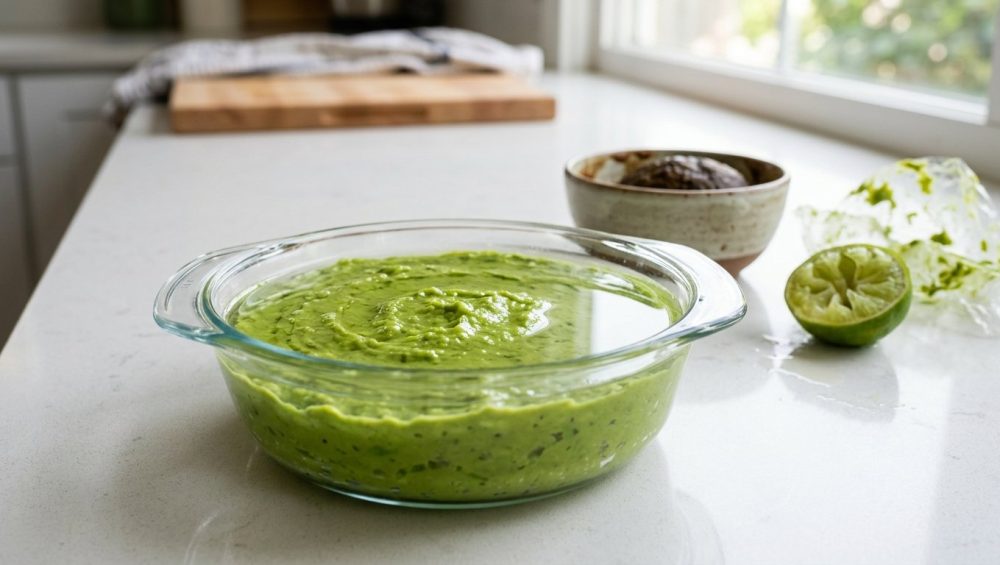
Once your surface is perfectly smooth and level, it is time to apply the seal. Take a spouted measuring cup filled with cold or lukewarm tap water. (I prefer cold water, as it helps rapidly drop the temperature of the dip for safer food storage).
Do not pour the water directly into the center of the guacamole from a high distance, or the force of the water will drill a hole right into your dip. Instead, place the spout of the measuring cup against the inside wall of the container, just above the surface of the guacamole. Gently and slowly trickle the water down the side of the glass. Let the water naturally fan out and cascade across the leveled surface of the dip.
You only need about a half-inch of water. Just enough to ensure that the entire green surface is fully submerged and completely isolated from the air above.
Step 3: The Safe Storage
Once the water seal is in place, secure a tight-fitting lid onto your container. Carefully transfer the container to your refrigerator, making sure you keep it level so the water doesn’t slosh around and disturb the smooth surface of the dip.
Under this protective aquatic blanket, your guacamole will remain vibrantly, shockingly green for up to three full days. The cold temperature of the refrigerator will further suppress any residual enzymatic activity, while the water acts as your impenetrable shield.
Step 4: The Pour-Off and Revive
Fast forward to the next day. You are ready for a snack. Pull the container out of the fridge and remove the lid. You will be greeted by a sight that defies all traditional kitchen logic: a perfectly green layer of guacamole sitting peacefully under a shallow puddle of water.
Take the container over to your sink, and very gently tilt it to pour the water off. Because you packed the dip down so tightly, the water will slide right off the hydrophobic fat layer and down the drain.
Will there be a few tiny droplets of moisture left on top? Yes. Don’t panic. Simply take a spoon and give the guacamole a vigorous stir. Those microscopic drops of water will seamlessly emulsify into the dense fat of the avocado. We all know the magic of a lemon squeeze can brighten a dish, but you will find that a day in the fridge under a water seal actually allows the onions, cilantro, and jalapeños to meld and harmonize, making the dip taste even better than it did on day one.
Troubleshooting the Water Seal Like a Pro
Even with a foolproof scientific method, the home kitchen is a place of variables and chaos. If you run into issues with the water seal, it usually comes down to user error. Let’s troubleshoot the most common complaints.
“My Guacamole Had Chunks and the Water Seeped In!”
If you are someone who prefers an ultra-chunky, rustic guacamole—where you barely mash the avocados at all—you have to be incredibly meticulous during the smoothing step. Large, unmashed chunks of avocado create structural gaps and deep air pockets in the dip.
If you just lightly rake a spoon over a chunky dip and pour water on it, the water is going to flood into those subterranean caverns. When you try to pour the water off the next day, it will be trapped inside the dip, resulting in a watery, miserable texture. If you like it chunky, you must use serious physical force to pack the dip down into the container before applying the water. You have to compress those air pockets out of existence.
“How Long Will This Actually Last?”
The water seal is a marvel of food preservation, but it is not a magic spell that grants immortality. While the lack of oxygen will stop the PPO enzyme from turning the avocado brown, it does not stop the natural growth of bacteria over time.
According to the FDA and food safety guidelines, cut avocados and homemade guacamole should be consumed within 3 to 4 days of preparation when stored in the refrigerator. After that point, even if the water seal has kept it looking beautifully green, the risk of spoilage and bacterial growth increases. Do not push your luck. Eat your leftovers promptly.
The Bigger Picture: Fighting Food Waste
We joke about the heartbreak of brown guacamole, but the reality of avocado waste is a massive global issue. Avocados are resource-intensive to grow, harvest, and transport. They require specific warm, humid climates, years of growth before a tree produces fruit, and highly coordinated global supply chains.
Because they are so delicate and prone to rapid enzymatic browning, the waste statistics are staggering. In some regions, up to half of the avocados produced are lost to pre- and post-harvest mishandling before they even reach a consumer. Once they reach our homes, the waste continues. We buy them, slice them, watch them turn brown, and throw them in the trash.
If you want to stop throwing away sad veggies and expensive fruits, you have to take responsibility for how you store them. Throwing away a bowl of guacamole just because it oxidized is a waste of your hard-earned money and a disrespect to the agricultural effort it took to get that fruit to your kitchen counter.
Conclusion: Stop Wasting Your Green Gold
You do not need to be a Michelin-starred chef to execute perfect food storage. You just need to respect the ingredients, understand a tiny bit of the underlying chemistry, and refuse to settle for mediocre kitchen myths that don’t actually work.
The next time you make a massive batch of guacamole for a weekend gathering, you can finally relax. You don’t need to anxiously monitor the snack table, you don’t need to ruin the flavor with a cup of lime juice, and you certainly don’t need to wrap your food in toxic, porous plastic.
Just pack it down, smooth it out, and pour a gentle layer of water over the top. Let the dense, hydrophobic lipids do the heavy lifting while the water acts as an impenetrable shield against the oxygen. It is fast, it is practically free, and it is scientifically guaranteed to keep your green gold looking exactly as vibrant and appetizing as the moment you mashed it. Now go make some tacos, and stop throwing your money in the compost bin.