The Great Dessert Struggle
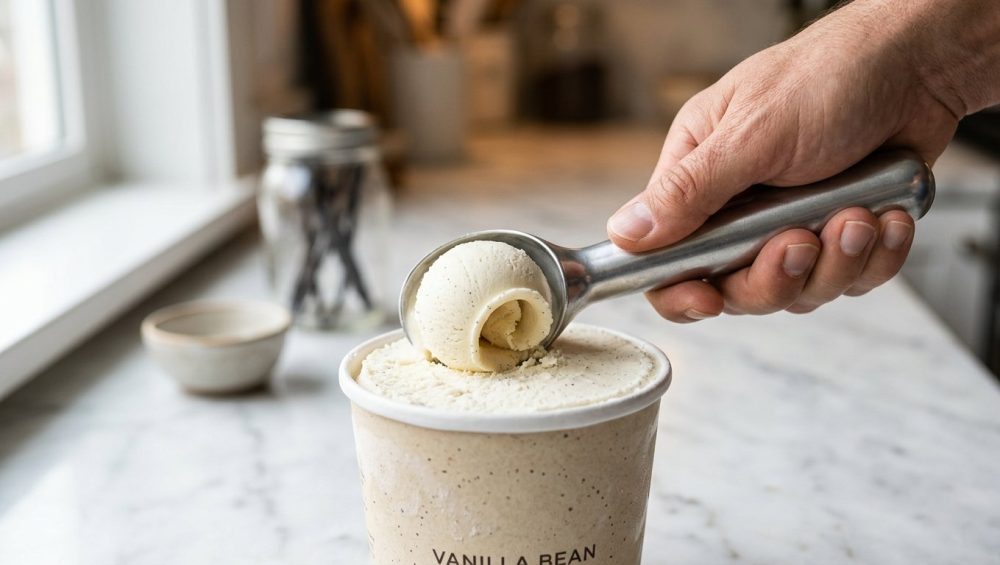
Let us set a highly familiar, deeply frustrating scene. It is 9:00 PM on a Friday night. You have survived another grueling week of emails, meetings, and uncooperative spreadsheets. You want exactly one thing: a massive, comforting bowl of premium vanilla bean gelato. You march into your kitchen, pull the pint from the depths of your freezer, pop the lid, and reach into your cutlery drawer for a standard soup spoon.
You plunge the spoon into the dairy abyss, apply a little pressure, and—snap.
Congratulations, you have just bent your favorite soup spoon at a horrifying ninety-degree angle, and the surface of the frozen dessert remains entirely unbothered. You curse under your breath, toss the ruined spoon into the sink, and resign yourself to leaving the pint on the counter to thaw for twenty minutes while you pace around the kitchen.
Listen to me closely, my weekend culinary warriors: you do not need to hit the gym to build stronger biceps just to serve dessert. You are simply bringing the wrong weapon to a thermodynamic battlefield. There is nothing more universally infuriating than wrestling with rock-hard ice cream after a long, exhausting week. You don’t need brute force; you need science. Specifically, you need a tool designed to manipulate the transfer of thermal energy. This is exactly why you need a heat-conductive ice cream scoop in your arsenal. Today, we are going to dive deep into the fascinating physics of frozen dairy, the graveyard of terrible kitchen gadgets, and the brilliant, liquid-filled aluminum hero that will save your silverware and your sanity.
The Physics of Frozen Dairy: Why Your Freezer Hates You
Before we talk about the solution, we have to understand the enemy. Why is your favorite frozen treat so incredibly difficult to penetrate? It comes down to a clash between food safety standards and the structural matrix of the dessert itself.
Ice cream is a complex emulsion made of water, fat, sugar, and air. The amount of air whipped into the mixture during the churning process is called “overrun.” Cheaper, mass-produced brands have a very high overrun—sometimes up to 100%, meaning the carton is half air. This makes it light, fluffy, and incredibly easy to scoop, even when deeply frozen. Premium brands and gelatos, however, have a very low overrun. They are dense, rich, heavy, and contain very little trapped air. When you freeze a low-overrun dairy product, it essentially turns into a block of sweet concrete.
Here is where the temperature mismatch occurs. For optimal food safety and long-term preservation, the FDA recommends that your home freezer be set to 0°F (-18°C) or even colder. However, the absolute ideal dipping temperature for serving frozen dairy is significantly warmer, generally between 6°F and 10°F. When you pull a pint out of a 0°F freezer, it is structurally too cold to yield to a standard utensil.
So, what do most people do? They leave it on the counter to thaw. This is a massive culinary sin. When you leave a pint at room temperature, it melts unevenly. The outside edges turn into soup while the center remains a solid brick. When you eventually put that half-melted pint back into the freezer, the liquefied water content refreezes. However, without the constant churning of an ice cream maker, that water freezes into large, jagged ice crystals. This cycle of melting and refreezing is the exact reason why your homemade ice cream turns icy and loses that velvety, luxurious mouthfeel you worked so hard to achieve.
Furthermore, serving semi-melted sludge guarantees that your ice cream melts too fast in the bowl, turning your carefully planned dessert into a sad, lukewarm puddle before you can even finish eating it. You need a way to carve through the dessert at 0°F without altering the temperature of the entire carton.
The Graveyard of Bad Gadgets (What NOT to Buy)
If you are like most home cooks, your kitchen drawers are currently holding at least one spectacularly useless scooping gadget. I have zero patience for tools that actively make cooking harder, and the dessert tool market is flooded with absolute garbage. Let’s review the usual suspects.
The Mechanical Trigger Scoop
You know the one. It looks like a half-sphere with a little metal sweeping arm inside, operated by a spring-loaded thumb trigger on the handle. Let me be brutally clear: these are designed for portioning soft cookie dough, cupcake batter, or mashed potatoes. They are not designed for frozen dairy. When you force a mechanical disher into a sub-zero block of dense gelato, you are putting immense stress on tiny, fragile moving parts. Within a few months, the gears strip, the internal spring snaps, or the thumb lever bends backward. They are a mechanical failure waiting to happen.
The Flimsy Plastic Spade
Usually given away for free or bought for a dollar, these plastic monstrosities lack the sheer tensile strength required to cut through a solid block of dairy. They flex, they bend, and eventually, they snap right down the middle, leaving a jagged piece of plastic buried in your mint chocolate chip.
The “Chrome-Plated” Mystery Metal Scoop
This is the most insidious offender. These heavy-looking scoops are made from cheap, porous base metals coated in a shiny layer of faux-chrome. Over time, the extreme cold, combined with the moisture of the freezer and the friction of scooping, causes that cheap plating to blister and peel. I am a fierce advocate for banishing toxic kitchen gear from your home, and finding flakes of mystery metal plating in your dessert is completely unacceptable. You deserve better, and your food deserves better.
The Hero We Don’t Deserve: The Thermodynamics of the Heat-Conductive Scoop
Enter the undisputed champion of the dessert world: the single-piece, liquid-filled, cast aluminum scoop. No moving parts. No cheap plating. No springs to break. Just pure, unadulterated thermodynamics at work.
To understand why this tool feels like magic, we have to talk about thermal conductivity. Standard spoons are made of stainless steel. Stainless steel is incredibly durable, but it is a remarkably poor conductor of heat. When a room-temperature steel spoon hits 0°F ice cream, the cold instantly drains the heat from the surface of the spoon, bringing the metal to a freezing equilibrium almost immediately.
Aluminum, on the other hand, has a thermal conductivity exponentially higher than stainless steel. It transfers heat rapidly and efficiently. But the real genius lies inside the handle.
These high-end scoops feature a hollow handle filled with a specialized, non-toxic heat-transfer fluid—usually a food-safe antifreeze like a propylene glycol and water mixture, or a specialized mineral oil. When you grip the handle, the natural 98.6°F warmth of your hand transfers through the highly conductive aluminum and warms the fluid inside.
This creates a microscopic convection current. The warmed fluid moves toward the cold bowl of the scoop, continuously pumping your body heat directly to the thin cutting edge. As you pull the scoop across the surface of the frozen dessert, this continuous supply of heat melts a microscopic, millimeter-thin layer of the ice cream right at the point of contact. This liquid layer acts as a lubricant, breaking the friction and allowing the aluminum to glide effortlessly through the dense fat and ice matrix. You aren’t forcing your way through the ice cream; you are literally melting your path through it.
A Brief History of Culinary Genius: Sherman Kelly and the Zeroll
You might think a tool this perfectly engineered is a modern marvel, but the technology is actually nearly a century old.
The story begins in 1935, right in the middle of the Great Depression. A man named Sherman Kelly was vacationing in West Palm Beach, Florida, when he stopped at a local parlor for a treat. As he watched the young woman behind the counter struggling to serve the hard dairy, he noticed that her hands were covered in painful blisters from the constant, agonizing use of a mechanical trigger disher. Kelly, an observant tinkerer, thought to himself that there simply had to be a better way.
He went to his garage in Toledo, Ohio, and developed a non-mechanical, cast aluminum scoop with a hollow handle filled with a proprietary defrosting fluid. He called his invention the Zeroll. At the time, his wife Hazel helped him run the fledgling business, working for a wage of fifty cents an hour.
The Zeroll scoop wasn’t just an ergonomic triumph; it was an economic miracle for struggling businesses during the Depression. Because of the unique, curved shape of the aluminum bowl, the tool didn’t just dig into the dessert—it rolled it. Traditional mechanical dishers compressed the ice cream, squeezing the air out of it. Because parlors buy ice cream by weight but sell it by volume (the scoop), compression was costing them money. The Zeroll rolled the ice cream into a perfect, uncompressed sphere, effectively giving vendors 10% to 20% more servings per gallon.
The invention was an overnight sensation, selling thousands of units in its first full year of production in 1936. Although production had to be temporarily halted during World War II because aluminum was desperately needed for the war effort, the company bounced back immediately after the war. The design is so flawlessly utilitarian and timelessly modern that it was even featured in the Museum of Modern Art (MoMA) in a 2004 exhibition curated by Paola Antonelli. Today, it remains the absolute gold standard for professionals and in-the-know home cooks alike.
The Anatomy of the Perfect Scoop
When people ask me for advice on curating a highly functional, minimalist setup, I always tell them to invest in tools that do one job flawlessly. If I had to write a definitive list of absolute beginner kitchen tools, this unpretentious piece of cast aluminum would easily make the top five. Its brilliance lies in its anatomical simplicity.
The Material
As discussed, the cast aluminum construction is non-negotiable. It is lightweight, incredibly durable, and possesses the thermal properties required to transfer your body heat rapidly from the handle to the bowl.
The Shape of the Bowl
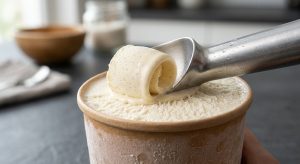
Look closely at a heat-conductive scoop, and you will notice the bowl is not a perfect half-sphere. It is slightly elongated with a subtle, sweeping curve. This is the “roll” in Zeroll. It is specifically engineered to force the frozen dairy to curl back in on itself as you pull, creating a visually perfect, aesthetically pleasing sphere that looks like it belongs in a mid-century diner.
The Cutting Edge
The rim of the bowl is machined to be relatively thin. It is not sharp enough to cut your hand, but it is thin enough to concentrate the thermal energy into a very narrow focal point, allowing it to easily pierce the frozen surface.
The Handle
The handle is thick, rounded, and perfectly ergonomic. It is designed to maximize the surface area in contact with your palm, ensuring the most efficient transfer of body heat into the internal fluid reservoir.
How to Actually Use It Like a Pro
Having the right tool is only half the battle; you also have to use the correct technique. If you are still hacking vertically at your dessert like you are chopping firewood, you are doing it wrong.
Step 1: Prime the Engine.
Before you even open the freezer, pick up the scoop and hold the handle firmly in your bare hand for about 15 to 30 seconds. You will actually feel the aluminum pull the heat from your skin. This primes the internal fluid and gets the convection current flowing.
Step 2: The Perimeter Scrape.
Do not dig straight down into the center of the pint. The center is the coldest, hardest part. Instead, start at the perimeter, right where the ice cream meets the cardboard edge.
Step 3: The “S” Curve.
Hold the scoop at a shallow, 45-degree angle. Press the edge into the dairy and pull it toward you, tracing a shallow “S” shape across the surface. You are not trying to excavate a deep trench; you are shaving off the top layer. As you pull, the heat melts the friction layer, and the shape of the bowl will naturally curl the ribbon of dairy into a perfect ball.
Step 4: Let the Tool Do the Work.
Never pry. Prying is for crowbars. If you find yourself using the edge of the carton as a fulcrum to lever out a stubborn chunk, stop immediately. Just glide across the surface and let the thermodynamics do the heavy lifting.
The Golden Rule: KEEP IT OUT OF THE DISHWASHER
I need you to read this next section very carefully, and I need you to commit it to memory. If you ignore everything else I have written today, remember this one unbreakable rule: Never, under any circumstances, put a fluid-filled aluminum ice cream scoop in the dishwasher.
I will shout this from the rooftops until I lose my voice. The dishwasher is a hostile, violent environment filled with extreme heat and caustic chemicals. Modern automatic dishwasher detergents contain highly alkaline compounds, such as sodium carbonate and sodium silicate, which are designed to dissolve baked-on food proteins.
Aluminum is an amphoteric metal, meaning it reacts aggressively to both strong acids and strong bases. When you subject bare or anodized aluminum to the high-pH chemical warfare of a dishwasher, the detergent literally eats away at the protective outer layer and attacks the raw metal. This causes rapid, catastrophic oxidation.
If you have ever opened your dishwasher and wondered why your perfectly shiny new ice cream scoop turned gray and started leaving a powdery, dark black soot all over your hands and your food, this aggressive chemical oxidation is the culprit. You have essentially chemically corroded the surface of your tool. This intense heat and chemical reaction is the exact same reason your aluminum baking sheets keep warping and losing their shiny finish when you lazily throw them in the bottom rack.
Furthermore, the extreme water temperatures in a modern dishwasher (often exceeding 170°F during the drying cycle) can cause the heat-conductive fluid inside the handle to expand violently. This can blow out the airtight seal at the base of the handle, causing the proprietary fluid to leak out or dry up entirely. Once that seal is broken and the fluid is gone, the scoop is dead. It becomes nothing more than a hollow, useless piece of metal.
Just like the annoying phenomenon where your silicone spatulas taste like soap after absorbing the synthetic fragrances of cheap dishwasher pods, your aluminum gear is fundamentally and permanently altered by the machine.
Hand wash your scoop. It takes exactly ten seconds. Run it under warm water, wipe it with a soapy sponge, rinse it, and dry it with a towel. If you complain about ten seconds of hand washing to preserve a tool that will otherwise last you a lifetime, we need to have a serious conversation about your kitchen priorities.
Comparing the Contenders: The Original vs. The Knockoffs
Because the design is so incredibly effective, the market is completely flooded with cheap knockoffs. You can easily find fluid-filled aluminum scoops on massive online retailers for under ten dollars. Do not buy them.
The original Zeroll scoop typically retails for around $20 to $25. The knockoffs cut corners in three critical areas:
- The Aluminum Density: Cheap knockoffs use thinner, lower-grade aluminum alloys that do not conduct heat as efficiently.
- The Fluid: Instead of a highly engineered, food-safe heat transfer fluid, cheap knockoffs often use plain water or inferior oils that do not create an effective convection current.
- The Seal: The end-cap seal on a ten-dollar scoop is notoriously weak. Even if you hand wash it, the seal will eventually fail, leaking mysterious fluid into your dishwater (or worse, your dessert).
Spend the twenty-five dollars. Buy the original, American-made Zeroll. It is an investment in your sanity. Why spend ten dollars every year replacing a leaky, oxidized knockoff when you can buy the gold standard once and pass it down to your children?
Troubleshooting Common Ice Cream Disasters
Even with a masterpiece of thermodynamic engineering in your hand, things can occasionally go wrong. Let’s troubleshoot.
“My scoop isn’t melting the ice cream!”
If you are dragging the scoop and it still feels like you are hitting a brick wall, there are two possibilities. First, you might have naturally very cold hands (poor circulation), meaning you aren’t transferring enough heat into the handle. Try running the scoop under warm tap water for three seconds before you start. Second, your freezer is set too cold. If your freezer is hovering at -20°F, no amount of hand-heat is going to save you. Check your freezer dial and adjust it to a reasonable 0°F. As I always emphasize when teaching the fundamentals of surviving kitchen disasters, you cannot fight basic physics and expect to win. Adjust your environment.
“My ice cream is rolling, but it’s covered in crunchy ice crystals.”
This is not the scoop’s fault. This means you (or someone in your household) previously left the pint sitting on the counter to thaw, allowed the edges to melt, and then put it back in the freezer. The damage is done. The emulsion is broken. Eat the crunchy ice cream and learn your lesson for next time.
Beyond Dessert: Alternative Uses for Your Heat-Conductive Scoop
While it is a highly specialized tool, your heat-conductive scoop doesn’t have to sit idle between dessert cravings. Because of its sturdy construction and sharp, sweeping edge, it is surprisingly versatile.
- Gutting Winter Squash: If you have ever tried to scrape the stringy, stubborn seeds out of a raw butternut squash or a pumpkin with a regular spoon, you know it is a miserable task. The sharp edge and ergonomic grip of your aluminum scoop make short work of scraping out squash cavities.
- Seeding Melons: It effortlessly glides through cantaloupe and honeydew to remove the seed core in one clean, sweeping motion.
- Portioning Thick Batters: While I generally prefer mechanical dishers for exact portion control, the fluid-filled scoop works beautifully for transferring thick, heavy batters into baking pans without bending.
The Sassy Sous-Chef’s Final Verdict
We spend so much time stressing over the complicated parts of cooking—nailing the perfect sear on a steak, balancing the acidity in a pan sauce, or keeping a delicate emulsion from breaking. Dessert is supposed to be the easy part. It is supposed to be your reward for a job well done.
Stop wrestling with your dessert. Stop bending your good silverware. Stop waiting twenty minutes for your premium pints to turn into soup on the kitchen counter. For the cost of a few overpriced lattes, you can permanently eliminate one of the most annoying micro-frustrations in the modern kitchen.
Buy a high-quality, heat-conductive aluminum scoop. Wash it by hand. Respect the thermodynamics. And most importantly, enjoy your perfectly spherical, effortlessly scooped ice cream. You’ve earned it.