Listen up, weekend culinary warriors. I know exactly what happens in your kitchen every October. You go to the farmer’s market, you see a beautiful, golden butternut squash, and you buy it because it looks like the absolute epitome of autumnal domestic bliss. You bring it home, set it proudly on your kitchen island, and then you just stare at it. For days. Maybe even weeks. It sits there, slowly mocking you, because you know that in order to turn that dense, bulbous gourd into a silky puree or perfectly caramelized roasted cubes, you have to peel it. And peeling a butternut squash with a standard kitchen peeler is a form of medieval torture.
You know the drill. You grab that heavy, vertical swivel peeler with the thick rubber handle that you bought at a big-box store. You drag it down the side of the squash. It skips. It stutters. The blade clogs immediately with a thick ribbon of waxy skin, forcing you to bang the peeler aggressively against the side of your trash can. You press harder, your wrist aching, until the dull blade suddenly slips off the tough epidermis and nearly takes off your thumb. By the time the squash is finally naked, your kitchen looks like a crime scene, your hands are covered in a sticky, sap-like residue, and you have wasted twenty minutes of your precious evening.
I have zero patience for pretentious chef-speak, but I have even less patience for kitchen tools that actively make your life harder. Cooking should not be a high-stakes wrestling match with your produce. If you are dreading meal prep, it is not because you lack culinary skills; it is because your equipment is setting you up for failure. It is time to stop fighting your food. It is time to upgrade to a carbon steel Y-peeler.
The Butternut Squash Battle: Why Your Current Peeler is Sabotaging You
Before we can fix the problem, we need to understand exactly why your current setup is failing you so spectacularly. The tool you are likely using is called a swivel peeler (sometimes referred to as a vertical peeler or an I-peeler). It features a straight handle with a vertical blade attached to the top that pivots back and forth.
The Anatomy of a Kitchen Struggle
The vertical swivel peeler was popularized decades ago, and it is perfectly fine if you are peeling a small, round, thin-skinned object like an apple or a russet potato. But when you introduce it to a massive, dense, thick-skinned beast like a butternut squash, the design flaws become glaringly obvious.
First, the parallel blade design forces your wrist into an incredibly awkward, weak angle. You are essentially holding the tool like a wand and trying to flick the blade away from your body, or worse, pulling it inward toward your own thumb. Your wrist is a complex, fragile joint made up of small ligaments; it was not designed for high-torque, repetitive pulling against dense resistance.
Second, the pivot point on most cheap swivel peelers is horribly unstable. Instead of biting into the tough skin of a winter squash, the blade wobbles, skates across the waxy surface, and ultimately slips. This forces you to apply excessive downward pressure to force the blade to engage. In the culinary world, applying excessive force to a dull blade is the number one recipe for a trip to the emergency room.
The Mystery Metal Problem
We also need to talk about the actual blade material on that vertical peeler. The vast majority of mass-produced, big-box store peelers are made with incredibly cheap, soft stainless steel, or worse, mystery metal alloys coated in faux-chrome. I am a zealot when it comes to banishing toxic kitchen gear from my countertops, and those cheap peelers that eventually rust, chip, and flake metallic dust into your food are enemy number one.
Because these mystery metals are so soft, the microscopic edge of the blade rolls and dulls almost immediately after a few uses. You are left trying to shave a rock-hard squash with a piece of metal that has the cutting power of a butter knife. The blade doesn’t cut; it bludgeons. It tears the flesh of the vegetable, leaving a jagged, uneven surface that cooks unevenly and looks terrible on the plate.
Enter the Carbon Steel Y-Peeler: The Ultimate Culinary Equalizer
If you walk into the prep kitchen of any high-end restaurant, you will not see bulky, rubber-handled swivel peelers. You will see line cooks effortlessly flying through crates of root vegetables using a small, lightweight, seemingly basic tool: the carbon steel Y-peeler.
What Actually is a Y-Peeler?
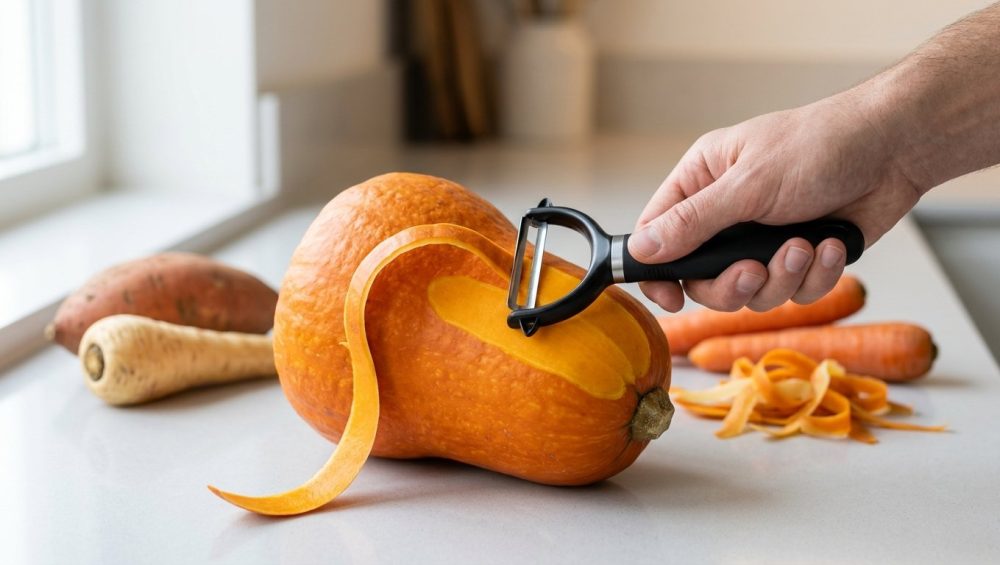
A Y-peeler gets its name from its distinct slingshot shape. Instead of a vertical handle with a blade at the top, a Y-peeler features a horizontal blade suspended between two plastic or metal arms. It looks remarkably similar to a traditional men’s shaving razor.
While it might look less substantial than the heavy, over-engineered gadgets sold on late-night infomercials, the Y-peeler is a marvel of functional minimalism. When you are evaluating beginner kitchen tools, you have to look past the marketing fluff and examine the actual physics of the design. The Y-peeler is not designed to look impressive in a drawer; it is designed to strip the skin off a vegetable with terrifying efficiency.
The undisputed king of this category is the Kuhn Rikon Original Swiss Peeler. It is a humble, brightly colored plastic tool with a carbon steel blade that costs about five dollars. Yet, this exact model is so highly regarded by professional chefs and home cooks alike that it has sold over 20 million units globally. It is the definition of punching above its weight class.
The Mechanical Advantage: Physics in the Kitchen
The true magic of the Y-peeler lies in its ergonomics and leverage. Because the blade is mounted horizontally, perpendicular to the handle, you do not use your weak wrist flexors to pull the blade. Instead, you hold the peeler with a secure downward grip and pull it straight toward your body.
This downward pulling motion is a massive mechanical advantage. It allows you to lock your wrist in a neutral, stable position and engage the much larger, stronger muscles of your bicep, tricep, and shoulder. You are using the weight of your entire arm to pull the blade through the tough squash skin, rather than relying on the tiny ligaments in your hand.
Because of this superior leverage, the downward pulling motion of a Y-peeler is significantly faster and drastically minimizes fatigue. Furthermore, the fixed blade angle of a high-quality Y-peeler provides a perfectly consistent peeling depth. It takes off exactly the tough outer skin and the fibrous green layer underneath, leaving the sweet, orange flesh perfectly intact and minimizing food waste.
Carbon Steel vs. Stainless Steel: The Blade Material Masterclass
You can buy Y-peelers with stainless steel blades, but if you want to truly conquer a butternut squash, you must insist on carbon steel. The difference in performance is not just noticeable; it is staggering. To understand why, we need a brief, no-nonsense masterclass in metallurgy.
Why Carbon Steel Holds a Terrifyingly Sharp Edge
Steel is an alloy made primarily of iron and carbon. Stainless steel is created by adding a significant amount of chromium (usually at least 10.5%) to the mix. This chromium creates a microscopic, passive layer of chromium oxide on the surface of the metal, which acts as a shield against water and oxygen, preventing rust.
However, there is a massive trade-off for this convenience. The large chromium molecules disrupt the fine crystalline structure of the steel. This makes stainless steel inherently softer and much more difficult to sharpen to an acute angle.
Carbon steel, on the other hand, lacks this high chromium content. Because its crystalline structure is tighter and more uniform, carbon steel can be honed to a microscopic edge that is 15% to 20% sharper than standard stainless steel.
When that razor-sharp carbon steel blade meets the slick, waxy cuticle of a butternut squash, it doesn’t skate or slide. It bites instantly. It grips the skin and effortlessly glides through the dense cellulose structure of the vegetable with almost zero resistance. It feels less like peeling a tough gourd and more like pulling a hot knife through butter.
The Durability and Longevity Factor
Beyond initial sharpness, carbon steel offers vastly superior edge retention compared to cheap stainless steel. If your knives get dull so fast that you find yourself crushing tomatoes instead of slicing them, you already understand the absolute misery of working with soft metal.
A high-quality carbon steel peeler will hold its terrifyingly sharp edge through months, if not years, of heavy weeknight meal prep. While a cheap stainless peeler will start to tear and mangle your produce after a few weeks of use, a carbon steel blade maintains its integrity, ensuring that every single stroke is clean, smooth, and effortless.
Ergonomics and Leverage: Stopping the Slips and Slices
My philosophy is that time is money, and there is nothing that ruins a productive weeknight meal prep session faster than a trip to the urgent care clinic. We need to have a very serious conversation about kitchen safety, because dull prep tools are a massive, hidden hazard in the home kitchen.
The Danger of the Swivel Peeler’s Pivot
According to consumer safety data, over 350,000 people are injured by kitchen knives and sharp prep tools every single year. A staggering 66% of these injuries are painful, debilitating lacerations to the fingers. Furthermore, roughly 160,000 children are injured in kitchen accidents annually, with sharp tools being a leading cause.
These injuries rarely happen because a tool is too sharp; they happen because a tool is too dull. One of the most dangerous rookie kitchen mistakes you can make is trying to force a blunt blade through a hard object. When your dull swivel peeler refuses to bite into the squash, you instinctively push harder. You tense your hand, you apply massive downward force, and you lose all fine motor control.
When that dull blade inevitably slips off the waxy surface of the squash, all of that pent-up kinetic energy has to go somewhere. Usually, it goes directly into the palm or thumb of your stabilizing hand.
Biomechanics of the Y-Peeler Grip
The Y-peeler drastically reduces this risk through its superior biomechanics. To hold a Y-peeler correctly, you do not grip it in a tight fist. Instead, you use a pinch grip. You place your thumb on one side of the Y-shaped frame and your index finger on the other, resting the handle gently in the palm of your hand.
This grip gives you immense tactile feedback and control over the blade. Because the carbon steel is so sharp, you do not need to apply heavy downward pressure. You simply rest the blade against the vegetable and pull smoothly. The tool does the work, not your muscles. If the blade does happen to slip, the lack of forceful pressure means it stops immediately, rather than rocketing into your other hand.
Conquering the Thick-Skinned Beasts: A Practical Guide
Now that you understand the mechanical and material superiority of the carbon steel Y-peeler, it is time to put it into practice. Buying the right tool is only half the battle; using the correct technique is what will actually save you time and frustration.
The Butternut Squash Breakdown
Do not try to peel a butternut squash while holding it entirely in your hand, and never try to peel it while it is rolling around on your cutting board. Stability is the key to speed and safety. Here is the definitive, no-nonsense method for breaking down a butternut squash in under two minutes:
- Amputate the Ends: Place the squash on your heaviest, most stable cutting board. Using a sharp chef’s knife, slice about half an inch off the top stem and the bottom base. You need flat, stable surfaces.
- Divide and Conquer: A butternut squash is essentially two different vegetables fused together: the solid, dense neck, and the hollow, seed-filled bulb. Cut the squash in half transversely, separating the long neck from the round base.
- Stand and Shave: Stand both pieces upright on their newly cut, flat bases. They are now completely stable and will not roll.
- The Downward Pull: Take your carbon steel Y-peeler, anchor the blade at the top edge of the squash, and pull straight down toward the cutting board in long, smooth, confident strokes. Rotate the squash as you go.
- The Second Pass: Butternut squash has a thin beige skin, but right underneath it is a fibrous, pale green layer of flesh that tastes woody and tough. You must peel past this green layer until you hit the vibrant, deep orange flesh underneath. With a carbon steel Y-peeler, this requires just a quick, effortless second pass.
Once you have a massive mountain of tough squash skins littering your workspace, you need a bench scraper to efficiently scoop the debris straight into your compost bin without dulling your chef’s knife on the board.
Sweet Potatoes, Celeriac, and Winter Roots
The Y-peeler is not just a one-trick pony for squash. It is the ultimate weapon against all thick-skinned, stubborn winter root vegetables.
Sweet potatoes, with their grooved, uneven surfaces and tough, dirt-caked skins, are notoriously difficult to prep with a vertical peeler. The wide blade of the Y-peeler glides over the bumps and effortlessly strips away the skin. Celeriac (celery root), which looks like a gnarly, alien brain covered in tough roots, can actually be peeled with a high-quality Y-peeler, saving you from having to hack away half the edible flesh with a paring knife.
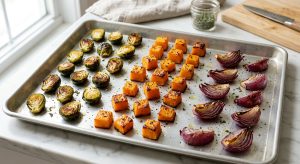
If you leave these thick, fibrous skins on your root vegetables out of sheer laziness, your roasted veggies turn mushy because the tough exterior traps steam in the oven, completely preventing that beautiful, crispy Maillard reaction caramelization we are all chasing. Proper prep is the foundation of proper cooking.
Peeler Maintenance: Keeping Your Carbon Steel Pristine
I have sung the praises of carbon steel, but I must give you a brutally honest warning: with great sharpness comes great responsibility. Carbon steel is a reactive metal, and it requires a very specific, non-negotiable maintenance routine. If you treat it like your cheap stainless steel tools, you will ruin it.
The Rust Factor (And How to Prevent It)
Because carbon steel lacks the protective chromium oxide layer of stainless steel, it is highly susceptible to oxidation. If you leave a carbon steel blade wet, it will develop surface rust in a matter of hours.
This means you can absolutely never toss your Y-peeler into the sink to soak in a pool of soapy dishwater. You cannot leave it sitting on a wet cutting board while you eat dinner. And you absolutely, under no circumstances, can ever put it in the dishwasher.
Proper Cleaning and Storage Protocols
Just like soaking bamboo cutting boards in the sink will cause them to warp, splinter, and completely ruin your knife edges, running a carbon steel peeler through the aggressive heat, moisture, and abrasive detergents of a dishwasher will destroy the blade permanently.
The cleaning protocol is incredibly simple, but it must be done immediately:
- The second you are done peeling, rinse the blade under warm running water to remove any acidic vegetable juices.
- If debris is stuck in the blade, use a soapy sponge to wipe it clean, being careful of the razor-sharp edge.
- Take a dry kitchen towel and thoroughly dry the entire peeler, paying special attention to the carbon steel blade. Do not let it air dry.
- Store it in a dry drawer. If you live in a highly humid environment, you can wipe a single drop of food-safe mineral oil across the blade to act as a moisture barrier.
If you do accidentally let it rust, do not panic. You can usually scrub light surface rust away with a bit of baking soda and a scouring pad, but it is much easier to just dry the damn tool in the first place.
The Financial and Environmental ROI of a Good Peeler
Let’s talk about the return on investment. I am a firm believer that anyone can cook like an absolute expert in a standard home kitchen, but you have to stop wasting your money on the wrong things.
Stopping the Disposable Peeler Cycle
There is a massive industry built around selling you oversized, over-engineered kitchen gadgets that promise to solve all your problems. You will see heavy, $20 peelers with massive, ergonomic rubber grips, swiveling heads, and futuristic designs. They look impressive in the packaging, but they are almost always equipped with a cheap, soft stainless steel blade.
You buy one, it works okay for a month, and then it dulls. You get frustrated, throw it in the trash, and buy another $20 gadget. This disposable cycle is terrible for your wallet and terrible for the environment.
The Kuhn Rikon Original Swiss Peeler, with its carbon steel blade, costs around five dollars. It is a fraction of the price of the bulky alternatives, yet it performs exponentially better and lasts significantly longer. When the carbon steel blade eventually does dull after a year or two of intense, heavy use, you can replace it for the cost of a fancy cup of coffee.
Time Saved vs. Money Spent
When you are compiling a list of the essential tools every beginner needs, do not fall into the trap of thinking that a higher price tag automatically equals better performance. The best tools in the kitchen are often the simplest.
But the true ROI of a carbon steel Y-peeler is not measured in dollars; it is measured in time. Weeknight cooking is a battle against the clock. If it takes you fifteen minutes of frustrating, dangerous labor to peel a single butternut squash, you are going to resent the cooking process. You will start viewing fresh vegetables as a chore, and you will inevitably default to ordering expensive, mediocre takeout.
By investing five dollars in a tool that strips a squash in sixty seconds flat, you are buying back your time, your energy, and your enthusiasm for cooking.
The Verdict: Reclaiming Your Prep Time
At the end of the day, cooking should be a joyful, creative process, not a frustrating battle against your own ingredients. You have enough stress in your life; you do not need to be fighting a butternut squash on a Tuesday evening.
Attempting to prep dense, tough winter root vegetables with a dull, unstable, vertical swivel peeler is just as self-sabotaging as using a cold pan to sear a premium steak. It is the wrong tool for the job, and it guarantees a miserable outcome.
If you are finally ready to stop slipping, stop cursing, and experience truly efficient vegetable prep, it is time to throw that dull, rusty, plastic swivel peeler into the trash where it belongs. Spend the five dollars. Buy the carbon steel Y-peeler. Learn the pinch grip, embrace the downward pull, and remember to dry the blade. Your wrists, your fingers, and your weeknight dinners will thank you. Now go buy a squash and show it who is boss.