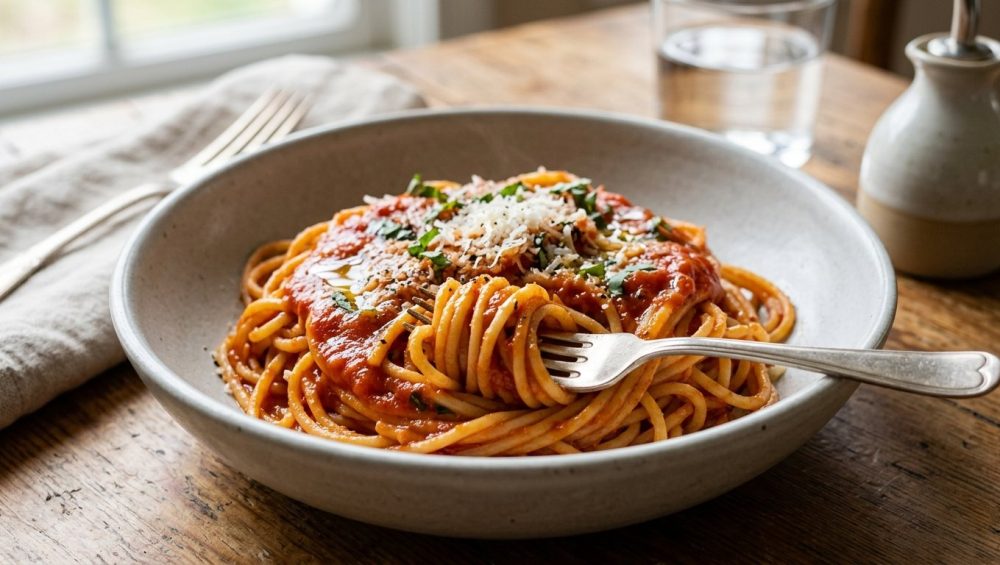
We need to have a serious, brutally honest conversation about the state of your weeknight dinner. You know exactly what I am talking about. You boil a pot of spaghetti, drain it until it is bone-dry, dump it onto a plate, and ladle a heavy scoop of marinara right on top. You carry it to the dining table, take your first twirl with your fork, and tragedy strikes. The sauce immediately slides right off the noodles, pooling at the bottom of the bowl in a watery, greasy puddle. You are left chewing on sad, naked, flavorless starch while the actual meal you worked so hard to prepare mocks you from beneath.
If this sounds like your typical Tuesday night, take a deep breath. You are not a bad cook. You simply haven’t been taught the fundamental culinary science of how to marry pasta and sauce. The restaurant-quality dishes you pay a premium for—the ones where the sauce clings to every single ridge and curve of the noodle like a glossy, savory glaze—are not the result of magic, nor do they require a culinary degree. They are the result of basic chemistry, a little bit of technique, and harnessing the secret power of starchy water.
Today, we are putting an end to watery puddles and separated sauces forever. We are going to dive deep into the microscopic architecture of your noodles, the physics of emulsions, and the absolute necessity of finishing your meals in the pan. Grab a glass of wine, preheat your skillet, and let’s fix this mess.
The Anatomy of a Pasta Disaster: Why Your Sauce Hates You
Before we can build the perfect dish, we have to deconstruct the crimes you are currently committing in your kitchen. Most home cooks sabotage their dinners before the water even comes to a rolling boil. If you want to know why your sauce refuses to stick, look no further than these four cardinal sins of weeknight cooking.
Sin 1: The Olive Oil Myth
At some point in the last fifty years, a terrible rumor started circulating that you should add a glug of olive oil to your boiling pasta water to keep the noodles from sticking together. I need you to banish this habit from your kitchen immediately. Oil and water do not mix. When you pour oil into your boiling pot, it simply floats on the surface. When you pour your cooked noodles through a colander, that floating oil coats every single strand of pasta on its way down the drain. You have just waterproofed your dinner. Sauce is primarily water-based; if your noodles are coated in a slick layer of oil, the sauce will literally slide right off. The only thing you need to prevent sticking is a sufficiently large pot, a generous handful of salt, and a quick stir during the first sixty seconds of cooking.
Sin 2: The Rinse Cycle
I have watched grown adults take a colander full of perfectly cooked, hot pasta and run it under cold tap water. It makes my soul hurt. Rinsing your pasta washes away the sticky surface starch that forms on the exterior of the noodles as they boil. That starch is the culinary glue that binds your sauce to the carb. The only time—and I mean the absolute only time—you should ever rinse pasta is if you are making a cold pasta salad and need to halt the cooking process and remove the starch to prevent a gummy texture. For a hot dish, rinsing is an unforgivable offense that strips your food of its functional integrity.
Sin 3: The Bone-Dry Drain
When your timer goes off, what do you do? You probably carry the heavy pot to the sink and dump the entire contents into a strainer, shaking it vigorously to ensure every last drop of moisture is gone. Congratulations, you just threw away the most valuable ingredient in your entire recipe. That cloudy, murky water you just sent down the drain is liquid gold. It is a concentrated suspension of starches that acts as a natural thickener and emulsifier. Without it, your sauce has no structural integrity. Next time, before you drain, you must reserve at least a cup of that water. Better yet, stop carrying heavy pots of boiling water across the kitchen—it is dangerous and inefficient. Instead, use a stainless steel spider skimmer to scoop the noodles directly from the water into your waiting sauce pan.
Sin 4: The Tepid Pour-Over
This is the ultimate hallmark of the amateur home cook: putting plain, naked noodles on a plate and ladling hot sauce over the top. Pasta is not merely a vehicle for sauce; it is an active participant in the dish. When you dump sauce on top of a dry noodle, the two elements remain entirely separate. The sauce doesn’t penetrate the pasta, and the pasta doesn’t flavor the sauce. To achieve true harmony, the pasta must finish its cooking process inside the simmering sauce, absorbing the liquid and exchanging starches.
The Science of the Emulsion: Liquid Gold Explained
Now that we have stopped ruining our dinners, let’s talk about the science of why things work. When we talk about a sauce “clinging” to pasta, we are actually talking about an emulsion.
An emulsion is a mixture of two or more liquids that are normally unmixable—like oil and water. Think of a simple vinaigrette. If you whisk olive oil and vinegar together, they temporarily mix, but if you let the bowl sit for five minutes, they separate into two distinct layers. The same thing happens in your pasta bowl. You have fats (olive oil, butter, rendered pancetta fat, cheese) and you have liquids (tomato juices, wine, vegetable broth). If you don’t bind them together, they will separate, leaving a greasy, oily slick at the bottom of your plate.
Enter your pasta water. As dried durum wheat pasta boils, the hot water causes the starch granules on the surface of the noodles to swell and burst. This releases a cloudy slurry of two specific carbohydrate polymers directly into the pot: amylose and amylopectin.
The Dynamic Duo: Amylose and Amylopectin
Amylose makes up about 15% to 20% of the total starch in wheat. It is a linear glucose polymer that acts as an exceptional natural emulsifier. At a microscopic level, amylose molecules align themselves at the interface between oil droplets and water, effectively reducing the surface tension and preventing the fat from separating and pooling. In fact, food physics research demonstrates that at 161°F (72°C)—the ideal temperature for finishing a dish in the skillet—amylose increases the viscosity of your sauce by nearly 2.5 times compared to using plain tap water.
Amylopectin, which makes up the remaining 80% to 85% of the starch, is a highly branched polymer. While amylose builds the bridge between fat and water, amylopectin provides the body and thickness. It creates a lush, mouth-coating texture that feels rich and creamy on the palate, even if you haven’t added a single drop of actual heavy cream.
When you introduce this starchy liquid gold into a pan of simmering sauce and vigorously toss it with your noodles, the mechanical agitation forces the fats and the starchy water to homogenize. The result? A perfectly stable, glossy, cohesive sauce that defies gravity and stubbornly clings to every millimeter of your meal.
Bronze vs. Teflon: The Microscopic Architecture of Cling
You can have perfect technique and a PhD in fluid dynamics, but if you are buying the wrong ingredients, you are still fighting an uphill battle. The brand and manufacturing style of the pasta you purchase dictates how well your sauce will adhere.
If you walk down the aisle of your local mega-mart, you will notice that the cheapest boxes of pasta look incredibly smooth, shiny, and bright yellow. This is because they are mass-produced using Teflon (PTFE) extrusion dies. In commercial manufacturing, dough is pushed through a metal plate—a die—to form its shape (spaghetti, penne, rigatoni). Teflon dies are favored by massive corporate brands because they are incredibly slick and have a low coefficient of friction. This allows the factory to pump out millions of pounds of pasta at breakneck speeds without the dough getting stuck or slowing down the machinery.
The problem? That zero-friction Teflon extrusion results in a noodle with a perfectly smooth, sealed, glass-like exterior. When you try to coat a Teflon-extruded noodle in sauce, there is absolutely nothing for the liquid to grab onto. It is like trying to paint a mirror.
The Beauty of the Bronze Die
If you want restaurant-quality results, you need to look for packaging that proudly states “Bronze Die Extruded” (or trafilata al bronzo). Traditional artisanal pasta makers use heavy bronze dies to shape their dough. Bronze is a porous, imperfect metal that creates a high amount of friction as the dough is forced through.
This friction is a beautiful thing. It aggressively tears and scuffs the exterior of the dough, resulting in a noodle that looks dull, chalky, and rough. On a microscopic level, a bronze-extruded noodle is covered in thousands of tiny craters, jagged edges, and abrasions. When you toss this rough-hewn pasta into your sauce, those microscopic craters act like tiny sponges and grappling hooks, absorbing the liquid and giving the emulsion a massive amount of surface area to cling to.
Furthermore, because bronze-die pasta is rougher, it releases significantly more starch into your boiling water, giving you a richer, more potent batch of liquid gold to work with when it is time to build your sauce. Yes, bronze-die pasta costs a dollar or two more per box. Pay it. Your time and your dinner are worth the investment.
Matching Shapes to Sauces: The Architecture of Cling
Even with a beautifully porous bronze-die surface, you must pair the correct architectural shape of pasta with the right style of sauce. Italians don’t have hundreds of pasta shapes just for aesthetic variety; they are engineered for specific fluid dynamics.
Long Ribbons (Fettuccine, Pappardelle, Tagliatelle)
Long, flat ribbons offer a massive amount of flat surface area. They are designed to stand up to rich, heavy, butter- or cream-based sauces, as well as dense meat ragùs. The wide surface allows the thick sauce to paint the noodle evenly, while the weight of the ribbon holds the heavy ingredients in place as you twirl it around your fork.
Tubes and Cylinders (Penne, Rigatoni, Ziti)
Tubes are engineered for structurally complex sauces that contain distinct chunks of ingredients—think crumbled sausage, diced vegetables, or heavy tomato concassé. The hollow center of a rigatoni acts like a trap, capturing small pieces of meat and pools of sauce inside the tube, delivering a perfect burst of flavor and texture in every single bite. The external ridges (rigate) provide additional friction to hold onto the liquid component of the emulsion.
Shells and Cups (Orecchiette, Conchiglie)
Shapes that form small cups or bowls are designed for sauces that feature small, loose ingredients like peas, pancetta, or beans. An orecchiette (little ear) will literally scoop up a tiny puddle of sauce and a piece of broccoli rabe, acting as a miniature edible spoon. If you try to serve a chunky sausage sauce with long, thin spaghetti, the meat will all fall to the bottom of the bowl. Pair the architecture to the meal.
Gear Talk: The Tools You Need (and the Toxic Trash You Must Toss)
As a culinary blogger who firmly advocates for the everyday home cook, I have a strict rule: I do not tolerate toxic, cheap, disposable kitchenware. If you want to cook efficiently and safely, you have to stop buying garbage.
When it comes to finishing pasta in the pan, the vessel you choose is just as important as the ingredients you buy. Building a vigorous, high-heat emulsion requires space, heat retention, and serious mechanical agitation (tossing and stirring).
The Non-Stick Nightmare
Do not, under any circumstances, try to build a beautiful, high-heat pasta emulsion in a cheap, peeling, Teflon-coated non-stick skillet. First of all, the slick surface of a non-stick pan actually hinders the mechanical shearing force needed to properly emulsify fats and starches. Second, and far more importantly, cheap non-stick coatings degrade quickly. When you are violently tossing a pound of heavy pasta and scraping the bottom of the pan with a metal or wooden utensil, you are micro-scratching that fragile coating. Before long, it begins to flake off into your food.
We are absolutely banishing toxic kitchen gear from our lives this year. Throw out the scratched aluminum pans. Also, stop ruining your nonstick pans with aerosol cooking sprays, which contain emulsifiers like soy lecithin that polymerize under heat and create a sticky, impossible-to-remove residue. If you must use non-stick for delicate eggs, treat it gently. But for tossing pasta? It is entirely the wrong tool for the job.
The Glory of Stainless Steel
To execute the perfect pan-finish, you need a large, heavy-bottomed, fully-clad stainless steel skillet or a wide carbon steel pan. Stainless steel provides the aggressive heat retention needed to rapidly boil down the starchy water and force the emulsion to bind. It also has a microscopic texture that provides the friction necessary to shear the fats and liquids together as you toss.
If you find that food constantly sticks to your stainless steel, it is almost certainly because you are not managing your heat correctly or you are trying to move proteins before they have naturally released. But for tossing a wet, saucy pasta, sticking is rarely an issue because the liquid deglazes the pan continuously.
If you want to upgrade your arsenal, I highly recommend investing in a saucier. You absolutely need a curved saucier pan if you cook a lot of pasta, risotto, or pastry creams. Unlike a traditional skillet with hard 90-degree angles at the base, a saucier has gently sloped, rounded walls. This allows your whisk or wooden spoon to reach every single corner, preventing garlic or cheese from getting trapped in the edges and burning. The sloped walls also make flipping and tossing the noodles effortlessly smooth, mimicking the exact wrist-flick motion professional chefs use on the line.
The Master Technique: Marrying Pasta and Sauce Perfectly
We have the right ingredients. We have the safe, heavy-duty gear. We understand the chemistry. Now, let’s put it all together into a foolproof, step-by-step masterclass that you can execute on a random Wednesday night in under twenty minutes.
Step 1: The Boil (And Why You Need Less Water)
Fill a pot with water, but do not fill it to the brim. The old culinary adage dictates that pasta must be cooked in a massive, rolling ocean of water to prevent sticking. Modern food science has completely debunked this. Researchers have published findings in the Journal of Science of Food and Agriculture proving that you can reduce your cooking water by up to 80% without negatively impacting the texture or gelatinization of the pasta.
By cooking your pasta in a smaller volume of water (just enough to comfortably submerge the noodles), you are doing two brilliant things. First, you are saving time and energy because a smaller pot boils significantly faster. Second, and most importantly, you are drastically concentrating the starch. A smaller volume of water means a much higher ratio of leached amylose and amylopectin. Your liquid gold becomes liquid platinum.
Bring the water to a boil and salt it aggressively. It should taste pleasantly seasoned, like a mild broth. Drop your bronze-die pasta in and stir continuously for the first 60 seconds. This is when the noodles release their initial burst of sticky surface starch, and stirring prevents them from clumping.
If you find that your pasta water always boils over, making a huge sticky mess on your stovetop, it is because the highly concentrated starch bubbles are trapping steam. Simply lower the heat slightly once the boil is established, or lay a wooden spoon across the rim of the pot to break the surface tension of the rising bubbles.
Step 2: The Early Pull
Look at the box your pasta came in. Does it say to boil for 10 minutes? Great. Set your timer for 8 minutes. You must pull your pasta out of the boiling water roughly two to three minutes before it reaches the “al dente” stage.
If you boil your pasta until it is perfectly soft and ready to eat, it is already too late. By the time you transfer it to the hot sauce, it will overcook, turn to mush, and fall apart. You want the noodles to still have a very firm, chalky, undercooked bite in the center when you pull them from the water. They will finish cooking in the skillet.
Step 3: The Skillet Finish
While your pasta is boiling, your sauce should be simmering in your wide stainless steel skillet or saucier. It could be a simple garlic and oil (aglio e olio), a rich tomato marinara, or a vibrant pesto.
When your timer goes off at the 8-minute mark, do not carry the pot to the sink. Use your spider skimmer or a pair of tongs to drag the undercooked noodles directly from the boiling water into the simmering sauce. It is perfectly fine—encouraged, actually—if they drag a bunch of water along with them.
Once all the noodles are in the skillet, take a ladle and scoop about half a cup of the concentrated, starchy pasta water directly into the sauce.
Step 4: The Vigorous Toss
Turn the heat under your skillet to medium-high. This is where the magic happens. You need to aggressively toss, stir, and agitate the noodles in the bubbling sauce and starchy water.
As the liquid boils and reduces, the pasta will absorb the flavorful sauce right into its core, finishing its cooking process. Simultaneously, the mechanical agitation of your stirring will force the concentrated amylose to bind the fats (the olive oil, the butter, the pork fat) with the water.
Watch closely. Over the course of 60 to 90 seconds, the watery, separated liquid at the bottom of the pan will suddenly transform. It will thicken, turn opaque, and become incredibly glossy. It will coat the back of a spoon and cling stubbornly to every single ridge of the pasta. You have just successfully built a stable starch emulsion.
Remove the pan from the heat immediately. If you are adding cheese (like Parmigiano-Reggiano or Pecorino), do it off the heat. Boiling cheese causes the dairy proteins to seize and separate, which is exactly why your cheese sauce gets grainy and unappetizing. Stir the finely grated cheese into the residual heat of the glossy sauce until it melts seamlessly.
Troubleshooting the Broken Emulsion
Even with the best intentions, things can occasionally go sideways. Here is how to rescue your dinner if the chemistry doesn’t quite work out on the first try.
Problem: The Sauce is Too Thin and Watery
If you have been tossing for two minutes and the sauce is still a watery puddle at the bottom of the pan, you likely added too much pasta water at once, or your pan wasn’t hot enough to achieve a rapid reduction.
The Fix: Do not panic. Simply leave the pan on medium-high heat and keep tossing. The water will eventually evaporate, and the starches will concentrate. If you are worried about the pasta overcooking while you wait, use tongs to remove the noodles temporarily, boil the sauce down rapidly until it thickens, and then toss the noodles back in to coat.
Problem: The Sauce is Too Thick and Gluey
If your pan was too hot, or you didn’t add enough liquid gold, the sauce might over-reduce, turning into a sticky, gluey paste that makes the noodles clump together in a massive ball.
The Fix: This is the easiest problem to solve. Take another ladle of your reserved hot pasta water and splash it into the pan. Toss vigorously off the heat. The hot water will immediately loosen the emulsion, restoring the silky, glossy texture. This is exactly why you must never dump all your pasta water down the drain!
Problem: The Sauce Separated into a Greasy Oil Slick
If your sauce looks broken—meaning there is a clear separation between a pool of oil and a pool of watery tomato or broth—your emulsion has failed. This usually happens if there wasn’t enough starch present, or if you didn’t agitate the pan aggressively enough.
The Fix: Add a splash of hot pasta water and stir like your life depends on it. The fresh injection of amylose, combined with heavy mechanical shearing force, will force the oil and water back into a unified state.
A Note on Leftovers
Because this technique relies on a delicate thermal emulsion, you will notice that leftover pasta in the fridge tends to look a little dry the next day. The starches cool, set, and lock up the moisture. When you reheat it, do not just microwave it dry. Add a splash of water to the bowl before heating. If you are storing leftovers, be warned that highly acidic tomato sauces love to permanently dye cheap Tupperware. If you are tired of scrubbing because your plastic containers stain orange, it is time to upgrade to tempered glass storage containers. They are non-porous, perfectly safe, and will never hold onto old food odors or colors.
Flavor Foundations: Don’t Let Bad Prep Ruin Good Science
You can master the emulsion, but if the foundational flavor of your sauce is flawed, no amount of liquid gold will save the dish. Let’s talk briefly about aromatics, specifically garlic, since it forms the backbone of 90% of weeknight pasta recipes.
Many home cooks rely on cheap, dull kitchen gadgets to speed up their prep. The garlic press is the worst offender. When you crush a clove of garlic through a metal grid, you are violently rupturing millions of cell walls, which releases a massive flood of allicin—the defense compound that gives garlic its sharp, pungent bite. This aggressive crushing is often the primary reason why your garlic tastes bitter and acrid when it hits the hot oil.
Instead of crushing, take an extra thirty seconds to gently slice or mince your garlic with a sharp chef’s knife. This preserves the cellular structure, allowing the garlic to gently toast and perfume the olive oil with a sweet, nutty aroma rather than a harsh, chemical burn. Start your sliced garlic in a cold pan with your oil, and bring the heat up slowly. This infuses the fat beautifully, creating the perfect, aromatic base to receive your starchy pasta water later on.
The Final Word: Reclaiming Your Kitchen
Cooking is not an innate talent bestowed upon a lucky few at birth. It is a series of repeatable, understandable techniques that anyone can master. For too long, home cooks have been sold a lie that they need to buy overpriced jars of pre-made sauce loaded with stabilizers and gums just to get dinner on the table.
You don’t need stabilizers. You don’t need heavy cream to make a dish feel rich. You certainly don’t need a culinary degree. You just need a box of bronze-die pasta, a heavy stainless steel pan, a pinch of salt, and the confidence to harness the incredible, scientific power of the water bubbling away on your stove.
The next time you make pasta, I want you to embrace the process. Don’t rush the boil. Don’t rinse your noodles. Pull them early, drop them into the simmering sauce, add that ladle of liquid gold, and toss like you mean it. Watch as the chemistry unfolds right before your eyes, transforming a disjointed pile of ingredients into a unified, restaurant-worthy masterpiece.
You deserve better than watery, naked noodles. Your sauce deserves a carb it can truly cling to. Now get into the kitchen, ditch the toxic non-stick pans, save that pasta water, and start cooking like the absolute boss you are. Dinner is served.