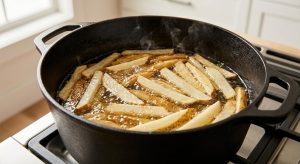
You’ve just nailed the perfect sear on a beautiful protein. The crust is golden, the aroma is intoxicating, and your kitchen smells like a Michelin-starred restaurant. You remove the meat to rest, stare at the crusty, flavor-packed browned bits left in the skillet, and think, “I’m going to make a pan sauce.” You deglaze with a splash of wine, let it reduce, and then, in a final flourish of culinary confidence, you drop a knob of butter into the bubbling liquid.
And then, tragedy strikes.
Instead of a glossy, velvety, restaurant-quality sauce that coats the back of a spoon, you are left looking at a broken, greasy, separated oil slick floating sadly on top of a thin, watery liquid. It looks completely unappetizing, it feels heavy on the palate, and you end up scraping it off your plate.
Listen up, my weekend culinary warriors. As someone who has set off the smoke detector more times than I care to admit, I know exactly how frustrating this is. But here is the good news: you do not need a culinary degree to fix this. You just need to understand a tiny bit of kitchen physics.
The state of home cooking has completely transformed recently. According to the comprehensive 2025–2026 HelloFresh State of Home Cooking report, a staggering 93% of households are committed to cooking at home more frequently this year. Driven by inflation, rising restaurant costs, and the booming “little treat culture” noted in recent market trend analyses, we are all trying to recreate luxury dining experiences in our own kitchens. We want the fancy sauces. We want the elevated weeknight dinners. But we don’t have the time to fail.
Today, we are going to master the single most important technique for elevating your weeknight pan-seared meals. We are going to talk about the simple, absolute magic of fridge-cold butter.
The Anatomy of a Broken Pan Sauce (And Why It’s Not Your Fault)
Before we can fix the greasy mess in your skillet, we need to understand what a pan sauce actually is, and why it is so prone to catastrophic failure.
What Actually Is a Pan Sauce?
At its core, a pan sauce is a rapid, à la minute (at the minute) sauce built directly in the skillet used to cook your main protein. It is the culinary equivalent of leaving no flavor behind. When you sear a steak, a chicken thigh, or a pork chop, the intense heat causes the amino acids and reducing sugars in the meat to undergo the Maillard reaction. This complex chemical process creates hundreds of new flavor compounds, many of which stick to the bottom of your pan in a crusty, caramelized layer known as the fond.
A pan sauce is simply the act of using a liquid to dissolve that fond, concentrating the flavor through evaporation, and then binding it all together with a fat to create a luxurious texture. It sounds incredibly simple, but it sits directly at the intersection of thermal dynamics and emulsion chemistry.
The Science of the Break: Oil and Water Hate Each Other
Here is the fundamental problem: water and oil (fat) absolutely despise each other. They are immiscible. If you pour oil into a glass of water, the oil will stubbornly float to the top.
To make a cohesive sauce, you have to force these two enemies to hold hands and play nicely. This forced marriage is called an emulsion. You are already familiar with this concept if you have ever made a vinaigrette. When your salad dressing always separates, it is because the temporary emulsion has broken, and the oil and vinegar have retreated to their respective corners.
A pan sauce finished with butter is a warm emulsion. The liquid you used to deglaze the pan (wine, stock, vinegar) is the water phase. The butter provides the fat phase. But butter is not just pure fat. It is a delicate, naturally occurring emulsion itself, consisting of roughly 80% butterfat, 15% to 18% water, and 1% to 2% milk solids (specifically proteins like casein and whey).
When a sauce “breaks,” it means the emulsion has failed. The microscopic droplets of fat have coalesced into large pools, separating entirely from the water. The result is that dreaded greasy oil slick. And the number one culprit behind this failure? Heat.
Enter Monter au Beurre: The Pretentious French Term for a Dead-Simple Trick
I have zero patience for pretentious chef-speak, but sometimes the French just nail it. The technique required to perfectly emulsify a pan sauce is called monter au beurre, which translates to “mounting with butter.”
It is a precise, temperature-controlled finishing method where freezing cold, cubed butter is vigorously whisked into a hot, reduced liquid strictly off the direct heat.
The Thermodynamics of Cold Butter
Why does the butter have to be cold? It all comes down to thermodynamics and the preservation of those crucial milk solids.
As we established, butter contains casein and whey proteins. These proteins act as natural emulsifiers—they are the chemical diplomats that convince the fat and water to bind together. However, these proteins are highly sensitive to temperature.
When you whisk fridge-cold butter into a hot liquid, the butter melts slowly and gradually. This controlled, gradual melting lowers the overall temperature of the sauce to an optimal zone (usually between 120°F and 140°F). In this exact temperature window, the milk solids gently denature, unfolding to form a microscopic scaffold that traps the fat droplets and the aqueous liquid, creating a stable, cohesive, velvety suspension.
The physical agitation of your whisk shears the melting fat into microscopic droplets, while the cold temperature ensures the fat doesn’t melt faster than the emulsifiers can do their job.
Why Warm or Melted Butter Ruins Everything
Now, let’s look at what happens when you do what most home cooks do: dropping a knob of room-temperature or slightly warm butter into a rapidly boiling pan sauce while the burner is still blasting.
When butter hits a boiling liquid (212°F or 100°C), the thermal shock is violent. The water inside the butter vaporizes almost instantly. More importantly, the delicate milk solids are subjected to temperatures well above their breaking point (150°F). The casein proteins over-coagulate, clump together, and completely lose their ability to act as emulsifiers.
Without the milk solids to hold everything together, the 80% butterfat is unleashed directly into the water phase. Because there is nothing to bind them, the fat immediately separates and pools on the surface. Congratulations, you have just created clarified butter floating on top of hot wine. It is a broken, greasy disaster.
This is why monter au beurre is a physics-driven process. The cold butter acts as a thermal brake, rapidly cooling the sauce down to the safe zone where emulsification can actually occur.
The Step-by-Step Masterclass to a Flawless, Velvety Pan Sauce
Now that we understand the science, let’s put it into practice. This is your foolproof, step-by-step masterclass for weeknight pan sauces. Time is money during the week, so this entire process should take you no more than five minutes while your protein is resting on the cutting board.
Step 1: The Sear and the Fond (Ditch the Toxic Non-Stick)
You cannot make a pan sauce without fond, and you cannot develop a proper fond in a cheap, peeling non-stick skillet.
I have a strict “no-go” rule on toxic kitchen gear. If you are still searing your steaks on a scratched Teflon pan, we need to have a serious intervention. Not only are you preventing the Maillard reaction from creating those delicious browned bits, but you are also actively exposing yourself to harmful chemicals.
In 2025, Minnesota became the first U.S. state to implement a sweeping ban on PFAS-containing cookware, with states like California, Colorado, and Connecticut rolling out strict regulations stretching into 2028. The science is clear: when PTFE (Teflon) is heated past 500°F—a temperature easily reached during a hard sear on a gas stove—it degrades and releases per- and polyfluoroalkyl substances (PFAS) into your food and the air. And don’t be fooled by “PFOA-free” marketing labels; independent consumer investigations in 2025 and 2026 have repeatedly shown that manufacturers simply replaced PFOA with structurally similar, equally toxic “GenX” chemicals.
It is time to start banishing toxic kitchen gear from your life. You need a high-quality, fully clad stainless steel skillet or a well-seasoned carbon steel pan. If you think food always sticks to stainless steel, you simply aren’t preheating it properly. Let the pan get hot, add your high-smoke-point oil, and sear your protein until it naturally releases from the metal.
Once your protein is perfectly cooked, remove it to a plate to rest. Do not wash the pan. Those crusty brown bits stuck to the bottom are the entire foundation of your sauce.
Step 2: The Aromatics (Proceed with Caution)
While your pan is still hot, you may want to add some aromatics like finely minced shallots or garlic. Use the residual fat left in the pan to briefly sauté them.
This step requires hyper-vigilance. The pan is still screaming hot from the sear. If you toss minced garlic into a 450°F skillet, it will instantly turn black, acrid, and bitter. If you find that your garlic always burns, turn the heat down to medium-low the second the protein comes out, and let the pan cool for 30 seconds before adding your aromatics. You only want to sweat them until they are fragrant and translucent, which takes about 45 seconds.
Step 3: The Deglaze (Scraping Up the Good Stuff)
Now it is time to deglaze. This means adding a cold liquid to the hot pan to rapidly cool it down and dissolve the fond.
You can use almost any liquid: dry white wine, dry red wine, chicken stock, beef broth, or even a splash of apple cider. (Side note: if you are doing extensive vegetable prep for this meal, you definitely need a bench scraper to move ingredients around, but for deglazing, you need a sturdy wooden spoon or a flat-edged spatula).
Pour in about half a cup of your chosen liquid. It will immediately hiss, spit, and boil furiously. Use your wooden spoon to aggressively scrape the bottom of the skillet, loosening every single caramelized brown bit. This is where the flavor lives.
Step 4: The Reduction (Concentrating the Flavor)
Once the bottom of the pan is scraped clean, turn the heat up to medium-high and let the liquid boil. You are now executing a reduction.
The goal here is to evaporate the excess water, concentrating the flavors of the fond, the aromatics, and the liquid itself. If you used wine, this step is crucial for cooking off the harsh bite of the alcohol. You want to reduce the liquid by at least half, or until it becomes slightly syrupy and the bubbles begin to look large and viscous.
Do not skip this step, and do not rush it. An emulsion is a delicate seesaw balance between water content and fat content. If you have too much thin, watery liquid in the pan, the butter will have nothing to bind to, and the sauce will be too loose.
Step 5: The Off-Heat Emulsion (The Cold Butter Magic)
This is the moment of truth. This is where you become a culinary genius.
Once your liquid is reduced to a few intense, syrupy tablespoons, turn off the burner and remove the skillet from the heat entirely. I cannot stress this enough. Pull the pan off the hot grate.
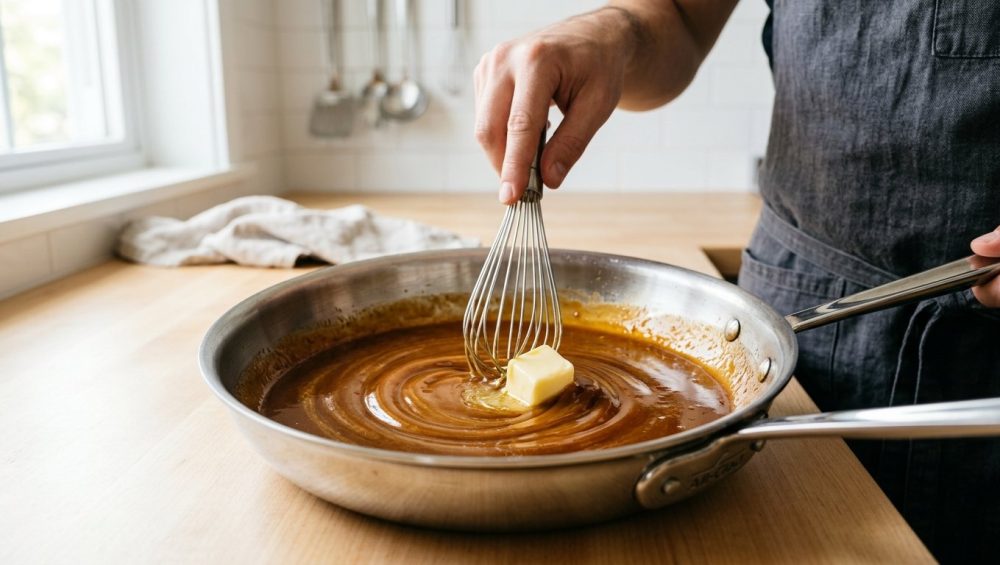
Take 2 to 3 tablespoons of fridge-cold butter that you have pre-cut into small cubes. Drop one or two cubes into the hot liquid. Immediately begin whisking vigorously.
Do not stop whisking. As the cold butter melts, it rapidly drops the temperature of the liquid. The physical shearing force of your whisk breaks the butterfat into microscopic droplets, while the milk solids wrap around them, locking them into the liquid.
As soon as the first cubes are mostly melted and incorporated, drop in the next cube, whisking continuously. You will literally see the magic happen before your eyes. The dark, thin liquid will suddenly transform, taking on a lighter, opaque, incredibly glossy sheen. It will thicken, becoming velvety and luxurious.
Taste it. It probably needs a pinch of kosher salt and a squeeze of fresh lemon juice to balance the richness of the fat. Pour it immediately over your resting protein. You have just successfully executed monter au beurre.
The Golden Rules of Emulsification: Troubleshooting Your Greasy Mess
If you tried this and you still ended up with a broken, oily disaster, you violated one of the fundamental laws of emulsion physics. Let’s troubleshoot your mistakes.
Mistake 1: The Heat Was Still On
I will say it again: you must take the pan off the heat. If the liquid is actively boiling when you add the butter, the temperature is above 212°F. The milk solids will instantly coagulate and fail, and the butterfat will separate. The sauce must be cooling down into that 120°F to 140°F sweet spot for the emulsion to hold.
Mistake 2: You Didn’t Reduce the Liquid Enough (Or You Reduced It Too Much)
Emulsions require balance. If you deglazed with a cup of chicken stock and only let it boil for ten seconds before adding butter, you have way too much water. The fat droplets will be too dispersed to form a cohesive sauce, resulting in a watery, greasy soup.
Conversely, if you reduced the liquid until the pan was practically bone-dry, there is no water left to suspend the fat. The butter will simply melt into a puddle of grease. You need a few tablespoons of concentrated, syrupy liquid to act as the base. If you accidentally over-reduce, splash in a tablespoon of tap water before adding the butter to restore the balance.
Mistake 3: You Dumped All the Butter in at Once
Patience is a virtue, even on a Tuesday night. If you drop a massive, four-tablespoon chunk of butter into the pan all at once, the outer layers will melt instantly while the core remains freezing cold. The liquid will be overwhelmed by the sudden influx of fat, and your whisk won’t be able to shear it fast enough. Add the cold butter one small cube at a time, allowing each to almost fully emulsify before adding the next.
Mistake 4: You Used Cheap, Watery Butter
Not all butter is created equal. Standard American supermarket butter is legally mandated to contain 80% butterfat, which means it contains a relatively high amount of water (up to 18%). Premium European-style butters contain 82% to 84% butterfat and have a much lower water content.
While you can absolutely make a successful pan sauce with cheap butter, it is slightly more prone to breaking because you are introducing excess water into the delicate emulsion balance. If you want truly foolproof, restaurant-quality results, invest in a good cultured European butter for your finishing sauces.
The Gear You Actually Need (And the Garbage You Need to Trash)
You don’t need a kitchen full of expensive gadgets to cook like a pro, but you do need the right tools for the job. Attempting a pan sauce with the wrong equipment is a recipe for immense frustration.
The Skillet: Stainless Steel or Carbon Steel Only
We already discussed why you are ruining your nonstick pans by searing meat at high temperatures, but let’s talk about the culinary implications.
Non-stick pans are designed to prevent food from sticking. This means they physically cannot develop a fond. Without a fond, you have no caramelized flavor compounds to deglaze. A pan sauce made in a non-stick skillet will taste like salty dishwater.
You must use an uncoated pan. A tri-ply or fully clad stainless steel skillet is the gold standard for home cooks. It conducts heat evenly, responds quickly to temperature changes (crucial for when you pull it off the heat to add the butter), and allows for magnificent fond development. A well-seasoned carbon steel pan is also an excellent choice, though highly acidic deglazing liquids (like heavy amounts of wine or vinegar) can temporarily strip the seasoning.
The Whisk: Flexibility is Key
Do not try to emulsify a pan sauce with a wooden spoon or a silicone spatula. You need mechanical shearing force to break up the fat droplets.
You need a whisk, but not just any whisk. A massive, stiff balloon whisk meant for whipping egg whites in a giant bowl will be useless in a flat, shallow skillet. You won’t be able to reach the corners of the pan.
Invest in a flat roux whisk or a highly flexible French coil whisk. These are designed to lay flat against the bottom of a skillet, allowing you to rapidly agitate the shallow pool of liquid and effortlessly incorporate the cold butter.
Advanced Pan Sauce Variations to Make You Look Like a Culinary Genius
Once you master the basic monter au beurre technique, you have unlocked the ultimate culinary cheat code. You can completely change the flavor profile of your weeknight dinners without learning any new cooking methods. Here are three foolproof variations to keep in your arsenal.
The Classic White Wine and Shallot (The Weeknight Savior)
This is the quintessential pan sauce, perfect for chicken breasts, pork chops, or mild white fish.
- Sear your protein and set aside.
- Sauté 1 tablespoon of finely minced shallots in the residual fat for 45 seconds.
- Deglaze with 1/2 cup of dry white wine (like Sauvignon Blanc or Pinot Grigio).
- Scrape the fond and reduce the wine until only about 2 tablespoons remain.
- Remove from heat. Whisk in 2 tablespoons of freezing cold butter cubes.
- Finish with a squeeze of lemon juice, a pinch of salt, and a tablespoon of chopped fresh parsley.
If your chicken breast turns out dry because you accidentally left it on the stove too long while answering an email, this sauce will provide the luxurious moisture and fat needed to completely mask your mistake. Nobody will know.
The Mustard and Herb Powerhouse
This sauce packs a massive punch and is incredible over rich meats like steak or lamb.
- Sear your steak and set aside.
- Deglaze the pan with 1/2 cup of beef or chicken stock.
- Whisk in 1 tablespoon of Dijon mustard. (Fun fact: mustard contains mucilage, a natural emulsifier that will actually make your sauce even more stable and resistant to breaking).
- Reduce until slightly syrupy.
- Remove from heat. Whisk in 2 tablespoons of cold butter.
- Finish with chopped fresh tarragon or thyme and a heavy crack of black pepper.
The Umami Bomb (Soy and Mushroom)
If you are craving deep, savory, earthy flavors, this is your go-to.
- Sear your protein (pork or beef work beautifully).
- Add a handful of sliced cremini mushrooms to the pan and sauté until browned.
- Deglaze with 1/4 cup of chicken stock, 2 tablespoons of soy sauce, and 1 tablespoon of rice vinegar.
- Reduce by half.
- Remove from heat. Whisk in 2 tablespoons of cold butter.
- Finish with thinly sliced scallions and a dash of toasted sesame oil.
Frequently Asked Questions About Pan Sauces
I hear the same excuses and questions from home cooks all the time. Let’s clear the air.
Can I use margarine or a vegan butter substitute?
Absolutely not. Margarine and heavily processed plant-based spreads do not have the same ratio of fat, water, and protein as dairy butter. They are often highly aerated and contain chemical emulsifiers that behave unpredictably under heat. If you try to mount a sauce with margarine, it will almost certainly break into a watery, oily mess. If you need a dairy-free sauce, you are better off relying on a starch-thickened reduction rather than an emulsion.
My sauce broke anyway. Can I save it?
Yes! Do not throw it away. If your sauce breaks into a greasy slick, it means it got too hot and the emulsion failed. To fix it, you need to rapidly cool it down and reintroduce mechanical agitation. Take the pan completely off the heat. Drop in one single ice cube and whisk like your life depends on it. The sudden drop in temperature, combined with the tiny bit of water from the melting ice, will often shock the emulsion back together.
I don’t cook with alcohol. What can I use instead of wine?
Wine is traditional because the alcohol helps extract alcohol-soluble flavor compounds from the fond, and the acidity balances the rich butter. However, you can easily substitute it. Use a high-quality, low-sodium chicken or beef stock, and add a splash of white wine vinegar, apple cider vinegar, or fresh lemon juice to replicate the missing acidity. If you happen to be cooking pasta as a side dish, you can even use a splash of the starchy cooking water; the reserved pasta water acts as an incredible natural binder for pan sauces.
Final Thoughts: Reclaiming Your Weeknight Dinners
Cooking at home should never feel like a stressful, anxiety-inducing chore. You do not need to spend four hours simmering a complex demi-glace to enjoy a restaurant-quality meal on a Tuesday night.
By understanding the simple physics of emulsification, ditching your toxic peeling cookware, and mastering the dead-simple art of whisking cold butter into a hot pan off the heat, you have the power to elevate any basic protein into a culinary masterpiece in under five minutes.
Stop settling for dry chicken. Stop eating bland pork chops. Stop scrubbing perfectly good flavor down the drain. Grab a stainless steel skillet, sear your meat, scrape up that beautiful fond, and let the magic of monter au beurre do the heavy lifting.
Now get out of here, go buy some high-quality European butter, and start cooking. You’ve got this.