Welcome back to my kitchen, you beautifully chaotic, weekend-warrior culinary hobbyists. We need to have a serious, sit-down conversation about a tragedy that is likely unfolding in your refrigerator right at this very moment. You know exactly what I am talking about. You spent your precious Sunday afternoon carefully curating a gorgeous, vibrant, perfectly seasoned bowl of guacamole. You sourced the perfect avocados, you mashed them to that flawless textural intersection of creamy and chunky, you tasted it, you adjusted the salt, and you served it to your friends. It was a triumph. But then, the inevitable happened: you had leftovers.
You put those leftovers in the fridge, and by Monday evening, you opened the door to find a depressing, oxidized, brown sludgy mess. It looks less like a vibrant Mexican dip and more like something you would find at the bottom of a swamp. You scrape off the top inch, sacrificing a heartbreaking amount of expensive produce to the compost bin, just to get to the green stuff underneath.
I have zero patience for pretentious chef-speak, but we are going to do a little hard science today because you need to understand why your food is betraying you. More importantly, I am going to teach you the absolute best, scientifically validated, foolproof method to keep your guacamole perfectly green for days. If you want to understand the magic of a water seal, you first have to understand the molecular warfare happening inside your favorite fruit.
The Biology of the Avocado: A Beautiful, Flawed Masterpiece
Before we can fix the problem, we have to understand the ingredient. The avocado (Persea americana) is an absolute diva of the produce aisle. Unlike most fruits, which are packed with sugars and starches, the flesh of an avocado is primarily composed of fatty acids—specifically, heart-healthy oleic acid and linoleic acid. This high fat content is exactly what gives guacamole its luxurious, buttery texture that we all obsess over.
However, this unique composition comes with a massive biological caveat. Avocados are essentially ticking time bombs of cellular degradation. In 2026, we are looking at a global food waste crisis where over a fifth of all food produced globally goes to waste. The avocado waste market alone is dealing with millions of tons of discarded fruit annually, and a heartbreaking percentage of that is consumer-level household waste caused entirely by premature browning. We throw away perfectly safe, edible food simply because it looks unappetizing.
To stop contributing to this massive waste of money and resources, we have to look at the avocado at a microscopic level. Inside the cells of an intact, uncut avocado, two crucial components are kept strictly separated by cellular walls. In the vacuole of the plant cell, you have phenolic compounds. In the surrounding cytoplasm, you have an enzyme called polyphenol oxidase (PPO). As long as the avocado is whole and unbruised, these two components never meet, and the flesh remains beautifully, vibrantly green.
But the second you take a knife to that avocado, you are destroying those cellular walls. You are forcing the phenolic compounds and the PPO to mix. And when they do, they are primed and ready for the catalyst that will ruin your dip: oxygen.
The Science of the Sludge: Demystifying Enzymatic Browning
The rapid browning of avocado flesh is a direct consequence of a chemical process known as enzymatic browning. This isn’t rot, and it isn’t mold. It is a defense mechanism.
When you mash your avocados for guacamole, you are exposing the newly mixed PPO and phenolic compounds to the oxygen in the air. In the presence of oxygen, the polyphenol oxidase enzyme acts as a catalyst, converting the phenolic compounds into a completely different class of molecules called quinones.
Quinones are highly reactive. They do not like to stay isolated. They immediately begin polymerizing, which means they link smaller molecules together to form long, complex chains called melanins. Yes, you read that correctly. Melanin is the exact same pigment family that is responsible for human skin color, and it is the exact same pigment that turns your beautiful green guacamole into a muddy, brown sludge.
Now, enzymatic browning happens in plenty of other produce—apples, potatoes, and bananas all fall victim to it. So why does guacamole seem to turn brown in the blink of an eye? It comes down to concentration. Avocados contain an exceptionally high concentration of polyphenol oxidase compared to other fruits. Furthermore, the optimum pH for avocado PPO to function is around 7.5, which is relatively neutral, and its optimum working temperature is right around room temperature (20°C or 68°F). When you leave a bowl of guacamole sitting on the counter at a party, you are literally providing the absolute perfect, optimal environment for this enzyme to run rampant and destroy your food.
The Graveyard of Failed Kitchen Hacks
If you have spent more than five minutes on the internet looking for cooking advice, you have undoubtedly encountered a litany of “hacks” meant to prevent guacamole from turning brown. As your designated sassy sous-chef, it is my duty to tell you that most of these hacks are absolute garbage. Let’s take a brutally honest walk through the graveyard of failed kitchen tricks and explain exactly why they let you down.
The Plastic Wrap Fallacy
The most common advice is to press a sheet of plastic cling wrap directly onto the surface of the guacamole. In theory, this creates a barrier against the air. In practice, it is a disaster. No matter how meticulously you press that film down, you are going to leave microscopic air pockets and crevices. Oxygen is relentless; it will find those pockets, and your guac will still develop brown, mottled spots. Furthermore, peeling slimy, avocado-covered plastic wrap off your dip the next day is a sensory nightmare. We are also trying to reduce our reliance on single-use plastics in the kitchen, so this method is a hard pass.
The Citrus Acid Myth
Another popular trick is to squeeze a heavy layer of lemon or lime juice over the top of the dip. The science behind this isn’t entirely wrong. As we established, PPO thrives at a neutral pH of 7.5. By introducing highly acidic citrus juice, you drastically lower the pH on the surface of the dip, which denatures the enzyme and slows down the browning process. However, this only protects the exact top millimeter of the guacamole where the juice makes direct contact. More importantly, it completely ruins the flavor profile. While your dinner actually needs acid to be balanced and delicious, drowning a delicate, fatty avocado dip in an aggressive puddle of raw citrus just makes it taste like a sour, unbalanced margarita.
The Olive Oil Slick
Some home cooks swear by pouring a thin layer of olive oil over the top of the guacamole. Oil does create a decent oxygen barrier, but it introduces a major textural flaw. Guacamole is already incredibly rich and fatty. Adding a slick of pure liquid fat on top makes the dish unpleasantly greasy. When you stir it back in the next day, you alter the entire mouthfeel of the dip, making it heavy and cloying rather than fresh and light.
The Onion Chunk Theory
There is a persistent myth that placing large chunks of cut red onion on top of your guacamole will stop the browning. The theory claims that the sulfur gases emitted by the onion will create an invisible shield over the dip. This is culinary pseudoscience at its worst. The sulfur gases do not distribute evenly, and oxygen simply flows right past them. All this hack accomplishes is making your refrigerator smell aggressively like raw onions.
The Pit in the Bowl Delusion
This is perhaps the most pervasive and annoying lie in modern culinary history. People will tell you to leave the avocado pit sitting right in the middle of the bowl of guacamole to keep it green. Let me be perfectly clear: the pit has no magical, enzyme-halting aura. The only part of the guacamole that stays green is the exact millimeter of flesh directly underneath the pit, simply because the pit is physically blocking the air from touching that specific spot. The rest of the bowl will still turn brown. Throw the pit in the compost bin where it belongs.
The Physics of the Water Shield: Why It Actually Works
Now that we have discarded the nonsense, let’s talk about the definitive, scientifically foolproof way to store your leftover guacamole. It costs zero dollars, it requires no special equipment, and it works flawlessly every single time. You are going to use water.
Yes, standard, room-temperature tap water.
When I first tell people to pour water over their precious avocado dip, they look at me like I have lost my mind. But this method relies on basic, undeniable physics and thermodynamics. Remember that enzymatic browning requires oxygen to fuel the reaction. Therefore, the ultimate goal of storage is to completely eradicate the oxygen supply.
Here is the magic number you need to know: oxygen diffuses through water approximately 10,000 times slower than it diffuses through the air.
Let that sink in. In the air, oxygen molecules are bouncing around freely, instantly colliding with the exposed surface of your guacamole. But water is a dense, fluid barrier. When you pour a layer of water over your dip, you are creating a literal, physical forcefield. The oxygen in the air above the container simply cannot penetrate the water layer fast enough to reach the avocado flesh below. By the time any microscopic amount of oxygen manages to slowly diffuse through the liquid, you will have already eaten the leftovers.
But what about the texture? Won’t pouring water over guacamole make it a soggy, watered-down, disgusting mess?
Absolutely not, and once again, we have science to thank for that. Remember when we discussed the biology of the avocado? It is packed with fatty acids. Fat and water are fundamentally incompatible; they are hydrophobic. Because guacamole is so incredibly dense with lipids, it actively repels the water. The water cannot dissolve the fats, and it cannot penetrate the dense matrix of the mashed fruit. The water simply sits harmlessly on top, acting as a heavy, airtight lid, while the guacamole beneath remains completely untouched and pristine.
Step-by-Step Masterclass: Executing the Foolproof Water Method
Knowing the science is only half the battle. If you want to survive the weekday cooking grind, you have to execute the technique properly. Here is my rigorous, step-by-step guide to saving your dip.
Step 1: The Smash and Level
You cannot just pour water over a jagged, mountainous bowl of freshly scooped guacamole. You have to prep the surface. Transfer your leftover dip into an appropriately sized storage container. Take the back of a spoon and aggressively pack the guacamole down into the bottom of the container. Your goal here is to eradicate any internal air pockets hidden within the dip itself. Once it is packed tightly, use the spoon to smooth the top surface until it is as flat and level as a freshly paved road.
Step 2: The Gentle Pour
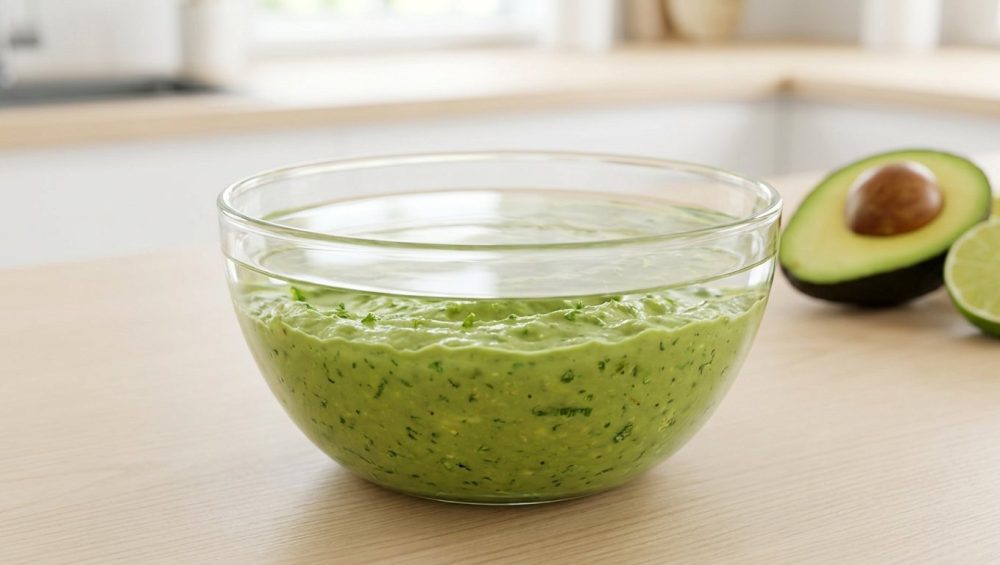
Take a measuring cup filled with room-temperature or slightly cool tap water. Do not use warm or hot water, as heat will accelerate enzyme activity. Hold your spoon upside down, hovering just above the surface of the guacamole. Gently pour the water over the back of the spoon. This disperses the flow of the water, preventing it from gouging a hole into your perfectly leveled dip. Pour just enough water to completely cover the surface—usually about half an inch deep is plenty. Ensure that the water touches the sides of the container all the way around, creating a total, unbroken seal.
Step 3: The Cold Storage
Place a secure lid on your container and put it in the refrigerator. We are utilizing temperature control as our secondary line of defense. While the water is blocking the oxygen, the cold environment of the fridge is doing its part. At 40°F (4°C), the kinetic energy of the molecules plummets. This drastically slows down the metabolic rate and the activity of any polyphenol oxidase that might still be lurking near the surface.
Step 4: The Drain and Stir
When Tuesday evening rolls around and you are ready for round two, pull the container from the fridge. Take it to the sink and very carefully tilt the container to pour the water off. Because the fat in the avocado repelled the liquid, the water will run off cleanly. You might notice a tiny bit of moisture left on the very top surface. Simply take a spoon and give the guacamole a vigorous stir. Any microscopic droplets of remaining water will effortlessly incorporate into the dip without altering the flavor or the texture whatsoever. What you are left with is vibrant, bright green, perfectly fresh guacamole.
The Sous-Chef’s Rant: Stop Ruining Your Prep With Toxic Gear
Since we are talking about storing food, I am going to take a brief detour to get on my soapbox. I am a relentless advocate for banishing toxic kitchen gear from your home, and food storage is where most home cooks make their biggest mistakes.
Do not execute this beautifully scientific water-seal method in a cheap, flimsy, scratched-up plastic container. I despise cheap plastic storage. First of all, it degrades over time, harboring bacteria in microscopic scratches. Secondly, we all know how those cheap plastic containers stain orange the second they touch anything containing paprika, chili powder, or tomato paste. If the plastic is porous enough to permanently absorb the color of your food, what exactly do you think it is leaching back into your meals?
When you are storing highly reactive, acidic, or fat-heavy foods like guacamole, you must use non-reactive, non-toxic materials. Invest in high-quality, tempered glass storage containers with airtight, BPA-free silicone lids. Glass is entirely impermeable, it doesn’t stain, it doesn’t hold onto phantom odors from last week’s garlic chicken, and it won’t leach endocrine disruptors into your beautiful organic produce. Alternatively, high-grade culinary stainless steel containers are fantastic, lightweight options that provide excellent thermal conductivity, meaning your food chills faster when you put it in the fridge.
Stop buying mystery metals and peeling plastics. Your health, and the quality of your weekend leftovers, demand better.
Perfecting the Rest of the Guacamole
I would be remiss if I taught you how to perfectly store your guacamole without ensuring that your initial product is actually worth saving. You can have the best storage technique in the world, but if your dip is fundamentally flawed from the start, you are just preserving mediocrity. Let’s fix your prep work.
The Aromatics and the Knife Work
Great guacamole relies on the sharp, pungent bite of raw aromatics, specifically onions and garlic. But how you process these ingredients dictates whether your dip is beautifully balanced or aggressively bitter.
When you are dicing your onions, please remember the danger of dull knives. A dull blade doesn’t slice through the onion’s cell walls; it crushes them. This crushing action violently releases a massive amount of sulfur compounds, which not only makes you cry uncontrollably but also makes the raw onion taste excessively harsh and acrid. Use a razor-sharp chef’s knife to achieve a clean, fine dice.
The exact same principle applies to your garlic. Avoid the trap of the garlic press at all costs. A garlic press obliterates the cell structure of the clove, releasing all of the allicin at once and creating a bitter, overpowering paste that will completely mask the delicate flavor of the avocado. Instead, use a sharp knife to mince your garlic finely, or use a ceramic rasp grater for a smoother, less aggressive integration.
The Tomatoes and The Herbs
If you choose to add tomatoes to your guacamole (a highly debated topic, but I support it for the textural contrast), you must treat them with respect. You absolutely a serrated utility knife to cleanly slice through the tough skin of a ripe tomato without squishing the delicate flesh inside. Remove the watery seed pulp before dicing, or your guacamole will become a soupy mess.
As for the cilantro, freshness is non-negotiable. There is nothing sadder than watching your fresh herbs get slimy in the bottom drawer of your fridge because you stored them improperly. Wrap your cilantro stems in a damp paper towel and store them in a breathable bag to keep them crisp. When chopping, use a sharp knife and only run your blade through the herbs once; chopping them back and forth repeatedly will bruise the leaves and turn them black.
And finally, a quick note on your prep station. If your wooden cutting board keeps cracking while you are trying to prep your ingredients, it means you are neglecting to oil it, allowing it to dry out and harbor bacteria in the fissures. Maintain your tools, and your tools will take care of your food.
The Ultimate Payoff: Stress-Free Culinary Artistry
Cooking shouldn’t be a source of stress, and dealing with leftovers certainly shouldn’t feel like a ticking clock of anxiety. Whether you are prepping a massive batch of dip for a chaotic Friday night dinner party or you just want to host a mindful toast bar for a relaxed Sunday brunch, knowing the science behind your food gives you the power to control it.
You do not need a culinary degree to cook like an expert. You just need a healthy dose of common sense, a refusal to accept bad internet hacks, and a basic understanding of how enzymes and oxygen interact. By leveraging the slow diffusion rate of oxygen through water, you are outsmarting the polyphenol oxidase. You are taking a delicate, highly perishable ingredient and bending it to your will.
So the next time you make a beautiful batch of guacamole, don’t panic when you have leftovers. Pack it down, pour that water shield over the top, and sleep peacefully knowing that science has your back. Your future self—and your grocery budget—will thank you. Now go sharpen your knives, throw away those toxic plastic tubs, and get back to cooking. You’ve got this.