The Heartbreak of the Broken Sauce
Picture this: It has been an exhaustingly long week. You have survived back-to-back meetings, endless emails, and the general chaos of modern adulthood. You decide to treat yourself to the ultimate comfort food—a bubbling, rich, soul-soothing pot of homemade macaroni and cheese. You make a beautiful roux. You whisk in your milk. And then, in the name of saving three minutes of prep time, you rip open a plastic bag of pre-shredded cheddar and dump it into the pot.
You stir. You wait for that glossy, magazine-cover cheese pull. But instead of a velvety cascade of dairy perfection, your sauce seizes. It turns into a greasy, separated, lumpy nightmare. The fat pools on the surface in a depressing yellow oil slick, while the dairy solids clump together at the bottom of the pot, looking and tasting remarkably like wet sand.
Welcome to the hidden trap of the modern kitchen.
I am all for time-saving weekday hacks. I firmly believe that your time is money, and when you are outfitting your beautifully organized dream kitchen, you might be tempted to prioritize convenience above all else. But as your resident culinary cheerleader and brutally honest sous-chef, I am here to tell you that buying bagged, pre-shredded cheese is the single biggest sabotage you can inflict upon your cooking. You do not need a degree from Le Cordon Bleu to make mind-blowing food, but you do need to understand the basic chemistry of what goes into your pot.
Today, we are leaving no stone unturned. We are going to dive deep into the culinary science of emulsions, expose the industrial additives lurking in your convenience foods, and teach you exactly how to achieve a perfectly silky, smooth cheese sauce every single time. Grab a glass of wine, and let’s fix your food.
The Chemistry of Cheese: A Delicate Balancing Act
Before we can understand why your sauce broke, we have to understand what cheese actually is. I promise to keep the pretentious chef-speak to an absolute minimum, but we do need a quick science lesson.
At its core, cheese is an emulsion—a highly unstable, temporary peace treaty between three conflicting ingredients: water, dairy fat, and a network of milk proteins called casein. In a solid block of cheese, this casein protein acts like a microscopic sponge, holding the water and the fat together in a happy, unified structure.
When you introduce heat to this structure, the rules of thermodynamics take over. As the temperature rises, the dairy fat liquefies and the protein matrix begins to relax and loosen. If you heat the cheese gently and introduce it to a stabilizing liquid (like a starch-thickened béchamel), the protein network expands gracefully, absorbing the liquid and creating a smooth, cohesive sauce.
However, if you apply too much heat, or if the delicate balance of moisture and protein is disrupted, the emulsion violently shatters. The casein proteins, stripped of their lubricating moisture, violently contract and slam into one another, coagulating into tight, rubbery little bundles. This is the “grit” or “graininess” you feel in your mouth. Meanwhile, the liquefied dairy fat, having been evicted from the protein matrix, has nowhere to go but out. It separates completely, leaving you with an oily, broken mess where your sauce slides off the noodles instead of clinging to them in a luxurious glaze.
The Industrial Sabotage: What Is Actually in That Bag?
Americans love cheese. In fact, U.S. cheese consumption recently hit record levels, with the average person consuming over 42 pounds of it annually. To feed this massive demand for convenience, the shredded cheese industry has exploded, and is projected to reach a staggering $2.4 billion in the U.S. by 2035.
But here is the dirty little secret of the commercial dairy industry: if you shred a block of high-moisture cheddar and throw it into a plastic bag, it will instantly compress back into a solid, moldy brick during shipping. To keep those convenient little shreds separated, fluffy, and shelf-stable for months, manufacturers coat them in a proprietary blend of anti-caking agents and preservatives.
When you buy a bag of shredded cheese, you are not just buying cheese. You are buying a chemical cocktail designed for warehouse longevity, not culinary excellence. Here are the primary culprits ruining your dinner:
Cellulose Powder (The Wood Pulp Problem)
Cellulose gum, often listed as carboxymethyl cellulose (CMC), is a plant-derived fiber. While it is perfectly safe for human consumption (it is essentially dietary fiber often derived from wood pulp or cotton lint), it is an absolute disaster for your cooking. Cellulose is highly hydrophilic, meaning it loves water. During the melting process, cellulose absorbs up to three times its weight in moisture. It acts like a microscopic sponge, aggressively stealing the water right out of the cheese’s protein matrix. Without that moisture, the emulsion breaks, melt homogeneity is completely disrupted, and free-fat release increases by a staggering 41%.
Potato Starch and Cornstarch
To prevent the shreds from sticking together, manufacturers dust the cheese heavily in cheap starches. While starch is a common thickening agent, the raw, uncooked starch coating the outside of the cheese shreds creates a physical barrier. It prevents the cheese proteins from bonding together smoothly when melted, resulting in a sauce that feels chalky, thick, and profoundly unappetizing.
Natamycin
Because pre-shredded cheese has a massive amount of surface area exposed to the air inside the bag, it is highly susceptible to mold. To combat this, manufacturers spray the shreds with natamycin, a natural anti-fungal agent. While it keeps the cheese from turning blue on the shelf, it alters the surface chemistry of the cheese, further inhibiting a clean, cohesive melt.
The “No-Go” Rule: How Bagged Cheese Destroys Toxic Cookware
We need to take a brief, snarky detour, because I am relentless when it comes to banishing toxic kitchen gear. You know I absolutely despise cheap, peeling non-stick pans. But did you know that your bagged cheese is actually accelerating the demise of your terrible cookware?
Cellulose powder is not just a moisture thief; it is physically abrasive. When you dump a bag of cellulose-coated cheese into a cheap Teflon pan and begin whisking aggressively, you are essentially creating a mild sandpaper slurry. In commercial NSF-certified abrasion testing, heating heavily cellulose-coated cheese was shown to accelerate the degradation of standard PTFE (Teflon) coatings by 2.8 times.
You are literally ruining your nonstick pans just by trying to melt cheap cheese in them.
When making a delicate cheese sauce, you must use high-quality, non-reactive, safe cookware. I highly recommend heavy-bottomed, multi-clad stainless steel or enameled cast iron. For the absolute best whisking experience, invest in a curved saucier pan. The sloped, rounded sides eliminate the hard 90-degree corners where flour and cheese love to stick, burn, and ruin your meal.
The Ultimate Fix: The Economics and Ergonomics of the Block
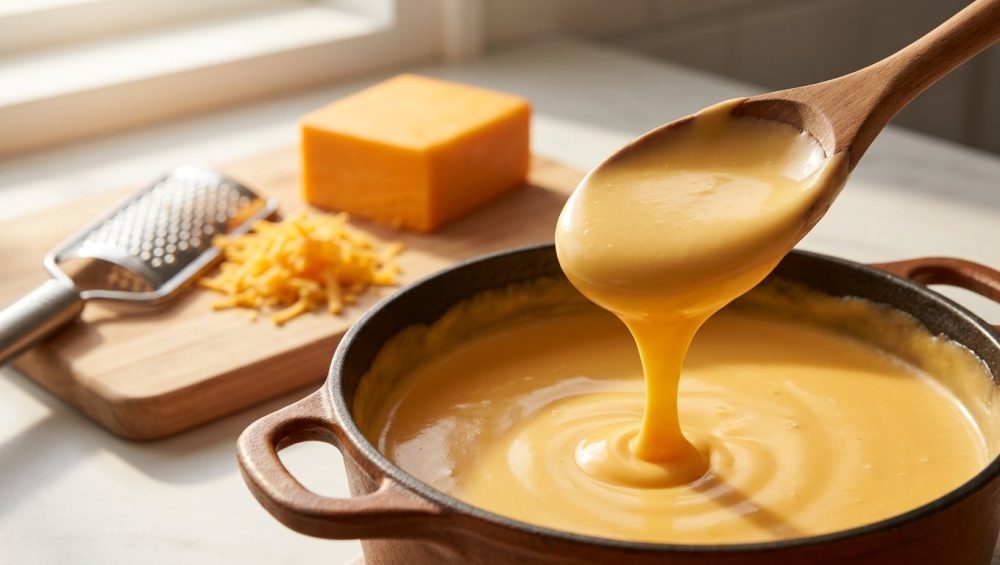
The solution to the grainy cheese sauce epidemic is frustratingly simple: you must buy a solid block of high-quality cheese and grate it yourself.
I know, I know. You are busy. But let’s be brutally honest—grating eight ounces of cheddar takes exactly forty-five seconds of your life. Just as you need a potato ricer for perfectly smooth, fluffy mashed potatoes, you need a sharp, high-quality stainless steel box grater for cheese.
When you grate your own cheese from a cold, firm block, you are preserving the natural moisture content of the dairy. There are no starches blocking the protein bonds. There is no wood pulp stealing the water. The cheese will melt evenly, stretch beautifully, and incorporate seamlessly into your liquid base.
Furthermore, block cheese is almost always cheaper per ounce than the pre-shredded bags. You are paying a premium for a factory machine to slice your cheese and cover it in sawdust. Save your money, protect your sauce, and grate it yourself. Pro tip: to easily transport your freshly grated mountain of cheddar from the cutting board to the stove, use a bench scraper to scoop it up in one clean motion. And if your wooden cutting board keeps cracking under the pressure of daily prep work, make sure you are treating it with food-grade mineral oil regularly!
The Masterclass: The Architecture of a Flawless Mornay Sauce
Now that we have eliminated the bagged saboteurs, we need to talk about technique. Even with freshly grated block cheese, a sauce can still turn grainy if you abuse it with improper heat.
The classic French method for a cheese sauce is called a Mornay. It relies on a starch-thickened base (a béchamel) to provide a gentle, stable environment for the cheese to melt into. Here is the foolproof, step-by-step blueprint for a sauce that will never break.
Step 1: The Perfect Roux
A roux is simply equal parts fat (usually butter) and flour, cooked together to eliminate the raw flour taste. Melt two tablespoons of high-quality butter in your saucier pan over medium-low heat. Whisk in two tablespoons of all-purpose flour. Cook this mixture, whisking constantly, for about two minutes until it smells slightly nutty and looks like wet sand. (A quick gear check: make sure you are using a fully sealed, stainless steel whisk. There is nothing worse than when a cheap whisk leaks dishwater into your pristine roux from a poorly sealed handle!)
Step 2: The Béchamel Base
Slowly whisk in two cups of whole milk. The temperature of the milk matters—if you dump ice-cold milk into a hot roux, it can clump. I prefer to warm my milk slightly in the microwave before adding it. Whisk vigorously until the mixture comes to a gentle simmer. The starches in the flour will swell and thicken the milk, creating a velvety, stable base. Let it simmer gently for about three to five minutes to fully activate the thickening power of the flour.
Step 3: The Critical Heat Check
This is where 90% of home cooks ruin their dinner. Cheese hates boiling heat. If you add your freshly grated cheese to a bubbling, boiling pot, the extreme heat will instantly denature the proteins and violently break the emulsion.
Once your béchamel is thickened, you must turn the stove burner completely off. If you are using a heavy cast iron pan that retains a massive amount of residual heat, physically move the pan to a cool burner.
Step 4: The Gentle Incorporation
With the heat off, add your freshly grated cheese (about two cups, or 8 ounces) in small handfuls. Do not dump it all in at once, which drops the temperature too rapidly and causes clumping. Whisk gently until the first handful is completely melted before adding the next. The ambient heat of the thickened milk is more than enough to gently coax the cheese into a liquid state without shocking the proteins. Season with salt, pepper, a pinch of mustard powder (which actually acts as a mild emulsifier!), and a dash of cayenne.
Advanced Culinary Science: The Magic of Sodium Citrate
For the weekend culinary hobbyists who want to achieve absolute, Michelin-level perfection without relying on a flour-heavy roux, we need to talk about chemical warfare. We need to talk about Sodium Citrate.
If you have ever marveled at the incredibly gooey, perfectly smooth texture of processed American cheese or Velveeta, you have witnessed the power of sodium citrate. It is a completely safe, naturally occurring salt of citric acid, and it is the professional chef’s ultimate secret weapon.
While some home cooks swear by the magic of evaporated milk to keep things smooth, sodium citrate is the undisputed king of emulsions. When you add sodium citrate to a heated liquid, it performs a brilliant bit of molecular restructuring. It actively replaces the calcium ions trapped inside the cheese’s casein protein network with sodium ions.
Why does this matter? Because calcium acts like a rigid glue, holding the proteins tightly together. By swapping the calcium for sodium, the proteins become highly soluble, flexible, and relaxed. The cheese loses its ability to coagulate and separate. You can literally boil a sodium citrate cheese sauce, and it will remain flawlessly smooth, glossy, and perfectly emulsified.
How to Make a “Modernist” Sodium Citrate Sauce
You can buy food-grade sodium citrate online for a few dollars, and a single bag will last you years. Here is the golden ratio for a pure, unadulterated, intensely flavored cheese sauce without a single grain of flour:
- The Liquid: Pour 1 cup of liquid (water, milk, or even a light beer) into a saucepan.
- The Magic Dust: Whisk in 2 to 3 teaspoons (about 11 grams) of sodium citrate until completely dissolved.
- The Heat: Bring the liquid to a gentle simmer.
- The Cheese: Gradually whisk in 8 to 10 ounces of freshly grated cheese (sharp cheddar, gruyere, pepper jack—literally any melting cheese will work).
The result is a sauce that tastes purely of the cheese you used, unmuted by flour or butter, with the luxurious, cascading texture of stadium nacho cheese. It is a mind-blowing trick that proves professional-level results are easily achievable in a standard home kitchen.
Troubleshooting: Can You Save a Broken Sauce?
Let’s say you are reading this article in a state of panic because your sauce is currently sitting on the stove, looking like a greasy bowl of cottage cheese. Can a broken, grainy sauce be saved?
Sometimes. It depends on how badly you scorched the proteins.
If the sauce has just begun to separate and look slightly gritty, you might be able to force the emulsion back together using brute mechanical force and a temperature shift.
- Remove from heat immediately.
- Add a splash of cold liquid. A tablespoon of cold milk or a splash of heavy cream can rapidly drop the temperature and introduce much-needed moisture back into the matrix.
- Blend for your life. A standard whisk might not cut it. Submerge an immersion blender (stick blender) into the pot and blitz it on high speed. The sheer mechanical force of the spinning blades can sometimes shatter the fat droplets into small enough pieces to re-integrate them into the sauce.
However, if the proteins have completely seized into hard, rubbery pebbles, the sauce is dead. No amount of whisking will reverse heavily denatured proteins. You must cut your losses, throw it out, and start over. Consider it a harsh, but effective, culinary lesson.
The Sassy Sous-Chef’s Final Verdict
Cooking is not magic; it is applied physics and chemistry that you get to eat. When you rely on highly processed, industrial shortcuts like bagged, pre-shredded cheese, you are surrendering control of your ingredients to a factory that cares about shelf life, not flavor.
You deserve better than grainy macaroni and cheese. You deserve better than a broken, oily fondue. By investing forty-five seconds of elbow grease to grate a fresh block of cheese, and by respecting the delicate temperature thresholds of dairy proteins, you will elevate your weeknight dinners from frustrating failures to absolute artistry.
Throw away the bag, protect your pans, and go make a sauce that will make you proud. You’ve got this.