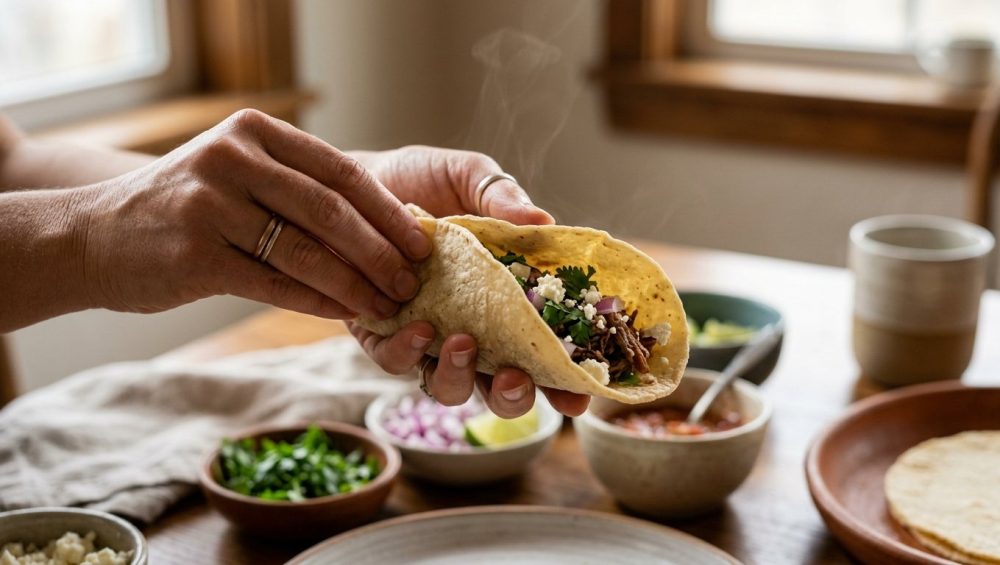
Listen, I don’t care if you have been cooking for twenty years or twenty minutes. If you are serving me a taco on a brittle, unheated, straight-out-of-the-plastic-bag corn tortilla, we are going to have words. There is absolutely nothing more heartbreaking than spending hours braising the perfect carnitas, meticulously dicing onions and cilantro, and executing a flawless salsa verde, only to have the entire structural integrity of your meal collapse in your hands on the very first bite. We have all been there. You pick up the taco, the bottom splits open like a trapdoor, and your beautiful, painstakingly prepared filling plummets onto your plate in a sad, soggy pile.
If this sounds familiar, take a deep breath. You are not alone, and more importantly, this is not a failure of your culinary abilities. It is a failure of physics, chemistry, and modern commercial food distribution. The good news? You do not need a culinary degree to fix this. You just need to understand a little bit of food science. Once you learn the actual mechanics of why corn dough behaves the way it does, breaking your takeout habit becomes infinitely easier, because your home-cooked meals will finally taste—and hold together—like the restaurant versions you crave.
Today, we are leaving no stone unturned. We are going to dive deep into the molecular biology of corn starches, the ancient and brilliant process of nixtamalization, the absolute garbage toxic cookware you need to throw in the trash immediately, and the precise, science-backed thermal techniques required to resurrect a stale tortilla. By the end of this masterclass, you will have the foolproof blueprint for flawless, flexible, tear-free tortillas.
The Starch Retrogradation Phenomenon: Why Your Tortillas Turn to Cardboard
To understand why your store-bought corn tortillas act like fragile discs of cardboard, we have to zoom in on the molecular level. The culprit ruining your dinner is a natural chemical process known as starch retrogradation.
When a tortilla is first cooked at the factory or tortilleria, the heat and moisture cause the starches in the corn—specifically two polysaccharides called amylose and amylopectin—to gelatinize. They absorb water, swell up, and form a soft, flexible, and beautifully pliable gel matrix. This is why a tortilla fresh off the comal is practically a religious experience. It is soft, steamy, and bends without the slightest hint of resistance.
However, the second that tortilla comes off the heat and begins to cool, the clock starts ticking. As the temperature drops, those swollen starch molecules begin to realign. The linear amylose chains and the highly branched amylopectin chains start to bind back together, forming rigid, ordered, crystalline structures. As they tightly bind to one another, they literally squeeze the water out of the gel matrix. This expelled moisture migrates to the surface of the tortilla and eventually evaporates into the surrounding air, or gets trapped as condensation inside the plastic bag.
This process of recrystallization and moisture expulsion is retrogradation. It is the exact same scientific mechanism that causes a fresh loaf of bread to go hard and stale on your countertop. The tortilla is not necessarily “drying out” in the traditional sense of losing all its water; rather, the water is no longer bound within the starch network where it needs to be to provide flexibility. For clumsy cooks who try to aggressively fold a retrograded tortilla without proper preparation, the result is an immediate, catastrophic structural failure.
The Refrigerator is Your Enemy
If you take one piece of advice away from this entire section, let it be this: stop putting your corn tortillas in the refrigerator. Cold temperatures drastically accelerate the rate of starch retrogradation. The environment inside your fridge is practically a custom-built laboratory designed to force amylose and amylopectin into rigid crystals as fast as humanly possible.
Refrigerated tortillas will often turn tough, rubbery, and incredibly brittle within a single day. If you are buying tortillas for a weekend gathering, leave them tightly sealed at room temperature in your pantry. If you absolutely must store them for a prolonged period (we are talking weeks), put them in the freezer. Freezing halts the retrogradation process entirely by locking the moisture in place as ice. But the refrigerator? The refrigerator is where tortillas go to die.
The Ancient Genius of Nixtamalization
You cannot talk about the science of a corn tortilla without paying immense respect to the Mesoamerican culinary innovation that makes it all possible: nixtamalization. If you were to take dried field corn, grind it into a powder, mix it with water, and try to press it into a tortilla, you would fail miserably. The dough would crumble into a gritty, unworkable mess.
To create the elastic, cohesive dough known as masa, the corn must first be nixtamalized. This ancient process involves steeping and cooking dried maize kernels in an alkaline solution, traditionally made using water and calcium hydroxide (slaked lime) or wood ash.
This highly alkaline bath performs several culinary miracles simultaneously. First, it dissolves the hemicellulose in the tough outer hull (the pericarp) of the corn kernel, making it easier to grind. Second, it alters the protein structure of the corn, allowing the ground particles to stick together and form a pliable dough. Third, and perhaps most importantly from a nutritional standpoint, the alkaline environment frees up bound niacin (Vitamin B3), preventing the devastating nutritional deficiency known as pellagra, while significantly boosting the calcium content.
During the steeping process, the moisture content of the corn kernel skyrockets from a dry 10-12% up to a saturated 40-42%. This incredible hydration, combined with the chemical transformation of the starches and proteins, is what gives a properly made corn tortilla its signature chew, its intoxicating earthy aroma, and its structural integrity. When we reheat a stale tortilla, our primary goal is to reawaken this specific nixtamalized starch matrix.
The Market Reality: We Are Buying Billions of Stale Tortillas
You might be wondering why you even have to deal with this problem in the first place. Why can’t the grocery store just sell soft tortillas? The answer, as always, comes down to mass commercial logistics and the sheer scale of the industry.
The global tortilla market is an absolute juggernaut. In 2025, the market was valued at a staggering $45.4 billion, and industry analysts project it to surge to over $68.2 billion by 2036. We are consuming billions upon billions of tortillas every single year. To keep up with this massive demand, commercial manufacturers have to prioritize shelf life, distribution logistics, and mold prevention over immediate culinary perfection.
When you buy a standard pack of corn tortillas from the middle aisles of a massive supermarket, you are buying a product that was likely manufactured days, if not weeks, prior. It has been shipped on refrigerated trucks, stacked on pallets, and left to sit under fluorescent lights. By the time that plastic bag makes it to your kitchen counter, the starch retrogradation is practically complete. The tortillas have lost their optimal 58-62% moisture sweet spot. They are dormant, crystallized, and desperately in need of resuscitation.
Do not blame yourself for buying them; we all need the convenience of store-bought staples to survive busy weeknights. But you must recognize that these commercial discs are not a finished, ready-to-eat product. They are a raw material that requires your active intervention before they hit the dinner table.
The “No-Go” Zone: Why I Refuse to Heat Tortillas on Toxic Teflon
Before we get into the exact thermal techniques for reviving your tortillas, we need to have a very serious, brutally honest conversation about the equipment you are using. I have a strict, non-negotiable rule in my kitchen: I do not cook on cheap, peeling, toxic non-stick pans, and neither should you.
If you are currently warming your tortillas on a scratched, ten-year-old Teflon skillet, you are playing a dangerous game with your health. The vast majority of traditional non-stick coatings are made using PTFE (polytetrafluoroethylene), which belongs to a massive family of synthetic chemicals known as PFAS (per- and polyfluoroalkyl substances). These are notoriously dubbed “forever chemicals” because they do not break down in the environment, and they accumulate in the human body.
The regulatory landscape is finally catching up to the science, and the hammer is dropping on toxic kitchen gear across the globe. In the United States, Minnesota led the charge by enacting a strict ban on the sale of cookware containing intentionally added PFAS, which took effect on January 1, 2025. Colorado and Maine followed suit with their own sweeping bans effective January 1, 2026. Europe is aggressively pursuing similar universal restrictions under the REACH framework.
Why is this particularly relevant to heating tortillas? Because properly reviving a tortilla requires dry, radiant heat. When you place a traditional PTFE non-stick pan on a burner without any oil, water, or food in it to absorb the thermal energy, the surface temperature skyrockets incredibly fast. According to the German Federal Institute for Risk Assessment (BfR), when a dry PTFE pan exceeds 360°C (about 680°F), the coating begins to break down and emit toxic, hazardous gases. Even at lower temperatures, chronic use of scratched, degrading non-stick surfaces can lead to the ingestion of microplastics and chemical flakes.
Furthermore, you should never be ruining your nonstick pans with aerosol cooking sprays, which contain emulsifiers that bake into the coating and destroy it, but you shouldn’t be using cooking spray on a tortilla anyway. The point is, non-stick pans are fragile, chemical-laden compromises that have absolutely no place in high-heat, dry-searing applications.
The Holy Trinity of Safe Cookware for Tortilla Revival
If we are throwing out the toxic Teflon, what should we be using? To achieve the perfect, pliable, lightly charred corn tortilla, you need a cooking surface that can handle dry heat, retain thermal energy, and radiate it evenly. You have three elite options.
1. The Carbon Steel Comal
If you want to do this the traditional, authentic way, you need a carbon steel comal. Carbon steel is an alloy of iron and a very small amount of carbon (usually less than 2%). It is stamped from a sheet of metal, making it significantly lighter and more responsive to temperature changes than cast iron.
In traditional Mexican kitchens, a wide, flat carbon steel comal is the undisputed king of tortilla preparation. It spans across multiple burners, providing a massive surface area to heat half a dozen tortillas simultaneously. Because it is highly heat-responsive, you can dial in your flame and the metal will react quickly, preventing you from accidentally incinerating your food. When properly seasoned, carbon steel pans develop a naturally slick, polymerized patina that requires zero synthetic chemicals.
2. The Heavy-Duty Cast Iron Skillet
If you do not own a dedicated comal, a large cast iron skillet is your next best friend. Cast iron is thick, heavy, and boasts unparalleled heat retention. It takes a few minutes to properly preheat, but once it gets hot, it stays hot.
This thermal mass is incredibly advantageous when you are heating a large stack of cold tortillas. If you drop a cold, slightly damp tortilla onto a flimsy aluminum pan, the temperature of the pan plummets, resulting in a weak, steamy, gummy mess. Cast iron shrugs off the temperature drop, immediately transferring high, radiant heat into the starch matrix of the dough. The process of seasoning cast iron is identical to carbon steel, relying on baked-in layers of natural cooking oils to create a safe, durable, and naturally non-stick surface.
3. The Multi-Clad Stainless Steel Pan
If you prefer a lower-maintenance option that does not require regular seasoning routines, a high-quality, fully clad stainless steel pan will absolutely get the job done. Stainless steel is virtually indestructible, highly resistant to warping, and completely non-toxic.
Because we are heating the tortillas dry (or with just a microscopic surface layer of water), you do not have to worry about the typical protein-sticking issues that plague novice cooks using stainless steel for eggs or fish. As long as you preheat the pan correctly, the tortilla will glide right off.
The Science of Re-Gelatinization: How to Actually Fix Them
We have covered the chemistry of why they break, and we have selected the proper, non-toxic hardware for the job. Now, it is time to execute.
The goal of reheating a corn tortilla is not just to make it hot. The goal is to safely cross the glass transition temperature of the retrograded starches—which sits right around 140°F (60°C)—without evaporating the remaining moisture. When the internal temperature of the tortilla crosses that 140°F threshold, the rigid amylose and amylopectin crystals melt, re-plasticizing the network and restoring the flexible gel state.
However, if your pan is too hot (exceeding 375°F), you will trigger rapid Maillard browning and severe dehydration. The moisture will flash off into steam instantly, the edges will curl, and the structure will collapse into a brittle, shattering mess. If your pan is too cold, the tortilla will sit there sweating, turning gummy and sticking to the metal.
You must hit the sweet spot. Here are the three scientifically validated methods for achieving tortilla perfection, ranked from the absolute best to the acceptable weeknight shortcut.
Method 1: The Cold Water Dip & Dry Sear (The Gold Standard)
This is the method used by professional taqueros and serious home cooks. It directly addresses both the temperature requirement and the moisture deficit of a stale commercial tortilla.
- Preheat Your Pan: Place your cast iron, carbon steel, or stainless steel skillet over medium-high heat. Let it preheat for a solid 3 to 5 minutes. You want the surface temperature to be hovering right around 325°F to 375°F. If you are using stainless steel, perform the water drop test—flick a tiny droplet of water into the pan. If it instantly shatters and boils away, it is too hot. If it forms a cohesive bead that dances across the surface like mercury, you are perfectly preheated. (This Leidenfrost effect is also the secret to making your pan actually non-stick for other ingredients).
- The Hydration Dip: Take your cold, stiff corn tortilla and quickly run it under a slow stream of cold tap water, or dip it rapidly into a shallow bowl of water. You are not soaking it. You do not want it dripping wet. You just want a micro-thin film of moisture coating the exterior.
- The Sear: Immediately slap the damp tortilla onto the dry, hot skillet. You will hear an aggressive sizzle. That is the surface water rapidly converting to steam, being forced directly into the core of the tortilla.
- The Flip: Leave it entirely alone for 12 to 18 seconds. Do not press it, do not poke it. Once you see the edges slightly lift and small, beautiful brown char spots develop on the underside, flip it.
- The Finish: Heat the second side for another 10 to 15 seconds. The tortilla should puff up slightly in the center—a sign that the internal moisture has turned to steam and successfully separated the layers of the masa. Remove it from the heat immediately.
Method 2: The Passive Ambient Humidity Chamber (The Make-Ahead Hack)
If you are hosting a large gathering and do not want to be standing over a hot stove dipping individual tortillas while your guests are drinking margaritas, this brilliant, scientifically sound method is for you. It requires zero active heat and relies entirely on controlled moisture equilibration.
- The Setup: Take your stack of stale tortillas and fan them out in a single layer inside a large, clean, airtight container (a wide Tupperware or a large resealable silicone bag).
- The Moisture Source: Add exactly one tablespoon of room-temperature water into the corner of the container. Do not pour the water directly onto the tortillas; you want it pooling empty in the corner.
- The Seal: Seal the container completely airtight.
- The Wait: Leave the container sitting on your counter at room temperature for 90 minutes. Flip the container or the tortillas once at the 45-minute mark.
The Science: Inside that sealed environment, the water evaporates and creates a microclimate with approximately 95% relative humidity. Without any thermal shock, the rigid starch crystals slowly absorb this ambient vapor, gently rehydrating the matrix. When you open the container 90 minutes later, the tortillas will be remarkably soft, pliable, and ready to be quickly warmed for service. Field tests show that tortillas revived this way retain their structural integrity for up to 22 hours, vastly outperforming microwave shortcuts.
Method 3: The Microwave Steam Wrap (The Desperate Weekday Fix)
I am a culinary purist, but I am also a realist. Sometimes it is a Tuesday night, you are exhausted, the kids are screaming, and you just need to get dinner on the table in four minutes flat. The microwave method is heavily flawed from a textural standpoint, but it works in a pinch.
- The Wrap: Take a stack of no more than six corn tortillas. Thoroughly dampen a clean, lint-free cotton kitchen towel (or a few high-quality paper towels) and wring out the excess water so it is damp, not dripping.
- The Cocoon: Wrap the stack of tortillas completely in the damp towel, ensuring no edges are exposed to the dry air.
- The Zap: Microwave on high for 45 to 60 seconds.
- The Rest: Leave the stack wrapped in the towel for an additional 60 seconds after the microwave stops. This allows the aggressive, uneven dielectric heating of the microwave to distribute evenly through the stack.
The Warning: Microwaves heat food by violently vibrating water molecules. This thermal shock can easily rupture the delicate starch networks. Tortillas heated this way will be incredibly soft and pliable for about 10 minutes, but once they begin to cool, they will rapidly undergo extreme retrogradation, turning into indestructible rubber disks. Use this method only for immediate consumption.
The Critical Final Step: The Holding Strategy
You have successfully re-gelatinized the starches. You have a beautiful, steaming, flexible tortilla. If you leave it sitting on a cold ceramic plate for three minutes, you will lose all your hard work. The moisture will flash off into the air, the temperature will drop below 140°F, and the tortilla will tear the moment you try to fold it.
To execute a truly relaxed dinner party, you must master the art of thermal holding. As soon as a tortilla comes off the skillet, it must immediately go into a heavily insulated environment.
Invest in a proper ceramic or terra-cotta tortilla warmer with a tight-fitting lid. Line the inside of the warmer with a thick, slightly damp cloth napkin. As you pull each tortilla off the heat, slide it directly into the cloth-lined warmer and shut the lid.
This creates a localized steam trap. The heat radiating from the freshly cooked tortillas will maintain the internal ambient temperature well above the critical 140°F threshold, while the damp cloth ensures the relative humidity stays high enough to prevent the edges from drying out and cracking. A well-insulated, cloth-lined warmer can keep a stack of tortillas in a state of perfectly pliable suspended animation for over an hour, allowing you to actually sit down, enjoy a drink, and eat with your guests instead of playing short-order cook at the stove.
Reclaiming Your Kitchen Confidence
Cooking should never be a source of stress, and you should never let a mass-produced, factory-retrograded disc of corn starch make you feel like a failure. The difference between a frustrating, messy dinner and a flawless, interactive, restaurant-quality taco night does not require expensive culinary school tuition. It simply requires an understanding of the materials you are working with.
Ditch the toxic, peeling non-stick pans that belong in a hazardous waste bin. Invest in a beautiful piece of carbon steel or cast iron. Respect the ancient science of nixtamalization, and understand that water and controlled heat are the keys to unlocking the magic of a corn tortilla.
Stop settling for broken tacos. Stop eating sad, crumbly dinners. Take control of your ingredients, apply a little bit of mindful kitchen science, and show those tortillas exactly who is in charge. You’ve got this. Now go make some tacos.