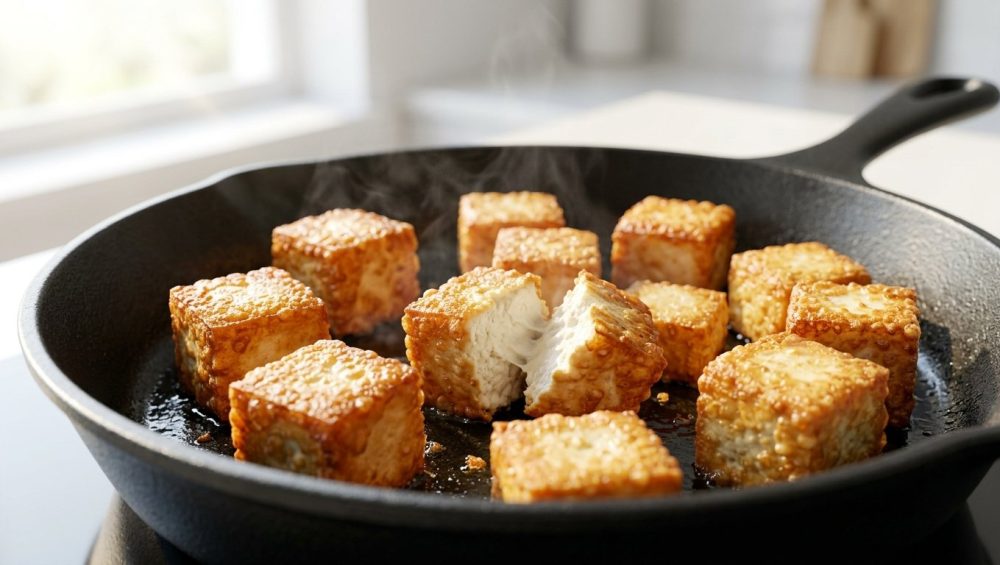
Listen, we need to have a serious talk about your tofu. I know exactly what happens in your kitchen on a Tuesday night. You buy a block of extra-firm bean curd with the noblest of intentions. You envision a glorious, golden-brown, restaurant-quality masterpiece. You slice it up, throw it into a lukewarm pan, push it around for ten minutes, and end up with a pale, crumbling, spongy disaster that tastes like hot sadness and sticks to your spatula. You end up ordering takeout, and the tofu claims another victim.
Take a deep breath. You do not need a culinary degree to fix this. You do not need a commercial deep fryer, and you certainly don’t need to resign yourself to a lifetime of soggy plant-based meals. What you need is a fundamental understanding of basic kitchen physics, a little bit of food science, and the willingness to stop treating your ingredients like an afterthought.
As a home cook, you have the power to create mind-blowing, perfectly crisp, flavor-packed tofu right on your own stove. We are going to break down the exact molecular reasons why your tofu is currently failing you, and I am going to teach you the precise pressing, freezing, brining, coating, and temperature-control techniques required to achieve a flawless, shatteringly crisp crust every single time. Grab a beverage, roll up your sleeves, and let’s get to work.
The Biology and Physics of the Bean Curd
To understand why your tofu refuses to crisp up, you first have to understand what tofu actually is. At its core, tofu is a three-dimensional protein-water gel. It is made by curdling fresh soy milk with a coagulant (typically calcium sulfate or magnesium chloride) and pressing the resulting curds into solid blocks.
The most important word in that definition is water.
Most of the tofu you buy at the grocery store is overwhelmingly composed of moisture. Even the varieties proudly labeled “Extra-Firm” or “Super Firm” are still holding onto an astonishing amount of water—often up to 70% or 80% of their total weight. This moisture is held in three different ways within the tofu’s structure: free water (which is loosely held and easily drains away), entrapped water (which is locked within the protein matrix), and bound water (which is chemically linked to the proteins themselves).
Why does this matter for your weeknight stir-fry? Because water is the ultimate enemy of crispiness.
When you want food to turn golden brown and develop that complex, savory, roasted flavor, you are relying on a chemical process called the Maillard reaction. This beautiful reaction between amino acids and reducing sugars only kicks into high gear when the surface temperature of your food reaches approximately 285°F to 300°F (140°C to 150°C).
Here is the brutal law of thermodynamics that is ruining your dinner: water vaporizes into steam at 212°F (100°C). As long as there is liquid water present on the surface of your tofu, the temperature of that surface absolutely cannot exceed 212°F. It is a thermal stall. If you throw wet tofu into a hot pan, it will not fry. It will sit there, violently sputtering, aggressively steaming itself into a rubbery, pale oblivion until all that surface moisture finally evaporates. By the time the surface is dry enough to actually start browning, the interior of your tofu is overcooked, tough, and completely devoid of joy.
Moisture control is everything. If you control the water, you control the crunch.
The Pressing Issue: Evicting the Free Water
The first and most traditional line of defense against soggy tofu is pressing. Pressing physically forces the free water out from between the protein strands. By densifying the structure, you increase the protein ratio, improve the structural integrity of the block (so it doesn’t disintegrate when you flip it), and drastically reduce the amount of surface moisture you have to fight in the pan.
If you are a beginner, you have probably tried the DIY pressing method: wrapping a block of tofu in half a roll of paper towels, balancing a cutting board on top, and precariously stacking three cans of black beans and a heavy cookbook on the board. Ten minutes later, the tower collapses, your counter is flooded, and your tofu is lopsided.
It is time to upgrade your routine. If you cook plant-based meals even twice a month, you need a dedicated tool for this. The sheer convenience and genius of a tofu press cannot be overstated. A proper spring-loaded press applies continuous, even pressure, extracting significantly more water in less time without turning your kitchen into a hazard zone.
However, let me be perfectly clear: I have zero patience for cheap, flimsy plastic gadgets that crack after three uses and leach mystery chemicals into your food. Invest in a high-quality, food-grade stainless steel or highly durable, BPA-free press with a water-catching tray. Press your firm or extra-firm tofu for at least 15 to 30 minutes. You will be shocked by the sheer volume of liquid that pools at the bottom. That is liquid that will no longer be ruining your sear.
The Freezer Hack: Molecular Texture Transformation
If you want to take your tofu from “pretty good” to “absolutely unrecognizable as a soybean product,” you need to utilize your freezer. This is a favorite trick among weekend culinary hobbyists who want to manipulate the texture of their food on a molecular level.
When you place a block of tofu in the freezer, the water trapped inside the protein matrix undergoes a phase change. As water turns into ice, it expands. These expanding ice crystals act like microscopic daggers, physically puncturing and stretching the cell walls and protein network of the bean curd.
When you subsequently thaw the tofu, those ice crystals melt and drain away, leaving behind a vast network of empty, coral-reef-like pores. The structural change is irreversible. The initial protein-water bonds are replaced by stronger protein-protein bonds. The result? A block of tofu that is incredibly spongy, highly elastic, and remarkably chewy. It takes on a dense, almost meaty texture that completely defies expectations.
Because the structure is now porous, it acts like an actual sponge. You can easily squeeze the remaining water out with your bare hands (no heavy cookbooks required), and it will aggressively drink up any marinade or sauce you introduce it to. If you are tired of dense, flavorless cubes, you must freeze it first. Just toss the entire unopened package in the freezer overnight, thaw it in the fridge or a bowl of warm water the next day, press the liquid out, and marvel at the transformation.
The Saltwater Soak: The Counterintuitive Miracle
I hear you. You are a busy professional. It is 6:00 PM on a Wednesday. You did not press your tofu for 30 minutes, and you certainly did not freeze it last night. You need a fast, foolproof shortcut that buys you time without sacrificing the quality of your dinner.
Enter the boiling saltwater soak.
This method sounds completely unhinged at first. Why on earth would you take a wet ingredient that you are desperately trying to dry out, and submerge it in a pot of boiling water?
The answer lies in the beautiful science of osmosis and protein denaturation.
Here is how it works: you bring a pot of water to a rolling boil and add a generous amount of salt (about 2 tablespoons of kosher salt for every 2 to 3 cups of water). You tear or cut your tofu into bite-sized pieces and drop them into the boiling brine for 5 to 10 minutes.
The high concentration of salt in the water creates an osmotic gradient. Because there is more salt outside the tofu than inside, the water inside the tofu is rapidly drawn out. Simultaneously, the heat from the boiling water causes the proteins on the surface of the tofu to tighten and contract, effectively squeezing out even more moisture like a wrung-out towel.
As a brilliant bonus, a small amount of the salt diffuses into the tofu, seasoning it from the inside out and neutralizing that raw, earthy “beany” flavor that turns so many people off.
When you pull the tofu out of the boiling water and let it drain on a paper towel, the residual heat causes the remaining surface moisture to flash-evaporate into the air. Within minutes, you are left with tofu that is perfectly seasoned, structurally firm, and incredibly dry on the surface. The magic of a saltwater soak is that it accomplishes in 10 minutes what a mechanical press takes 30 minutes to do, while simultaneously injecting flavor into the core of the protein.
The Starch Shield: Armor for Your Bean Curd
Even if you have pressed, frozen, or boiled your tofu, you still need an insurance policy to guarantee that shattering, audible crunch. That insurance policy is starch.
Tossing your prepped tofu in a light coating of starch does two critical things. First, the dry starch immediately absorbs any microscopic droplets of moisture remaining on the surface of the tofu, preventing them from interfering with the hot oil. Second, when starch hits hot oil, it undergoes a process called gelatinization and dehydration, forming a rigid, crackly, golden crust that acts as a protective barrier.
But not all starches are created equal. If you are dusting your tofu in regular all-purpose wheat flour, please stop. Flour contains gluten and proteins that will burn quickly and turn gummy, resulting in a heavy, doughy exterior.
Cornstarch is the standard, accessible choice for most home cooks, and it works wonderfully. It creates a light, crispy shell that browns nicely. However, if you want to elevate your cooking and achieve restaurant-level perfection, you need to seek out potato starch or sweet potato starch.
Potato starch behaves differently than cornstarch. It produces a tighter, cleaner, and noticeably lighter crust that stays crispy significantly longer, even after it cools down or gets tossed in a sauce. If you have ever marveled at the impossibly light, glass-like crunch of Korean fried chicken, you have experienced the power of potato starch. Sweet potato starch takes this a step further, yielding an even harder, more brittle snap.
Whichever starch you choose, the rule is the same: apply it right before cooking. If you coat your tofu in starch and let it sit on the counter for twenty minutes, the starch will absorb too much internal moisture from the tofu, turning into a wet, sticky paste that will glue itself to your pan. Toss and immediately fry.
The Heat, The Hardware, and The Oil
We have arrived at the most critical juncture of this masterclass. You have perfectly prepped, dry, starch-coated tofu. You are ready to cook. If you mess up the heat or use the wrong equipment here, all your hard work is instantly voided.
Let’s talk about your pan. If you are attempting to sear tofu in a scratched, peeling, lightweight, bargain-bin non-stick skillet, we are going to have a problem. I despise cheap, toxic kitchenware. Cooking on deteriorating Teflon not only ruins your sear because the thin metal cannot hold heat, but it also flakes mystery chemicals into your food. Banishing toxic kitchen gear is the very first step to becoming a competent home cook.
To achieve a masterful crust, you need a pan with high thermal mass—something that holds onto heat and doesn’t drop in temperature the second you add your food. You need a heavy-bottomed carbon steel skillet, a well-seasoned cast iron pan, or a high-quality multi-clad stainless steel skillet.
“But Sassy Sous-Chef,” you whine, “tofu always sticks to my stainless steel pan!”
Yes, it does, because you are impatient. Food sticks to your stainless steel when you add it to a pan that is too cold. When proteins hit warm metal, they chemically bond to it. When they hit screaming hot metal, the moisture in the food instantly vaporizes, creating a microscopic layer of steam that lifts the food slightly off the surface of the pan. This is called the Leidenfrost effect.
To ensure your pan is ready, use the magic of the water drop test. Flick a few drops of water into your dry, heating pan. If the water sits there and bubbles away, the pan is too cold. If the water instantly shatters into tiny beads that glide and dance across the surface like mercury, your pan is perfectly preheated and ready for oil.
Speaking of oil, stop using extra-virgin olive oil for high-heat searing. Olive oil has a low smoke point and contains unrefined particles that will burn, turning your food bitter and filling your kitchen with acrid smoke. You need a neutral, high-heat cooking oil. Avocado oil is the undisputed king here, boasting a massive smoke point of around 520°F (270°C). Peanut oil is also excellent, offering great stability and a subtle, complementary flavor for Asian-inspired dishes.
And please, for the love of all things holy, do not spray aerosol cooking sprays onto your hot pans. The chemical propellants in those cans build up into a sticky, polymerized resin that is impossible to clean, effectively ruining your nonstick pans and cast iron alike. Use real, liquid oil. You don’t need a deep fryer; a generous, even coating that covers the bottom of the skillet is enough to conduct heat and trigger the Maillard reaction.
When you drop your tofu into the hot oil, you will hear a fierce sizzle. That is the sound of surface water rapidly vaporizing. This escaping steam creates outward pressure, forming a temporary barrier that actually prevents the oil from soaking into the tofu. Paradoxically, frying at the correct, high temperature results in less greasy food than frying at a low temperature.
Once the tofu is in the pan, leave it alone. Do not poke it. Do not push it around. Let the heat do its job. Wait 3 to 4 minutes until a deep golden crust forms, then flip.
The Step-by-Step Masterclass Workflows
Now that you understand the science, let’s put it into practice. Here are the two definitive methods for achieving flawless tofu, depending on how much time you have.
Method A: The Weeknight Warrior (Fast, Efficient, Foolproof)
This is for Tuesday nights when you are hungry, tired, and need food in 20 minutes.
- The Tear: Open a block of firm or extra-firm tofu. Do not slice it into perfect, boring cubes. Instead, use your hands to tear it into jagged, irregular, bite-sized chunks. Tearing creates craggy, uneven edges, which vastly increases the surface area. More surface area equals more crunch, and those rough edges will grab onto your sauce beautifully. (Plus, if you try to slice it perfectly and it crumbles into a mess, you’ll just get frustrated. Usually, this happens because your knives get dull so fast from improper care, but tearing bypasses the knife entirely).
- The Boil: Bring a pot of water to a boil. Add a heavy pinch of salt. Drop the torn tofu chunks in and boil for 5 to 7 minutes.
- The Drain: Remove the tofu with a slotted spoon or spider skimmer and place it on a paper-towel-lined plate. Let it sit for 3 minutes so the residual heat flashes off the remaining surface moisture.
- The Coat: Toss the dry chunks in a bowl with 2 tablespoons of potato starch (or cornstarch) until lightly and evenly coated.
- The Sear: Heat your carbon steel or cast iron skillet over medium-high heat. Do the water drop test. Add 2 tablespoons of avocado oil. Carefully place the tofu chunks in the pan in a single layer. Let them sear undisturbed for 3-4 minutes per side until deeply golden and crispy.
- The Finish: Remove the tofu, wipe out the pan, make your sauce, and toss the crispy tofu back in at the very last second before serving.
Method B: The Weekend Perfectionist (Slow, Supreme, Mind-Blowing)
This is for Saturday nights when you have the time to engineer the ultimate, meaty, flavor-bomb texture.
- The Freeze: Place an unopened package of extra-firm tofu in the freezer overnight.
- The Thaw: The next morning, thaw the package in the fridge or submerge it in warm water until completely softened.
- The Press: Remove the tofu from the packaging. It will look yellow and spongy. Place it in your tofu press for 15 minutes, or simply squeeze it firmly between your hands over the sink. Watch in amazement as a waterfall of liquid pours out.
- The Marinade: Because the tofu is now a dry sponge, it will absorb anything. Cut it into thick planks or cubes. Soak it in a highly seasoned marinade (soy sauce, rice vinegar, sesame oil, garlic, ginger) for 15 minutes.
- The Coat & Fry: Remove the tofu from the marinade, pat it completely dry with paper towels (crucial!), toss in potato starch, and shallow-fry in a hot skillet with avocado oil until shatteringly crisp on all sides.
Troubleshooting Your Tofu Tragedies
Even with the best instructions, things can go sideways if you aren’t paying attention. Let’s troubleshoot the most common rookie mistakes.
“My tofu is sticking to the pan and tearing apart when I flip it!”
You either used a cold pan, didn’t use enough oil, or you tried to flip the tofu before the crust fully formed. The Maillard reaction creates a rigid structure that naturally releases from the pan when it is ready. If it feels glued down, give it another 60 seconds. Also, ensure your cookware is properly maintained. If you are scrubbing your seasoned pans with harsh abrasives and ruining your cast iron, food will inevitably stick to the damaged surface.
“My tofu is crispy, but the inside tastes like absolutely nothing.”
Tofu is a blank canvas. If you don’t paint it, it remains blank. If you use the boiling method, make sure the water is heavily salted. If you use the freezing method, make sure your marinade is highly concentrated. Furthermore, the sauce you toss the cooked tofu in needs depth. Don’t just pour raw spices and cold soy sauce over your food. Utilize the magic of blooming in oil by briefly frying your garlic, ginger, and chili flakes in the pan before adding your liquid ingredients. It unlocks fat-soluble flavor compounds that completely transform the dish.
“My crust falls off the minute I add the sauce.”
You are either drowning the tofu or letting it sit too long. Crispy starch coatings are fragile. If you simmer your perfectly fried tofu in a watery teriyaki sauce for ten minutes, the starch will rehydrate, turn to mush, and slide right off the bean curd. The secret to restaurant-style glazed tofu is to thicken your sauce first (using a small cornstarch slurry) until it is tight and syrupy. Turn off the heat, toss the crispy tofu into the thick glaze, fold it twice to coat, and serve it immediately.
The Final Word
Cooking incredible plant-based food at home does not require magic, and it certainly doesn’t require suffering through sad, soggy meals. It simply requires respecting the ingredients, understanding how water interacts with heat, and ditching the terrible habits (and terrible pans) that are holding you back.
You now possess the exact scientific knowledge and practical techniques to conquer the bean curd. Go forth, tear up some tofu, boil it, coat it, and sear it in a screaming hot pan. Your weeknight dinners are about to get a whole lot louder, and infinitely more delicious. You’ve got this.