Picture this: It is a Friday night. You have decided to treat yourself. You just dropped twelve dollars on a pathetic, wilting clamshell of organic basil and another fifteen dollars on a bag of pine nuts roughly the size of a matchbox. You hand-grated a mountain of imported Parmigiano-Reggiano until your knuckles bled. You brought out the good stuff—the liquid gold, cold-pressed, extra virgin olive oil you usually save for special occasions. You toss it all into your food processor, hit the pulse button, and envision a chorus of Italian angels singing as you prepare to toss this vibrant green masterpiece with a bowl of artisanal linguine.
You dip a spoon in to taste your creation.
But instead of a sweet, herbaceous, garlicky triumph, your mouth violently puckers. It tastes like battery acid, earwax, and deep, profound regret. It is aggressively, undeniably bitter.
Welcome to my kitchen, darling. Grab a glass of wine. You didn’t mess up the recipe. You messed up the physics. We are going to cut through the pretentious recipe jargon and look at the hard, undeniable chemistry of your ingredients. I am going to teach you exactly why your expensive appliances are ruining your expensive ingredients, how to fix a ruined sauce if you are currently in the middle of a culinary meltdown, and the foolproof sequencing method to ensure you never make bitter pesto again.
The Crime Scene: The Science of Bitter Olive Oil
When a home cook tastes a bitter batch of pesto, their first instinct is usually to blame the basil. They assume the leaves were too old, or perhaps the garlic was too sharp. While subpar produce certainly doesn’t help, the true villain in this culinary tragedy is almost always your extra virgin olive oil, and more specifically, how you treated it.
Let’s get one thing straight: Extra virgin olive oil (EVOO) is incredibly healthy, largely because it is packed with powerful, disease-fighting antioxidants called polyphenols. These chemical compounds are the reason the Mediterranean diet is constantly praised by cardiologists. However, the specific phenolic compounds in olive oil, primarily oleuropein aglycon and ligstroside aglycon, are also incredibly potent bitter tastants. In fact, human beings have twenty-five distinct bitter taste receptors in our mouths (known as TAS2Rs), and these specific olive oil polyphenols heavily activate the TAS2R1, TAS2R8, and TAS2R14 receptors on your tongue.
In a high-quality bottle of EVOO, these bitter polyphenols are suspended inside a protective coating of fatty acids. As long as they remain tucked inside their little microscopic lipid blankets, your tongue never directly interacts with them. This is why you can dip a piece of crusty bread into a dish of raw olive oil and taste only fruity, grassy, and buttery notes. The bitterness is physically shielded from your tastebuds.
Enter the high-speed food processor.
When you dump EVOO into a blender or food processor, the metal blades spin at thousands of revolutions per minute. This violent, high-shear blending process forcefully tears the oil apart, breaking it down into microscopic droplets to form an emulsion. This mechanical shearing physically strips away the protective fatty acid coating, ejecting those naked, highly astringent polyphenols straight into your sauce. The smaller the oil droplets become, the higher the dispersion of polyphenols, and the more violently bitter the final product tastes.
You didn’t make a bad recipe; you simply executed a highly efficient chemical extraction of the worst-tasting compounds in your kitchen. If you want to preserve the delicate flavor of your olive oil, you must stop using your food processor to force the final emulsion.
The Ancestral Wisdom: Mortar, Pestle, and Patience
To truly understand how to fix our modern mistakes, we have to look at how this sauce was originally created. Pesto alla Genovese is not just a list of ingredients; it is a cultural emblem rooted in the rugged, steep terrain of Liguria, a crescent-shaped region in northwestern Italy.
A Brief History of Pounding
The word “pesto” is not a noun describing a basil sauce; it is derived from the Italian verb pestare, which literally means to pound, to crush, or to trample. It is a technique. Long before basil was ever introduced to the Italian peninsula, the ancient Romans were making a primitive predecessor to pesto called moretum. Moretum was a pungent, paste-like condiment made from garlic, hard cheese, herbs, olive oil, and sometimes nuts or vinegar, heavily pulverized in a mortar. It was a staple for soldiers and farmers because it was high in fat, non-perishable, and deeply flavorful.
It wasn’t until much later—with the first official recipe for Pesto alla Genovese appearing in print in 1865—that the basil-heavy sauce we know and love became a codified Italian staple.
Why the Old Ways Worked
The traditional Ligurian method utilizes a heavy marble mortar and a wooden pestle. This is not just for rustic aesthetics; it is a highly functional scientific choice. A mortar and pestle does not slice, shear, or whip. It crushes. It bruises. It gently coaxes the essential oils out of the basil leaves and mashes the garlic and pine nuts into a rich paste without ever creating the violent, microscopic emulsion that ruins olive oil. When the olive oil is finally stirred into the mortar at the very end, it remains largely intact, keeping those bitter polyphenols safely hidden away.
Now, I am a fierce advocate for the everyday home cook. I know that time is money. I know you do not have forty-five minutes on a random Tuesday night to manually grind basil leaves by hand while your children are screaming for dinner. But understanding the physics of the traditional method allows us to hack the modern machine. We can use the food processor for the heavy lifting, as long as we respect the chemistry of the oil.
The Masterclass Solution: The Sequencing Method
How do we get the incredible convenience and speed of the food processor without triggering a bitter polyphenol explosion? We separate the processing from the emulsifying. We are going to use the machine to chop the solids, and we are going to use our hands to fold in the fat. Follow this exact sequence, and you will achieve a sweet, perfectly balanced, vibrant green pesto every single time.
Step 1: The Dry Grind
Start by adding your toasted pine nuts, peeled garlic cloves, and a generous pinch of coarse sea salt to the empty bowl of your food processor. Pulse this mixture until it resembles coarse, wet sand. I have begged you in the past to stop adding garlic first to a hot skillet where it will immediately burn, but in a raw application like this, the garlic absolutely must be processed first. The coarse salt acts as a mechanical abrasive, helping to break down the tough cell walls of the garlic and nuts before the delicate herbs are introduced.
Step 2: The Green Machine
Next, add your fresh basil leaves. Do not pack them in too tightly. Pulse the machine in short, one-second bursts. Do not simply hold the button down and let the machine run continuously. The friction generated by high-speed spinning blades creates heat, and heat is the absolute enemy of fresh basil. We will discuss the enzymatic browning process and why your pesto turns brown in the storage section, but for now, just remember to keep the processing time as brief as possible. Scrape down the sides of the bowl with a silicone spatula between pulses to ensure an even chop.
Step 3: The Cheese Fold
Once the basil is finely chopped and incorporated into the nut and garlic mixture, add your finely grated Parmigiano-Reggiano and Pecorino Romano. Pulse the machine exactly two or three times—just enough to distribute the cheese evenly through the paste. Do not over-process the cheese, or it will begin to clump and heat up, releasing its oils prematurely.
Step 4: The Manual Labor (The Crucial Step)
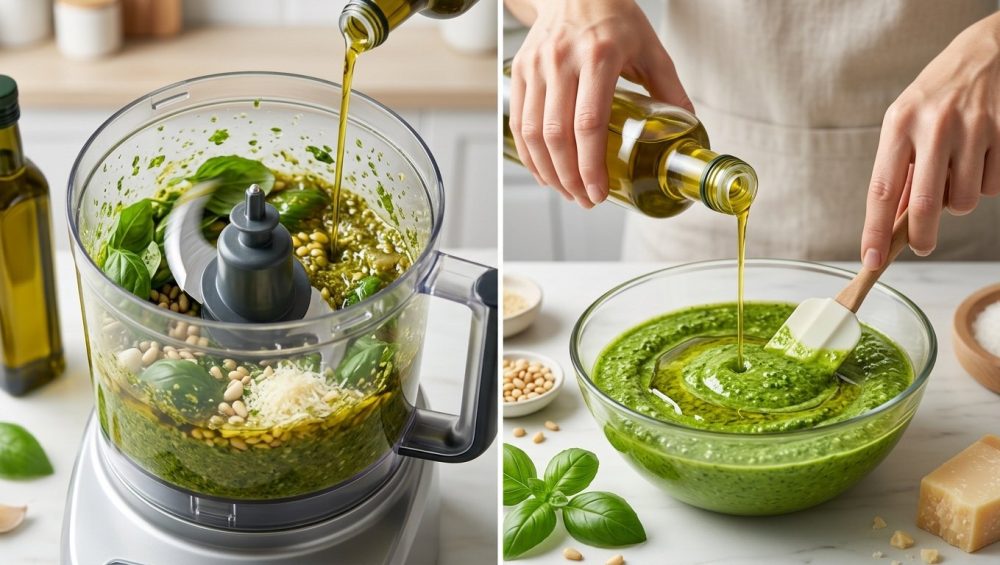
This is where you save your sauce. Absolutely do not pour your extra virgin olive oil into the food processor. Take the blade out of the work bowl. Scrape your glorious, fragrant, bright green paste into a separate mixing bowl. Grab a spatula or a wooden spoon. Slowly pour your high-quality EVOO into the bowl, and gently fold it into the paste by hand.
By hand-mixing the oil into the solids, you are combining the ingredients without mechanically shearing the fat. The oil droplets remain large and intact. The polyphenols stay safely tucked inside their fatty acid blankets. The result is a lush, sweet, perfectly balanced pesto that tastes exactly like it was made in a Ligurian grandmother’s kitchen, but took you less than ten minutes to prepare.
The Ingredient Inquisition: What Else is Ruining Your Sauce?
Even if you master the sequencing method and perfectly protect your olive oil, subpar ingredients will haunt your final dish. Pesto is a raw sauce. There is no heat to cook out impurities, and there is no heavy stock to mask off-flavors. Every single ingredient must pull its weight.
The Pine Nut Problem
Pine nuts (pignoli) are traditional, but they are also incredibly high in natural oils. When these oils are exposed to air and light for too long, they oxidize and go rancid. If you open a bag of pine nuts and they smell like old paint, dusty cardboard, or modeling clay, throw them directly into the garbage. Rancid nuts will instantly ruin your sauce with a stale, chemical bitterness. Always buy pine nuts from a store with high turnover, store them in the freezer to preserve their oils, and toast them gently in a dry skillet for three minutes before using them to wake up their natural buttery flavor.
If you are substituting walnuts due to the astronomical price of pine nuts, proceed with extreme caution. Walnut skins contain heavy tannins that are incredibly bitter. If you use walnuts, you must blanch them in boiling water for one minute, shock them in ice water, and rub the skins off with a kitchen towel before adding them to your pesto.
The Garlic Overload
Raw garlic is a volatile ingredient. When you crush or chop a clove of garlic, you are breaking its cell walls, which allows two chemical compounds—alliin and the enzyme alliinase—to mix and form allicin. Allicin is the compound responsible for that sharp, burning, pungent garlic flavor. The more you process the garlic, the more allicin is created. If you use too much garlic, or if you are using older cloves that have sprouted a green germ in the center, your pesto will taste harsh and metallic. Always slice your garlic cloves in half and remove the green germ before processing, as it harbors the most concentrated bitter flavors.
The Basil Bolting
Not all basil is created equal. The traditional choice is sweet Genovese basil (Ocimum basilicum), which has tender, rounded leaves and a delicate, slightly sweet, anise-like flavor. If you are growing your own basil, you must harvest it before the plant flowers. When a basil plant goes to seed—a process known as bolting—the leaves become tough, leathery, and develop a harsh, licorice-heavy, bitter edge. Always pinch off the flowers of your basil plants to keep the leaves sweet and tender.
The Cheese Compromise
Never, under any circumstances, use pre-shredded cheese in a raw sauce. Pre-shredded bags of Parmesan are coated in anti-caking agents, usually powdered cellulose (wood pulp) or potato starch, to prevent the shreds from clumping together in the bag. These starches prevent the cheese from properly emulsifying into the oil, resulting in a gritty, grainy, flavorless paste. Buy a block of real Parmigiano-Reggiano and grate it yourself on a microplane. It takes sixty seconds and fundamentally changes the quality of your food.
The Sassy Sous-Chef’s Guide to Kitchen Gear (No Toxic Trash Allowed)
You know my strict rules by now. I despise cheap, toxic kitchenware. I believe that buying cheap tools is a tax on the poor, because you end up replacing them every six months when they inevitably break or ruin your food. My uncompromising stance on banishing toxic kitchen gear applies heavily to how you prepare raw, acidic, and oily sauces.
The Food Processor Warning
If you are using a twenty-dollar food processor you bought at a discount store a decade ago, the blades are likely dull. Dull blades do not cut basil; they batter it to death. This violent bruising destroys the cell structure of the herbs, releasing enzymes that cause rapid oxidation, turning your bright green sauce into a swampy, brown, bitter mess.
Furthermore, beware of cheap plastic work bowls. Low-quality plastics scratch easily, creating microscopic ravines that harbor bacteria and rancid oils. Worse, when exposed to acidic ingredients (like lemon juice) or highly lipophilic ingredients (like olive oil), cheap polycarbonate plastics can leach endocrine-disrupting chemicals like phthalates into your food. A heavy-duty food processor with a durable, BPA-free work bowl and razor-sharp stainless steel blades is one of the essential tools every beginner needs to cook safely and efficiently.
The Mortar and Pestle Upgrade
If you want to slow down on a Sunday afternoon and tackle this recipe the traditional way, you need the right equipment. Do not buy a smooth ceramic mortar, a wooden bowl, or a tiny granite spice grinder. You need a heavy, large, unpolished Carrara marble mortar with a wooden pestle. The interior of the mortar must be unpolished and slightly rough; this texture provides the necessary friction to grind the garlic and basil into a paste. The wooden pestle is preferred because it is gentler on the delicate basil leaves than a heavy stone pestle, preventing over-bruising.
Triage: How to Actually Fix Bitter Pesto
Alright, let’s address the elephant in the room. You didn’t read this article before you started cooking. You threw everything into the blender, held the button down for three minutes, and now you have a bowl of aggressively bitter, highly emulsified pesto. If you are currently surviving kitchen disasters and staring down a bowl of ruined sauce, step away from the trash can. We can perform culinary triage.
The Fat Fix
Bitterness can be effectively masked and suppressed by fat. Fat coats the palate and physically blocks the bitter receptors on your tongue from interacting with the polyphenols. If your pesto is too sharp, fold in an extra handful of finely grated Parmigiano-Reggiano. Alternatively, you can crush some extra toasted pine nuts by hand and stir them in. When tossing the pesto with your hot pasta, add a generous pat of high-quality, unsalted European butter. The butter will melt into the starchy pasta water, creating a lush, creamy emulsion that dulls the harshness of the over-processed olive oil.
The Acid Adjustment
Home cooks constantly forget that a heavy, fat-laden dinner actually needs acid to lift the flavors and cut through the richness. Acid distracts the palate from bitterness. While traditional Genovese pesto does not contain lemon juice, a squeeze of fresh lemon is an incredible rescue tool for a bitter batch. The bright, sharp acidity of the citrus will immediately balance the astringent polyphenols and bring the herbaceous notes of the basil back to the forefront.
The Sweetness Strategy
I generally loathe adding sugar to savory Italian food, but desperate times call for desperate measures. Knowing how to balance a broken sauce with a microscopic drop of sweetness is one of the best ways to save ruined meals from the garbage bin. If the fat and acid adjustments haven’t fully cured the bitterness, add a tiny, pea-sized drop of honey or a literal pinch of white sugar to the pesto. You are not trying to make the sauce sweet; you are simply introducing a conflicting flavor profile that forces your tastebuds to re-evaluate the bitterness. Stir it well and taste again.
Storing, Serving, and Protecting Your Liquid Gold
Once you have achieved pesto perfection, you must protect it from the elements. Basil is a highly delicate herb that oxidizes and turns brown the moment it is exposed to oxygen.
The Oxidation Battle
If you are storing leftover pesto, transfer it to a narrow glass jar. Tap the jar on the counter to remove any air bubbles, and smooth the top of the pesto with the back of a spoon. Finally, pour a thin, quarter-inch layer of extra virgin olive oil directly over the top of the pesto. This layer of oil acts as an airtight seal, preventing oxygen from reaching the basil and keeping your sauce vibrant and green in the refrigerator for up to a week.
A Note on Knife Skills
If you decide to skip the food processor entirely and hand-chop your basil for a rustic, chunky pesto, you must ensure your chef’s knife is honed and razor-sharp. A dull blade crushes cell walls rather than slicing them cleanly, which leads to rapid enzymatic browning and off-flavors. This is the exact same scientific reason why you cry chopping onions on a Tuesday night. Treat your herbs with respect, and they will reward you with unparalleled flavor.
The Heat Warning
Finally, the most important rule of serving: Never, ever cook your pesto. Do not put it in a hot pan over a flame. Heat destroys the delicate volatile oils in the basil, muting its flavor, and turns the beautiful emulsion of cheese and oil into a stringy, greasy, separated mess.
When your pasta is perfectly al dente, reserve a cup of the starchy pasta boiling water. Drain the pasta and return it to the warm (but off-the-heat) pot. Add your room-temperature pesto and a splash of the hot starchy water. Toss vigorously. The residual heat of the pasta will gently warm the sauce, while the starches in the water will bind the oil and cheese into a silky, luxurious glaze that coats every single noodle perfectly.
You do not need a culinary degree to cook like an absolute professional in your home kitchen. You just need to understand the basic chemistry of your ingredients, respect the limitations of your appliances, and refuse to settle for mediocre results. Now get back in the kitchen, step away from the pulse button, and go fold that olive oil by hand. You’ve got this.