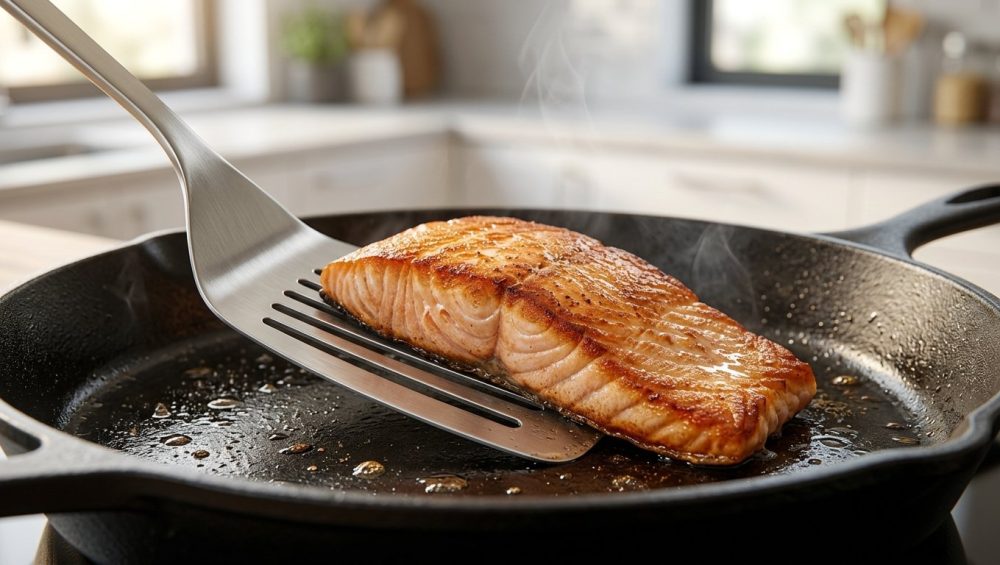
Picture this: You’ve just spent twenty dollars on a beautiful, center-cut salmon fillet. You’ve patted it dry, seasoned it perfectly, and achieved that glorious, restaurant-quality sear in your hot skillet. The kitchen smells amazing. You are practically a Michelin-starred chef in your own mind. And then, the moment of truth arrives. You reach for your trusty, thick, blunt-edged plastic spatula to flip the fish. You push. The fish resists. You shove harder. The fillet buckles, the crispy skin tears, and your pristine piece of seafood instantly transforms into a pile of mangled cat food.
If you are wondering why your fish fillets always fall apart, I am here to deliver a hard truth: It is not your cooking skills. It is your atrocious spatula.
Welcome to my kitchen, where we do not tolerate gear that sabotages our dinners. As a home cook who has ruined more than my fair share of delicate proteins, I can tell you that the difference between culinary triumph and a tear-inducing disaster often comes down to a single millimeter of kitchen engineering. Today, we are declaring war on those clunky, melting plastic bulldozers you call spatulas, and we are paying homage to the unsung hero of the culinary world: the slotted fish turner.
The Anatomy of a Kitchen Disaster: Why Your Current Spatula is Sabotaging You
Before we can appreciate the genius of the fish turner, we need to have a brutally honest conversation about the crime scene currently residing in your utensil drawer. Most home kitchens are plagued by thick, rigid, synthetic spatulas that have absolutely no business coming near a hot pan.
The Blunt Force Trauma of Thick Plastic
Let us look at the physics of flipping. When you sear a delicate piece of fish, an egg, or a pancake, you are creating a fragile crust. To successfully flip that food, your tool needs to slide underneath that crust without disturbing it.
Standard plastic or silicone spatulas are manufactured with thick, blunt leading edges. They do not slide; they plow. When you force a quarter-inch-thick piece of plastic under a fragile piece of cod, you are essentially hitting it with a blunt instrument. The angle of attack is too steep, causing the food to buckle and tear. You are not lifting the protein; you are forcefully wedging it off the pan. It is the culinary equivalent of trying to perform open-heart surgery with a snow shovel.
The Toxic Truth About Peeling Non-Stick Gear
If the mechanical failure of plastic spatulas wasn’t enough to convince you, let’s talk about the chemical warfare happening in your skillet. I have a strict, zero-tolerance policy when it comes to banishing toxic kitchen gear.
Those cheap, black plastic spatulas you bought in a bundle for ten dollars? They are a health hazard. Recent studies, including peer-reviewed research from environmental toxicity groups, have revealed that many black plastic kitchen utensils are manufactured using recycled electronic waste. Yes, the plastic casing from old computers and televisions is melted down and turned into your cooking tools. Because of this, these spatulas frequently test positive for toxic flame retardants like Decabromodiphenyl ether, alongside heavy metals and microplastics.
When you press that plastic spatula into a hot skillet, it degrades. The edges melt, fray, and chip. Where do you think those microscopic melted plastic polymers and chemical oligomers go? They go directly into your pan sauce. They go into your scrambled eggs. If your spatula looks like it has been chewed on by a small dog, you are actively consuming plastic with your weeknight dinners. Furthermore, if you have ever noticed that your silicone spatulas taste soapy or impart a chemical flavor to your food, it is because synthetic materials absorb and release volatile compounds under high heat. It is time to throw them in the trash where they belong.
Enter the Slotted Fish Turner: A Masterclass in Culinary Engineering
Now that we have cleared out the toxic landfill in your drawer, let us introduce the solution. The slotted fish turner (historically known as a “fish slice” dating back to 18th-century silver service) is a masterclass in functional design. It is not just a spatula; it is a precision instrument.
Despite its hyper-specific name, the fish turner is the most versatile, high-performance tool you can own. Let us break down the mechanical advantages that make it an absolute necessity for anyone who wants to cook like a pro without the pretentious chef-speak.
The Razor-Thin Beveled Edge
The magic of the fish turner begins at the tip. Unlike the blunt edge of a plastic flipper, a quality fish turner is crafted from tempered stainless steel that is ground to a razor-thin, beveled edge.
This micro-thin blade acts like a scalpel. Instead of plowing into your food, it glides seamlessly between the searing surface of the pan and the delicate crust of the protein. By reducing the thickness of the leading edge to less than a millimeter, the fish turner dramatically lowers the angle of attack. It separates the food from the cooking surface with surgical precision, ensuring that the crispy skin of your salmon or the golden-brown crust of your smash burger remains entirely intact.
The Strategic Slotted Design
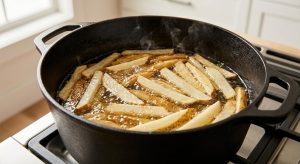
Have you ever tried to lift a heavy piece of battered fish out of hot oil, only to have a pool of greasy fat come along for the ride? The slots on a fish turner are not there for aesthetic purposes; they are vital to its hydrodynamic efficiency.
When you slide a solid spatula under food in a pan, you create a vacuum effect, trapping hot oil and cooking juices. The wide, elongated slots on a fish turner allow those liquids to drain instantly. This serves two crucial purposes. First, it reduces fluid drag, allowing the spatula to move swiftly through hot oil without splashing. Second, it ensures that when you lift your food, you are leaving the excess grease in the pan, preventing your crispy crusts from becoming instantly soggy.
The Asymmetrical Curve
Take a close look at a proper fish turner, and you will notice it is not flat. It features a distinct, asymmetrical curve at the head. This curve is an ergonomic stroke of genius.
When you are cooking in a skillet with high, sloping sides, a flat spatula forces you to hold your wrist at an awkward, steep angle to get under the food. The curved head of the fish turner naturally conforms to the geometry of the pan. It allows you to approach the food from a lower, more comfortable angle, giving you maximum leverage with minimal wrist strain. Whether you are navigating a crowded cast-iron skillet or reaching into a deep roasting pan, that curve acts as a cradle, securely holding the food as you lift and flip.
The Perfect Balance of Flex and Tension
The defining characteristic of a professional-grade fish turner is its metallurgy. These tools are forged from high-carbon spring steel. This material possesses a unique physical property: it is highly flexible but retains a powerful “memory,” meaning it instantly snaps back to its original shape.
This flexibility is the secret weapon against tearing. When you press a rigid spatula under a piece of food, the force is transferred directly into the protein, causing it to break. When you press a fish turner under a fillet, the steel blade flexes, absorbing the downward force. It acts as a shock absorber, gently contouring to the bottom of the pan and sliding under the food without applying destructive pressure. Yet, despite this flex, the spring steel has enough tensile strength to lift a half-pound steak without bending backward. It is the perfect marriage of delicacy and brute strength.
The Science of the Flip: Mechanics and Thermodynamics
To truly understand why the fish turner reigns supreme, we must look at what happens in the pan on a molecular level. Cooking is just applied thermodynamics, and flipping food is an exercise in managing surface tension and heat transfer.
Surface Tension and the Leidenfrost Effect
When you place a cold piece of protein into a hot stainless steel pan, the moisture on the surface of the food rapidly evaporates, causing the proteins to denature and bond with the metal. This is why you end up with food sticking to stainless steel.
As the food cooks, the Maillard reaction occurs, creating a dehydrated, browned crust. Proper heat management triggers the Leidenfrost effect—where a microscopic layer of steam prevents the food from permanently welding to the metal—eventually allowing the food to release naturally. However, this release is rarely 100% perfect. There are always microscopic points of adhesion.
A thick plastic spatula cannot break these microscopic bonds without tearing the surrounding crust. The razor-thin steel edge of the fish turner, however, acts as a wedge. It slides under the protein and cleanly severs those microscopic bonds at the exact point of contact, separating the crust from the pan while leaving the structural integrity of the food completely uncompromised.
Minimizing Protein Tearing Through Angle of Attack
In physics, the angle of attack determines how much lift is generated versus how much drag (or resistance) is encountered. When you use a thick spatula, the steep angle pushes the food horizontally across the pan before it lifts it vertically. This horizontal pushing is what tears the delicate flakes of white fish.
The fish turner’s ultra-thin, flexible blade creates a nearly flat angle of attack. It lifts the food vertically almost immediately, eliminating horizontal drag. This means the force is distributed evenly across the bottom of the fillet, rather than concentrated on the fragile leading edge.
Beyond the Catch of the Day: The Fish Turner’s Versatility
Do not let the name fool you. Calling this tool a “fish turner” is like calling a smartphone a “calculator.” Yes, it performs that function flawlessly, but its utility extends far beyond the seafood counter. If you value efficiency and hate a cluttered kitchen, this is the ultimate multi-tasking weapon.
Saving Your Over-Easy Eggs from Disaster
There is nothing more tragic than a punctured egg yolk bleeding out into your frying pan. Eggs are incredibly delicate, and flipping them requires a gentle touch. The flexible spring steel of the fish turner easily navigates the curved edges of your skillet, sliding seamlessly under the egg white. The wide slots prevent a vacuum from forming, allowing you to lift and turn the egg with a delicate flick of the wrist. Say goodbye to tearing your fried eggs and hello to picture-perfect weekend breakfasts.
Flawless Pancakes and Smashed Burgers
When you are flipping your weekend pancakes, you need a tool wide enough to support the batter so it doesn’t fold in half and splatter wet dough everywhere. The elongated head of the fish turner provides a massive surface area, cradling the entire pancake for a confident, splash-free flip.
Conversely, when it is burger night, the fish turner transitions into a heavy-duty workhorse. While it has flex, a high-quality fish turner has enough rigidity near the handle to press down on ground beef, ensuring maximum contact with the pan for that coveted, crispy crust. Plus, the sharp edge easily scrapes under the patty, ensuring you don’t leave that delicious crust stuck to your cast iron, which is the number one reason your burgers shrink into thick pucks.
The Ultimate Pan-Sauce Deglazer
After searing a steak or roasting a chicken, your pan is left with the fond—the caramelized, browned bits of protein and fat stuck to the bottom. This fond is liquid gold, the flavor base for incredible pan sauces.
Plastic spatulas will melt if you try to forcefully scrape a screaming hot pan. Wooden spoons are great, but they lack a sharp edge. The fish turner is the ultimate deglazing tool. As you pour in your wine or broth, the flat, sharp stainless steel edge effortlessly scrapes every single microscopic particle of flavor off the bottom of the pan, incorporating it into your sauce.
It is also unparalleled for sheet pan dinners. If you are tired of mushy roasted vegetables sticking to your baking sheets, the fish turner easily slides under potatoes, broccoli, and carrots, lifting them cleanly without leaving the caramelized, crispy edges behind.
Proper Technique: The “Sassy Sous-Chef” Method for Flawless Flipping
Owning the right tool is only half the battle; you must also know how to wield it. Flipping delicate food is an exercise in confidence. If you hesitate, you fail. Here is how to execute the perfect flip every single time.
The Confidence Slide
The biggest mistake home cooks make is approaching the food timidly. If you slowly poke and prod at a piece of fish, it will fall apart. You must commit.
Hold the fish turner by the handle, keeping your wrist loose. Angle the curved edge so it sits flush against the bottom of the pan. In one swift, confident motion, slide the turner directly under the center of gravity of the food. Do not stop halfway. The momentum and the razor-thin edge will cleanly sever any sticking points.
The Wrist-Flick Release
Once the food is securely on the spatula, lift it straight up, just a few inches above the pan. Do not lift it too high, or you risk splashing hot oil. Now, instead of awkwardly rotating your entire arm, use a swift flick of your wrist to turn the spatula 180 degrees, gently laying the food back down on its uncooked side.
The key word here is gently. You are not slapping the food down; you are placing it. Let the tip of the spatula touch the pan first, and slide it out from under the food as you lower it.
How to Choose a Buy-It-For-Life Fish Turner
Not all fish turners are created equal. If you buy a cheap, flimsy knock-off, you will end up with a bent piece of tin that cannot lift a chicken nugget. Here is exactly what you need to look for when upgrading your arsenal.
Material Matters: High-Carbon Stainless Steel vs. Mystery Metals
The blade must be constructed from high-carbon stainless steel. Standard stainless steel is too rigid and will not provide the necessary flex. High-carbon spring steel offers the perfect balance of flexibility and memory. Run your thumb across the front edge (carefully). It should feel noticeably tapered and beveled, almost like a dull knife. If the edge is blunt and thick, put it back on the shelf.
Handle Construction: Wood, POM, and Balance
The handle is where you will feel the difference between a professional tool and a cheap gadget. Traditionalists love a riveted wooden handle (like walnut or rosewood) because it provides a warm, comfortable grip and excellent balance. However, wooden handles require hand-washing and occasional oiling.
If you prefer low maintenance, look for a handle made of POM (polyoxymethylene) or high-density fiberglass-reinforced polymer. These synthetic handles are incredibly durable, heat-resistant, and impervious to moisture. Avoid cheap, hollow plastic handles, as they throw off the balance of the tool, making it feel top-heavy and clumsy in your hand.
Left-Handed? Yes, They Make Them for You
Remember that asymmetrical curve we discussed earlier? That curve is specifically angled for right-handed users, allowing them to approach the food naturally from the right side of the pan.
If you are a southpaw, using a standard fish turner will feel incredibly awkward, as the curve will be fighting against your natural wrist angle. Fortunately, high-end culinary manufacturers produce left-handed fish turners, where the bevel and the curve are mirrored. Do not settle for a right-handed tool if you are left-handed; the ergonomics matter.
Caring for Your Culinary Weapon
A high-quality slotted fish turner is a buy-it-for-life piece of equipment, provided you treat it with a modicum of respect.
Ditch the Dishwasher
If you purchase a fish turner with a wooden handle, the dishwasher is a death sentence. The extreme heat, harsh detergents, and prolonged moisture will strip the natural oils from the wood, causing it to crack, splinter, and eventually separate from the metal tang.
Even if you opt for a synthetic handle, I highly recommend hand-washing your fish turner. The razor-thin beveled edge that makes this tool so magical is susceptible to dulling and micro-pitting if it violently bangs against ceramic plates and heavy pots during a turbulent dishwasher cycle. Take thirty seconds, wash it with hot, soapy water, and dry it immediately.
Keeping the Edge Honed
Over years of heavy use—scraping cast iron skillets and deglazing stainless steel pans—the beveled edge of your fish turner may develop tiny burrs or lose its microscopic sharpness.
You do not need to take it to a professional knife sharpener, but you can easily maintain the edge at home. Just as you would use a stainless steel bench scraper to safely gather ingredients without dulling your actual chef’s knife, you should treat the edge of your fish turner with care. If it starts to feel dull, you can lightly run the beveled edge over a fine-grit honing steel or a ceramic sharpening rod just a few times to realign the metal and restore its smooth, gliding action.
Also, a crucial warning: Never use a stainless steel fish turner on a Teflon or ceramic non-stick pan. The sharp metal will instantly scratch the delicate chemical coating, ruining your nonstick pans forever and leaching toxic flakes into your food. Save the fish turner for your carbon steel, cast iron, and stainless steel cookware.
Stop Mangling Your Dinner
Cooking should be a joyful, rewarding experience, not a frustrating battle against your own equipment. As home cooks, we spend entirely too much time, money, and emotional energy sourcing good ingredients and following recipes, only to stumble at the finish line because we are using the culinary equivalent of a plastic toy to do a professional’s job.
Ditching your chunky plastic spatula for a slotted stainless steel fish turner is the single easiest, most cost-effective upgrade you can make in your kitchen. It requires no culinary degree, no mastering of complex French techniques, and no massive financial investment. It is simply a matter of letting superior engineering do the hard work for you.
So, the next time you are staring down a beautiful, flaky piece of white fish, or attempting to flip a delicate over-easy egg, you can proceed with the absolute confidence of a seasoned chef. Slide that razor-thin edge under your food, execute the perfect flick of the wrist, and watch as your dinner lands flawlessly intact. You have got this, and more importantly, your spatula finally has your back.