The Great Sticky Rice Epidemic (And Why It’s Not Your Fault)
Let us have a brutally honest conversation about the state of your weeknight side dishes. You come home after a long day, you measure out a cup of white rice, you toss it into a pot with some water, and twenty minutes later, you are staring at a dense, gluey mound of sadness that looks more like industrial wallpaper paste than a culinary masterpiece. You poke it with a fork, and the entire mass moves as one single, highly depressing unit.
If this sounds familiar, take a deep breath. I am here to tell you that you do not lack some mythical culinary gene, nor do you need a degree from Le Cordon Bleu to boil water and grains. You are simply falling victim to the exact same trap that ensnares millions of home cooks every single evening: a fundamental misunderstanding of starch chemistry and a kitchen drawer full of the wrong equipment. As your resident sassy sous-chef, I have zero patience for the pretentious chef-speak that makes cooking feel like a secret club. I firmly believe that anyone can produce restaurant-quality, perfectly distinct, fluffy grains of rice in a standard home kitchen. But to do that, we have to talk about the real enemy here.
The enemy is not your stove. The enemy is not the brand of rice you bought. The enemy is the powdery, invisible layer of starch coating every single grain in your pantry, and the fact that your current method of removing it is completely ineffective. If you want to master simple weeknight dinners, you need to understand the science of what is happening in your pot, and you need to permanently evict the useless tools that are sabotaging your meals.
The Frustration of the Mushy Mound
We have all been there. You are trying to assemble a beautiful, fresh meal, and you just want a bed of light, airy rice to soak up your pan sauce. Instead, your rice turns out mushy, clumps together, and ruins the entire textural experience of the dish. It is incredibly frustrating, especially when time is money and you are just trying to get a decent dinner on the table before you collapse on the couch.
The primary reason this happens is that most home cooks either skip washing their rice entirely, or they attempt to wash it using a standard colander or a flimsy wire mesh strainer. Both of these tools are fundamentally flawed for this specific task. To understand why we need a dedicated micro-perforated strainer to fix this epidemic, we first have to put on our lab coats and dive deep into the microscopic world of rice starch.
The Science of Starch: Amylose vs. Amylopectin
Rice is not just a uniform little white pebble; it is a complex biological structure packed with carbohydrates. Specifically, the texture of cooked rice is almost entirely dictated by two distinct types of starch molecules: amylose and amylopectin. The ratio of these two starches determines whether your rice will cook up into distinct, fluffy grains or a sticky, cohesive mass.
Amylose: The Long, Lean Fluff-Maker
Amylose is a long, straight, unbranched polymer made of glucose molecules. Because of its linear structure, amylose molecules pack tightly together and do not easily dissolve or absorb water. When you are eating a bowl of rice where every single grain is separated, firm, and distinct, you are eating rice with a high amylose content.
Long-grain varieties like Basmati and Jasmine typically contain high levels of amylose (often around 22% or higher) and relatively low levels of amylopectin. These grains undergo high volume expansion when cooked, remain dry and flaky, and even become quite firm upon cooling. If your goal is to build a beautiful, grain-separated base for a curry, you want high amylose.
Amylopectin: The Branchy, Sticky Culprit
On the other end of the spectrum, we have amylopectin. Unlike the straight and narrow amylose, amylopectin is a highly branched, bushy starch molecule. This branched structure gives it a unique superpower (or super-villainy, depending on your dinner plans): it is highly water-soluble and gelatinizes rapidly when exposed to heat and moisture.
When rice has a high amount of amylopectin, it becomes incredibly sticky once cooked. Short-grain rice typically contains the lowest levels of amylose and the highest levels of amylopectin. In fact, true glutinous rice (often called “sticky rice,” which is a staple in Thai and Laotian cuisine) can have amylose levels as low as 3.3%, meaning it is almost entirely composed of sticky amylopectin. This makes it perfect for eating with your hands or molding into shapes, but it is an absolute disaster if you are trying to make a light, fluffy pilaf.
Medium-grain rices, like Arborio, fall somewhere in the middle. They usually contain about 15-17% amylose and a healthy dose of amylopectin, which is exactly why they release enough starch to create a rich, creamy consistency perfect for risotto.
What Happens When Heat Meets Surface Starch
Here is where the science directly impacts your weeknight cooking disasters. When rice is harvested and processed, it goes through a milling phase to remove the husk, bran, and germ (to create white rice). This mechanical milling process damages the exterior of the rice kernels, leaving a fine layer of starch dust clinging to the surface of every single grain.
This surface dust is heavily concentrated with amylopectin. If you take unwashed rice and dump it directly into a pot of boiling water, that surface layer of branched amylopectin instantly hydrates and gelatinizes. Before the actual grain of rice has even begun to cook through to the center, the outside of the grain has turned into a sticky, glue-like gel. This gel acts as an adhesive, binding all the rice grains together in the pot.
This is why rinsing your grains is not just an optional, fussy step reserved for restaurant chefs. It is a mandatory mechanical process required to physically strip that gelatinous adhesive off the exterior of the rice before heat is ever applied.
The Great Rinsing Debate: Why Your Colander is Betraying You
So, you accept the science. You know you need to wash your rice. You walk over to your cabinets, pull out a piece of equipment, and immediately set yourself up for failure. The tool you use to wash your rice is just as important as the act of washing it.
The Standard Mesh Strainer: A Clogged Nightmare
Many well-meaning home cooks reach for a standard wire mesh strainer. On paper, this makes sense. The holes are small enough that the rice will not fall through. However, wire mesh strainers are designed for entirely different culinary tasks. They are meant for sifting dry flour, dusting powdered sugar, or straining out tiny aromatics from a smooth broth.
When you use a wire mesh strainer to wash rice, you encounter several maddening problems. First, the woven wire creates a highly textured surface. As you agitate the wet rice, the sharp, raw edges of the grains get wedged into the microscopic gaps between the woven wires. You end up having to aggressively scrape the wet rice out of the strainer, which breaks the grains and releases even more starch.
Secondly, the fine mesh traps the starchy water. Instead of draining rapidly, the starchy slurry pools in the bottom of the strainer, meaning your rice is just taking a bath in its own glue. Finally, cleaning a wire mesh strainer after it has been coated in gelatinized rice starch is an absolute nightmare. You will spend ten minutes scrubbing it with a sponge, completely defeating our “time is money” philosophy.
The Sink Drain Tragedy
The other common mistake is using a standard pasta colander. Colanders are fantastic for draining large, bulky items like rigatoni or boiled potatoes. They are built for volume and speed. They are emphatically not built for small grains.
If you attempt to wash rice in a standard colander, you will immediately witness the tragedy of your expensive Jasmine rice slipping right through the large perforations and swirling down the sink drain. You lose a quarter of your food, you clog your plumbing, and you are left holding a bowl of unevenly washed grains. This is exactly the kind of rookie mistake that makes people hate cooking. If you want to stop making gummy rice and stop losing your food to the garbage disposal, you need a highly specific piece of engineering.
Enter the Micro-Perforated Strainer: Your New Best Friend
This brings us to the hero of our masterclass: the micro-perforated strainer. If you take away only one piece of advice from this entire essential kitchen survival guide, let it be this. Upgrading to a dedicated micro-perforated strainer will permanently eliminate your rice-cooking anxiety.
What Exactly is a Micro-Perforated Strainer?
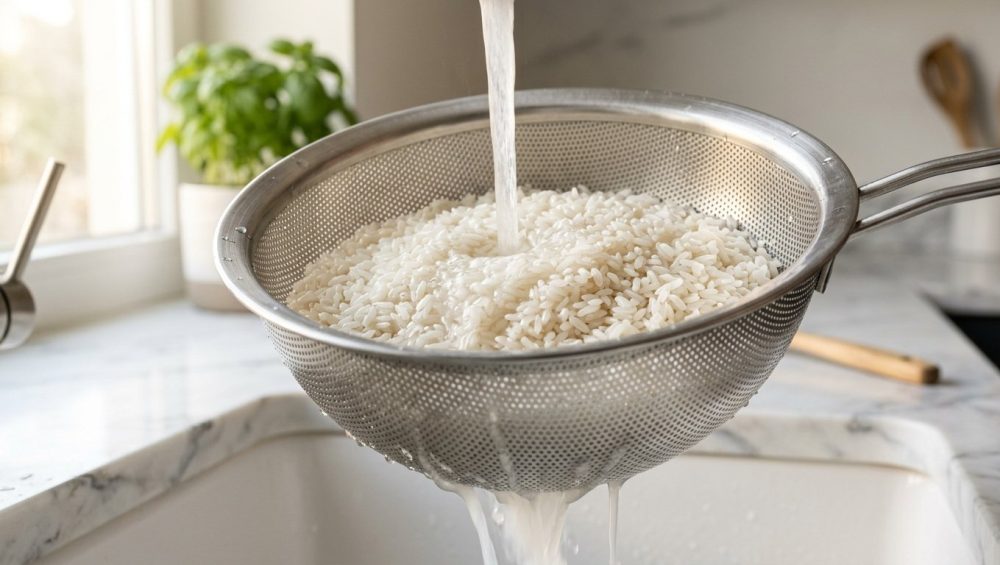
Unlike a wire mesh strainer, which is made by weaving thin strands of metal wire together, a micro-perforated strainer is constructed from a single, solid sheet of stainless steel. Using advanced manufacturing techniques, thousands of tiny, uniform, microscopic holes are precision-punched or laser-cut directly into the solid metal plate. The metal is then pressed and formed into a bowl shape.
Because it is made from a solid sheet of metal rather than woven wire, the interior surface of a micro-perforated strainer is incredibly smooth. There are no overlapping wires for the rice grains to get trapped under.
The Physics of Perfect Drainage
The engineering behind the micro-perforated strainer is what makes it the undisputed champion of the kitchen sink. The holes are specifically calibrated to be small enough to contain tiny grains—like rice, quinoa, and amaranth—but large enough to allow for rapid, unimpeded water flow.
When you wash rice in one of these strainers, the starchy water drains instantly. The starch is carried away by the kinetic energy of the running water, rather than pooling at the bottom. Furthermore, because the interior is smooth, you can vigorously agitate the rice with your hands without tearing the grains or getting them stuck in the metal. When you are done, the rice slides out effortlessly into your cooking pot, and the strainer rinses clean in about three seconds. It is a flawless execution of kitchen physics.
The “No-Go” Rule: Avoiding Toxic and Cheap Strainers
Now, before you run to the nearest discount home goods store and buy the first strainer you see, we need to have a serious talk about material safety. As your sassy sous-chef, I have a strict, non-negotiable “No-Go” rule when it comes to cheap, toxic kitchenware. I am on a personal crusade regarding banishing toxic kitchen gear from your home, and strainers are a massive blind spot for most people.
The Dangers of Mystery Metals and Flimsy Plastics
Do not, under any circumstances, wash your food in cheap plastic colanders. Recent studies have shown that plastic kitchen tools, especially older ones that have been subjected to heat and abrasion, can release microplastics and nanoplastics directly into your food during preparation. When you are vigorously rubbing rice against the side of a plastic colander, you are essentially sanding down the plastic and adding microscopic synthetic polymers to your dinner.
Similarly, you must avoid “mystery metal” strainers. Cheap, unbranded metal strainers bought for a few dollars online are often made from low-grade alloys that are highly susceptible to corrosion and chemical leaching.
Why High-Quality Stainless Steel is Non-Negotiable
You must insist on high-quality, professional-grade stainless steel—specifically 18/10 or 304 food-grade stainless steel. Stainless steel is an alloy made primarily of iron, carbon, chromium, and nickel. The chromium is what makes it “stainless” by forming a passive layer of chromium oxide on the surface that prevents rust. The nickel adds durability and a polished finish.
However, not all stainless steel is created equal. Toxicological studies have demonstrated that low-grade stainless steel can leach significant amounts of nickel and chromium into food, particularly when exposed to long cooking times or highly acidic ingredients (like tomato sauces). While you are generally only using a strainer for a few minutes of rinsing, cheap stainless steel will quickly degrade, rust, and potentially contaminate your food.
A micro-perforated strainer made from heavy-duty 304 stainless steel is structurally robust. It will not warp when you press down on it, it will not rust, and it is completely non-reactive. It is a one-time purchase that will last you a lifetime. Do not compromise on this.
The Sassy Sous-Chef’s Masterclass: How to Wash Rice Like a Pro
You have the science. You have the proper, non-toxic micro-perforated strainer. Now, let us execute the perfect wash. This is how you guarantee that your fried rice is always mushy-free and perfectly separated.
Step-by-Step: The Agitation Method
Simply running water over your rice while it sits in the strainer is not enough. The surface starch is stubbornly clinging to the grains, and it requires mechanical friction to detach.
- Measure and Submerge: Place your measured rice into your micro-perforated strainer. Submerge the strainer into a slightly larger bowl filled with cold water.
- The Swish and Rub: Use your fingers to vigorously swish the rice around in the water. Gently rub the grains together between your palms. You are essentially giving the rice a deep-tissue massage. You will immediately see the water turn a milky, opaque white. That is the enemy (amylopectin) dissolving into the water.
- Lift and Drain: Lift the micro-perforated strainer out of the bowl. Because of the precision-punched holes, the starchy water will drain instantly, leaving your grains safely contained. Dump the cloudy water from the bowl down the drain.
The Clear Water Benchmark
You must repeat this process. One wash is never enough. For standard long-grain white rice, you will typically need to repeat the agitation and draining process three to five times.
Your benchmark for success is not a specific number of washes; it is the clarity of the water. You want to continue rinsing until the water runs mostly clear. It does not have to be crystal-clear like a mountain spring—a slight haze is acceptable—but it should no longer look like a glass of milk. Once you hit that clear water benchmark, you have successfully mechanically removed the excess surface starch, and you are ready to cook.
Just remember, washing rice removes surface starch to improve texture, but it does not remove the starch inside the grain. Therefore, washing does not significantly reduce the carbohydrate or calorie content of the rice, no matter what a fad diet blog might tell you. It is purely a textural technique.
Beyond the Rinse: Cooking Techniques for Distinct, Fluffy Grains
Washing your rice perfectly is 80% of the battle. But if you want to cross the finish line and achieve absolute perfection, we need to address the actual cooking process. You can have the cleanest rice in the world, but if you drown it in liquid, you will still end up with soup.
The Water-to-Rice Ratio Reality Check
Throw away the old wives’ tale of measuring water by resting your index finger on the rice and filling to the first knuckle. That is not science; that is a guessing game based on the arbitrary length of your digits.
The standard culinary advice for long-grain white rice is often a 1:2 ratio (one cup of rice to two cups of water). However, recent sensory science studies have revealed that this ratio actually produces a wetter, stickier rice than most people prefer. A study by the Centre for Advanced Sensory Science found that for consumers who prefer a truly fluffy, distinct texture, a ratio closer to 1:1.2 or 1:1.5 is far superior.
When you wash rice, the grains absorb a small amount of water during the rinsing process itself. If you then add a full two cups of water to the pot, you are actually over-hydrating the grains. For perfectly fluffy Basmati or Jasmine rice, try using a 1:1.5 ratio (one cup of dry rice to one and a half cups of water).
Bring the water and rice to a boil in a heavy-bottomed pot (or a high-quality curved saucier pan to ensure even heat distribution). The moment it reaches a steady boil, immediately reduce the heat to the absolute lowest setting, cover it with a tight-fitting lid, and set a timer for 15 to 20 minutes.
Resting and Fluffing (Patience, My Friend)
Here is the final, agonizing step where many impatient home cooks fail. When the timer goes off, turn off the heat. Do not touch the lid.
I repeat: Do not lift the lid to peek. Do not stir it. Do not immediately serve it.
You must let the rice rest, off the heat, with the lid securely on, for a minimum of 10 minutes. This resting period is a critical phase of the cooking science. While the heat is off, the starches inside the grain are still settling, and the excess steam trapped in the pot is gently redistributing itself evenly throughout the rice.
If you rip the lid off immediately, the sudden drop in temperature and pressure will cause the starches to seize up, and the rice at the bottom of the pot will be waterlogged while the top is dry. Allowing it to rest ensures that every single grain finishes cooking gently and evenly.
After the 10-minute rest, remove the lid and use a fork or a rice paddle to gently fluff the grains. You will be rewarded with a pot of rice where every grain is distinct, aromatic, and perfectly tender. It is the ultimate secret to a mindful bibimbap, a flawless stir-fry base, or a beautiful side dish.
Reclaiming Your Time and Your Sanity
Cooking should not be a stressful chore that ends with you scraping burnt, gluey starch off the bottom of a cheap pot. By understanding the simple science of amylose and amylopectin, and by investing in a high-quality, non-toxic micro-perforated strainer, you are taking control of your kitchen.
Weeknight Efficiency
Remember our core philosophy: time is money. A micro-perforated strainer is not just about achieving better texture; it is about ruthless efficiency. When you use the right tool, you can wash your rice in exactly two minutes. You lose zero grains down the drain. You spend zero minutes trying to scrub sticky starch out of woven wire mesh.
You simply rinse the smooth stainless steel bowl under the tap, and you are done. It is a small, inexpensive upgrade that pays massive dividends in your daily routine, helping you to finally eliminate kitchen chaos for good.
The Verdict: Stop Making Gummy Rice
You now possess the definitive knowledge required to banish mushy, clumpy rice from your life forever. You know that surface amylopectin is the enemy of fluffiness. You know that standard mesh strainers and wide-holed colanders are culinary saboteurs. You know that toxic plastics and cheap mystery metals have no place in a healthy home.
Most importantly, you know that the magic of a micro-perforated strainer—combined with the magic of a rice washing technique that relies on agitation and clear water—will yield professional-level results every single time.
So, pour yourself a glass of wine, throw away that warped plastic colander you’ve had since college, and embrace the simple, beautiful science of the perfect grain. You’ve got this.