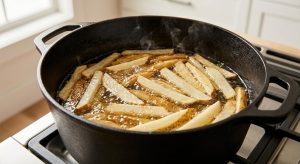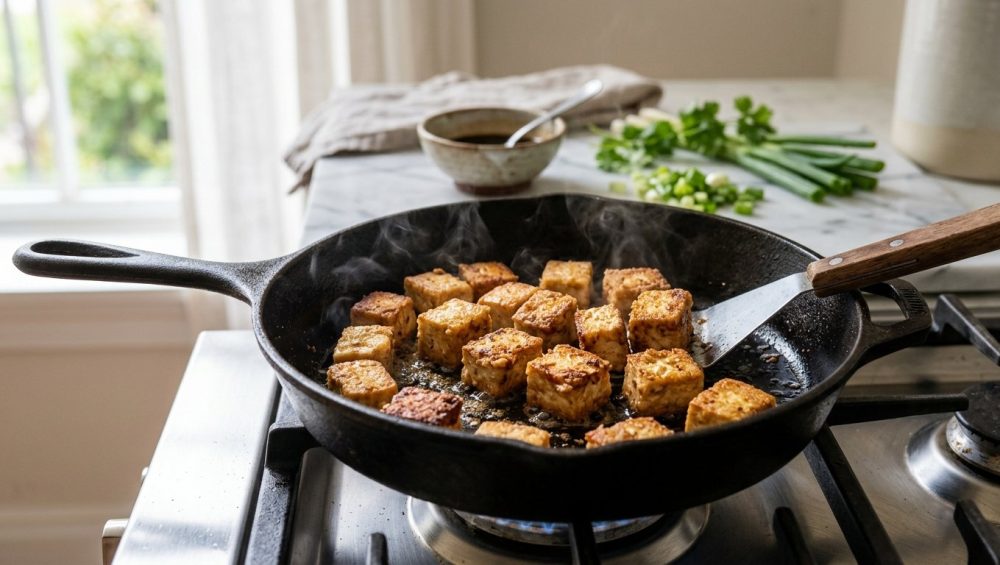
Listen, if your tofu looks like a sad, pale sponge that just crawled out of a swamp, we need to have a serious conversation. You are not a bad cook. You do not lack culinary talent. You are simply fighting a losing battle against the laws of basic physics. I see it all the time: well-meaning home cooks buy a block of extra-firm tofu, chop it into cubes, and toss it directly into a hot skillet, fully expecting it to miraculously transform into the golden, shatteringly crisp masterpieces they get at their favorite local takeout spot.
Instead, the oil spits violently across the stovetop, the kitchen fills with the smell of hot bean water, and the tofu emerges from the pan looking like a bleak, rubbery eraser. It is bland, it is soggy, and it is entirely your fault for skipping the most crucial step in plant-based cooking.
When you are exhausted and just want to throw together simple weeknight dinners, dealing with a sputtering pan of wet soy is the last thing you need. You do not need a Michelin star to fix this. You do not need years of culinary school. You just need to understand the simple science of surface moisture, the thermodynamics of a hot skillet, and the absolute mechanical brilliance of a spring-loaded tofu press.
The Mushy Tofu Epidemic: Why We Are All Suffering
The Kitchen Crime of Steamed “Fried” Tofu
Let us establish a fundamental culinary truth: you cannot fry water. It is scientifically impossible. Yet, every single night, thousands of weekend culinary hobbyists attempt to do exactly that. They take a highly porous block of plant protein that is quite literally saturated with liquid, drop it into cooking oil, and wonder why it refuses to sear.
Cooking waterlogged tofu is one of those rookie kitchen mistakes that discourages beginners and makes people believe that plant-based proteins are inherently inferior to meat. When you place wet tofu into a hot pan, it does not fry. It steams. The internal moisture rapidly heats up, breaches the surface of the bean curd, and pools in your skillet. You end up boiling your dinner in its own juices. The resulting texture is mushy on the outside and dense on the inside, completely incapable of absorbing sauces, spices, or marinades.
Stop Blaming the Bean Curd
Before you throw your spatula across the room and order a pizza, you need to stop blaming the ingredient and start looking at the manufacturing process. Tofu is made by coagulating soy milk and pressing the resulting curds into solid white blocks. It is a hydrated gel network of soy proteins.
Even if you buy the package clearly labeled “Extra-Firm,” you are still purchasing a product that is approximately 50% to 60% water by weight. Medium and firm varieties can contain upwards of 70% to 75% water. You are essentially bringing home a water balloon disguised as food. The manufacturers leave this water inside the packaging to keep the tofu fresh, preserve its structural integrity during shipping, and prevent it from drying out on the supermarket shelf. But the moment you take that block out of its plastic tub, that protective water becomes your absolute worst enemy. If you do not actively extract that moisture before applying heat, you are guaranteeing a culinary disaster.
The Science of the Sear: Why Surface Moisture is Your Enemy
The Maillard Reaction Explained (Without the Pretentious Chef-Speak)
To understand why wet tofu is a tragedy, you must understand the holy grail of cooking: the Maillard reaction. Named after French chemist Louis Camille Maillard who first described it in 1912, this is the complex series of non-enzymatic chemical reactions between amino acids and reducing sugars that occurs when food is exposed to high heat.
The Maillard reaction is the magic that gives a perfectly seared steak its dark crust, a loaf of artisan bread its golden exterior, and roasted coffee beans their deep, complex aroma. It creates hundreds of brand-new flavor compounds that literally did not exist in the raw ingredient. But here is the critical catch that most home cooks completely ignore: the Maillard reaction only kicks into high gear at temperatures between 280°F and 330°F (140°C to 165°C).
The Thermodynamics of a Wet Sponge in a Hot Pan
Now, let us look at the thermodynamics of water. At sea level, water boils at exactly 212°F (100°C). This is a hard, unbreakable law of physics. It does not matter if you turn your gas burner up to a roaring inferno; if there is liquid water present on the surface of your food, the temperature of that surface cannot and will not exceed 212°F until every single microscopic drop of that water has evaporated.
The latent heat of vaporization dictates that it takes a massive amount of thermal energy to turn liquid water into steam. When you drop a wet block of tofu into a preheated skillet, the pan’s heat energy is entirely hijacked. Instead of initiating the Maillard reaction and browning the soy proteins, the heat is wasted on boiling the surface water. The temperature of your pan plummets. The browning process completely stalls. This is exactly why your food sticks to your stainless steel skillet when you try to flip it too early—the proteins chemically bond to the metal because the protective, non-stick crust of the Maillard reaction has not been allowed to form.
Why Paper Towels and Cookbooks Are a Terrible Solution
For decades, well-meaning but misguided cookbook authors have peddled the same archaic advice: wrap your block of tofu in half a roll of paper towels, put it on a plate, and balance a heavy cast-iron skillet or a stack of encyclopedias on top of it. I absolutely despise this method.
First, it is incredibly wasteful. You are burning through expensive paper towels just to soak up bean water. Second, it is a massive kitchen hazard. Balancing heavy, unanchored weights on top of a slippery, wet block of soy protein is a recipe for a bruised foot or a shattered floor tile. Leave your heavy bamboo cutting boards for chopping vegetables, not for crushing your dinner.
Most importantly, static weight is mechanically flawed. When you stack books on tofu, the weight applies a fixed amount of pressure. As the water drains out and the tofu compresses, the books drop, but the pressure does not adapt. The force is often uneven, causing the tofu to tilt, bulge, and eventually suffer a structural blowout where the sides crack and crumble. You are left with a fractured mess that will fall apart the second it hits your spatula.
Enter the Spring-Loaded Tofu Press: A Physics Masterclass
How Constant, Even Pressure Changes Everything
If you want to cook like an expert without spending hours prepping, you need to work smarter, not harder. This is where we introduce the hero of our story: the spring-loaded tofu press. This inexpensive, brilliant piece of mechanical engineering completely eliminates the guesswork, the mess, and the danger of the cookbook-stacking method.
Once you understand the genius of a tofu press, you will never go back to the dark ages of balancing soup cans on plates. A spring-loaded press operates on a very simple principle of physics known as Hooke’s Law. Inside the press, heavy-duty tension springs push down on a flat pressing plate. When you lock the lid into place, the springs compress, applying a strong, continuous downward force onto the tofu block.
Here is why this is revolutionary: as the water is slowly expelled from the tofu, the block physically shrinks in height. If you were using a static weight, the pressure would decrease as the block compressed. But with a spring-loaded press, as the tofu shrinks, the compressed springs naturally expand, actively following the tofu downward. This maintains a constant, unyielding, and perfectly even pressure throughout the entire 15 to 30-minute pressing cycle. You do not have to babysit it. You do not have to tighten any screws halfway through. You just set it and walk away.
The Problem with Plate-and-Weight Stacking
Let us dive deeper into the mechanics of why static weights destroy your food. Tofu has a specific yield stress—the maximum amount of force it can withstand before its internal structure permanently deforms or breaks. When you slam a heavy cast-iron pan on top of a block of tofu, you are applying immediate, blunt-force trauma to a delicate protein matrix. The water inside the block cannot escape fast enough to accommodate the sudden compression, so the pressure builds internally until the sides of the tofu violently rupture.
A spring-loaded press, however, applies its pressure gradually and evenly across a perfectly flat surface area. It gently coaxes the water out of the microscopic cellular pockets without exceeding the yield stress of the soy curds.
Protecting the Structural Integrity of the Block
The internal structure of tofu is a tightly woven web of coagulated proteins. By using a gentle, spring-loaded mechanism, you are essentially wringing out a sponge without tearing its fibers. The block retains its perfect, uniform rectangular shape. It emerges from the press looking exactly like it did when it went in, just slightly denser, significantly firmer, and dramatically drier. This structural integrity is exactly what allows you to chop the tofu into perfect, uniform cubes that will sear evenly in your skillet without disintegrating into a crumbly scramble.
The Sponge Effect: Why Pressed Tofu Actually Tastes Good
The Vacuum Principle of Flavor Absorption
We need to address the elephant in the room: tofu, on its own, tastes like absolutely nothing. It is a blank culinary canvas. It relies entirely on the chef to impart flavor. But you cannot paint on a canvas that is already soaking wet.
When you use a spring-loaded press to force the water out of the tofu, you are not just preparing it for the Maillard reaction; you are physically altering its internal architecture. By evacuating the water, you are emptying out millions of microscopic pockets within the protein matrix. You are creating a vacuum.
When you take that freshly pressed, highly porous block of tofu and submerge it in a marinade, capillary action takes over. The empty voids inside the tofu act like a sponge, aggressively sucking up the soy sauce, the toasted sesame oil, the minced garlic, and the grated ginger, pulling the flavors deep into the center of the block.
Marinades Need Room to Breathe
If you refuse to press your tofu, your marinade has nowhere to go. The internal pockets are already at maximum capacity, filled to the brim with flavorless packing water. Your carefully crafted, expensive marinade will simply sit on the slick outer surface of the wet tofu. The moment you place it in the pan, that surface marinade will wash off, pool in the oil, and burn into a bitter, blackened mess before the tofu ever has a chance to cook.
Furthermore, water and oil do not mix. If you are using a vinaigrette or an oil-based marinade on unpressed tofu, the waterlogged surface will literally repel the fat. Pressing is not an optional step; it is the mandatory gateway to flavor.
How to Choose a Tofu Press (And What Toxic Garbage to Avoid)
The “No-Go” Rule on Flimsy Plastics and Mystery Metals
As your sassy culinary guide, I have zero patience for pretentious chef-speak, but I have even less patience for cheap, toxic kitchenware that actively poisons your food. I have a strict “no-go” rule on garbage equipment.
The market is currently flooded with incredibly cheap, flimsy plastic tofu presses imported by drop-shippers. Do not buy them. Low-grade plastics are highly porous and prone to micro-abrasions. This is why your cheap plastic containers stay greasy after storing leftover marinades—the oils and bacteria seep deep into the degraded plastic. When you put a block of tofu under heavy spring tension inside a cheap plastic chassis, that plastic will eventually snap under the pressure, sending shards of acrylic flying across your kitchen. Worse, cheap plastics often contain endocrine-disrupting chemicals like BPA and BPS that can leach into your food under pressure.
Just like I constantly warn you about ruining your nonstick pans with toxic aerosol sprays, I must warn you about cheap plastic presses. You are cooking to nourish your body; do not wrap your food in chemical-leaching garbage.
What Makes a High-Quality Spring-Loaded Press
When curating your kitchen, you want to invest in durable, safe, and highly functional tools. A high-quality spring-loaded tofu press should be constructed from robust, food-grade materials. Look for presses made from thick, BPA-free, high-density polyethylene (HDPE), durable bamboo, or solid stainless steel.
Pay close attention to the mechanical components. The tension springs MUST be made of high-grade, rust-proof stainless steel. If they are made of cheap mystery metals, they will oxidize after two trips through the dishwasher and begin depositing toxic iron oxide (rust) directly onto your food.
Finally, a truly genius press will feature a built-in catchment tray or a double-layered drainage system. This ensures that as the water is violently squeezed out of the tofu, it is collected in a reservoir at the bottom of the press, rather than flooding your clean countertops and dripping onto your kitchen floor.
Your Step-by-Step Guide to Restaurant-Quality Crispy Tofu
Step 1: The Drain and Press
Time is money, and we are going to prioritize efficiency. Remove your block of extra-firm tofu from its packaging and drain the excess liquid down the sink. Place the block directly into the center of your spring-loaded press. Lock the lid down, engaging the tension springs.
Now, walk away. Leave the press on your kitchen counter, or place it in the refrigerator if you are prepping ahead of time. Allow the press to do its job for a minimum of 15 to 30 minutes. Use this time productively to chop your broccoli, mince your aromatics, and whisk together your sauce. You are buying back your time.
Step 2: The Cornstarch Coating (Your Secret Weapon)
Once the pressing cycle is complete, unlock the press, discard the extracted water, and transfer your beautifully dense, dry block of tofu to a cutting board. Slice it into uniform, bite-sized cubes.
Here is the culinary secret weapon that separates the amateurs from the pros: the starch dredge. Toss your pressed tofu cubes in a bowl with a light dusting of cornstarch, arrowroot powder, or potato starch. Starch molecules (specifically amylose and amylopectin) are highly hygroscopic. They will actively seek out and absorb the absolute last microscopic droplets of surface moisture remaining on the tofu. When these starch-coated cubes hit the hot cooking oil, the starch immediately gelatinizes and dehydrates, forming an impenetrable, shatteringly crispy crust that mimics the texture of deep-fried food, all while using a fraction of the oil.
Step 3: The Pan-Seared Perfection
Place a heavy-bottomed skillet (preferably carbon steel or stainless steel) on the stove over medium-high heat. Let the dry pan heat up completely. Use the water drop test to ensure your pan is at the optimal temperature—flick a few drops of water into the skillet; if they instantly bead up and dance across the surface like mercury (the Leidenfrost effect), your pan is ready.
Add a generous splash of high-heat cooking oil, such as avocado oil or grapeseed oil. Carefully place your starch-coated tofu cubes into the pan in a single layer. Ensure they are not touching; overcrowding the pan traps steam and lowers the temperature, defeating the entire purpose of pressing them.
Now, practice the hardest culinary skill of all: patience. Do not poke them. Do not shake the pan. Do not aggressively scrape at them with your spatula. Leave them completely alone for 3 to 4 minutes. Let the Maillard reaction work its magic. Once a thick, golden-brown crust has formed on the bottom, the tofu will naturally release from the pan. Flip each cube and repeat until all sides are crispy.
Step 4: The Deglaze
Once your tofu is perfectly seared, remove it from the skillet and set it aside on a wire cooling rack (never on a paper towel, which will trap steam and ruin your hard-earned crust). If you look at your pan, you might see a layer of browned, caramelized proteins stuck to the bottom. This is called fond, and it is pure flavor.
Instead of scrubbing, you can turn those burnt bits into sauce by deglazing the pan. With the pan still over medium heat, pour in a splash of soy sauce, rice vinegar, or vegetable broth. The liquid will rapidly boil, lifting the caramelized bits off the metal. Whisk in your pre-mixed stir-fry sauce, let it reduce and thicken, and then toss your crispy tofu back into the pan for exactly ten seconds to coat it in the sticky glaze before serving.
Time-Saving Tofu Hacks for the Busy Weeknight Cook
The Freezer Trick for Next-Level Texture
If you are cooking for someone who claims they hate the texture of tofu, I am going to teach you a scientific trick that will completely blow their mind. If you want a meaty texture, you should always freeze it first before pressing.
When you place a sealed package of tofu into the freezer, the laws of thermodynamics take over. As the water inside the tofu drops below freezing, it crystallizes into ice. Water is one of the only substances on earth that physically expands (by about 9%) when it freezes. As these ice crystals expand, they violently puncture and stretch the delicate cell walls of the soy protein matrix.
When you eventually thaw the tofu (either in the fridge overnight or in a bath of warm water), those ice crystals melt back into liquid water. But the structural damage to the protein matrix is permanent. The tofu is now riddled with massive, gaping structural voids. When you load this thawed block into your spring-loaded press, the water literally pours out with zero resistance. What you are left with is a highly porous, incredibly spongy block of tofu that pulls apart in layers, closely mimicking the fibrous texture of chicken breast. It absorbs marinades instantly and crisps up with a ferocious crunch.
Batch Pressing and Prep
I firmly believe that an organized kitchen is a peaceful kitchen. You can absolutely press your tofu in advance to save time on busy weeknights. The moment you get home from the grocery store, open your tofu, drain it, and lock it into your spring-loaded press. Place the entire press into the refrigerator.
You can leave it under spring tension overnight. Because the press applies constant, even pressure, it will not destroy the block. By the time you are ready to cook the next evening, the tofu will be incredibly dense, bone-dry, and ready to absorb whatever flavor profile you throw at it. You have effectively eliminated the prep time from your cooking routine, buying yourself the luxury of a stress-free dinner.
The Final Verdict: Reclaim Your Plant-Based Dinners
Cooking is not magic. It is simply applied physics and chemistry. When you understand how water acts as a thermal barrier, how the Maillard reaction demands high heat, and how a hydrated protein matrix absorbs flavor, you immediately realize why your past attempts at cooking tofu have failed.
You do not need to settle for soggy, bland, steamed bean curd. You do not need to waste your evenings balancing cast-iron skillets on top of paper towels. By investing in a high-quality, non-toxic, spring-loaded tofu press, you are automating the most frustrating part of plant-based cooking. You are gently and evenly extracting the enemy of the sear, protecting the structural integrity of the ingredient, and paving the way for restaurant-quality crispy edges right in your own kitchen.
Stop fighting the laws of thermodynamics. Press your tofu, coat it in starch, manage your heat, and start making mind-blowing food without the stress. You’ve got this. Now go preheat your skillet.