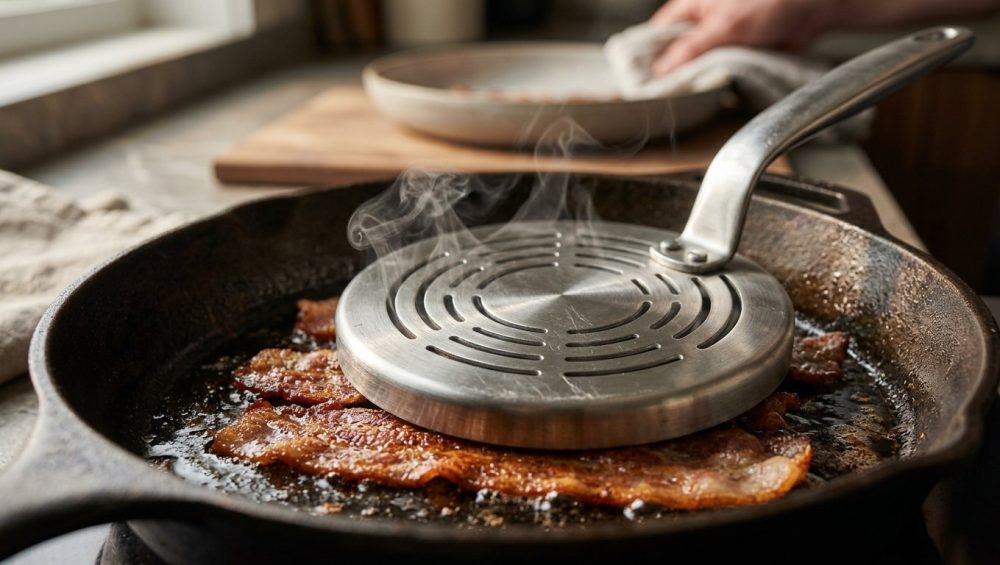
Start with the universal, deeply frustrating experience of cooking breakfast meat. The anticipation builds as the smell of coffee fills the air, the skillet sizzles, and you drop a pristine, beautiful strip of meat into the hot oil. And then, the rebellion begins. Before your eyes, the meat contorts into a rigid, undulating wave. The edges burn to a bitter, acrid crisp, while the center lifts off the pan, remaining a flabby, translucent disappointment. You find yourself standing over the stove with a pair of tongs, aggressively holding down the corners of the meat like you are wrestling a tiny, greasy alligator. It is infuriating, and frankly, it is a terrible way to start your morning.
Weekday cooking is an absolute battlefield. Time is money, and you simply do not have the luxury of babysitting a piece of pork. You need efficiency, you need speed, and most importantly, you need professional-level results without needing a culinary degree. You might be standing there, spatula in hand, wondering why your bacon always curls in the first place. The answer lies in the unforgiving laws of thermodynamics and protein biochemistry. But more importantly, the solution lies in ditching your prehistoric kitchen habits and embracing a piece of culinary engineering that will fundamentally change how you cook: the vented stainless steel chef’s press.
The Science of the Swine: Thermodynamics and Protein Contraction
To defeat the enemy, you must first understand the enemy. Meat is not a uniform, static ingredient; it is a complex, heterogeneous landscape of lean muscle fibers, connective tissue, and dense layers of fat. When you drop a cold strip of meat into a hot skillet, you are initiating a chaotic, multi-front chemical reaction that you need to control.
The Fat vs. Muscle Tug-of-War
At a microscopic level, meat is essentially a dense sponge made of protein, holding roughly 75% water. When exposed to heat, the proteins in the lean muscle—specifically myosin and actin—begin to denature and coagulate. Around 120°F (50°C), the myosin proteins unfold and link together, violently squeezing out their internal water. As the internal temperature climbs toward the 140°F to 160°F (60°C to 70°C) range, the collagen within the connective tissue aggressively shrinks and contracts.
Simultaneously, the fat layers are undergoing a completely different thermodynamic process. Fat does not contract like muscle; it renders. It melts from a solid into a liquid, shrinking in volume at a much slower, entirely different rate than the rapidly tightening muscle fibers.
Imagine tying a thick rubber band to a piece of cotton string and throwing them both into a hot dryer. The rubber band snaps and shrinks violently, while the string does almost nothing. The resulting mechanical tension causes the entire structure to buckle. The muscle pulls, the fat resists, and your breakfast meat curls up toward the ceiling, completely abandoning the hot surface of your skillet.
The Maillard Reaction and the Enemy of Crispiness
Here is where the real culinary tragedy occurs. Heat transfer in a skillet relies entirely on conduction—direct, uninterrupted physical contact between the hot metal pan and the food. When the meat curls, it lifts off the cooking surface. You immediately lose conduction, and the cooking process stalls.
To achieve that beautiful, savory, golden-brown crust that we all crave, you need to trigger the Maillard reaction. This is the complex chemical tango between amino acids and reducing sugars that produces hundreds of incredible flavor compounds. But the Maillard reaction has a strict, non-negotiable prerequisite: it requires a completely dry environment and temperatures generally exceeding 280°F (140°C).
When the meat lifts off the pan, it creates a hollow pocket underneath. The water being squeezed out of the contracting muscle fibers pools in this pocket. Because water cannot exceed 212°F (100°C) at normal atmospheric pressure before turning into steam, your food is no longer searing; it is boiling in its own localized puddle of sadness. Boiling meat results in a gray, flabby, unappetizing mess. Failing to manage surface moisture is one of the most common beginner cooking mistakes that ruins otherwise perfect, expensive ingredients.
The Flaws of Traditional Kitchen Weights
For decades, the diner cook’s answer to curling meat has been the cast iron press. On paper, the logic makes sense: if the meat wants to curl and lift, smash it down with a heavy piece of metal. But in practice, traditional solid cast iron presses are culinary saboteurs that have no place in a modern home kitchen.
Cast Iron Presses: The Heavy, Steamy Saboteurs
Cast iron presses are archaic, blunt instruments designed for massive commercial diner griddles, not your delicate home cookware. First, they are entirely too heavy. When you drop a solid three-pound slab of iron onto a chicken breast or a delicate piece of fish, you aren’t just keeping it flat; you are aggressively crushing the cellular structure and squeezing the internal juices out onto the pan, leaving you with dry, stringy, ruined meat.
More importantly, solid cast iron presses create a thermodynamic nightmare. Remember that meat is mostly water. As the meat sears, that surface water evaporates and tries to escape as steam. A solid, unvented press traps that steam directly against the surface of the food. You are essentially creating a suffocating mini-sauna over your protein. The trapped moisture drops the surface temperature well below the Maillard threshold, effectively steaming your food instead of searing it. You want a crust, but you get a soggy, gray, rubbery exterior.
The “Toxic Gear” Warning: What to Avoid
If you think heavy cast iron is bad, do not get me started on the cheap, mass-produced aluminum presses coated in mystery non-stick chemicals. I have a strict, zero-tolerance policy when it comes to banishing toxic kitchen gear from my home, and you should too.
These cheap, lightweight weights are often made of poor-quality metals that warp under high heat. Worse, their cheap non-stick coatings are absolutely not designed to withstand the intense, direct heat of a searing skillet. After just a few uses, that toxic coating begins to blister, peel, and flake directly into your food. You are literally ingesting forever chemicals just because you wanted a flat piece of meat. It is unacceptable. A home cook deserves durable, safe, professional-grade equipment that will last a lifetime.
Enter the Vented Chef’s Press: A Masterclass in Culinary Engineering
If you want professional, restaurant-quality results in your home kitchen, you need to use the tools that actual chefs use. The vented stainless steel Chef’s Press is a masterpiece of functional design, born out of necessity and perfected by the laws of physics.
Steam Ventilation: The Ultimate Game-Changer
In 2004, Chef Bruce Hill was running the tiny, high-volume kitchen at Bix Restaurant down a secret alley in San Francisco. Space was incredibly tight, time was short, and the old cast iron weights his line cooks were using were trapping steam and ruining the sear on his signature dishes. He desperately needed a tool that provided localized weight without trapping moisture.
The result was the Chef’s Press. It is stamped from heavy-gauge, USA-forged steel and features a series of precise, staggered vents. These vents are the ultimate secret weapon. As the moisture evaporates from your searing meat, the steam escapes instantly through the vents. The surface of the food remains bone-dry, allowing the temperature to rapidly climb past 280°F and trigger a violent, beautiful Maillard reaction. You get a perfect, edge-to-edge crust in a fraction of the time, because the food is making 100% contact with the pan without being suffocated by its own steam.
Stainless Steel: The Safe, Non-Toxic Champion
The Chef’s Press is made of solid, high-quality stainless steel. It will never rust, it will never peel, and it will never leach toxic chemicals into your breakfast. It is virtually indestructible. Many home cooks struggle with protein adhesion, but using a vented press actually solves this. By ensuring firm, even contact, the heat transfers rapidly, allowing the proteins to sear, release their moisture, and naturally detach from the cooking surface, making your stainless steel pan actually non-stick.
Stackable Weight: Precision Control for Every Protein
Perhaps the most brilliant aspect of the Chef’s Press is its modular, stackable design. They typically come in 8 oz, 13 oz, and 18 oz (or 19 oz) varieties. The handles are ergonomically designed to interlock, allowing you to stack multiple presses on top of each other to perfectly customize the weight for whatever you are cooking.
If you feel like everything sticks to your pan when cooking uneven cuts of meat, it is because the heat is not distributing evenly across the surface. An 8 oz press is gentle enough to keep a delicate piece of prosciutto or a thin slice of eggplant flat without crushing it into a paste. But if you are searing a thick, stubborn ribeye steak with a massive fat cap that desperately wants to bow in the center, you can easily stack two 13 oz presses together to force that meat flush against the hot metal. You control the pressure, rather than letting a monolithic block of cast iron dictate the fate of your dinner.
Beyond the Bacon: How a Chef’s Press Transforms Your Weekday Cooking
While it is the ultimate breakfast meat tamer, the vented press is a multi-tasking powerhouse that will drastically improve almost everything you cook on the stovetop. By maximizing direct surface contact, it cooks food 20% to 30% faster—a massive, undeniable victory for your hectic weeknight schedule.
The Perfect, Non-Soggy Grilled Cheese
We have all made a grilled cheese sandwich where the bread toasts terribly unevenly—burnt to a crisp on the outer crust edges and pale, soft, and sad in the middle. Worse, if you try to press it down with a standard spatula, you just mash the bread into a dense, gummy paste while the cheese oozes out the sides.
A vented press provides gentle, perfectly even weight across the entire surface of the sandwich. It forces the bread into full, uninterrupted contact with the skillet, ensuring a uniform, golden-brown crust. Because the steam from the melting cheese and heating butter can escape freely through the vents, the bread stays incredibly crispy. Whether you are throwing together a quick lunch on a Tuesday or hosting an elaborate, mindful grilled cheese bar for friends on a Saturday afternoon, this tool guarantees absolute perfection.
Searing Steaks and Smashing Burgers
When you sear a steak, especially cuts like a New York Strip or a Picanha that feature a thick, dense band of fat along one side, the intense heat causes that fat to render and shrink rapidly. The steak will literally bow in the middle, lifting the center of the meat completely off the pan. You end up with a gray, boiled center and overcooked, tough edges.
To fix this, first, employ the magic of a paper towel to aggressively dry the surface of the meat before it ever touches the skillet. Then, once the steak hits the hot oil, immediately place a 13 oz or 18 oz Chef’s Press right on top. The weight forces the center of the steak down, maintaining full, aggressive contact with the pan. You will achieve a steakhouse-quality, edge-to-edge crust in significantly less time, locking in the juices and flavor before the interior overcooks.
For smash burgers, the press is equally invaluable. You can use it to firmly press the ball of ground beef into the screaming hot steel, maximizing the surface area for that lacy, crispy edge that defines a perfect diner-style burger. The vents ensure the burger sears rather than steams in its own juices.
Flattening Poultry and Searing Seafood
Chicken thighs and breasts have a wildly uneven topography. Left to their own devices in a flat pan, only about 40% of the skin actually touches the hot metal. The rest stays rubbery, pale, and thoroughly unappetizing. A vented press flattens the meat, driving the skin directly into the heat source. The fat renders out quickly, and the skin crisps up like a savory potato chip.
Fish is notoriously difficult for home cooks to master. The skin of a salmon fillet or a sea bass is packed with dense collagen. The exact moment it hits a hot pan, that collagen contracts violently, causing the entire fish to curl up into a rigid “U” shape. If you try to force it down with a spatula, you risk breaking and flaking the delicate flesh. An 8 oz vented press provides just enough gentle, sustained weight to counter the contraction of the collagen without bruising the meat. And if you really want to ensure the fish doesn’t stick and develops a mind-blowing, shatteringly crisp crust, utilize the secret power of mayonnaise—brushing a microscopic layer on the exterior of the fish right before searing.
Caramelizing Vegetables
Do not limit this incredible tool to just meat. If you want to elevate your vegetable game, the vented press is your best friend. Searing thick slices of cauliflower, halved heads of radicchio, mushrooms, or long spears of asparagus can be frustrating because they are rigid and simply do not lay flat in the pan.
A press forces them against the hot metal, rapidly accelerating the caramelization process. You get those deep, sweet, roasted flavor notes in mere minutes on the stovetop, saving you the immense hassle of preheating the oven (and constantly wondering if you need a simple oven thermometer because your roasting times are always wildly off). Pressing mushrooms, in particular, forces them to expel their internal water much faster, allowing them to brown beautifully instead of acting like soggy sponges.
How to Use and Maintain Your Vented Press Like a Pro
The true beauty of high-quality, intelligently designed kitchen gear is that it does not require a master’s degree to operate or maintain. It is designed to make your life easier, not give you another tedious chore to worry about after dinner.
Preheating: To Do or Not to Do?
A very common question from enthusiastic home cooks is whether they should preheat the press in the pan before placing it on the food. In 95% of everyday cooking scenarios, the answer is a resounding no.
If you preheat the weight until it is screaming hot, you are effectively cooking the food from both sides simultaneously. While this might sound like a brilliant time-saver in theory, it actually removes your control over the cooking process. For thin items like breakfast meats or a delicate grilled cheese sandwich, a blazing hot press will scorch the top before the bottom has a chance to properly sear and develop flavor.
Keep the press at room temperature. Let the pan do the heavy lifting and cook from the bottom up, while the press simply provides the mechanical force necessary to maintain perfect conduction. The stainless steel will naturally absorb some ambient heat from the pan, but it won’t actively sear the top of your food. This allows you to flip the item when the time is exactly right and monitor the crust perfectly.
Cleaning and Care (Spoiler: It’s Easy)
If you own a traditional cast iron press, you already know the miserable drill: scrub it gently without soap, dry it immediately on the warm stove so it doesn’t instantly rust, rub it down with a thin layer of oil, and pray it doesn’t go rancid in your dark cupboard. Who on earth has time for that routine on a busy Tuesday night?
The vented stainless steel Chef’s Press requires absolutely zero maintenance. When you are done cooking, you just throw it directly into the dishwasher. The high-quality 304 stainless steel can easily handle the harsh detergents and high heat without corroding, rusting, or degrading in the slightest. There are no tiny crevices for bacteria to hide in, no fragile coatings to baby, and no tedious seasoning rituals to perform. Just be sure you are ignoring the hidden danger of aerosol sprays, which contain propellants and emulsifiers that bake into an impenetrable, sticky resin on your cookware; simply wash your stainless steel tools with standard soap and water, and they will last forever. It is a true workhorse tool designed to take a beating in a professional kitchen and come out looking brand new every single time.
The Verdict: Reclaiming Your Pan
Cooking at home should never be an exercise in frustration. You absolutely do not need a culinary degree to make mind-blowing, restaurant-quality food; you simply need to understand the basic science of what is happening in your pan, and you need the right tools to manipulate those variables in your favor.
Curling breakfast meats, soggy sandwiches, and gray, steamed steaks are not personal failures; they are thermodynamic inevitabilities when you use the wrong equipment. By swapping out your heavy, steam-trapping cast iron weights for a brilliantly engineered, vented stainless steel press, you are taking total control of your kitchen. You are maximizing heat transfer, accelerating cooking times by up to 30%, and guaranteeing a perfect, crispy sear on every single protein and vegetable that crosses your cutting board.
Stop wrestling with your food. Stop settling for rubbery, unevenly cooked meals. Invest in a scientifically backed tool that works exactly as hard as you do, and reclaim your rightful place as the absolute master of your stovetop.