The Universal Tofu Tragedy: Why Your Stir-Fries End in Tears
Listen, I love a good weeknight stir-fry just as much as the next busy professional, but if your tofu currently looks like a pile of scrambled eggs that gave up on life, we need to have a serious chat. You are not alone in this culinary disaster. According to recent market analysis, the global tofu industry is absolutely exploding, projected to reach a staggering $12.31 billion by 2034, growing at a steady 7.1% compound annual growth rate [3]. That means millions of people are buying blocks of soy curd every single day, bringing them home, and aggressively destroying them in their frying pans.
It is a tragedy of epic proportions. You start with a pristine, beautiful block of plant-based potential. You chop it into perfect little cubes. You heat up your oil. But the second that tofu hits the pan, all hell breaks loose. It spits, it splatters, it sticks to the bottom, and the moment you try to flip it with your spatula, it crumbles into a sad, watery mush. If you can effortlessly cook tender meat on a Tuesday night but your plant-based dinners are a consistent disaster, the problem isn’t your cooking skills. The problem is that you are fundamentally misunderstanding the ingredient.
Water is the enemy of browning, and tofu is essentially a giant, white sponge filled with water. Where that water sits, how it behaves, and how you manage it dictates absolutely everything about your final dish [3]. If you leave the water inside the tofu, it will steam from the inside out the second it hits the hot oil. That trapped moisture prevents the surface temperature from exceeding 212°F (100°C)—the boiling point of water. If you remember anything from basic kitchen thermodynamics, you know that the Maillard reaction (the chemical process that gives browned food its distinct, delicious flavor and crispy texture) requires temperatures of at least 300°F (150°C). As long as your tofu is waterlogged, it will never, ever get crispy. It will just boil in its own juices until it falls apart.
But fear not. You do not need a Michelin star, a culinary degree, or an expensive gadget to fix this. You just need a pot of water, a handful of salt, and a basic understanding of food science. We are going to completely revolutionize how you handle this ingredient.
The Great Pressing Myth: Why Traditional Methods Waste Your Time
If you google “how to cook tofu,” 99% of the recipes will tell you to press it. They will instruct you to wrap the block in a small forest’s worth of paper towels, sandwich it between two plates, and balance a precarious tower of heavy cookbooks and expired cans of chickpeas on top. Or worse, they will tell you to go buy a specialized, single-use plastic “tofu press” that will inevitably break after three uses and clutter up your cabinets.
I have zero patience for this. First of all, time is money. When I walk through my front door at 6:15 PM on a Wednesday, I am already hungry. I do not have forty-five minutes to sit around waiting for gravity to slowly squish the life out of my dinner. Weekday cooking requires efficiency, smart hacks, and aggressive time management.
Secondly, pressing is inherently flawed. If you are balancing heavy books on your tofu while it sits on one of those cheap bamboo cutting boards, you are applying uneven pressure. One side gets flattened into a pancake, while the other side remains suspiciously plump. Furthermore, pressing only really works on extra-firm tofu. If you try to press soft or medium tofu, you will simply crush it into a paste.
The traditional pressing method operates on brute force. It tries to physically smash the water out of the protein structure. But what if, instead of fighting the tofu with gravity and heavy books, we used cellular biology to gently coax the water out from the inside?
The Counterintuitive Miracle: The Saltwater Soak
My absolute favorite culinary tricks are the ones that sound completely unhinged until you understand the science behind them. If your goal is to dry out a block of tofu, the very last thing you would logically think to do is drop it into a pot of boiling water. It sounds like a prank. “Hey, do you want to dry off? Go jump in the pool!”
But boiling tofu in salted water—or pouring boiling salted water over it—is a centuries-old technique widely utilized in traditional Chinese cooking [1][9]. It is the secret behind the bouncy, resilient texture of restaurant-style mapo tofu, and it is the ultimate hack for achieving crispy, golden-brown stir-fries at home.
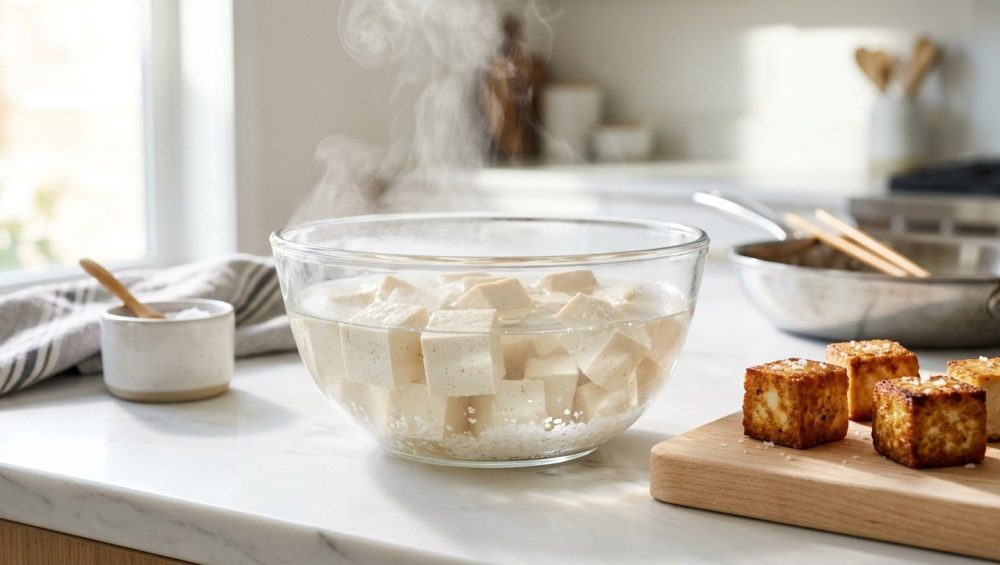
When you submerge cubed tofu in a hot, heavily salted brine for just 10 to 15 minutes, a series of complex molecular reactions take place. The hot water doesn’t make the tofu soggier; it actually forces the internal moisture out, tightens the structural integrity of the block, and seasons the food from the inside out [1][8]. It is faster than pressing, it requires zero specialized equipment, and it produces a texture that gravity alone could never achieve.
The Food Science: Why Boiling Water Actually Dries Tofu Out
To truly master the kitchen, you have to stop blindly following recipes and start understanding why things happen. We are going to put on our lab coats for a minute and break down the exact mechanisms that make the saltwater soak so magical. There are two primary scientific principles at play here: osmosis and protein coagulation.
The Magic of Osmosis
You probably vaguely remember osmosis from your high school biology class. Osmosis is the movement of water across a semi-permeable membrane from an area of low solute concentration to an area of high solute concentration.
Tofu is highly porous; it is basically a biological sponge. The water trapped inside the tofu has a very low concentration of salt. The boiling brine you just prepared has a very high concentration of salt. When you drop the tofu into the brine, nature immediately seeks equilibrium. To balance out the stark difference in salinity, the water inside the tofu rushes out into the pot [1][8].
Simultaneously, through the process of diffusion, a small amount of the dissolved sodium ions moves into the tofu [1]. This exchange is the first half of the magic trick. You are using the fundamental laws of physics to actively pull the moisture out of the center of the cubes, rather than just squishing the surface.
Protein Coagulation and the Sponge Effect
The second half of the magic trick relies on heat. Tofu is made by curdling fresh soy milk with a coagulant (like calcium sulfate or nigari) and then pressing those curds into a block. The structure of tofu is essentially a complex, microscopic web of soy proteins holding onto pockets of water.
When you introduce tofu to boiling water, that intense heat causes the soy protein network to denature and contract [3]. Think of the protein web like a clenched fist. As the heat penetrates the tofu, the proteins tighten and shrink. This physical contraction acts exactly like an invisible hand squeezing a sponge. As the protein matrix tightens, it physically expels the water trapped inside its pockets [1][3][4].
The combination of osmotic pressure pulling the water out, and protein coagulation squeezing the water out, results in a piece of tofu that is significantly denser, firmer, and drier than when it started [3]. The heat also slightly relaxes the outer “pores” of the tofu, allowing it to release that surface moisture rapidly once it is removed from the water [1].
Seasoning from the Inside Out: The Brine Factor
Beyond texture, the saltwater soak solves the second greatest complaint about tofu: it tastes like absolutely nothing.
Because tofu is packed with water, it acts as a barrier to flavor. Most home cooks try to solve this by marinating their raw tofu for hours. But here is a brutal truth: marinades do not penetrate raw, waterlogged tofu. Oil and water do not mix. If your tofu is full of water, your expensive sesame oil and soy sauce marinade is just going to sit on the surface, waiting to burn the second it hits your hot skillet.
The saltwater soak changes the game. As the water rushes out via osmosis, the salt diffuses in [1][9]. You are effectively brining the tofu. This gently seasons the entire cube from the inside out, providing a baseline of savory flavor that enhances whatever sauce you add later. Furthermore, because the heat has relaxed the surface pores and expelled the internal water, the tofu is now primed and ready to act like a dry sponge [1]. Once you take it out of the water and pat it dry, it will absorb your stir-fry sauces in a matter of seconds, rather than requiring an overnight marinade [1].
The Definitive Step-by-Step Masterclass to the Saltwater Soak
Alright, enough theory. Let’s get our hands dirty. This is the foolproof, step-by-step method to executing the perfect saltwater soak.
Step 1: Sourcing and Prepping the Right Block
While this technique works wonders on soft tofu to keep it from disintegrating in soups, for a crispy stir-fry, you want to start with Firm or Extra-Firm tofu. Open the package over your sink and drain away the murky packing liquid.
Place the block on a stable cutting board and cut it into uniform, one-inch cubes. Do not rush your knife work. Uniformity ensures that every single piece cooks at the exact same rate. Once your cubes are perfectly portioned, do yourself a favor and scoop up the cubes with a bench scraper. Trying to transfer delicate ingredients by balancing them on the blade of your chef’s knife is a rookie mistake that will end with half your dinner on the floor.
Step 2: Formulating the Perfect Brine
You need a pot large enough to comfortably hold all your tofu without crowding. Add about 3 to 4 cups of water—enough to fully submerge the cubes. Now, add the salt. Do not be shy here. You want the water to taste like the ocean. A good rule of thumb is 1 to 1.5 tablespoons of kosher salt or sea salt for every 3 cups of water.
Bring this mixture to a rolling boil over high heat. If you want to get fancy, you can infuse this boiling liquid with smashed garlic cloves, slices of fresh ginger, or a splash of soy sauce, but plain salt water works perfectly fine for everyday weeknight meals.
Step 3: The Heat Shock
Once the water is boiling rapidly, gently slide your tofu cubes into the pot. Be careful not to splash boiling water on yourself—we are making dinner, not taking a trip to the burn unit.
Let the tofu boil for exactly 3 to 5 minutes [1]. You don’t want to leave it in there forever, or the proteins will tighten so much that the tofu becomes tough and rubbery. You are looking for a quick, aggressive heat shock. You will actually see the cubes expand slightly and bob in the water as the structural changes occur.
If you do not want to dirty a pot, the alternative method is to place your tofu cubes in a heat-safe colander in the sink, boil water in your electric kettle, and slowly pour the boiling saltwater over the cubes, letting them sit in the hot water for about 15 minutes [2][8]. Both methods trigger the necessary protein coagulation and osmosis.
Step 4: The Crucial Drain and Dry
This is the most important step in the entire process. Do not mess this up.
Carefully drain the tofu into a colander. You will notice immediately that the cubes feel different. They are bouncier, firmer, and less fragile. But they are currently wet on the outside from the bath.
Transfer the hot cubes to a plate lined with a clean, lint-free kitchen towel or several layers of heavy-duty paper towels. Spread them out in a single layer. Take another towel and gently pat the tops of the cubes. Because the internal water has been squeezed out, the surface water will evaporate very quickly due to the residual heat. Let them sit for about 5 minutes to steam off. And please, use a clean towel, instead of using a cheap silicone tool that smells like garlic from last week’s dinner to move them around. We want clean, pure flavors.
Your tofu is now perfectly seasoned, structurally sound, and aggressively dry on the surface. It is ready for the pan.
The “No-Go” Rule on Toxic Gear: Equipping Your Kitchen for Success
Before we talk about searing this beautiful tofu, we need to address the elephant in the room: your cookware. I firmly believe that anyone can cook like a professional at home, but not if you are sabotaging yourself with garbage equipment. If you are trying to get a hard, crispy sear on a block of tofu using a scratched, peeling, $15 Teflon pan, you are almost certainly ruining your nonstick pans in the process, and worse, you are likely ingesting toxic forever chemicals.
I have an absolute, uncompromising “no-go” rule on toxic kitchen gear. Cheap non-stick coatings degrade rapidly under the high heat required for stir-frying. When Teflon (PTFE) is heated past 500°F (260°C), it begins to break down and release toxic fumes. Stir-frying is a high-heat contact sport. You need cookware that can handle the thermal shock without flaking mystery metals into your food.
If you want restaurant-quality crispiness, you need to rely on thermodynamics, not toxic chemicals. This is why you desperately need a carbon steel wok for this. Carbon steel is the undisputed king of the stir-fry. It is relatively lightweight, it responds instantly to temperature changes, and when properly seasoned with polymerized oil, it becomes naturally non-stick. It can withstand roaring high temperatures without breaking a sweat, allowing you to achieve that elusive “wok hei” (the breath of the wok) flavor.
If you don’t have a wok, your next best option is a well-seasoned cast iron skillet, or at the very least, a heavy-bottomed stainless steel pan. With stainless steel, you simply utilize the Leidenfrost effect to prevent sticking: heat the dry pan until a drop of water beads up and dances across the surface like a marble, then add your oil, and immediately add your dry tofu. The intense, immediate heat instantly sears the exterior of the tofu, creating a crispy crust before the proteins have a chance to bond with the metal of the pan.
Throw away your peeling non-stick pans. Invest in safe, durable, high-quality metals. Your health, and your stir-fries, will thank you.
Advanced Culinary Tactics: Elevating Your Tofu Game
Now that you have perfectly prepped, saltwater-soaked tofu and a screaming hot, non-toxic pan, you are ready to cook. But because I want you to completely dominate your weekend cooking projects, let’s explore a few advanced tactics to take this to the next level.
The Cornstarch Crunch:
If you want an absolutely shattering, glass-like crunch on the exterior of your tofu, toss your dried cubes in a light dusting of cornstarch or potato starch right before they hit the pan. The starch absorbs any microscopic droplets of remaining surface moisture and fries up into a brilliant, golden crust. Just be sure to tap off the excess powder before frying, or you will end up with a gummy, floury mess in your oil.
Aromatics and Heat Management:
When you are stir-frying, timing is everything. You want to sear the tofu undisturbed. Place the cubes in the hot oil and leave them alone. Do not poke them. Do not shake the pan. Let the Maillard reaction do its job for 2 to 3 minutes until a golden crust forms, then flip. Once the tofu is crispy, remove it from the pan. Then, add your aromatics (garlic, ginger, scallions). The pan will be incredibly hot, and if your garlic always burns when you throw it in the hot oil, it is because you are leaving it in there too long while trying to cook the protein. Cook the tofu, remove it, briefly fry the aromatics, build your sauce, and then toss the crispy tofu back in at the very last second to coat it.
The Freezing Hack:
The saltwater soak is incredible for firming up tofu, but if you want an even meatier, sponge-like texture, you can freeze it first. Freezing causes the water inside the tofu to turn into ice crystals. As water freezes, it expands, stretching the protein network. When you thaw the tofu, those ice crystals melt and drain away, leaving behind massive, cavernous pockets. If you take thawed, previously frozen tofu and run it through the saltwater soak, you will end up with a texture that is so chewy and robust, it can easily go toe-to-toe with chicken or beef in a heavy braise.
Troubleshooting Rookie Mistakes
Even with the best techniques, things can go sideways if you aren’t paying attention. Here are the most common pitfalls home cooks encounter with the saltwater soak, and exactly how to fix them.
“My tofu is way too salty!”
This means your brine was too concentrated, or you boiled it for way too long. The goal is to create osmotic pressure, not to cure the tofu like a ham. Stick to the ratio: 1 to 1.5 tablespoons of salt per 3 cups of water, and do not boil for more than 5 minutes. If you are planning to toss the tofu in a very salty sauce (like a heavy soy or oyster sauce reduction) later, you can dial the salt in the boiling water back just a bit.
“It still stuck to the pan and fell apart.”
Two things went wrong here. First, you didn’t dry the surface well enough. Remember, water destroys the sear. If the tofu is wet, it drops the temperature of the oil, causing the proteins to glue themselves to the metal. You might be wondering why your knives go dull when you chop wet ingredients haphazardly, but wet ingredients also ruin your pan’s non-stick capabilities. Second, your pan wasn’t hot enough. You need shimmering oil and a pre-heated pan before the tofu ever makes contact.
“The tofu turned out rubbery and tough.”
You over-boiled it. Heat tightens the protein network. A quick 3 to 5-minute blanch squeezes out the water and firms the structure. A 20-minute rolling boil will squeeze the structure so tight that it becomes a dense, unchewable eraser. Watch the clock.
The Final Word: Empowering the Home Cook
Cooking should not be a source of stress, and you certainly shouldn’t have to settle for sad, watery, flavorless meals just because you are cooking plant-based proteins on a Tuesday night. The culinary world is full of pretentious jargon and overly complicated techniques, but at the end of the day, good cooking just comes down to understanding your ingredients and applying a little bit of basic science.
The saltwater soak is the perfect example of working smarter, not harder. By ditching the heavy cookbooks and the useless plastic gadgets, and instead leveraging the magic of osmosis and protein coagulation, you can transform a bland, watery block of soy into a firm, seasoned, crispy masterpiece.
You don’t need a culinary degree to make mind-blowing food. You just need to respect the science, invest in safe, high-quality gear, and trust your instincts. Now go boil some water, toss out your peeling Teflon, and show that tofu who is boss. Dinner is going to be spectacular.