Look, I know you bought that block of extra-firm tofu with the best of intentions. You envisioned a beautifully golden, shatteringly crisp, restaurant-quality stir-fry that would finally prove to your family that plant-based dinners don’t have to taste like punishment. But let me guess what actually happened: You ended up with a pan full of pale, scrambled, aggressively bland mush that glued itself to your skillet.
I’ve been there. We have all been there.
For years, Western home cooks have been taught that the only way to conquer tofu is to press it. We’ve been instructed to wrap it in a small forest of paper towels, place it on a plate, and meticulously balance a wobbly tower of heavy cast iron skillets and dusty college textbooks on top of it. We are told to wait an hour while it slowly weeps onto the kitchen counter. If you are tired of using a tofu press or playing a high-stakes game of Jenga just to make a weeknight dinner, I have fantastic news for you.
You don’t need to press your tofu. In fact, you shouldn’t.
There is a centuries-old, scientifically backed culinary technique that is faster, cleaner, and infinitely more effective. It will tighten the proteins, season the soy from the inside out, and draw out excess moisture in a fraction of the time. It sounds entirely counterintuitive, but the secret to the crispiest, firmest tofu you will ever make is to drown it in boiling, salty water.
Welcome to the magic of the saltwater soak. Grab a glass of wine, pull up a stool, and let’s get into the no-nonsense culinary science of why this method is going to completely revolutionize your weeknight cooking.
The Flexitarian Revolution: Why We Need Better Tofu Techniques
Before we dive into the microscopic thermodynamics of soy proteins, we need to talk about why this matters right now. If you feel like you’re suddenly seeing tofu everywhere, you aren’t imagining things. We are living in the golden age of the flexitarian diet.
This isn’t just a niche ingredient reserved for strict vegans anymore. Everyday home cooks are actively looking to incorporate more plant-based proteins into their weekly rotations for health, environmental, and economic reasons. The global market data backs this up. In 2025, the global tofu market reached a staggering USD 6.92 billion, and it is projected to climb to USD 7.31 billion in 2026. Europe alone saw its tofu market cross the USD 708 million mark in 2025, with expectations to hit nearly USD 796 million by the end of 2026.
People are buying tofu in record numbers. The problem is, nobody taught them how to cook it properly.
The gap between the glorious, bouncy, flavor-packed tofu you get at your favorite local pan-Asian restaurant and the sad, watery cubes you make at home is vast. Most beginner recipes treat tofu as a blank, flavorless sponge that needs to be aggressively squished and then drowned in a heavy sauce to be palatable. But traditional Asian cuisines have known for centuries that tofu is a delicate protein network that requires a little bit of spa treatment before it hits the wok.
By banishing toxic kitchen gear and embracing actual, foundational cooking techniques, we can bridge that gap. You don’t need a culinary degree to cook like a pro, but you do need to understand a little bit of basic kitchen science.
The Culinary Science: Why Adding Water Actually Dries Tofu Out
I know what you are thinking. “You want me to take a waterlogged block of soybean curd, which I am desperately trying to dry out so it will get crispy, and submerge it in more water?”
Yes. I absolutely do.
To understand why the hot saltwater soak works, we have to look at the three scientific principles at play: osmosis, syneresis, and diffusion.
Osmosis: The Moisture Magnet
If you remember high school biology, you might recall that water loves to move from areas of low solute concentration to areas of high solute concentration to achieve equilibrium. Tofu is essentially a protein-water gel. It is packed with internal moisture. When you submerge that block of tofu into a highly concentrated saltwater bath (a hypertonic solution), the salt acts like a magnetic force. It aggressively attracts the water molecules trapped inside the tofu, drawing them out through the porous surface.
Pressing tofu relies on brute force and gravity to squeeze water out, which often results in cracked, mangled blocks. Osmosis does the work at a molecular level, pulling the water out gently and uniformly. Interestingly—and entirely counterintuitively—a hot saltwater soak can actually remove more internal moisture in 15 minutes than pressing it for an hour.
Syneresis: The Heat Squeeze
Why must the water be boiling hot? This is where syneresis comes into play. When the delicate soy protein network is exposed to high heat, the proteins denature and contract.
Think of the tofu’s internal structure like a microscopic sponge. When you drop it into boiling water, the heat causes that sponge to actively shrink and tighten. As the protein network tightens, it physically squeezes out the loose, unattached water trapped inside. This process not only expels moisture but also fundamentally alters the texture of the tofu. It becomes noticeably firmer, springier, and significantly less likely to crumble into a scrambled mess when you try to flip it in your skillet.
Diffusion: Seasoning from the Inside Out
The final piece of the puzzle is flavor. Tofu is infamous for its grassy, slightly “beany” raw flavor, which many people find off-putting.
When you soak tofu in hot salt water, a small amount of the salt diffuses into the tofu itself. You are effectively brining the protein. Instead of relying entirely on a thick, sugary glaze to mask the flavor of the soy, you are seasoning the tofu from the inside out. The salt neutralizes that raw, grassy taste and creates a savory, seasoned baseline. Because the tofu is already perfectly seasoned internally, whatever sauce or marinade you add later will taste exponentially better.
The Masterclass: How to Execute the Perfect Saltwater Soak
Now that we understand the science, let’s get down to the practical execution. Time is money on a weekday, and this method is going to save you a lot of it. Here is your definitive, step-by-step guide to perfectly brined tofu.
Step 1: Selecting and Prepping the Tofu
For this method to yield the crispiest results for a stir-fry or pan-sear, you need to start with Firm or Extra-Firm tofu. Soft or silken tofu has a completely different structural makeup and will disintegrate in a roaring boil.
Remove the tofu from its packaging and drain the liquid it was sitting in. Now, you need to break it down. You can slice it into neat, uniform cubes, but if you want to cook like a true kitchen artist, try tearing it. Using your hands to rip the tofu into bite-sized, irregular chunks creates jagged, craggy edges. Those uneven edges create more surface area, and more surface area means more jagged, crispy bits when it hits the hot oil.
Step 2: The Golden Ratio of Salt to Water
You need a brine that is aggressively salty. Remember, you aren’t consuming all this salt; the vast majority of it is going straight down the drain. The high salinity is strictly there to trigger the osmotic reaction.
A good rule of thumb is to use about 1/4 cup of kosher salt for every 4 cups (1 liter) of water. If you are using fine table salt, you can scale that back slightly, to about 2 to 3 tablespoons per liter. Do not skimp on the salt. If the water tastes like a mild soup broth, it is not salty enough. It needs to taste like the ocean.
Step 3: The Hot Bath
You have two options here, depending on your workflow.
Method A: The Pour-Over (Best for multitasking)
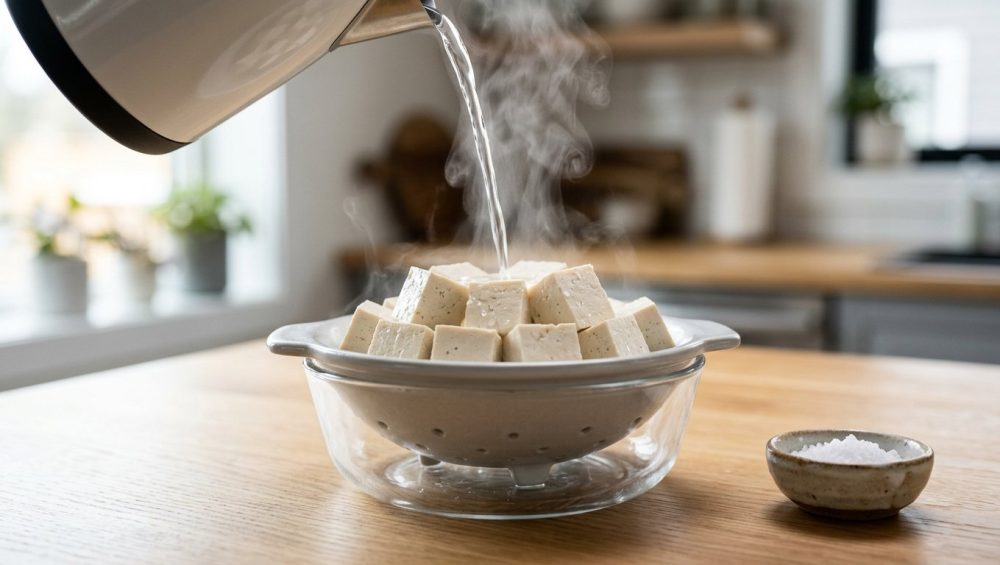
Place your cubed or torn tofu into a large, heatproof bowl. Bring your salted water to a rolling boil in a kettle or a saucepan. Pour the roaring hot water directly over the tofu until it is completely submerged. Walk away and let it steep for 10 to 15 minutes.
Method B: The Simmer (Best for maximum firmness)
Bring a pot of salted water to a gentle boil on the stove. Carefully drop your tofu pieces into the water. Let them simmer for 3 to 5 minutes. Turn off the heat and let them sit in the hot water for another 10 minutes. This method is heavily utilized in traditional Chinese cooking to prep tofu for dishes like Mapo Tofu, as it rapidly tightens the curds.
Step 4: The Crucial Drying Phase
This is the most important step in the entire process. Once your tofu has soaked, drain it into a colander.
Because the hot water caused the tofu to contract and expel its internal moisture (syneresis), the surface of the tofu will actually dry incredibly fast once it is removed from the water. However, you must help it along. Moisture is the ultimate enemy of the Maillard reaction (the chemical process that causes browning and crisping). If you throw wet tofu into a pan of hot oil, it will steam, sputter, and stick.
Lay the drained tofu out on a clean, lint-free kitchen towel or heavy-duty paper towels. Gently pat the tops dry. You don’t need to press hard—just blot away the surface moisture.
The “No-Go” Rule: Ditching Toxic Gear for the Perfect Sear
As your biggest cheerleader, I need to give you some tough love. You can execute the perfect saltwater soak, dry your tofu impeccably, and still completely ruin your dinner if you are using garbage cookware.
I have zero patience for cheap, lightweight, peeling non-stick pans. If your skillet has a mystery chemical coating that is flaking off into your food, throw it in the trash immediately. Not only are you risking your health with degrading Teflon and PFAS chemicals, but you are also actively sabotaging your cooking.
To get a beautiful, golden-brown crust on your tofu, you need high, sustained heat. Cheap non-stick pans cannot handle high heat without degrading. Furthermore, if you are relying on aerosol cooking sprays, you are ruining your nonstick pans by baking an invisible, sticky layer of soy lecithin onto the surface, which actually causes food to stick worse over time.
If you want to cook like an expert, you need to use expert tools. For searing tofu, I demand that my readers use either a heavy-bottomed carbon steel wok, a high-quality stainless steel skillet, or a well-seasoned cast iron pan. Yes, seasoning cast iron takes a tiny bit of effort, but the naturally polymerized, non-toxic, non-stick surface it provides is unmatched. These pans hold thermal mass beautifully, meaning when you drop your room-temperature tofu into the pan, the temperature of the metal won’t plummet. Sustained heat equals a perfect crust.
Troubleshooting the Sear: Why Your Tofu Still Sticks
Okay, you brined the tofu. You dried the tofu. You bought a gorgeous new carbon steel pan. But your tofu still glued itself to the bottom of the skillet like cement. What went wrong? Let’s troubleshoot the three most common rookie mistakes.
1. The Cold Pan Catastrophe
The number one reason food sticks to a pan is impatience. Never, ever put your tofu into a cold skillet. If the oil isn’t hot enough, the tofu will act like a sponge, soaking up the oil instead of frying in it. Just like using a cold pan will ruin your roasted vegetables by steaming them, a cold skillet will leave your tofu pale, greasy, and permanently adhered to the metal.
2. Failing the Water Drop Test
If you are using a stainless steel pan, you have to understand thermal dynamics. You must preheat the dry pan over medium heat until it passes the water drop test. Flick a tiny drop of water into the pan. If it sizzles and evaporates immediately, the pan is too cold. If it splits into a million tiny droplets, it’s too hot. You are looking for the sweet spot where the water drop forms a perfect, cohesive bead that dances and glides around the surface of the pan like mercury.
This phenomenon is called the Leidenfrost effect. By mastering the Leidenfrost effect, you create a microscopic layer of vapor between the pan and the food, effectively turning a sticky stainless steel pan into a naturally non-stick surface. Only when the pan has reached this state should you add your high-heat cooking oil (like avocado or grapeseed oil), let the oil shimmer, and then add your tofu.
3. The Urge to Fiddle
Once the tofu hits the hot oil, leave it alone. Do not poke it. Do not nudge it. Do not aggressively shake the pan.
When proteins hit hot metal, they initially bond to it. As the Maillard reaction occurs and a crust forms, the proteins will naturally release themselves from the cooking surface. If you try to force the tofu to flip before that crust has formed, you will rip the bottom right off, leaving the crispy part glued to the pan and the mushy interior exposed. Have a sip of your wine, set a timer for 3 to 4 minutes, and practice the ancient culinary art of doing absolutely nothing.
Alternative Methods: When to Use the Freezer Instead
The hot saltwater soak is my absolute holy grail for fast, efficient, weeknight cooking. It requires zero forethought. But what if you are a planner? What if you want a texture that is less like traditional tofu and more like a dense, chewy, meat substitute?
If you have the luxury of time, you should look into freezing it first.
When you place a block of tofu in the freezer, the water trapped inside turns into ice. Because water expands when it freezes, those ice crystals push against the soy protein network, stretching it out and creating large, sponge-like pockets. When you thaw the tofu, the ice melts, leaving behind a highly porous, incredibly chewy structure that absorbs marinades like a vacuum cleaner.
For the ultimate weekend culinary project, you can actually combine these two methods. Freeze your tofu, thaw it, tear it into chunks, and then drop it into a hot saltwater soak. The boiling salt water will rapidly thaw any remaining ice, draw out the excess moisture from the newly formed pockets, and season the intensely chewy curds from the inside out. It is a game-changer for vegan “chicken” nuggets or hearty stews.
Flavor Town: Taking Your Brined Tofu to the Next Level
Because your saltwater-soaked tofu is already structurally sound and seasoned internally, it is the perfect canvas for bold, aggressive flavors. Here are a few ways to elevate your perfectly seared cubes:
The Cornstarch Crunch
If you want an auditory crunch that can be heard from the next room, take your drained, thoroughly dried, brined tofu and toss it in a bowl with a tablespoon of cornstarch or arrowroot powder. The starch will adhere to the dry surface of the tofu and create a shatteringly crisp exterior when it hits the hot oil.
The Sticky Soy-Garlic Glaze
Do not marinate your tofu before cooking it. Wet marinades prevent browning. Instead, sear your brined tofu until it is golden and crispy on all sides. Then, turn the heat down to low and pour in a mixture of soy sauce, toasted sesame oil, freshly grated ginger, minced garlic, and a splash of maple syrup. The porous, hot tofu will instantly absorb the glaze, and the sugars will caramelize around the crispy edges in seconds.
The Spicy Peanut Toss
For a rich, decadent weeknight meal, whisk together smooth peanut butter, rice vinegar, a splash of warm water, soy sauce, and a generous dollop of chili crisp. Toss your freshly seared, hot tofu in this mixture off the heat. The residual heat from the tofu will melt the peanut butter into a luxurious, clinging sauce.
The Weeknight Workflow: Efficiency is Everything
I firmly believe that anyone can cook incredible meals at home, but I also know that on a Tuesday at 6:00 PM, you do not want to be running a science experiment. You want dinner on the table. Here is how the saltwater soak fits seamlessly into a stress-free, 30-minute workflow.
- Start the Kettle: The minute you walk into the kitchen, turn on your electric kettle or put a pot of water on the stove.
- Prep the Tofu: Tear your block of extra-firm tofu into chunks, place them in a bowl, add a heavy handful of kosher salt, and pour the boiling water over the top. Set a timer for 15 minutes.
- Chop the Veggies: While the tofu takes its hot bath, prep your vegetables. (And please, ditch the bamboo cutting boards—they are notoriously hard on your knife blades. Use a good quality end-grain wood or professional rubber board).
- Mise en Place: Use a stainless steel bench scraper to scoop up your prepped aromatics and veggies, organizing them neatly by the stove so you aren’t scrambling later.
- Drain and Dry: When the timer goes off, drain the tofu. Lay it on a towel and pat it aggressively dry.
- Sear and Sauce: Get your carbon steel pan ripping hot. Sear the tofu undisturbed until golden. Toss in your veggies, add your sauce, and serve.
You have just created a flawless, flavor-packed, perfectly textured plant-based dinner in under 30 minutes. No heavy books, no soggy paper towels, no waiting around for a press to do its job.
Cooking doesn’t have to be a chore, and it certainly doesn’t require a degree from Le Cordon Bleu. It just requires a little bit of know-how, a refusal to settle for mediocre kitchen gear, and the willingness to try something new. So, the next time you find yourself staring down a block of tofu, skip the press. Boil the kettle, grab the salt, and let a little bit of culinary science do the heavy lifting for you. You’ve got this.