Listen up, you beautiful kitchen disasters. We have all been there. You have invited your friends over for a weekend dinner. You have spent hours curating the perfect, fresh ingredients. You have chopped, you have diced, and you are ready to present a gorgeous, scratch-made meal. You bring your painstakingly crafted salad to the table, pour on your homemade vinaigrette, and watch in absolute horror as it instantly separates into a sad, greasy oil slick floating on top of a harsh puddle of acidic vinegar. Your greens wilt. Your guests politely push the soggy leaves around their plates. Your pride evaporates.
If you are still buying bottled salad dressing that contains more synthetic gums and preservatives than actual food, I am here to lovingly but firmly intervene. You do not need a culinary degree to make a restaurant-quality dressing, and you certainly do not need to rely on store-bought bottles that taste like seasoned plastic. You just need to understand a little bit of basic kitchen chemistry. I am your biggest cheerleader, but I have zero patience for pretentious chef-speak or overly complicated techniques. We are going to break down exactly why your dressings fail, how to force oil and water to play nicely together, and how to use this foolproof technique to host a fresh, build-your-own salad gathering that will make you look like a culinary genius.
The Science of Emulsions: Why Oil and Vinegar Hate Each Other
To understand why your dressing breaks, you have to understand the fundamental nature of your ingredients. Oil and vinegar are the culinary equivalent of two people who just went through a terrible breakup. They physically refuse to be in the same room together.
Vinegar is predominantly water. It is hydrophilic, meaning it loves water and easily bonds with other water-based liquids. Oil is hydrophobic, meaning it actively repels water. When you pour them into the same jar, the water molecules cling to each other, and the oil molecules cling to each other, resulting in two distinct, separated layers.
An emulsion is simply the forced, temporary marriage of these two opposing liquids. When you whisk oil and vinegar together, you are applying kinetic energy. This energy physically violently smashes the oil into microscopic droplets, dispersing them throughout the continuous phase of the vinegar.
The Physics of the Break
Here is where the science gets fascinating—and where most home cooks fail. Emulsions are, by their very nature, thermodynamically unstable. This means that the universe actively wants your dressing to separate. The oil droplets will constantly seek each other out, bumping into one another and merging back together in a process called coalescence, until they form a solid layer of oil again.
To keep a vinaigrette stable for more than three minutes, you need to smash those oil droplets down to an incredibly small size. Recent food science studies indicate that for a dressing to remain stable at room temperature for over 24 hours, the oil droplets need to be between 2 and 5 micrometers (µm) in diameter. If you are just lazily shaking your ingredients in a mason jar like a maraca, you are only breaking the oil down to about 12 µm or larger. At that size, gravity and Brownian motion take over, and your dressing separates before you even get the jar to the dining table.
The Polyphenol Problem: Why Blenders Ruin Olive Oil
You might be thinking, “Well, if I just need tiny droplets, I will throw it in the food processor and blast it on high speed!” Hold your horses. If you are using extra virgin olive oil, aggressive blending can actually ruin your dressing.
Extra virgin olive oil contains bitter-tasting compounds called polyphenols. Normally, these polyphenols are tucked away inside fatty acids. But when you subject olive oil to the extreme, high-speed shear of a blender or food processor, you physically tear those fatty acids apart, releasing a massive wave of polyphenols into the liquid. Your dressing will instantly turn incredibly bitter and metallic. For olive oil-based vinaigrettes, you must rely on the mechanical action of hand-whisking. Save the blender for neutral oils like avocado or grapeseed.
The Magic Ratios: Mastering the Golden Rule of Dressing
Before we talk about how to bind the dressing, we need to talk about proportions. You cannot just eyeball oil and vinegar and hope for the best. To achieve a perfectly balanced emulsion, you need to respect the math.
The Classic 3:1 Formula
The undisputed, golden rule of a classic vinaigrette is three parts oil to one part acid. This is the baseline from which all great dressings are born. If you use too much acid, the dressing will be harsh, astringent, and will overpower your delicate greens. If you use too much oil, the emulsion becomes too heavy, coating your mouth in a greasy film and weighing down the salad.
For a standard, weeknight-friendly batch of dressing that will perfectly coat a large salad for four people, the translation is simple:
- 9 tablespoons of oil (just over half a cup)
- 3 tablespoons of acid (vinegar or citrus juice)
- 1 tablespoon of your chosen emulsifier
This exact ratio provides enough aqueous liquid (the acid) to suspend the oil droplets, while keeping the flavor profile rich and rounded. It is also crucial to understand why your dinner actually needs acid to balance out the fat; without that sharp hit of vinegar or citrus, the oil simply tastes flat and heavy on the palate.
When to Break the Rules
While 3:1 is the gold standard, a confident home cook knows when to bend the rules. The type of acid you use dictates the amount of oil you need.
White wine vinegar and red wine vinegar are highly acidic, typically sitting at a pH of around 2.4 to 2.6. They require the full three parts of oil to mellow their harsh bite. However, if you are using a sweeter, milder acid like Meyer lemon juice, grapefruit juice, or a high-quality aged balsamic vinegar (which sits at a higher pH of 3.2 to 3.6), the 3:1 ratio will completely drown out the delicate flavors of the acid. In these cases, you should drop the ratio down to 2:1 (two parts oil to one part acid).
The Stabilizers: Your Dressing’s Secret Service
You have your kinetic energy, and you have your ratios. But to keep those microscopic oil droplets from coalescing back together, you need a chemical bridge. You need an emulsifier.
An emulsifier is a miraculous little amphiphilic molecule. This means it has a split personality: one end of the molecule is hydrophilic (it loves water), and the other end is lipophilic (it loves oil). When you introduce an emulsifier into your dressing, these molecules rush to the surface of the oil droplets. The oil-loving tail buries itself in the oil, while the water-loving head sticks out into the vinegar. This forms a protective physical barrier around every single oil droplet, preventing them from fusing back together.
The Miracle of Mustard Mucilage
When it comes to vinaigrettes, harnessing the secret power of Dijon mustard to bind your dressing is the absolute best trick in the book. Mustard is not just there for a tangy flavor kick; it is a scientifically proven powerhouse of stabilization.
Mustard seeds are surrounded by a thick, glutinous outer layer called bran, which contains a complex carbohydrate known as mucilage. Mucilage is a natural hydrocolloid and a highly effective surfactant. When you whisk Dijon mustard into your vinegar, the mucilage rapidly dissolves into the aqueous phase, reducing the interfacial tension between the oil and the water by up to 38%. This makes it exponentially easier to smash the oil into tiny droplets, and keeps those droplets securely locked in place.
Always use a smooth Dijon or a coarse stone-ground mustard. Standard yellow hot dog mustard has been heavily processed and lacks the necessary concentration of mucilage to hold a robust emulsion.
Viscosity Modifiers: Honey and Syrups
While honey, maple syrup, and agave nectar are frequently added to dressings, it is a culinary myth that they are true emulsifiers. They do not have the amphiphilic molecules required to coat oil droplets.
However, they are incredible viscosity modifiers. When you whisk a tablespoon of honey into your vinegar base, it drastically thickens the liquid. By making the continuous phase (the vinegar) thicker and more sluggish, you physically slow down the movement of the oil droplets. They cannot swim through the thick honey-vinegar mixture fast enough to bump into each other, which drastically delays separation. Combining a true emulsifier (mustard) with a viscosity modifier (honey) results in a bulletproof dressing that will stay emulsified in your fridge for over a week.
Particulate Stabilizers: Garlic and Shallots
Finely minced garlic, shallots, and even ground black pepper act as particulate stabilizers. This creates what food scientists call a “Pickering emulsion.” Instead of chemical molecules coating the oil droplets, microscopic solid particles of garlic and shallot physically wedge themselves between the oil and water, acting as tiny roadblocks that prevent the oil droplets from merging.
The Mechanical Breakdown: Tools and Techniques for a Bulletproof Bond
You know the science, you have your ratios, and your stabilizers are prepped. Now we have to talk about execution. This is where your technique—and your equipment—will make or break your meal.
The “No-Go” Rule on Toxic Gear (Rant)
I am going to pause here because I need to address a massive, toxic elephant in the kitchen. I absolutely despise cheap, peeling non-stick kitchenware. I see home cooks using flimsy whisks coated in silicone or mystery non-stick materials, whisking away inside scratched, peeling Teflon bowls.
Stop it. Throw it in the garbage immediately.
Non-stick coatings are primarily made of PTFE (polytetrafluoroethylene), commonly known as Teflon, which falls under the umbrella of PFAS, or “forever chemicals.” These chemicals are notorious for accumulating in the human body and the environment. A horrifying 2022 study conducted by researchers at Newcastle and Flinders Universities utilized Raman imaging to analyze scratched non-stick cookware. They discovered that a single, microscopic crack in a Teflon coating can release over 9,100 microplastic particles directly into your food. If the coating is visibly broken or peeling, that number jumps to 2.3 million microplastics and nanoplastics.
Do you really want to be whisking millions of toxic microplastics into your beautiful, organic salad dressing? Absolutely not. You must aggressively banish this toxic gear from your home. If your whisk leaks dishwater from the handle because the cheap glue has degraded, or if the coating is flaking off the wires, it is a biological hazard.
Invest in a solid, fully sealed, bare stainless steel balloon whisk. Use heavy glass or high-quality stainless steel mixing bowls. These materials are non-reactive, completely non-toxic, and will last you for the rest of your natural life.
The Damp Towel Trick and the Slow Drizzle
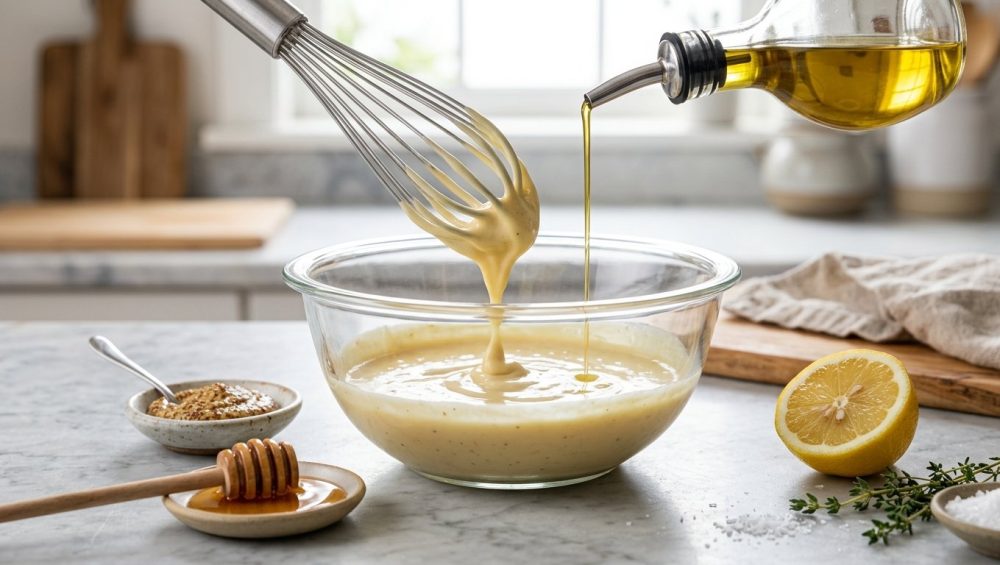
To build the emulsion, you need both hands. One hand will whisk vigorously, and the other will pour the oil. Because you do not have a third hand to hold the bowl, you need to use the damp towel trick. Wet a kitchen towel, wring it out completely, and twist it into a circle on your countertop. Nestle your stainless steel mixing bowl into the center of the towel ring. The bowl is now securely anchored and will not spin or slide away from you.
- The Base: Add your acid (vinegar/citrus), your emulsifier (Dijon mustard), your viscosity modifier (honey), and your salt and pepper to the bowl. Crucial scientific note: Salt only dissolves in water, not in oil. If you add the salt at the end, it will just sink to the bottom of the oil and remain gritty. You must dissolve it in the vinegar first.
- The Whisk: Whisk the base ingredients together until they are completely smooth and homogenous.
- The Slow Drizzle: This is the most important mechanical step. You must disperse the oil (the dispersed phase) into the vinegar (the continuous phase). If you dump all the oil in at once, the dressing will instantly drown and break. You must add the oil drop by drop at first. Whisk furiously. Once you see the mixture start to turn opaque and thicken—a sign that the emulsion is forming—you can increase the pour to a very slow, thin, steady stream. Never stop whisking.
- The Finish: Once all the oil is incorporated, the dressing should look thick, creamy, and glossy.
Troubleshooting: How to Rescue a Broken Emulsion
Sometimes, despite our best efforts, we rush the pour, or our ingredients are too cold (refrigerated olive oil thickens to a high viscosity, severely inhibiting droplet dispersion). The dressing breaks. Do not throw it away. You can easily rescue it.
The Boiling Water Hack
If the dressing has only slightly separated, you can often shock it back together using kinetic energy and heat. Add exactly one teaspoon of rapidly boiling water to the broken dressing and whisk it as fast as humanly possible. The intense heat lowers the surface tension of the oil just enough to allow the droplets to break apart and re-emulsify.
The Fresh Bowl Reset
If the dressing is a total, tragic disaster, you need to start over with a fresh continuous phase. Grab a clean bowl. Add one fresh teaspoon of Dijon mustard and one teaspoon of vinegar. Whisk them together. Now, treat your broken, separated dressing as if it were pure oil. Very slowly, drop by drop, whisk the broken dressing into the new mustard base. The fresh emulsifiers will grab onto the rogue oil droplets and pull the whole mixture back into a tight, glossy emulsion.
Designing the Ultimate Mindful Salad Bar
Now that you have mastered the science of the vinaigrette, it is time to put it to use. We are going to talk about hosting.
Beating the 2026 Hosting Anxiety Epidemic
Recent statistics paint a fascinating picture of modern socializing. According to a 2025 survey by Talker Research, a massive 72% of people now prefer staying in and hosting friends at home rather than going out to crowded, expensive restaurants. People are craving genuine community and intimate connection.
However, a parallel study revealed that 48% of people suffer from severe anxiety about hosting, and 33% are actively uncomfortable having a large group of people in their home. The pressure to perform, to cook a flawless multi-course meal, and to manage the timing of hot food is driving home cooks to the brink of a nervous breakdown.
Mastering the art of effortless hosting means prepping components ahead of time and relying on interactive, communal dining formats. The absolute best way to feed a crowd with zero stress is the Mindful Salad Bar. It is fresh, it caters to every single dietary restriction (vegan, gluten-free, keto—everyone is happy), and most importantly, 100% of the work is done before your guests even ring the doorbell.
The Prep Schedule: Because Time is Money
When discussing weeknight dinners or casual weekend entertaining, I firmly believe that time is money. You do not want to be trapped in the kitchen sweating over a hot stove while your friends are drinking wine in the living room. Here is your foolproof timeline for a Saturday night salad bar gathering:
Thursday:
- Make your vinaigrette. Because you used mustard and honey, the emulsion is rock solid and will easily hold in the fridge for days.
- If you are making a creamy dressing variation (like a buttermilk ranch), make that now too. Flavors deepen and mature in the fridge.
Friday:
- Wash and chop all your hardy vegetables (carrots, bell peppers, cucumbers, radishes). Store them in airtight glass containers with a slightly damp paper towel to maintain crispness.
- Prep your proteins. If you are serving grilled chicken, get it into a marinade. Remember, when using stainless steel pans for searing your salad proteins, ensure the pan is properly preheated to utilize the Leidenfrost effect, preventing the meat from sticking and tearing.
Saturday Morning:
- Wash your delicate greens. This is non-negotiable: you must use the absolute magic of a salad spinner to dry your greens. Oil and water repel each other. If your lettuce leaves are covered in residual rinse water, the vinaigrette will physically slide right off the leaves and pool at the bottom of the bowl. The greens must be bone dry.
- Set up your serving station. Pull out your bowls, serving spoons, and plates.
Saturday Evening (1 Hour Before Guests Arrive):
- Cook your proteins, let them rest, and slice them.
- Pull your dressings out of the fridge so the oil can come up to room temperature.
- Pour yourself a glass of wine. You are completely done.
Staging the Ingredients
A proper salad bar requires architectural staging. You want to guide your guests through the line logically.
- The Base: Offer two types of greens. One tender (spring mix, butter lettuce) and one sturdy (chopped romaine, massaged kale).
- The Bulk: Roasted sweet potatoes, quinoa, or chickpeas. This grounds the salad and makes it a filling meal rather than a side dish.
- The Fresh Crunch: Cucumbers, cherry tomatoes, shaved red onion, bell peppers.
- The Sweet & Salty: Dried cranberries, fresh apple slices, crumbled feta, shaved parmesan, olives.
- The Heavy Protein: Sliced grilled chicken, hard-boiled eggs, baked tofu.
- The Texture Toppers: Toasted almonds, sunflower seeds, crispy croutons.
- The Dressings: Placed at the very end of the line, alongside a pair of tongs for tossing.
Equipment Recommendations: Safe, Durable, and Actually Useful
As I mentioned during my anti-Teflon rant, curating a beautifully organized dream kitchen requires ditching toxic tools and investing in gear that actually works. You do not need a lot of equipment to make a perfect vinaigrette, but the tools you do use need to be high quality.
The Mixing Bowls
Avoid plastic mixing bowls at all costs. Plastic is lipophilic (oil-loving). It absorbs fats and holds onto them, which is why if your plastic containers stay greasy after storing leftover vinaigrette, it is almost impossible to scrub them clean. Furthermore, plastic easily scratches, harboring bacteria.
Invest in a nested set of thick, tempered glass bowls or heavy-gauge stainless steel bowls. They are non-porous, completely unreactive to the high acidity of vinegar, and can be easily sterilized in the dishwasher.
The Whisks
You need a French whisk or a balloon whisk made of uncoated stainless steel. A French whisk has a narrower profile and stiffer wires, which is fantastic for aggressively shearing oil into tiny droplets. A balloon whisk has a wider, more bulbous shape, which is great for incorporating air. Either will work beautifully, provided the handle is completely sealed so dirty dishwater cannot seep inside and breed mold.
The Storage Bottles
Store your finished vinaigrettes in glass bottles or mason jars with tight-fitting lids. Glass will not leach chemicals into your highly acidic dressing, and it allows you to easily see if the emulsion has held or if it needs a quick, vigorous shake before serving.
Conclusion
Cooking does not have to be a stressful, chaotic chore, and entertaining certainly does not require you to sacrifice your sanity. By understanding the simple, molecular science of how oil and water interact, you can banish broken, greasy dressings from your kitchen forever. You now know how to leverage the mucilage in mustard, how to properly execute a slow-drizzle mechanical emulsion, and exactly why you need to throw those toxic, peeling non-stick whisks directly into the trash.
More importantly, you know how to host a relaxed dinner party without suffering a nervous breakdown. A mindful, prep-ahead salad bar removes the pressure of timing hot dishes and allows you to actually sit down, have a drink, and enjoy the company of your friends. And if you want to take that salad bar to the absolute next level, try utilizing the magic of a yogurt marinade to keep your chicken juicy and flavorful before searing it off.
You have the science, you have the strategy, and you have the sass. Now get into the kitchen, grab a stainless steel whisk, and go make something spectacular. You’ve got this.