Picture this: It is 6:30 PM on a Tuesday. You are standing in your kitchen, staring down a cutting board, armed with a knife you bought on clearance five years ago, preparing to tackle a mountain of aromatics for a simple weeknight bolognese. Two minutes later, your mascara is running down your face, your eyes feel like they have been pepper-sprayed, and you are blindly waving a kitchen towel in the air like you are surrendering to the vegetable kingdom. We have all been there. It is the universal culinary tragedy that unites weekend hobbyists and seasoned home cooks alike.
But here is the brutally honest truth that nobody wants to admit: it is not the onion’s fault. It is yours. More specifically, it is your offensively dull knife.
If you want to stop weeping over onions, you need to stop treating your kitchen tools like indestructible crowbars and start understanding the actual physics of your prep work. You absolutely do not need an expensive culinary degree to cook like a Michelin-starred chef in your own home, but you do need to maintain your gear. Consider this comprehensive masterclass your ultimate kitchen survival guide to defeating the dreaded onion tear-gas attack once and for all. We are going to dive deep into the botanical biology of the onion, the complex chemical warfare it wages against your corneas, and the precise physical mechanics of why a dull blade is your kitchen’s greatest enemy.
The Botanical Bully: Why Onions Evolved to Make Us Suffer
Before we can effectively fix the problem, we need to respect the enemy. The common onion (Allium cepa) is a botanical marvel that has been cultivated by humans for millennia. But long before it was the flavor base for every great soup, stew, and sauce in human history, it was just a vulnerable bulb trying to survive in the wild.
Because an onion grows underground, it is entirely stationary. It cannot run away from hungry voles, grubs, foraging mammals, or insects. To ensure its survival, the onion evolved a highly sophisticated, microscopic chemical weapons defense system. It is a biological booby trap designed to inflict immediate, searing pain on anything foolish enough to take a bite out of it.
As the onion grows in the soil, it acts like a sponge, aggressively absorbing sulfur from the surrounding dirt. The plant metabolizes this raw sulfur and converts it into a highly specialized class of sulfur-rich amino acids. These amino acids are stored safely inside the onion’s cellular structure, waiting in absolute silence until the plant is attacked. When you slice into an onion, you are not just prepping dinner; you are breaching a heavily fortified biological bunker, triggering a defense mechanism that has been perfected over millions of years of evolution.
A Masterclass in Chemical Warfare
Let us get into the hardcore food science, because understanding the underlying chemistry is the very first step to conquering it. The tear-inducing reaction does not happen by magic; it is a rapid, multi-stage enzymatic cascade.
The Cellular Booby Trap
Inside the microscopic cells of an onion, there are tiny, pressurized, balloon-like compartments called vacuoles. These vacuoles act like microscopic glass vials holding an enzyme called alliinase. Floating around in the cytoplasm outside these vacuoles are those sulfur-rich amino acids the plant worked so hard to build, primarily one called isoalliin (S-1-propenyl-L-cysteine sulfoxide).
As long as the onion is whole and intact, the enzyme and the amino acid remain peacefully separated by the vacuole membrane. But the exact moment you rupture the cell wall—whether you are a hungry rodent sinking your teeth in, or a home cook hacking away with a blunt blade—the biological alarm is tripped. The cell walls collapse, the vacuoles burst open, and the alliinase enzyme violently floods out, mixing with the isoalliin in the cytoplasm. This immediate, highly reactive combination produces a highly unstable compound known as 1-propenyl sulfenic acid.
The 2002 Discovery That Changed Everything
For decades, the global scientific community thought that was the end of the story. Chemists widely believed that this unstable sulfenic acid simply degraded spontaneously on its own, turning into the gas that makes us cry. But science is rarely that simple, and the onion is far more devious than we gave it credit for.
In 2002, a groundbreaking study published in the prestigious journal Nature by Japanese researcher Shinsuke Imai and his team revealed a massive missing link. They discovered a previously completely unknown enzyme hiding in the onion’s chemical arsenal, which they aptly named lachrymatory factor synthase (LFS).
This sneaky LFS enzyme acts as a biological catalyst. It intercepts the unstable sulfenic acid and rapidly converts it into a highly volatile, airborne sulfur compound called syn-propanethial-S-oxide. This chemical is a true lachrymator—a literal tear-inducing agent. Because it is an incredibly volatile gas, it immediately aerosolizes upon creation, floating up from your cutting board and making direct contact with the moisture layer protecting your corneas.
The Final Reaction: Acid in Your Eyes
When syn-propanethial-S-oxide hits the water in your eyes, it undergoes one final, agonizing chemical reaction: it hydrolyzes to form trace amounts of actual sulfuric acid. Yes, you read that correctly. By chopping an onion improperly, you are effectively creating a weak acid bath directly on your own eyeballs.
Your nervous system instantly panics. The ciliary nerves in your cornea fire off frantic warning signals to your brain, alerting it to chemical damage. In response, your brain commands your lachrymal glands to go into absolute overdrive, desperately flushing the acid out with a flood of reflex tears. You are not crying because you are sad; your body is executing a frantic emergency flush to save your vision.
Not All Onions Are Created Equal: The Sulfur Spectrum
It is worth noting that not every onion will wage the same level of chemical warfare against you. Because the entire reaction relies on the sulfur the onion absorbs from the soil, the tear-inducing potency of an onion is directly tied to its specific variety and where it was grown.
Standard yellow onions and pungent red onions are notorious for having incredibly high concentrations of sulfur compounds. They are the heavy artillery of the Allium family and will make you weep instantly if you disrespect them with a bad knife. White onions are slightly milder but still pack a punch.
On the other end of the spectrum are sweet onions, such as Vidalia, Walla Walla, or Maui onions. These varieties are intentionally cultivated in soil that has an exceptionally low sulfur content. Because the plant simply does not have access to the raw materials needed to build its chemical weapons, sweet onions contain far less isoalliin. You can often chop a Vidalia onion with relative ease, but they lack the sharp, intense flavor profile required for robust cooking, making them better suited for raw applications like salads or sandwiches. If you are cooking a rich, deeply flavored dish, you need the sulfur-heavy yellow or red onions, which means you need to perfect your cutting technique.
The Physics of the Cut: Slicing vs. Crushing
Now that you understand the microscopic chemical warfare happening on your cutting board, let us talk about why your specific knife is making the situation ten times worse. The total amount of tear-inducing gas released into the air is directly proportional to the total number of onion cells you rupture. This is where the physics of blade geometry comes into play.
Microscopic Carnage: What a Dull Knife Actually Does
Under an electron microscope, a truly sharp, well-maintained knife edge looks like a perfectly aligned, microscopic V-shape. It is a precision instrument designed to cleanly cleave through cellular walls, parting the molecular structure of the food with minimal collateral damage.
A dull knife, on the other hand, looks like a jagged, flattened, rolled-over speedbump. When you bear down on an onion with a dull knife, you are not actually slicing; you are bludgeoning. You are applying immense downward force to compensate for the lack of a sharp apex. Instead of cleanly parting a single, narrow layer of cells, the blunt edge forcefully crushes, tears, and mashes thousands of surrounding cells into a pulpy, bruised mess.
Remember those microscopic vacuoles holding the alliinase enzyme? A sharp knife silently slices through a highly localized, narrow path of them. A dull knife acts like a steamroller, detonating a massive, wide-scale explosion of vacuoles across multiple layers of the onion. You are essentially maximizing the chemical reaction, generating an overwhelming, concentrated cloud of syn-propanethial-S-oxide.
The Aerosol Effect: Launching the Attack
The damage caused by a dull blade goes far beyond just crushing cells. A fascinating study published in the Proceedings of the National Academy of Sciences (PNAS) utilized high-speed cameras to track the microscopic droplets of onion juice ejected during chopping.
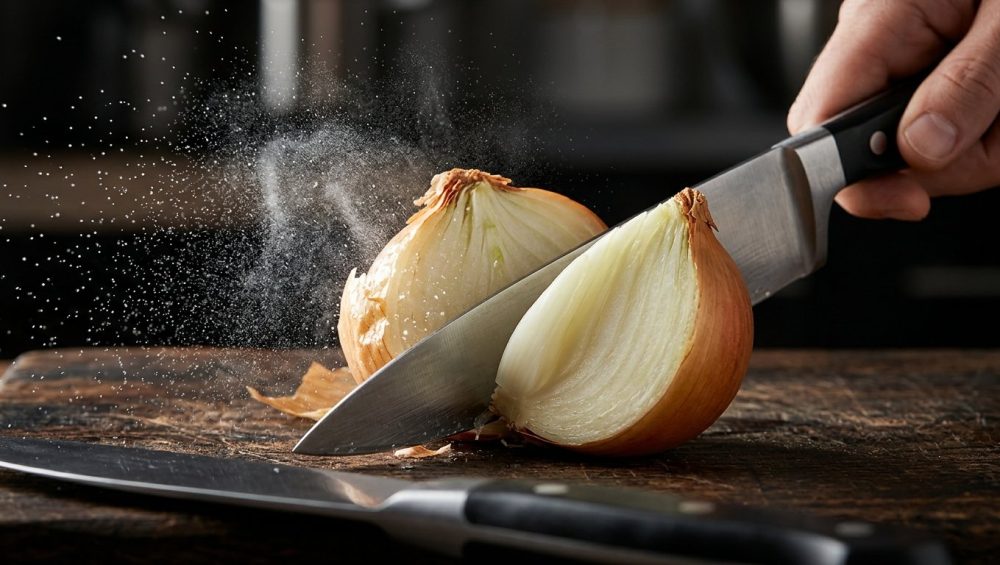
The researchers proved that a dull blade, combined with a forceful, aggressive chopping motion, literally launches a fine mist of this tear-inducing chemical high into the air, projecting it directly into the cook’s face. Because the blunt blade wedges the onion apart rather than slicing it, the mechanical force propels the juice upward. By utilizing a razor-sharp blade and a smooth, gliding slicing motion, the aerosolized spray is drastically reduced, keeping the volatile compounds closer to the board and away from your eyes.
The “No-Go” Zone: Toxic Gear and Gimmicks You Need to Trash
As your sassy culinary cheerleader, I am here to empower you, but I am also here to give you some tough love. Time is money, and cooking with garbage tools is a massive waste of both. I have a strict “No-Go” rule when it comes to cheap, toxic, or gimmicky kitchenware. It is time for you to finally banish toxic kitchen gear from your life forever, because it is actively sabotaging your meals and your sanity.
The Infomercial “Never Needs Sharpening” Scam
If you bought a set of brightly colored, plastic-handled knives from a late-night infomercial or a big-box discount bin, do yourself a favor and throw them away immediately. These knives are almost always stamped from low-grade, mystery-metal stainless steel that ranks abysmally low on the Rockwell Hardness Scale (HRC). Because the steel is so remarkably soft, the microscopic edge rolls over and degrades almost instantly.
To compensate for this terrible metallurgy, manufacturers often give them a micro-serrated edge and market them with the outright lie that they “never need sharpening.” The truth is, they cannot be sharpened because the steel is absolute junk. They rip and tear through food like a microscopic chainsaw, maximizing your onion tears and destroying the cellular integrity of your fresh produce.
Worse yet, many of these cheap knives are heavily coated in non-stick paints or brightly colored synthetic resins to make them look aesthetically pleasing. As you drag these dull, dragging blades forcefully through hard root vegetables, that toxic coating micro-chips and peels right off into your food. You absolutely do not want mystery polymers and cheap paint in your weeknight dinners.
Glass Cutting Boards: The Ultimate Edge Destroyers
You could own a stunning, hand-forged Japanese chef’s knife worth hundreds of dollars, but if you are cutting on a glass, marble, or granite cutting board, you are destroying your blade in a matter of seconds. Glass and stone are significantly harder than steel. Every single time the knife strikes the glass board, the fragile microscopic apex of the blade flattens, rolls, and chips. It is the culinary equivalent of driving a luxury sports car over a police spike strip.
Even highly-rated bamboo boards are a massive problem. Bamboo is technically a grass, not a wood, and it contains high levels of hard silica. Furthermore, bamboo boards are manufactured by gluing hundreds of small strips together, meaning your knife is constantly striking hardened resin glues. This constant abrasion is notoriously harsh on edges, actively ruining your knives over time.
If you want to protect your blade, you must stick to a high-quality end-grain wooden cutting board made from maple, walnut, or cherry. Alternatively, invest in a professional-grade rubberized board (like a Hasegawa or Asahi). These materials are soft enough to absorb the impact of the blade, preserving the microscopic edge and keeping your cuts clean, precise, and tear-free.
The Sassy Sous-Chef’s Definitive Guide to Blade Maintenance
You do not need to be a grizzled blacksmith or a professional knife maker to maintain a sharp edge. You just need to understand the fundamental difference between daily maintenance and actual sharpening. This is exactly why your knives go dull so fast: you are skipping the most basic step of kitchen prep.
Honing vs. Sharpening: Stop Confusing the Two
The single biggest rookie mistake in the home kitchen is confusing a honing rod with a knife sharpener. That long, heavy, ribbed steel rod that came with your knife block? It does not actually sharpen your knife.
As you chop vegetables, the microscopic apex of your knife blade takes a beating. It bends, folds, and rolls over to one side. To your hand, the knife feels incredibly dull, but the metal is actually still there; it is just out of alignment. A honing rod is designed to gently push that microscopic rolled edge back into a perfect, straight alignment. You should be honing your knife every single time you cook. It takes exactly ten seconds, and it is non-negotiable.
However, there is a catch. If you are using a high-hardness Japanese blade, like those beautiful super steel kitchen knives, you must ditch the grooved metal honing steel immediately. Japanese steel is incredibly hard (often 60+ on the HRC scale), which allows it to hold a razor edge for a long time, but it makes the steel more brittle. A ribbed metal rod can actually catch and chip the brittle edge. Upgrade to a smooth ceramic honing rod, which is gentle enough to align the edge but hard enough to handle premium metallurgy without causing micro-fractures.
When It’s Time to Actually Sharpen
Eventually, through months of use, the microscopic edge wears away entirely, and no amount of honing will bring it back. That is when you need to actually sharpen the blade, which involves physically grinding away old steel to create a brand-new, razor-thin apex.
For the weekend culinary hobbyist, I highly recommend learning to use a whetstone. A 1000/3000 grit combination water stone is absolutely perfect for beginners. The 1000-grit side removes material to establish a new edge, and the 3000-grit side polishes that edge to a razor finish. It sounds intimidating, but watching a few tutorials and practicing on an old knife is incredibly meditative and deeply satisfying.
If you absolutely refuse to learn how to use a whetstone, that is totally fine—but you must outsource the job. Find a reputable local professional knife sharpener (check your local farmers’ market, butcher shop, or high-end kitchen supply store) and drop your primary knives off twice a year. The ten or fifteen dollars you spend to professionally sharpen your chef’s knife will pay for itself a hundred times over in the sheer amount of time, frustration, and literal tears you will save.
Practical Prep Hacks: Maximizing Efficiency Because Time is Money
A razor-sharp knife is your primary weapon against onion tears, but because I am utterly obsessed with efficiency, I am going to give you a few more foolproof cooking secrets to completely neutralize the chemical threat.
Thermodynamics and The Cold Onion Trick
You have probably heard a million ridiculous old wives’ tales about how to stop crying while cutting onions: chew a piece of mint gum, hold a wooden matchstick between your teeth, put a piece of bread in your mouth, or wear ridiculous swimming goggles. With the exception of the goggles (which do provide a physical barrier but look completely absurd), they are all absolute nonsense. But there is one hack that is firmly rooted in thermodynamic science: chilling the onion.
Remember our chemical enemy, syn-propanethial-S-oxide? It is a volatile gas. In the realm of physics, the volatility of a chemical—meaning how quickly it evaporates and becomes airborne—is directly linked to its temperature. Heat increases kinetic energy, causing the gas molecules to rapidly expand, bounce around, and fly up into your face. Cold, on the other hand, dramatically slows down molecular movement.
By placing your onions in the refrigerator for 30 to 45 minutes before you need to chop them, you significantly lower the temperature of the internal chemistry. When you slice into the chilled onion, the tear-inducing gas is sluggish, dense, and heavy. It stays much closer to the cutting board instead of rocketing up to your corneas. It is a simple, zero-effort trick that uses basic thermodynamics to save your eyes.
Proper Chopping Technique (Save Your Fingers and Your Eyes)
Even with a sharp knife and a cold onion, your physical technique matters immensely. Stop hacking at the onion haphazardly like you are chopping firewood.
First, cut off the stem end, but leave the hairy root end entirely intact. The root of the onion contains the absolute highest concentration of sulfur compounds. By leaving it whole and uncut until the very end, you keep the largest chemical bomb safely contained.
Halve the onion from the stem to the root, peel back the papery skin, and place the flat side down on your board to create a stable base. Adopt the classic “claw grip” with your non-dominant hand: curl your fingertips inward like a bear claw, resting your knuckles against the flat side of the knife blade. This acts as a physical guide for the knife and ensures you will never accidentally slice off a fingertip.
Make horizontal slices toward the root (without cutting all the way through it), then make vertical slices, and finally chop across to create perfectly uniform, beautiful dice. Because your knife is sharp, you should be using a smooth, forward-gliding motion, letting the blade do the work rather than forcing it down with your body weight.
And when it is finally time to transfer those perfectly diced onions to your hot skillet, for the love of all things holy, do not drag the sharp, delicate edge of your knife across the wooden board to scoop them up. You are instantly destroying the microscopic edge you just worked so hard to maintain. Instead, you need a bench scraper. It is a cheap, five-dollar piece of flat stainless steel that will scoop up a massive amount of ingredients, save your knife edge, and drastically speed up your prep time.
Conclusion: Conquer the Cutting Board
Cooking should be a joyous, creative release at the end of a long, stressful workday. It should not be a frustrating endurance test that leaves you weeping over a cutting board, dreading the simple act of preparing a meal. The difference between cooking feeling like a stressful, chaotic chore and an effortless, deeply rewarding culinary experience almost always comes down to the quality and maintenance of your tools.
You do not need a culinary degree to make mind-blowing food. You just need to respect the science of your ingredients and refuse to settle for dull, toxic, inadequate gear. Take fifteen minutes this weekend to seriously evaluate your knife block. Toss the gimmicky infomercial junk in the trash, buy a decent ceramic honing rod, and get your primary chef’s knife professionally sharpened.
Once you experience the sheer, effortless glide of a razor-sharp blade cleanly cleaving through an onion without a single tear being shed, you will never look back. Maintain your gear, protect your eyes, and eliminate kitchen chaos once and for all. Now, pour yourself a large glass of wine, grab that freshly honed blade, and go show those aromatics exactly who is boss.