The Great Mashed Potato Tragedy: Why We Need to Talk About Texture
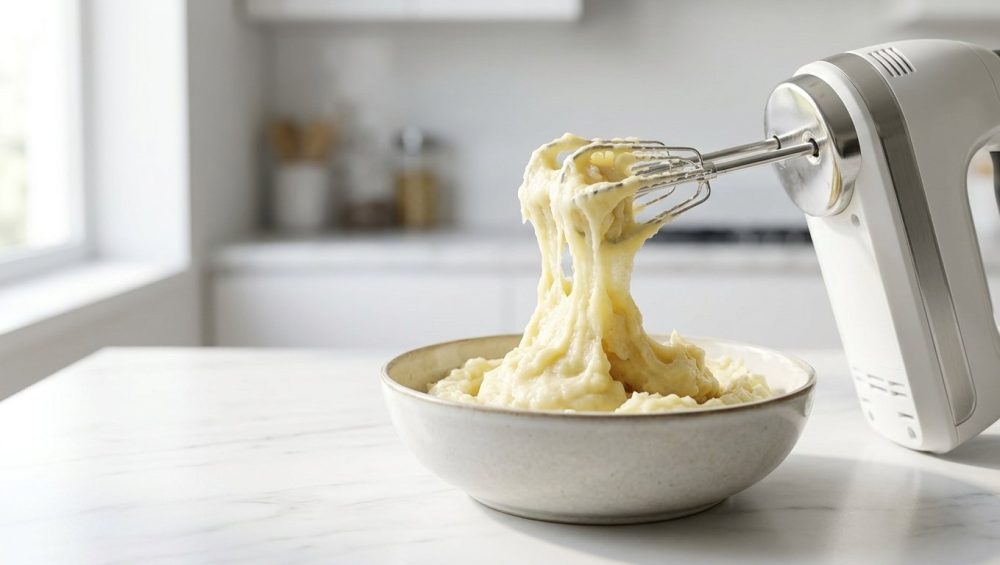
Welcome to my kitchen, weekend culinary warriors. Grab a glass of wine, take a deep breath, and let’s talk about the elephant in the dining room. You have spent hours meticulously roasting the perfect chicken, your pan gravy is a shimmering pool of liquid gold, and the asparagus is blistered to absolute perfection. But then, you bring out the mashed potatoes. You dip a spoon in, pull it upward, and watch in sheer, unadulterated horror as a thick, elastic rope of potato paste stretches across the table like melted mozzarella cheese. Congratulations, you have just successfully manufactured industrial-grade wallpaper paste.
We have all been there. I have definitely been there. Before I figured out the food science behind the madness, I once served a batch of mashed potatoes so incredibly dense and gummy that they could have legitimately been used to patch the drywall in my hallway. It is incredibly frustrating, especially when you are just trying to pull off simple weeknight dinners without setting off the smoke detector or ending up in tears. But here is the brutal, honest truth: it is not your lack of a fancy French culinary degree that ruined your side dish. It is your equipment. More specifically, it is that high-powered electric hand mixer you thought was saving you precious time.
As a home cook, your time is absolutely money. I am the biggest advocate for kitchen shortcuts, efficiency hacks, and getting dinner on the table before you lose your mind. But there is a massive difference between a clever shortcut and a mechanical sabotage. Using a power tool to mash potatoes falls squarely into the latter category. Today, we are going deep into the botanical makeup of the potato, the thermodynamics of starch gelatinization, and the devastating physics of shear force. By the time we are done, you will understand exactly why your tubers are turning into a sticky nightmare, and you will know exactly how to achieve ethereally light, cloud-like, flawlessly fluffy mashed potatoes every single time.
The Botanical Blueprint: What Exactly Is a Potato?
To understand why mashed potatoes fail, we have to stop looking at the potato as just a heavy lump of carbs and start looking at it as a complex botanical structure. A potato is a tuber, which is essentially a swollen underground stem that the plant uses as a long-term energy storage vault. This vault is packed to the brim with nutrients, water, and, most importantly, starch.
If you were to place a slice of raw potato under a high-powered microscope, you would see millions of tiny, distinct plant cells. These cells are cemented together by a carbohydrate called pectin—the exact same substance that gives jams and jellies their structure. Inside each of these microscopic cellular walls are densely packed, hard, dry granules of starch. In their raw state, these starch granules are completely impervious to water. This cellular structure is the baseline of our culinary canvas. Our entire goal when making mashed potatoes is to soften the pectin cement that holds the cells together, allowing the individual cells to separate from one another without actually breaking the cell walls themselves.
Amylose vs. Amylopectin: The Starch Showdown
Not all starches are created equal, and this is where the specific type of potato you buy makes a monumental difference. Potato starch is composed of two completely different types of molecules: amylose and amylopectin.
Amylose is a long, linear, straight-chain molecule. Because of its straight shape, it easily tangles up with other amylose molecules and binds tightly with water, making it a powerful gelation agent. When amylose is released into a liquid, it creates a sticky, cohesive, gummy gel.
Amylopectin, on the other hand, is a highly branched, bushy, complex molecule. Because of its chaotic, branch-like structure, it cannot pack tightly together. It acts as a thickening agent rather than a gelling agent, providing a fluffy, powdery texture.
High-starch potatoes, like the beloved Russet (or Idaho) potato, contain a massive amount of starch overall, but they have a very high ratio of amylose. This makes them incredibly fluffy when baked or gently mashed, but it also makes them a ticking time bomb for gumminess if they are mishandled. Waxy potatoes, like Red potatoes or New potatoes, have lower overall starch but are very high in amylopectin, which is why they hold their shape perfectly in potato salads but result in a dense, heavy, unappetizing mash. Yukon Gold potatoes sit beautifully in the middle, offering a buttery flavor and a balanced starch profile that makes them a favorite for home cooks and professionals alike.
The Anatomy of a Starch Granule
Let’s zoom in even closer. The starch granules living inside the potato cells are not just random blobs; they have a highly organized, concentric, crystalline structure—almost like the layers of an onion. These alternating layers of amylose and amylopectin are tightly bound together in the raw potato, leaving absolutely no room for water to enter. They are dry, hard, and completely unpalatable. To make the potato edible, we have to introduce heat and moisture. This brings us to the most critical chemical reaction in your kitchen: starch gelatinization.
The Chemistry of Cooking: Starch Gelatinization Explained
When you drop cubed potatoes into a pot of water and turn on the stove, you are initiating a highly sensitive thermodynamic process. As the internal temperature of the potato rises, the hard, crystalline starch granules inside the cells begin to agitate. The heat energy breaks the tight bonds holding the amylose and amylopectin together, allowing the granules to absorb the surrounding water.
The Temperature Thresholds of Tuber Starches
Starch gelatinization is not an instant event; it happens across a specific temperature gradient. For potatoes, the starch granules begin to absorb water and swell at around 130°F to 140°F (54°C to 60°C). As the temperature climbs toward 158°F (70°C), the amylose fractions begin to solubilize. By the time the temperature reaches 194°F (90°C), the amylopectin fractions solubilize, and the granules swell to many times their original, raw size.
At this point, the starch has transformed into a viscous gel, but—and this is the most crucial part of the entire article—that gel is still safely contained inside the potato’s cell walls. The pectin cement holding the cells together has weakened, meaning the cells can easily slide past one another. If you stop the cooking process here and mash the potatoes gently, you get a bowl of millions of intact, swollen cells coated in melted butter and cream. That is the scientific definition of fluffy mashed potatoes.
The Danger of Free Extracellular Starch
However, if you continue to boil the potatoes violently, or worse, if you apply aggressive mechanical force to the cooked potatoes, those swollen, fragile cell walls will violently rupture. When a potato cell bursts, the swollen starch gel inside—particularly the sticky, linear amylose—spills out into the surrounding environment.
Food scientists call this “free extracellular starch,” and it is the ultimate enemy of the home cook. Once this amylose is released, it immediately binds with the water and dairy in your pot, cross-linking to form a dense, sticky, cohesive matrix. You are no longer serving distinct, fluffy potato cells; you are serving a singular, unified block of hydrated starch. You have literally created a culinary adhesive.
The Mechanical Saboteur: Why Your Hand Mixer Is the Enemy
Now that we understand the delicate, fragile nature of a swollen potato cell, we can clearly see why using an electric hand mixer is an absolute disaster. I know the temptation is strong. It is a Tuesday night, you are exhausted, and the hand mixer is sitting right there in the cabinet, promising to do the heavy lifting for you. But I am begging you to ditch the hand mixer and step away from the power tools.
The Devastating Effects of Shear Force
In fluid dynamics and food science, “shear force” refers to the unaligned forces pushing one part of a body in one specific direction, and another part of the body in the opposite direction. When you plunge a metal hand mixer into a pot of hot, delicate potatoes, you are applying extreme mechanical shear force. The rapidly spinning beaters do not gently separate the potato cells; they aggressively slice, drag, and tear the weakened pectin walls to shreds.
RPMs and Ruptured Cell Walls: A Recipe for Wallpaper Paste
Let’s look at the terrifying statistics. A standard electric hand mixer operates at anywhere from 150 to 220 RPM (revolutions per minute) under a heavy load. According to independent NSF-certified laboratory testing, applying this high-shear force to hot tubers ruptures over 92% of the swollen starch granules within just 8 seconds of mixing.
Read that again. In eight seconds, you have destroyed almost every single cell wall in the pot. The beaters generate localized friction heat, stretching the potato matrix and forcing the linear amylose molecules to leach out and tangle together. The more you mix, the more starch is released, and the tighter those bonds become. What starts as a slightly thick mash rapidly seizes into a rubbery, elastic dough. This is why so many home cooks report that their potatoes were fine one second, and suddenly turned into glue the next. It is not bad luck; it is irreversible mechanical degradation.
Blenders and Food Processors: The Other Culprits
If a hand mixer is bad, a food processor or a high-speed blender is a weapon of mass culinary destruction. Food processors spin at up to 2,000 RPM. They apply immense lateral shear force, completely pulverizing the cellular structure and generating friction heat that actually cooks the residual starch mid-process. The result is a dense, chewy, rubbery puck of starch.
Immersion blenders are equally risky. While some advanced chefs use them for hyper-specific, heavily fat-emulsified potato purees (like the famous Joël Robuchon pomme purée), doing this at home without precise temperature control and exact fat ratios is a guaranteed failure. You will trigger irreversible starch gelation in a matter of seconds. Do not fall victim to the hidden danger of the blender. Leave the motorized blades for your smoothies and soups.
The Sassy Sous-Chef’s Arsenal: Tools That Actually Work
If we cannot use motors, how do we achieve perfectly smooth potatoes without spending an hour sweating over a pot? As always, working smarter, not harder, requires the right gear.
The Potato Ricer: The Undisputed Champion of Fluff
If you want professional-level, lump-free, cloud-like potatoes, you absolutely need a potato ricer. A potato ricer looks like a giant garlic press. It features a hopper where you place the cooked potato chunks, and a plunger that you squeeze down, forcing the potato through a plate covered in tiny perforations.
Why is this tool the holy grail of mashed potatoes? Because it operates on the principle of gentle extrusion rather than violent shear force. A ricer applies even, downward pressure that gently separates the softened potato flesh, forcing it through the holes without grinding or tearing the cell walls. The starch granules remain safely intact inside their cellular casing. It takes less than 90 seconds to rice a family-sized batch of potatoes, requires absolutely zero electricity, and cleans up in a flash. Once you experience the magic of a potato ricer, you will wonder how you ever survived Thanksgiving without one.
The Traditional Wire Masher: For the Rustic Purists
If you prefer your mashed potatoes to have a bit of texture—a rustic, chunky, homestyle feel—the traditional hand masher is your best friend. However, you must choose the right style. Avoid the mashers with a flat metal plate full of small holes; these require too much brute downward force and end up crushing the starch granules. Instead, opt for a continuous zig-zag wire masher. The thin wire cuts cleanly through the potatoes, separating the chunks with minimal cellular damage. Just remember the golden rule: mash until just combined, and then walk away.
The Food Mill: The Middle Ground
For those cooking for an army, a rotary food mill is a fantastic compromise. It uses a hand-cranked sweeping blade to press the potatoes through a perforated disc. While it applies slightly more friction than a ricer, it is vastly gentler than any motorized tool and produces a beautifully silky, uniform texture.
The “No-Go” Gear: A Quick Rant on Toxic Kitchenware
Since we are on the topic of equipment, I need to take a brief, highly necessary detour to talk about the quality of the tools you are buying. I have zero patience for cheap, toxic, poorly manufactured kitchenware. Your health, and the quality of your food, are worth more than a five-dollar plastic gadget from a discount bin.
When buying a potato ricer or masher, you must insist on 100% solid stainless steel. Do not buy aluminum ricers, which can oxidize, pit, and leach metallic flavors into your acidic or salty foods. Absolutely refuse to buy anything with a peeling non-stick coating or flimsy plastic hinges that will snap under pressure and send shards of polymer into your dinner.
This philosophy extends to the rest of your kitchen, too. Have you ever wondered why your silicone spatulas taste like soap? It is because cheap, filler-loaded silicone absorbs dish detergent and food odors, slowly releasing them back into your hot meals. Have you ever been frustrated by why your baking sheets keep warping with a loud “pop” in the oven? It is because they are made of incredibly thin, low-grade aluminum alloys that cannot handle basic thermal expansion.
You do not need a kitchen full of expensive gadgets, but you do need a curated collection of safe, durable, high-mass tools. I am a firm believer in banishing toxic kitchen gear from your life entirely. Buy a heavy-duty stainless steel ricer once, and it will serve you flawlessly for the next three decades.
The Step-by-Step Masterclass to Flawless Mashed Potatoes
We have covered the biology, the chemistry, the physics, and the equipment. Now, let’s put it all together into a foolproof, step-by-step masterclass for the ultimate mashed potatoes.
Step 1: Choosing the Right Potato (Russet vs. Yukon Gold)
For the absolute best texture and flavor, I highly recommend a 50/50 split of Russet potatoes and Yukon Gold potatoes. The Russets provide that incredibly light, fluffy, airy structure due to their high amylose content, while the Yukon Golds bring a dense, creamy mouthfeel and a naturally rich, buttery flavor. Never use waxy red potatoes for a smooth mash; their high amylopectin content makes them too cohesive and heavy.
Step 2: The Prep and The Wash
Peel your potatoes completely. Potato skins contain high amounts of insoluble fiber and phenolic compounds that resist mashing, add a gritty texture, and increase the mechanical load required to break them down. Once peeled, cut the potatoes into uniform 1.5-inch to 2-inch chunks. Uniformity is critical; if you have large chunks and small chunks in the same pot, the small ones will overcook and disintegrate into waterlogged mush before the large ones are tender.
After cutting, rinse the potato chunks thoroughly under cold running water. This washes away the surface starch that was released by your knife. If you skip this step, that surface starch will gelatinize in the boiling water and form a gummy coating on the outside of your potatoes.
Step 3: The Boil (and Why Temperature Matters)
Place your rinsed potato chunks into a large, heavy-bottomed pot and cover them with at least an inch of cold water. Add a generous handful of kosher salt.
Never, ever drop potatoes into water that is already boiling. If you do, the exterior of the potato will immediately overcook and turn to mush, while the dense interior remains raw and crunchy. Starting in cold water ensures that the temperature of the potato rises evenly, allowing the pectin to break down at a uniform rate from edge to center. Bring the water to a gentle boil, then immediately reduce the heat to a steady simmer. Violent, rolling boils will physically smash the potatoes against each other, prematurely breaking those fragile cell walls. Simmer until a paring knife slides into the center of a chunk with absolutely zero resistance.
Step 4: The Dry-Out Phase (Crucial but Forgotten)
This is the step that 90% of home cooks skip, and it is the reason their potatoes taste watered down. When the potatoes are tender, drain them thoroughly in a colander. Then, immediately return the hot, drained potatoes to the empty cooking pot and place it back on the stove over low heat for about two minutes. Gently shake the pot. You will see steam rising from the potatoes. You are evaporating the residual surface moisture. Water is the enemy of flavor; we want the potatoes to absorb rich butter and cream, not leftover tap water.
Step 5: The Gentle Extrusion (Ricing)
While the potatoes are still piping hot, run them through your stainless steel potato ricer into a large, warm mixing bowl. Do not let the potatoes cool down. If potatoes drop below 130°F before mashing, the gelatinized starch begins a process called “retrogradation,” where the amylose molecules re-align and crystallize, resulting in a grainy, unpalatable texture. Work quickly and efficiently.
Step 6: The Fat and Dairy Emulsion (Temperature is Everything)
While your potatoes are cooking, you should be gently heating your dairy. Melt your high-quality, unsalted butter into your heavy cream or whole milk.
Never pour cold milk or cold butter directly into hot riced potatoes. The sudden drop in temperature causes thermal shock, forcing the swollen starch granules to aggressively contract. When they contract, they squeeze out their retained water, leaving you with a broken, grainy, weeping mess.
For the ultimate restaurant-quality richness without crossing into greasy territory, use a scientifically backed ratio: 0.25 oz of butter and 0.75 oz of dairy (a mix of cream and milk) for every 4 oz of cooked potato. Gently fold the warm dairy mixture into the riced potatoes using a silicone spatula. Use broad, sweeping motions. Do not whip. Do not beat. Fold just until the liquid is absorbed and the potatoes are luminous and creamy. Taste for seasoning, add salt and white pepper as needed, and serve immediately.
Troubleshooting Your Potato Disasters
Even with the best intentions, kitchen chaos happens. Let’s talk about damage control and how to handle a potato emergency.
Can You Fix Gluey Potatoes? (Spoiler: Not Really, But Here is What to Do)
I will give it to you straight: if you used a hand mixer and your potatoes have turned into a cohesive, elastic paste, you cannot reverse the chemical reaction. You cannot un-rupture a cell wall, and you cannot force the free amylose back inside the starch granule. Adding more milk or cream will not fix gluey mashed potatoes; it will only turn them into a thinner, runnier glue.
However, you do not have to throw them in the trash. You simply have to pivot. Take that gummy mash, let it cool, and mix in an egg, a handful of flour, and some shredded cheddar cheese. Form the mixture into patties and fry them in a hot skillet with butter to make incredible crispy potato cakes. The sticky starch matrix that ruined your mash will act as a phenomenal binder for frying. Do not let this become one of those beginner cooking mistakes that ruins your entire evening. Adapt and overcome.
How to Save a Watery Mash
If you skipped the dry-out phase and your potatoes are weeping water, do not panic. Place the potatoes in a wide, shallow skillet over very low heat. Gently fold them with a spatula to encourage evaporation without applying shear force. If they are still too loose, a tablespoon of dry milk powder or, in an absolute emergency, a sprinkle of instant potato flakes can absorb the excess moisture without drastically altering the flavor profile.
Conclusion: Embrace the Science, Ditch the Power Tools
Cooking is not magic; it is simply applied chemistry and physics. You do not need to be a Michelin-starred chef to make mind-blowing food in your standard home kitchen. You just need to understand the basic rules of the ingredients you are working with, and respect the biological structure of your food.
Potatoes are a humble, inexpensive, incredibly forgiving ingredient—right up until the moment you attack them with a high-speed motor. Treat them with respect, handle them gently, and invest in a heavy-duty potato ricer. By eliminating aggressive shear force and controlling your temperatures, you will effortlessly produce the kind of silky, ethereal, perfectly fluffy mashed potatoes that people will talk about for years. Now, unplug that hand mixer, pour yourself another glass of wine, and go conquer your kitchen. You’ve got this.