We’ve all been there. You’ve got a beautiful, expensive piece of protein on the block, you grab your trusty chef’s knife, and instead of slicing through it like a culinary ninja, you end up sawing at it like you’re trying to cut down a tree with a butter knife. It’s infuriating. It wastes your precious time. And frankly, it’s dangerous. But before you start blaming the knife, or worse, giving up and ordering takeout, we need to have a little chat about what is actually happening to your blades.
Your kitchen knives aren’t magically evaporating. They aren’t melting. They are undergoing microscopic mechanical deformation. And the culprit? It’s usually you. Well, you and the terrible cutting surfaces you’ve been tricked into buying.
As a home cook, your time is money. You don’t have hours to spend hunched over a series of whetstones every Tuesday evening just to prep a weeknight meal. You need tools that work, gear that is safe, and techniques that actually save you time. That means understanding the basic metallurgy of your kitchen cutlery, identifying the sheer forces you are recklessly applying, and throwing away the abrasive death traps you call cutting boards.
Let’s get into the hard science of why your blades go dull so fast, and the definitive, no-nonsense ways to stop it.
The Microscopic Anatomy of 55-60 HRC Stainless Steel
To understand why your knife is failing you, we first have to understand what it’s made of. Let’s strip away the pretentious chef-speak and look at the raw metallurgy.
Most standard, high-quality Western kitchen cutlery is forged from stainless steel alloys like X50CrMoV15 or VG-10. These alphanumeric soups simply describe the chemical composition of the metal—specifically, the balance of carbon for hardness, chromium for stain resistance, and elements like molybdenum and vanadium for structural integrity.
Understanding the Rockwell Hardness Scale (HRC)
In the world of metallurgy, we measure the hardness of blade steel using the Rockwell C Scale (HRC). This test involves driving a diamond-tipped cone into the metal under a specific load and measuring the depth of the indentation.
Your typical high-quality Western chef’s knife sits comfortably in the 55 to 60 HRC range. Why this specific range? Because it is the ultimate compromise for the everyday home cook.
If a knife is too soft (under 54 HRC), it won’t hold an edge at all. You’ll be sharpening it every time you look at it. If a knife is too hard (62+ HRC, like many premium Japanese high-carbon steel blades), it becomes incredibly brittle. Sure, a 64 HRC blade can be sharpened to a microscopic, laser-thin edge, but the moment you accidentally twist it against a chicken bone, it will shatter like glass.
A 55-60 HRC blade is tough. It has enough carbon to maintain a sharp edge, but enough flexibility to absorb impact without catastrophically chipping. However, this flexibility comes with a trade-off: microscopic edge deformation.
The Razor’s Edge: A Microscopic Perspective
When you look at a sharpened knife edge under a stereo microscope, it doesn’t look like a flat line. It looks like a jagged mountain ridge. A truly sharp apex is incredibly thin—often measuring just a few micrometers across.
At this microscopic scale, the steel at the very edge is incredibly vulnerable. When you apply force, that microscopic apex has to go somewhere. Because 55-60 HRC steel is relatively ductile, the apex doesn’t usually snap off. Instead, it bends. It folds over on itself. This is what we call “edge rolling.”
Edge Rolling vs. Micro-Chipping: The Autopsy of a Dull Blade
When your knife stops cutting cleanly, it’s because the microscopic geometry of the apex has been compromised. But not all dullness is created equal. There are two primary mechanisms of failure: edge rolling and micro-chipping.
The Mechanics of Edge Rolling
As mentioned, edge rolling is the most common fate for a 55-60 HRC stainless steel knife. Imagine a piece of aluminum foil standing straight up. If you press down on it slightly off-center, the top edge will fold over.
This is exactly what happens to your knife’s apex. The extreme pressure of cutting, combined with the slight lateral movements of your hand, forces the microscopic edge to bend to one side. Once the edge rolls, the apex is no longer pointing straight down into the food. Instead, you are dragging a rounded, folded-over shoulder of steel across your ingredients. This is why a rolled edge feels blunt, even though the actual volume of metal hasn’t been lost.
The Catastrophe of Micro-Chipping
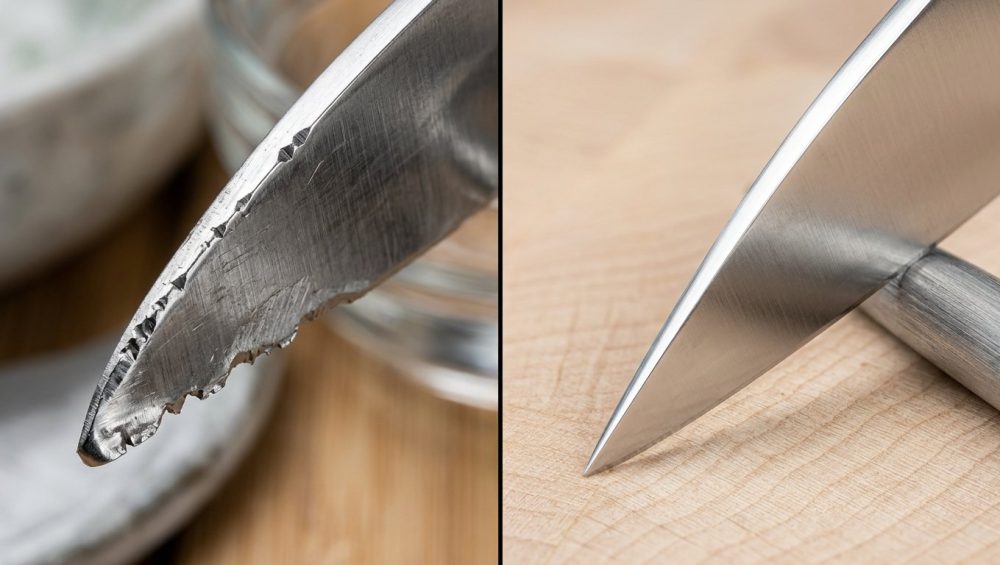
While rolling is a deformation of the steel, micro-chipping is the actual removal of material. This happens when the localized stress on the apex exceeds the tensile strength of the steel.
Even in 55-60 HRC steel, micro-chipping can occur if you strike something significantly harder than the blade itself. Under a microscope, a micro-chipped edge looks like a series of jagged craters.
Here is the good news: edge rolling is entirely reversible without removing any metal. Micro-chipping, however, requires you to grind away steel until you reach the bottom of the deepest crater, establishing a brand new apex. If you are constantly micro-chipping your blades, you are drastically reducing their functional lifespan.
Stop Scraping Your Board: The Physics of Lateral Sheer Force
Now that we know how the edge fails, let’s talk about why it fails. And I’m going to be brutally honest with you: it’s probably your technique.
One of the most destructive habits in the home kitchen is lateral scraping. You know exactly what I’m talking about. You spend five minutes chopping onions, and then you turn your beautiful, precision-engineered chef’s knife sideways and scrape it across the board to scoop the diced pieces into a pan.
The Math Behind the Madness
Let’s look at the physics of this sheer force. A standard Western chef’s knife is sharpened to an angle of about 15 to 20 degrees per side. This geometry is designed to withstand vertical compressive force. When you chop straight down, the force is distributed evenly up the spine of the blade.
But when you turn the blade sideways and scrape, you are applying lateral sheer force directly against the weakest point of the apex. You are essentially taking a microscopic, 15-degree wedge of metal and violently bending it sideways against a hard surface.
This lateral stress guarantees immediate edge rolling. A single aggressive scrape across a cutting board can do more microscopic damage to your blade than an entire week of proper vertical chopping.
The Cheap, Brilliant Fix
If you want to save your edges and your sanity, do yourself a favor and buy a bench scraper. Also known as a dough scraper or a pastry scraper, this is a cheap, blunt piece of rectangular steel with a handle. It is designed specifically for scraping, scooping, and moving ingredients.
Using a knife to scrape a board is like using a sports car to tow a tractor. It’s the wrong tool for the job. Keep a bench scraper on your cutting board, use it to move your prep, and watch how much longer your knife holds its edge.
The Abrasive Assassins: Glass, Ceramic, and the Bamboo Lie
If your technique is flawless and your knife is still going dull after a single prep session, the problem is sitting right underneath your food. Your cutting board is actively destroying your blades.
To understand why, we need to talk about the Mohs Hardness Scale. The Mohs scale measures the scratch resistance of various minerals through the ability of a harder material to scratch a softer material.
Standard 55-60 HRC knife steel sits right around 5.5 to 6.5 on the Mohs scale. For a cutting board to be safe for your knife, it must be softer than the steel. If the board is harder than the knife, the board becomes an abrasive. It acts exactly like sandpaper, violently grinding away your microscopic apex with every single stroke.
The Glass and Ceramic Atrocities
Let me be incredibly clear: glass and ceramic cutting boards are an abomination. They have no place in a functional kitchen.
Tempered glass sits at roughly 6.5 to 7 on the Mohs scale. Ceramic can be even harder. When you chop on a glass board, you are literally slamming a delicate, micron-thin steel edge into a surface that is harder than the steel itself. You wouldn’t slice a roast in a glass baking dish, so why would you prep on a glass board?
Every time the blade makes contact with glass or ceramic, the steel loses the battle. The apex doesn’t just roll; it severely micro-chips. A glass board can completely destroy a freshly sharpened edge in less than twenty minutes of prep work. Furthermore, the slick surface of glass is a massive safety hazard, allowing your knife to slip laterally and slice your fingers instead of the food.
And if you think cutting on a ceramic plate is any better, think again. The glaze on a ceramic plate is essentially the same material as your non-stick ceramic pan coating—it is brutally hard and will flatten a knife edge instantly.
The Bamboo Lie
Now we arrive at the most pervasive myth in modern kitchenware: the marketing lies surrounding bamboo cutting boards.
For the last decade, bamboo has been pushed as the ultimate eco-friendly, durable, and stylish cutting board material. But ask any professional chef or knife sharpener about bamboo, and they will tell you to throw it in the fireplace.
Here is the botanical reality: bamboo is not wood. It is a grass. Because it is a grass, it lacks the lignin synthesis that trees use to stabilize their trunks. To support its own weight and grow rapidly, bamboo absorbs massive amounts of silica from the soil.
Silica is the primary component of sand and quartz. It sits at a solid 7 on the Mohs hardness scale.
When you cut on a bamboo board, you are dragging your 5.5 Mohs steel knife across microscopic nodes of 7 Mohs silica. It is the metallurgical equivalent of chopping your vegetables on a sheet of medium-grit sandpaper. The silica aggressively abrades the steel, stripping away metal particles and rapidly dulling the blade.
Furthermore, because bamboo stalks are hollow and narrow, manufacturing a bamboo board requires slicing the grass into thin strips and gluing them together under immense pressure. This means a bamboo board is easily 20% to 30% glue by volume. That glue is often a hard, abrasive synthetic resin that further damages your knife.
I have a strict rule against toxic kitchen gear, and while bamboo itself isn’t inherently toxic, the mystery resins used in cheap boards can be. Ditch the bamboo. Your knives will thank you.
The Problem with Plastic
What about plastic? Polyethylene (PE) and polypropylene (PP) boards are softer than steel, which is good. They are cheap, and you can throw them in the dishwasher.
However, because they are so soft, your knife easily slices into the plastic, creating deep, microscopic trenches. These trenches become structural traps. When your blade sinks into a groove and you inevitably twist your hand even a fraction of a millimeter, the rigid plastic walls of the trench grip the apex of the blade and wrench it sideways, causing severe edge rolling.
Worse, those deep gouges become breeding grounds for bacteria, and as the board degrades, you end up slicing microplastics into your food. Just like storing leftovers in cheap plastic containers, relying on cheap plastic boards is a false economy. They ruin your knives, look terrible after a month, and need to be replaced constantly.
The 15-20 Degree Honing Realignment Protocol
So, you’ve stopped scraping your board, and you’ve thrown away your glass and bamboo atrocities. But remember, 55-60 HRC steel is ductile. Even with perfect technique on a perfect surface, the microscopic apex will eventually fold over from the sheer vertical pressure of cutting through dense foods.
This is where the honing rod comes in.
There is a massive misconception that a honing rod (often incorrectly called a “sharpening steel”) actually sharpens your knife. It does not. Sharpening is the process of using an abrasive (like a whetstone) to grind away steel and create a new edge. Honing is the process of mechanically pushing a rolled edge back into vertical alignment.
Think of it like fixing a bent wire. You aren’t removing metal; you are just bending it back to where it belongs.
Choosing the Right Honing Rod
For a 55-60 HRC stainless steel knife, you need a grooved steel honing rod. The steel rod is harder than the knife, allowing it to grip the rolled burr and push it back into place.
(Note: If you own a 62+ HRC Japanese knife, do not use a steel honing rod. The hard, brittle steel will chip against the rod. For those knives, you need a ceramic rod, or better yet, a leather strop. But for standard Western cutlery, a grooved steel rod is perfect.)
The Mechanical Protocol
Honing requires precision. If you just wildly slap the blade against the rod like a TV chef trying to look busy, you are going to ruin the edge. You must match the factory bevel of the blade, which is typically 15 to 20 degrees per side.
Here is the foolproof, time-saving method for realigning your edge:
- Plant the Rod: Hold the honing rod vertically, planting the tip firmly onto a damp towel on your countertop. Do not hold it in the air. You need stability to maintain the angle.
- Find the Angle: Place the heel of the knife blade against the top of the rod at a 90-degree angle. Cut that angle in half to get 45 degrees. Cut it in half again, and you are at 22.5 degrees. Tilt it just a hair closer to the rod, and you have found your 15-20 degree sweet spot.
- The Pull: Applying very light pressure (about the weight of the knife itself), pull the blade down the rod, drawing it from the heel to the tip. The goal is to make sure the entire length of the edge contacts the rod in one smooth motion.
- Alternate Sides: Repeat the process on the other side of the blade. Alternate sides for about 5 to 8 strokes per side.
By alternating sides, you are gently pushing the microscopic rolled burr back and forth until it stands perfectly straight up.
If your knife is made of 55-60 HRC steel, you should be honing it every single time you use it. It takes exactly ten seconds, and it will extend the time between actual whetstone sharpenings from a few weeks to several months. Efficiency is everything.
The Ultimate Fix: Enter Acer Saccharum (Sugar Maple)
We have addressed the metallurgy, the mechanics, and the maintenance. Now, we must provide the ultimate environmental fix. If glass is an atrocity, bamboo is a lie, and plastic is a trap, what is the correct cutting surface?
The definitive, scientifically backed answer is end-grain hardwood. And not just any hardwood—specifically Acer saccharum, commonly known as Sugar Maple or Hard Maple.
Understanding the Janka Hardness Scale
To understand why Sugar Maple is the holy grail of cutting boards, we look to the Janka Hardness Scale. The Janka test measures the resistance of wood to denting and wear by measuring the force required to embed an 11.28-millimeter steel ball halfway into the wood.
Sugar Maple has a Janka hardness rating of 1,450 pounds-force (lbf).
This number is the absolute Goldilocks zone for 55-60 HRC kitchen knives. If a wood is too soft (like Pine or Hinoki, under 1,000 lbf), it gouges easily, creating the same bacterial trenches as plastic. If a wood is too hard (like Brazilian Walnut or Teak, pushing 3,000+ lbf), it acts like a mild abrasive and dulls the blade.
At 1,450 lbf, Sugar Maple is firm enough to resist deep gouging, but soft enough to yield to the microscopic steel apex. It provides a stable, predictable surface that respects the metallurgy of your blade.
The Genius of End-Grain Construction
But the species of wood is only half the equation. The orientation of the wood grain is what truly stops your knives from dulling.
Most cheap wooden boards are “edge-grain” or “face-grain.” This means the wood is laid flat, and the grain runs horizontally across the board. When you chop on an edge-grain board, your knife is physically severing the wood fibers. It’s like chopping a bundle of raw spaghetti in half. This severs the fibers, leaves permanent scratches, and creates resistance against the blade.
An “end-grain” board is constructed by cutting the wood into blocks and turning them so the end of the grain points straight up. Imagine that same bundle of dry spaghetti, but now it is standing vertically on the counter.
When your knife strikes an end-grain board, it doesn’t sever the fibers. Instead, the microscopic apex slides between the vertical fibers. The wood physically separates to accommodate the blade, cushioning the impact. When you lift the knife away, the resilient fibers of the Sugar Maple snap back together.
This is known as the “self-healing” property of end-grain wood. Because the blade is sliding between the fibers rather than violently hacking through them, the sheer force and compressive stress on the apex are drastically reduced. Your 55-60 HRC edge doesn’t roll. It doesn’t chip. It just glides.
The Real-World Impact
Transitioning to an end-grain Sugar Maple board is a revelation. Yes, they are heavy. Yes, they require a bit of maintenance (you must condition them with food-grade mineral oil to prevent drying). But the return on investment is unparalleled.
In controlled tests, knives used exclusively on end-grain maple retain their edge geometry up to three times longer than knives used on standard edge-grain boards, and infinitely longer than those subjected to glass or bamboo.
Think about the time you waste hacking at a tomato with a blunt blade. Think about the frustration of tearing your delicate herbs instead of cleanly slicing them. Think about the sheer annoyance of scraping the fond off a stainless steel pan with a dull prep knife because you were too lazy to grab the right tool.
Investing in a proper wooden cutting board and dedicating ten seconds a day to proper honing isn’t just about being a knife snob. It is about fundamentally respecting your time and your ingredients.
The Bottom Line
You do not need a culinary degree to maintain a razor-sharp edge. You do not need to spend hundreds of dollars on exotic, brittle powdered-metallurgy steel that requires a Ph.D. to sharpen. Your standard 55-60 HRC stainless steel knife is a magnificent, resilient tool, provided you stop actively trying to destroy it.
Stop scraping your ingredients sideways. Throw your glass, ceramic, and bamboo cutting boards directly into the nearest dumpster. Buy a cheap bench scraper. Learn to use a honing rod at a 15-20 degree angle. And treat yourself to the self-healing magic of an end-grain Sugar Maple block.
Cooking should be a joy, not a physical struggle against blunt instruments. Take care of your edges, and I promise you, your edges will take care of your weeknight dinners. Now go chop something. Properly.