Listen up, weekend warriors. We need to have a serious talk about the spongy purple menace sitting in your crisper drawer. I know you have been traumatized by soggy eggplant dishes that taste like a greasy kitchen sponge. I have been there. I have set off my smoke detector trying to sear it, and I have cried over a pan of mushy, oil-logged vegetables. But you do not need a culinary degree to fix this. You just need a little bit of food science.
One of the biggest rookie kitchen mistakes is treating eggplant like a zucchini or a bell pepper. It is an entirely different beast. Today, we are going to break down exactly why this vegetable behaves so badly in the pan, and I am going to teach you a brilliant, science-backed thermal hack that will completely change the way you cook.
The Spongy Purple Menace: Why Eggplant Ruins Your Dinner
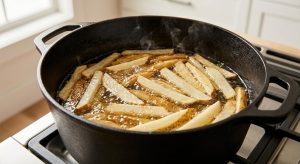
Let us begin by validating your culinary frustration. Eggplant is intimidating. When you chop it up and toss it into a hot pan with a glug of premium olive oil, it does not sizzle and brown beautifully like an onion. Instead, it instantly sucks the pan completely dry, leaving you with a screeching, burning mess. You panic, you add more oil, and it drinks that too.
The resulting texture is slimy, heavy, and downright unappetizing. To defeat the enemy, we must first understand the enemy’s biology.
Anatomy of an Oil Sponge: The Cellular Biology
Eggplant (Solanum melongena) is botanically a berry, and its internal architecture is a marvel of evolutionary biology—and an absolute nightmare for your frying pan.
The flesh is composed of large, fragile parenchyma cells. These cells are packed with water; in fact, a raw eggplant is roughly 92 percent water by weight. But the real issue lies in the spaces between the cells. The structural integrity of the vegetable is maintained by a highly porous pectin matrix. Pectin is a complex carbohydrate that acts as the cellular glue holding the plant walls together.
Interspersed throughout this rigid pectin matrix are microscopic air pockets. In a raw state, these air pockets give the vegetable its signature lightweight, spongy feel. When you slice into it, you are exposing millions of these tiny, empty chambers. Because of this unique biological makeup, the raw flesh absorbs so much oil the second it makes contact with a fat source in your skillet.
The Thermodynamics of Frying a Sponge
Let us look at the physics of what happens when raw eggplant hits hot oil. As the vegetable enters the pan, the heat immediately begins to affect those microscopic air pockets. Gases expand when heated. The air trapped inside the spongy pectin matrix rapidly expands and rushes out of the vegetable.
This rapid evacuation of air creates a microscopic vacuum effect within the cellular structure. Capillary action takes over, and the hot cooking oil is violently sucked into the empty voids left behind by the escaping air. Before the heat has a chance to break down the rigid cellulose and pectin to collapse the structure, the oil has already invaded deep into the flesh.
The result? The vegetable essentially deep-fries itself from the inside out, trapping tablespoons of heavy lipids within its matrix. You are left eating a greasy, heavy sponge.
The Traditional Fix: Why Salting is Good, but Flawed
If you have ever opened a traditional Italian or French cookbook, you have undoubtedly been told to salt your eggplant before cooking it. The standard procedure dictates slicing the vegetable, aggressively coating the pieces in kosher salt, placing them in a colander in the sink, and waiting anywhere from forty-five minutes to two hours.
The Osmotic Illusion: What Salt Actually Does
The culinary dogma claims that salting achieves two things: it removes the bitter compounds, and it draws out moisture to collapse the sponge. Let us aggressively fact-check this with some modern food science.
First, the bitterness. Historically, eggplants contained high levels of solanine, a toxic alkaloid that gave the flesh a harsh, astringent bite. Salting was originally employed to purge these bitter juices. However, we are not cooking in the nineteenth century. Modern agricultural breeding has largely eliminated this issue, reducing solanine levels in commercial varieties by a staggering 68 to 82 percent. According to legendary food scientist Harold McGee, bitterness is incredibly rare in modern eggplants, making the solanine-purging argument entirely obsolete.
Second, the moisture extraction. Salt does draw out water through the process of osmosis. When you coat the exterior of a slice with salt, it creates a hypertonic environment, forcing water to migrate from the cells to the surface to equalize the solute concentration. However, clinical food science trials have demonstrated that this osmotic drawing only penetrates the surface layers—roughly 1.2 millimeters deep.
While it does extract some surface moisture, it barely puts a dent in the overall 92 percent water content. Furthermore, the liquid that drains away is not just “excess water.” It is nutrient-rich cytosol packed with potassium, magnesium, and flavor-building polyphenol precursors. By salting and draining, you are literally pouring the vegetable’s natural umami down the sink.
The Time-Drain Factor (Why Weeknight Cooks Hate It)
Time is money, and my patience on a Tuesday night is non-existent. The traditional salting method requires at least thirty minutes of inactive waiting time, followed by a meticulous process of rinsing off the excess salt and aggressively patting every single slice dry with paper towels.
If you fail to dry the slices perfectly, you introduce surface water into a hot pan of oil, which immediately vaporizes into steam, dropping the pan’s temperature and completely preventing the Maillard reaction (the chemical process responsible for browning and flavor development). You end up steaming your food instead of searing it. For the busy home cook trying to get dinner on the table, this fussy, time-consuming ritual is a massive deterrent.
The Magic of the Microwave: A Thermal Masterclass
This brings us to the ultimate, science-backed kitchen hack that will change your culinary life. If we need to collapse the spongy air pockets before they can absorb oil, and we do not have an hour to wait for salt to do a mediocre job, we need a rapid, highly effective thermal intervention. When it comes to this vegetable, the microwave is your best friend.
Vaporizing Internal Water: The Science of the Collapse
To understand why this works, you have to understand how a microwave oven operates. Unlike a stovetop skillet that heats food via conduction (transferring heat from the metal pan to the surface of the food), a microwave uses electromagnetic radiation—specifically, dielectric heating.
The microwaves penetrate the food and agitate the water molecules trapped inside the cells. This rapid agitation causes friction, which generates intense heat from the inside out. When you place your cubed or sliced eggplant into the microwave, you are directly targeting that 92 percent water content.
Within seconds, the internal water begins to boil and vaporize into steam. This internal steaming effect is the secret weapon against the spongy pectin matrix.
Breaking Down the Pectin Matrix
As the internal water turns to steam, the extreme heat and pressure safely and rapidly break down the rigid cellulose and pectin walls. The microscopic air pockets that usually act as oil vacuums physically collapse under the thermal stress.
You are essentially pre-shrinking the sponge. By the time the vegetable comes out of the microwave, its cellular architecture has been completely altered. The voids are gone. The flesh is dense, silky, and structurally compromised in the best way possible. When this pre-collapsed flesh finally hits the hot oil in your skillet, there are no empty air pockets left to suck up the fat.
The 3-to-5-Minute Miracle: Step-by-Step Execution
Here is the exact, foolproof protocol for executing this technique. You do not need a culinary degree; you just need a plate and a roll of paper towels.
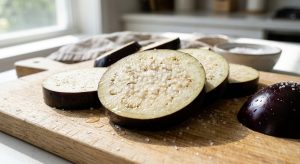
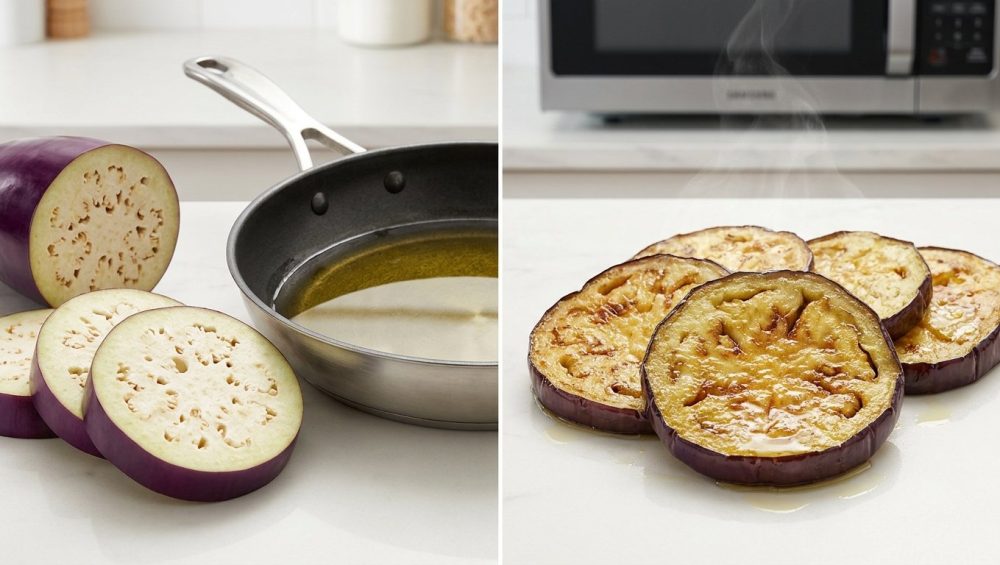
- Prep the Vegetable: Wash and dry your eggplant. Leave the skin on for structural integrity and a boost of fiber. Grab your chef’s knife and break it down into your desired shape—whether that is one-inch cubes for a hearty caponata or thick rounds for a classic Parmesan. If you are struggling to achieve clean cuts without crushing the flesh, the culprit is your dull knife. Keep your blades honed. Scoop up your perfectly diced cubes with a stainless steel bench scraper to transfer them quickly from the cutting board to the plate.
- The Paper Towel Base: Line a large, microwave-safe plate with two layers of heavy-duty paper towels. The paper towels are crucial because they will absorb the massive amount of steam and moisture that the microwave forces out of the vegetable.
- Arrange the Pieces: Place your cuts onto the paper towels in a single, even layer. Do not pile them on top of each other, or they will steam unevenly.
- The Thermal Blast: Microwave the plate on high power. For an average-sized batch of cubes, three to five minutes is the sweet spot. If you are doing large, thick rounds from a massive globe eggplant, you may need to push it to six or seven minutes. You will know they are ready when the pieces look slightly shriveled, feel dramatically softer to the touch, and have visibly shrunk in size.
- The Final Press: Carefully remove the plate (it will be blazing hot). Take another paper towel and gently press down on the tops of the pieces to blot away any remaining surface moisture.
Your eggplant is now perfectly prepped, structurally collapsed, and ready to be seared to golden-brown perfection on the stovetop.
The Great Oil Mitigation Showdown: Microwave vs. Salt
Let us look at the hard data. When you pit the traditional osmotic salting method against the rapid thermal microwave method, the results are staggeringly one-sided.
Lipid Absorption Rates Analyzed
When raw, untreated eggplant is pan-fried, it can easily absorb up to 30 percent of its weight in oil within the first two minutes of cooking. It is an oil-guzzling monster.
When subjected to the traditional salting method, the surface moisture extraction helps create a slight barrier, but the internal air pockets remain largely intact. Studies show that salted eggplant still absorbs roughly 15 to 20 percent of its weight in oil. It is better, but it is still unnecessarily greasy.
When subjected to the microwave pre-treatment, the lipid absorption rate plummets. Because the internal air pockets have been completely destroyed by the internal steam, the oil has nowhere to go. Microwaved eggplant absorbs as little as 3 to 5 percent of its weight in oil. The fat stays in the pan where it belongs, acting as a heat-transfer medium to create a beautiful, crispy crust rather than being soaked into the center of the food.
Texture and Flavor Retention
Beyond just mitigating oil, the microwave method produces a vastly superior texture and flavor profile. Because you are not washing away the nutrient-rich cytosol down the drain, the natural, earthy, slightly sweet umami of the vegetable remains entirely intact.
Furthermore, because the interior is already partially cooked by the microwave, you spend significantly less time pan-frying it. You only need to sear the exterior for a few minutes on high heat to trigger the Maillard reaction. This results in a glorious contrast: a deeply browned, crispy exterior giving way to a lush, creamy, custard-like interior. It is time to stop eating greasy eggplant forever.
Safe Gear for the Perfect Sear
Now that you have perfectly prepped, collapsed eggplant, you need to cook it. And as your sassy sous-chef, I refuse to let you throw this beautifully prepped ingredient into a cheap, toxic piece of garbage pan.
Banishing Toxic Non-Stick from Your Kitchen
I have zero patience for cheap, flaking Teflon pans. Traditional non-stick coatings are made with per- and polyfluoroalkyl substances (PFAS), often referred to as “forever chemicals.” When you heat these flimsy aluminum pans over high heat to get a good sear on your vegetables, the synthetic coatings begin to break down, releasing invisible, toxic fumes into your kitchen air and leaching microplastics into your dinner.
Furthermore, you can never achieve a proper, restaurant-quality sear in a traditional non-stick pan. The coating inherently prevents the food from bonding with the heat source, meaning you get a sad, pale, steamed exterior instead of a robust, caramelized crust. I am absolutely militant about banishing toxic kitchen gear from my house, and you should be too.
The Right Pans for the Job (Carbon Steel and Stainless)
To get that mind-blowing, golden-brown crust on your microwaved eggplant, you need cookware with serious thermal mass. You need a pan that holds onto heat and does not drop in temperature the second you add your food.
Your best options are heavy-clad stainless steel or traditional carbon steel. Carbon steel is a phenomenal choice for high-heat vegetable searing. It is lighter than cast iron but offers the same incredible heat retention. Understanding the thermodynamics of carbon steel will change your searing game. When properly seasoned through the polymerization of cooking oils, it develops a naturally slick, non-toxic patina that rivals any chemical non-stick pan on the market.
If you are using stainless steel, you must preheat the pan properly before adding your oil. You want the steel to be hot enough that a drop of water dances across the surface like a bead of mercury—a phenomenon known as the Leidenfrost effect. This heat control helps prevent protein sticking when you add other ingredients to the pan alongside your vegetables. Once the pan is properly heated, add a thin layer of high-quality oil (like avocado or light olive oil), and lay your microwaved eggplant pieces down. Do not touch them. Let them sear undisturbed for two to three minutes until a deep, beautiful crust forms, then flip.
Beyond the Microwave: Elevating Your Eggplant Game
You have mastered the cellular biology. You have executed the microwave collapse. You have seared the pieces perfectly in a safe, high-quality pan. Now, we need to talk about flavor architecture.
Flavor Pacing and Acid Balance
Eggplant has a deep, earthy, slightly sweet flavor profile, and its creamy interior texture can feel incredibly rich on the palate. To balance that richness, you must introduce acidity.
One of the most common mistakes home cooks make is relying solely on salt to season their food. If your dish tastes flat, your dinner actually needs acid to wake it up. Acid cuts through the heavy, creamy mouthfeel of the vegetable, brightening the entire dish and stimulating your salivary glands.
Once your eggplant is beautifully seared and removed from the heat, hit it immediately with a splash of high-quality acid. A squeeze of fresh lemon juice, a drizzle of aged balsamic vinegar, or a splash of sharp sherry vinegar will completely transform the flavor profile. Pair this with fresh, tender herbs like basil, mint, or parsley, and you have elevated a simple vegetable to a restaurant-quality centerpiece.
Integrating the Technique into Weeknight Meals
The beauty of the microwave method is its sheer efficiency. You can prep, microwave, and sear a batch of eggplant in under fifteen minutes. This makes it a viable, realistic option for chaotic weeknight dinners.
Toss the crispy, creamy cubes into a simmering marinara sauce for a rapid pasta alla Norma. Layer them into a quick weeknight moussaka. Fold them into a spicy Szechuan garlic sauce. Or simply serve them on a platter, drizzled with tahini, scattered with pomegranate seeds, and finished with flaky sea salt for a stunning, effortless side dish.
The Final Verdict: Taking Back Your Kitchen
Cooking should not be a stressful, tear-inducing chore, and you should never have to compromise the quality of your meals because an ingredient is acting stubborn. The traditional methods of preparing eggplant are rooted in outdated science and historical necessity. By applying a little modern food physics, we can completely bypass the frustrating, time-consuming hurdles of the past.
The three-minute microwave pre-treatment is not a lazy shortcut; it is a highly calculated, thermally efficient technique that guarantees superior results. It vaporizes the internal water, safely collapses the porous pectin matrix, and neutralizes the vegetable’s oil-absorbing capabilities before it ever touches your skillet.
You do not need to be a Michelin-starred chef to make incredible food. You just need to understand the basic rules of the kitchen and use the right tools for the job. So, ditch the salt shaker, step away from the sink, and embrace the magic of the microwave. Your weeknight dinners—and your waistline—will thank you. Now get out there, fire up that carbon steel skillet, and show that spongy purple menace exactly who is in charge.