Picture this: It is 6:30 PM on a Tuesday. You are exhausted, you are hungry, and you have ambitiously decided to make a scratch-made macaroni and cheese to salvage the evening. You melt the butter, whisk in the flour, and pour in the cold milk. Everything is going fine. You turn your back for exactly fifteen seconds to pour yourself a much-deserved glass of Pinot Noir and yell at the dog to get out of the trash.
Suddenly, it hits you. That acrid, unmistakable, soul-crushing stench of scorched dairy. You whip around, grab your whisk, and stir frantically, but the damage is done. Little black and brown flecks of burnt carbon are floating to the surface of your once-pristine béchamel. Dinner is ruined, your kitchen smells like a tire fire, and you are now staring down the barrel of a three-day soaking and scrubbing marathon just to salvage your pot.
If this sounds familiar, I need you to take a deep breath and listen to me: It is not your fault. You are not a bad cook. You do not lack culinary intuition. You are simply a victim of terrible cookware geometry.
In my kitchen, time is money, and I refuse to spend my precious weekend scrubbing burnt milk proteins out of a poorly designed pot. If you want to stop scorching your sauces, you do not need a culinary degree, and you certainly don’t need to stir for an hour straight. You just need to understand the physical mechanics of your cookware. Today, we are taking a brutally honest, highly researched deep dive into the physics of heat distribution, fluid dynamics, and the ultimate secret weapon of the home kitchen: the curved saucier pan.
The Geometry of Failure: Why Standard Saucepans Ruin Your Food
To understand the solution, we first have to dissect the problem. Go into your kitchen cabinets and pull out your standard, everyday saucepan. Look at the shape. It has a perfectly flat bottom, and the walls shoot straight up at a harsh, 90-degree right angle.
Why does this shape exist? Because it is incredibly cheap and easy for manufacturers to produce. A straight-sided cylinder is the most basic form of metal stamping. And to be perfectly fair, this shape is absolutely fine if you are just boiling water for pasta, heating up a can of soup, or blanching some green beans.
But for delicate, scratch-made sauces, that 90-degree corner is a literal death trap.
The Stagnant “Dead Zone”
When you are making a sauce—whether it is a cheese sauce, a gravy, a custard, or a delicate pan reduction—you are typically using a whisk to keep the ingredients emulsified and moving. Here is the fatal geometric flaw: your whisk is round. Your pan is square at the bottom. A round whisk cannot, under any circumstances, reach into a sharp, 90-degree corner.
This creates what culinary professionals call a “dead zone.” As you whisk the center of the pot, the fluid dynamics of the simmering liquid push the heavier ingredients to the outer edges. Starches (like the flour in your roux) and proteins (like the casein and whey in your milk) are heavier than water. Because the whisk cannot agitate the corners, these heavy molecules settle into the crevices and become completely stagnant.
Once they settle, they act as an insulating blanket against the hot metal bottom. The temperature in that specific corner spikes uncontrollably. The proteins curdle, the starches seize, and within seconds, they scorch. This lack of agitation is exactly why your cheese sauce gets grainy—the proteins overheat and separate because they were trapped in a stagnant corner, completely missing the shearing force of your whisk.
The Thermodynamics of Scorching
Let’s get slightly nerdy about the thermodynamics of a burning sauce. When a liquid is constantly moving, the heat from the burner is distributed evenly throughout the volume of the fluid. The water content in your sauce regulates the temperature, preventing the mixture from exceeding 212°F (100°C).
However, when starches and proteins settle in a dead zone, the water localized in that corner rapidly boils off. Without water to regulate the temperature, the heat of the metal shoots up dramatically. The Maillard reaction (which causes delicious browning) quickly accelerates into pyrolysis (carbonization and burning). By the time you smell the smoke, the chemical structure of your sauce has literally turned to ash.
Enter the Saucier: The Physics of the Perfect Curve
If the 90-degree angle is the enemy, the solution is beautifully simple: eliminate the angle.
Enter the saucier (pronounced saw-see-ay), also known as a chef’s pan. A saucier is a specialized piece of cookware specifically engineered for tasks that require constant whisking and rapid reduction. Instead of straight walls and sharp corners, a saucier features a wider mouth, flared sides, and a continuous, sweeping, bowl-like curve that seamlessly connects the bottom of the pan to the rim.
There are zero sharp angles. There are zero dead zones.
The Kinetic Energy of Continuous Motion
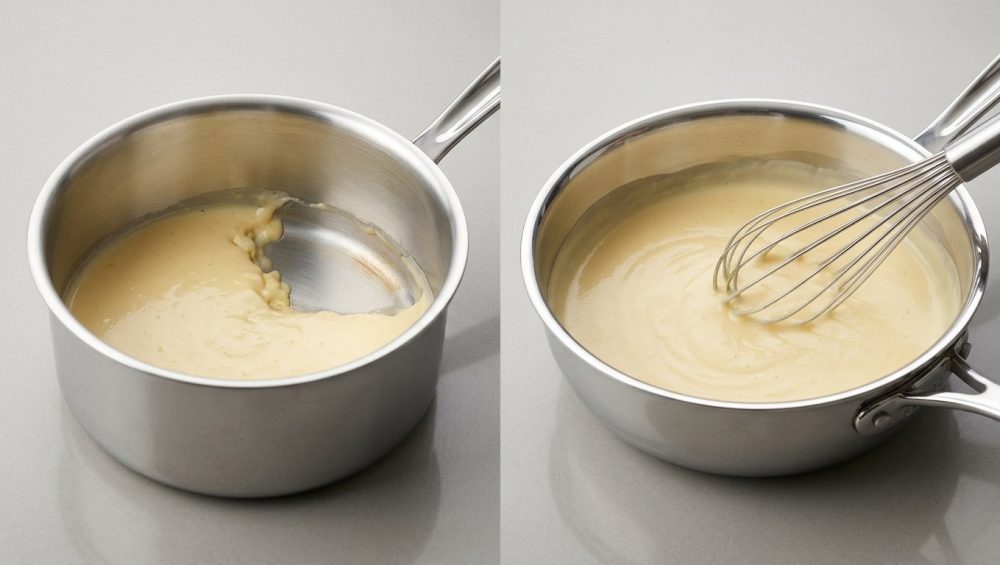
The magic of the saucier lies in how it interacts with your tools. The sweeping curve of the pan perfectly mirrors the rounded tines of a balloon whisk or a French whisk. When you drag your whisk across the bottom of a saucier, the tines glide effortlessly up the curved sidewalls. Every single square inch of the pan’s interior is swept clean with every single stroke.
Because the whisk can maintain continuous contact with the entire surface area, the kinetic energy of your stirring is transferred perfectly into the fluid. The ingredients are forced into a constant, rolling vortex. Starches are kept in suspension. Proteins are continuously hydrated. Nothing has the opportunity to settle, which means nothing has the opportunity to burn.
Faster, Stress-Free Reductions
Beyond whisking efficiency, the geometry of a saucier offers a massive advantage in speed. Because the sides are flared outward, the pan has a significantly wider surface area at the top than a standard straight-sided saucepan.
In the world of sauce-making, a larger surface area means a higher rate of evaporation. If you are reducing a stock for a demi-glace, thickening a balsamic glaze, or simmering a marinara, the wide mouth of the saucier allows the excess water to escape into steam much faster. When it comes to conquering weeknight cooking anxiety, shaving ten to fifteen minutes off your stove time is an absolute game-changer. You get a thicker, richer sauce in a fraction of the time, with practically zero risk of a scorched bottom.
Whisking Dynamics and Fluid Mechanics
We cannot talk about the saucier without talking about the whisk. The two are a symbiotic pair. A pan is only as good as the tool used inside it, and a whisk is only as effective as the pan allows it to be.
When making an emulsion—like a hollandaise or a beurre blanc—you are forcing two liquids that hate each other (fat and water) to bind together. This requires intense mechanical shearing force. You have to vigorously whip the mixture to break the fat down into microscopic droplets so they can be suspended in the water.
In a straight-sided saucepan, your whisk constantly violently crashes into the 90-degree corners, interrupting your rhythm and splashing hot liquid over the edge. In a saucier, the fluid mechanics work with you. The curved walls act like a half-pipe for your sauce. As you whisk aggressively, the liquid rides up the flared side and folds back down onto itself. This folding action aerates the mixture and creates a highly stable, homogenized matrix. The rounded bottom does all the heavy lifting to prevent broken emulsions by keeping the liquid constantly moving and shearing.
(As a quick side note: please invest in a fully sealed, professional-grade stainless steel whisk. I will not even get into why your whisk leaks dishwater into your food today, but just know that a cheap whisk with a hollow, unsealed handle is a bacterial nightmare. Pair your beautiful new pan with a proper tool.)
Fully Clad vs. Disc Bottom: The Thermal Conductivity Mandate
Now, we must address the most critical, highly technical aspect of buying a saucier. You can have the most perfectly curved pan in the world, but if the metallurgy is cheap, your sauces will still burn.
When shopping for stainless steel cookware, you will encounter two distinct manufacturing methods: Disc-Bottom (or encapsulated base) and Fully Clad (or multi-ply). Understanding the difference between these two is the secret to unlocking professional-level cooking.
The Problem with Disc-Bottom Pans
Disc-bottom cookware is constructed from a single, thin sheet of stainless steel. Because stainless steel is actually a terrible conductor of heat on its own, manufacturers weld a thick “disc” or “puck” of highly conductive aluminum or copper strictly to the flat bottom of the pan.
For a straight-sided stockpot used for boiling soup, a disc bottom is perfectly acceptable. But for a curved saucier, a disc bottom is a catastrophic design flaw.
Here is why: The conductive aluminum disc only covers the flat bottom of the pan. It stops abruptly right before the curved sidewalls begin. If you are cooking on a gas stove, the flames lick up the sides of the pan. Because the sides are made of thin, un-clad stainless steel, they cannot distribute that heat evenly. The heat becomes trapped right at the edge where the disc ends and the thin walls begin, creating a massive, localized hot spot known as the “ring of fire”.
When you whisk your sauce up the curved walls of a disc-bottom saucier, the thin layer of liquid hits that super-heated ring of fire and instantly scorches. You have essentially traded a 90-degree dead zone for a 360-degree burn ring.
The Fully Clad Solution
To utilize a saucier properly, it absolutely must be fully clad.
Fully clad (often labeled as tri-ply or 5-ply) means the cookware is made from a continuous, multi-layered sheet of metal. Manufacturers take a thick core of highly conductive aluminum (or copper) and permanently roll-bond it between two layers of stainless steel under thousands of tons of extreme hydraulic pressure. This unified, multi-ply sheet is then deep-drawn into the shape of the pan.
Because the conductive core extends all the way from the base up to the very rim of the pan, the heat is distributed flawlessly and evenly across the entire curved surface. There are no hot spots. There is no ring of fire. The sidewalls heat at the exact same rate as the bottom.
Once you understand why your stainless steel pan sticks, you realize that localized hot spots are the ultimate enemy of smooth cooking. A fully clad saucier entirely eliminates those hot spots, wrapping your delicate sauces in a gentle, even, omnidirectional hug of heat.
The “No-Go” Rule: Why Toxic Non-Stick Saucepans Are a Scam
This brings me to a topic that makes my blood boil. As a home cook advocate, I have a strict, uncompromising “No-Go” rule when it comes to toxic, cheap kitchenware. And the biggest scam currently being pushed on anxious amateur cooks is the non-stick saucepan.
Many beginners, terrified of burning their sauces or scrubbing pots, instinctively reach for a Teflon (PTFE) coated non-stick saucepan. They think it is the safe, foolproof choice. It is not. It is a fragile, potentially toxic crutch that actively prevents you from cooking well.
The Whisking Paradox
Let’s look at this logically. To make a great sauce, you need to whisk vigorously. But if you take a metal whisk to a non-stick pan, you will instantly scratch, gouge, and destroy the fragile chemical coating.
“But I’ll just use a silicone whisk!” you say. Have you ever tried to break up stubborn flour lumps in a roux with a floppy, flexible silicone whisk? It is an exercise in futility. Silicone lacks the rigid, shearing force required to properly emulsify fats and break down starches. You need the rigid tines of a metal whisk, which means you need a pan surface that can take a beating. High-quality stainless steel can be whisked, scraped, and abused for decades without degrading.
The 2026 PFAS Reality Check
Beyond the mechanical flaws, we need to talk about the health and environmental reality of non-stick coatings. The industry refers to PFAS (per- and polyfluoroalkyl substances) as “forever chemicals” because they do not break down in the environment or in the human body. PTFE (the polymer used in traditional non-stick coatings like Teflon) is a PFAS compound.
Research has consistently shown that when these pans are scratched or heated past certain thresholds, they shed millions of toxic microplastics and chemical off-gases directly into your food and the air.
The regulatory landscape has finally caught up to the science. As of 2026, progressive U.S. states like Maine, Colorado, and Minnesota have outright banned the sale of PFAS-coated non-stick cookware. Over in Europe, France and Denmark have initiated strict PFAS bans, and the EU is actively moving toward a universal restriction covering over 10,000 PFAS compounds, specifically targeting the synthetic coatings used in cookware.
As I always emphasize when discussing banishing toxic kitchen gear, your health and peace of mind are worth the investment. You do not need a synthetic, peeling polymer to prevent your food from sticking.
While the science of polymerization is what keeps your cast iron skillets naturally slick, your saucepans rely purely on thermal mass, even heat distribution, and continuous physical motion. A fully clad stainless steel saucier will outlive you, it will never leach forever chemicals into your family’s dinner, and it will give you infinitely superior culinary results.
The Sauces That Demand a Saucier
So, what exactly are we making in this miraculous curved pan? While a saucier is incredibly versatile—you can use it to boil eggs, make oatmeal, or reheat soup—it truly earns its keep when you are executing technique-heavy, temperature-sensitive recipes.
1. The Mother Sauces (Béchamel and Velouté)
The foundation of a great macaroni and cheese, a classic lasagna, or a rich gravy is the roux—a cooked mixture of equal parts fat (butter) and flour. The flour must be toasted evenly to remove the raw cereal taste. In a standard saucepan, flour gets trapped in the corners and burns, turning your sauce bitter. In a saucier, the whisk keeps the roux moving, ensuring a perfectly even, golden toast. When you slowly stream in your cold milk or stock, the sweeping curve allows you to incorporate the liquid rapidly, guaranteeing a silky, lump-free finish every single time.
2. Custards, Puddings, and Pastry Cream
If you want to test the limits of your cookware, try making a vanilla pastry cream. Egg yolks are notoriously finicky. They coagulate and scramble at relatively low temperatures. When tempering eggs and thickening a custard on the stove, you must keep the mixture in constant, vigorous motion. If even a tablespoon of that custard sits stagnant in a 90-degree corner for a few seconds, the yolks will scramble, and your smooth pudding will be ruined by rubbery, eggy lumps. The saucier is virtually mandatory for pastry chefs for this exact reason.
3. Risotto
While not technically a sauce, risotto behaves like one in the pan. The secret to a creamy risotto is not heavy cream; it is the slow, continuous extraction of starch from the Arborio rice grains through constant agitation. Stirring a sticky, starchy mass of rice in a straight-sided pot is exhausting, and the grains inevitably stick and burn in the corners. The wide, sloping walls of a saucier allow you to fold and toss the rice effortlessly with a wooden spoon or spatula, mimicking the tossing motion (the onda) used by Italian chefs.
4. Caramel and Candy Making
Melting pure sugar requires intense, even heat. If your pan has hot spots, one side of the sugar will turn black and bitter while the center is still crystallized. The fully clad construction of a high-quality saucier ensures the sugar melts and caramelizes uniformly.
5. Acidic Reductions and Pan Sauces
When you deglaze a pan with wine or simmer a batch of crushed tomatoes, you are dealing with highly acidic ingredients. If you try to reduce a tomato sauce in a cheap, unlined aluminum pot or a heavily scratched non-stick pan, the acid will physically react with the exposed metal, leaching a highly unpleasant, tinny flavor into your food. This is exactly why your tomato sauce tastes metallic. A fully clad stainless steel saucier is completely non-reactive. It preserves the bright, clean flavors of your acidic ingredients while the wide mouth reduces the liquid to a syrupy consistency in record time.
How to Choose Your Forever Saucier
If I have convinced you to finally ditch the cheap, warped saucepans and upgrade to a proper saucier, you need to know exactly what to look for. Not all chef’s pans are created equal. Here is your uncompromising buying checklist:
1. The Material and Cladding
As we exhaustively covered, it must be fully clad. Do not buy a disc-bottom pan, no matter how cheap it is. Look for tri-ply (stainless steel – aluminum – stainless steel) as your baseline. Aluminum is an exceptional heat conductor and provides incredible performance for the price.
If you have the budget and want the absolute pinnacle of thermal responsiveness, look for a 5-ply pan with a copper core. Copper reacts to temperature changes almost instantaneously, giving you microscopic control over delicate sauces. Just ensure the interior cooking surface is high-quality 18/10 stainless steel for durability and non-reactivity.
2. The Size and Capacity
Sauciers typically range from 1 to 5 quarts. For the vast majority of home cooks, a 2-quart or 3-quart saucier is the absolute sweet spot.
- A 2-quart is perfect for a batch of pastry cream, a quick pan sauce for two, or a morning batch of oatmeal.
- A 3-quart is the ultimate workhorse. It is large enough to hold a family-sized batch of macaroni and cheese sauce, a full recipe of risotto, or a hearty batch of pastry cream, while still being small enough to maneuver easily on a crowded stovetop.
3. Handle Ergonomics
You are going to be holding this pan with one hand while whisking vigorously with the other. The handle must be comfortable, secure, and heat-resistant. Look for a cast stainless steel handle that is riveted to the pan (rivets are far more durable than spot-welds). The handle should be hollow or specially designed with a V-shaped split near the pan body to disperse heat, ensuring it stays cool on the stovetop.
If you are buying a 3-quart or larger, I highly recommend finding a model that includes a small “helper handle” on the opposite side. A pot full of liquid is heavy, and a helper handle makes transferring the pan from the stove to the sink infinitely safer and easier.
4. The Rolled Rim
Look closely at the top edge of the pan. A cheap pan will have a blunt, straight-cut edge. A high-quality saucier will feature a flared, rolled rim. This is critical for pouring. A rolled rim allows you to pour your finished cheese sauce directly over your pasta without the liquid dribbling down the side of the pan and making a mess on your counter.
A Note on Cleaning and Maintenance
I know that moving away from non-stick cookware can cause a bit of anxiety regarding cleanup. But I promise you, maintaining a fully clad stainless steel saucier is incredibly easy once you know the tricks.
Because the heat distribution is so even, you are drastically reducing the chances of burning food to the bottom in the first place. But if you do get a little bit of stubborn protein stuck to the pan, do not panic, and do not reach for a harsh steel wool pad that will scratch your beautiful finish.
Simply fill the dirty pan with an inch of water and a splash of white vinegar or a drop of dish soap. Put it back on the stove and bring it to a gentle simmer. The heat and water will naturally deglaze the pan, lifting the stuck-on food right off the metal. Take a wooden spoon, scrape the bottom gently, and rinse it out in the sink.
For routine polishing and removing those annoying rainbow-colored heat tints or cloudy hard water stains, keep a can of Bar Keepers Friend under your sink. A quick scrub with this mildly acidic powder and a soft sponge will make a ten-year-old stainless steel saucier look like it just came out of the box.
The Sassy Sous-Chef’s Final Verdict
Cooking should not be an exercise in frustration. You should not have to babysit a pot of milk, stirring until your arm goes numb, only to end up with a scorched, clumpy disaster anyway.
Just like knowing the chemistry behind your ingredients, or understanding exactly why your mashed potatoes turn into glue, understanding the physical geometry of your cookware changes absolutely everything about how you operate in the kitchen.
Stop blaming yourself for broken sauces. Stop buying cheap, toxic, peeling non-stick crutches that end up in a landfill every two years. Invest in a beautifully curved, fully clad stainless steel saucier. Let the physics of the pan do the heavy lifting, let your whisk glide effortlessly through the curves, and pour yourself that glass of wine. You’ve earned it, and thanks to your new favorite pan, your dinner is going to be flawless.