Let’s get one thing straight right out of the gate: if you currently hate tofu, I do not blame you. I really don’t. Most people’s introduction to this ancient, plant-based protein involves biting into a pale, flabby, lukewarm cube of sadness that tastes like the ghost of a soybean and has the structural integrity of a wet kitchen sponge. It is a culinary tragedy that has turned countless weekend hobbyists away from one of the most versatile ingredients on the planet.
But here is the brutally honest truth from your favorite snarky sous-chef: the tofu isn’t the problem. You are. Or, more accurately, your preparation methods are.
You do not need a degree from Le Cordon Bleu to make mind-blowing, restaurant-quality food in a standard home kitchen. What you do need is a basic understanding of food physics and a willingness to stop relying on terrible, outdated kitchen hacks. If you want that gorgeous, golden-brown, shattering crunch that you get from your favorite Thai takeout spot, you have to manage the moisture.
Today, we are leaving the dark ages of soggy, flavorless plant-based dinners behind. We are going to dive deep into the thermodynamics of searing, the microscopic anatomy of a soybean curd, and why a dedicated, spring-loaded tofu press is the single most important tool you can own if you want to cook flexitarian meals that actually taste good. Grab a glass of wine, take notes, and let’s fix your dinner.
The Anatomy of a Tofu Block: What Are We Actually Eating?
Before we can manipulate an ingredient, we have to understand what it is. Tofu is not raw dough, and it certainly isn’t a porous piece of bread. It is a colloidal gel.
At a microscopic level, tofu is formed when soy milk is treated with a coagulant—typically a salt like calcium sulfate or an acid like glucono delta-lactone. This causes the soy proteins (specifically glycinin and β-conglycinin) to denature and bond together, forming a three-dimensional structural network. This complex web of proteins traps water inside it.
And when I say it traps water, I mean it traps a staggering amount of water. Even the blocks explicitly labeled as “extra-firm” at your local supermarket contain anywhere from 83% to 87% water by weight. Think about that for a second. You are essentially buying a highly structured water balloon masquerading as a solid brick of food.
To understand why this moisture ruins your dinner, you have to understand that the water inside tofu exists in two distinct forms:
- Bound Water: This is water that is chemically trapped inside the protein matrix itself. You cannot remove this water without completely destroying the structural integrity of the tofu.
- Free Water (Interstitial Water): This is the water that is loosely held in the gaps between the protein strands. It is the liquid that leaks out and puddles on your cutting board when you slice into the block.
Our goal as home cooks is not to dehydrate the tofu into a piece of jerky. Our goal is to forcefully evict the free water while leaving the denatured protein network intact. If you throw a block of tofu straight out of the packaging into a hot skillet, that free water is going to dictate exactly how your meal cooks—and spoiler alert, it’s not going to end well.
The Thermodynamics of Searing: Why Water is the Enemy of Crunch
If you want to cook like an expert, you have to worship at the altar of the Maillard reaction. Named after the French chemist Louis-Camille Maillard, who first described it in 1912, this is the holy grail of culinary science.
The Maillard reaction is a form of non-enzymatic browning. It is a complex chemical reaction between amino acids (the building blocks of our soy protein) and reducing sugars. When subjected to heat, these compounds break down and recombine to form thousands of brand-new flavor molecules. It is the exact same chemical process that turns a pale piece of dough into a golden crust of bread, transforms raw ground beef into a savory smashed burger, and gives roasted coffee its bitter, complex depth.
But the Maillard reaction is incredibly picky about its operating environment. It begins slowly at lower temperatures, but to achieve that rapid, aggressive browning and flavor development we crave, the surface temperature of your food needs to reach between 285°F and 330°F (140°C to 165°C).
Here is where the physics of your wet tofu completely ruins your plans: water boils and turns to steam at 212°F (100°C).
Because of a thermodynamic principle known as evaporative cooling, as long as there is liquid water actively escaping from the surface of your food and turning into steam, the surface temperature of that food mathematically cannot exceed 212°F. It is physically impossible. The thermal energy from your stove is entirely consumed by the phase change of water turning into gas, rather than heating the protein.
If your tofu is packed with 87% water, that moisture is going to continuously leak into your hot pan. You are not searing your dinner; you are aggressively steaming it in a shallow puddle of its own juices. When protein is steamed in a hot skillet rather than seared, it aggressively sticks to your stainless steel like industrial superglue. You will be left scraping a shredded, pale, mushy mess off the bottom of your cookware.
You can preheat your skillet perfectly, and you can religiously perform the water drop test to ensure your cooking surface has reached the precise thermal threshold for a non-stick sear, but if the ingredient you drop into that pan is essentially a saturated sponge, the temperature of the pan will instantly plummet. Water is the ultimate enemy of the Maillard reaction. If you want crunch, you must eliminate the moisture.
The Danger of the “Cookbook Jenga” Method
So, we know the water has to go. If you search the internet for how to press tofu, you will inevitably stumble upon the most ubiquitous, infuriating kitchen hack of all time: the “Cookbook Jenga” method.
The instructions usually tell you to wrap your wet block of tofu in half a roll of paper towels, place it on a wooden cutting board, and then balance a heavy cast-iron skillet, three encyclopedias, and a stray can of chickpeas on top of it. You are then supposed to walk away and pray that your precarious tower of garbage doesn’t collapse onto your floor.
I despise this method with every fiber of my being. As a busy professional, my “Time is Money” rule strictly forbids wasting twenty minutes constructing a structural engineering project on my counter on a random Wednesday evening. Beyond being incredibly annoying, the cookbook method is scientifically flawed for several reasons:
Uneven Pressure and Shearing Fractures
Gravity is pulling those heavy books down, but unless your tower is perfectly centered and perfectly level—which it never is—the pressure distribution is completely asymmetrical. This uneven force causes shearing fractures within the tofu’s delicate protein matrix. The block will crack, split, and fissure. When you try to slice it later, those micro-fractures will cause the tofu to crumble into a sad, unmanageable pile of soy rubble.
The Law of Diminishing Returns
When you first place your heavy books on the tofu, you are applying maximum pressure. But as the free water is expelled, the tofu physically shrinks in height. Because your stack of books is a static weight, as the tofu compresses, the effective contact pressure decreases. The very moment the tofu needs the most force to expel the stubborn remaining moisture in its core, the static weight is providing the least amount of resistance.
The Bacterial Breeding Ground
This is the part no one talks about. When you press tofu with books and paper towels, the extracted water has nowhere to go. It just sits there, pooling around the base of the tofu. Freshly packaged tofu is highly susceptible to spoilage. By leaving it sitting in a stagnant puddle of lukewarm, nutrient-rich water at room temperature for an hour, you are creating a perfect anaerobic microenvironment. Food science studies have shown that failing to properly drain this water significantly increases the risk of psychrotrophic bacterial growth, including spoilage organisms like Pseudomonas. It is unhygienic and entirely avoidable.
The Magic of the Spring-Loaded Tofu Press
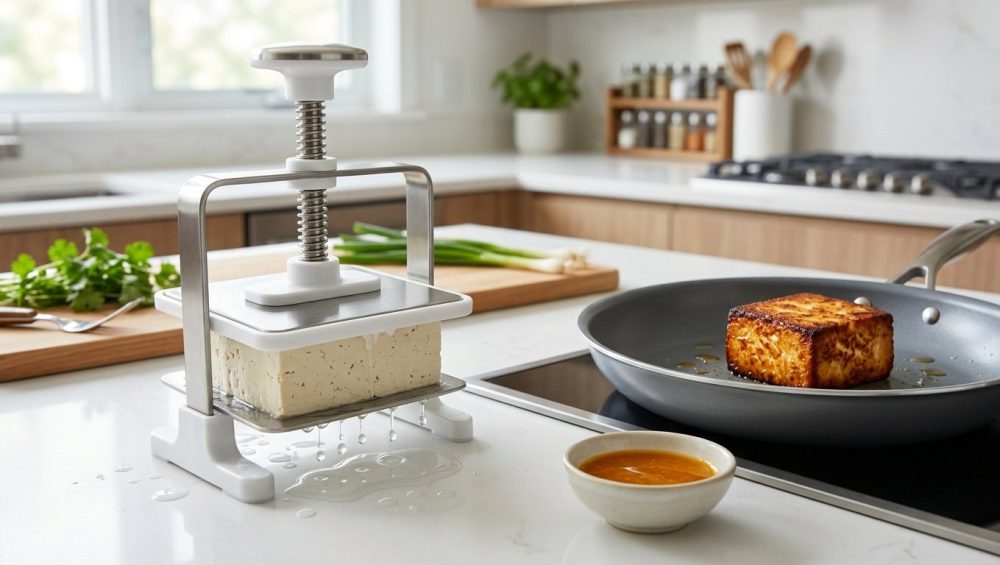
If you want professional-level results without the headache, you need to use the right tool for the job. Enter the dedicated, spring-loaded tofu press. This inexpensive, brilliant little device completely eliminates the variables that ruin the cookbook method.
The Physics of Dynamic Pressure
The secret to a flawless tofu press lies in Hooke’s Law of elasticity. Instead of relying on a static, dead weight, a spring-loaded press utilizes a coiled mechanical spring (or heavy-duty tension bands) to apply continuous, dynamic pressure to the protein block.
As the tofu releases its free water and begins to shrink in volume, the spring physically expands to fill the void. This means that the press is constantly pushing down, maintaining an optimal, calibrated compression of roughly 15 to 25 psi throughout the entire process. This continuous force gently and evenly densifies the protein matrix, forcing out the interstitial water without ever causing the violent shearing fractures associated with heavy books.
Efficient Drainage
A properly designed press suspends the tofu above a catch tray or features built-in drainage channels. As the water is squeezed out of the block, it falls away from the protein and is isolated in a separate reservoir. The tofu is never left sitting in its own stagnant juices, which drastically reduces the water activity (Aw) on the surface of the food, keeping it sanitary and perfectly prepped for a high-heat sear.
The “No-Go” Rule on Toxic Gear
Because I care about your health and your wallet, I must issue a stern warning: do not buy cheap, flimsy, mystery-plastic tofu presses from anonymous online drop-shippers. I have a strict zero-tolerance policy for toxic kitchenware. Cheap plastics will warp under the tension of the springs, they will develop micro-scratches that harbor horrific bacteria, and they can leach endocrine-disrupting chemicals into your food when exposed to acidic marinades.
Just like a bargain-bin frying pan that has lost its non-stick coating after three uses, a cheap plastic press is a false economy destined for the landfill. If you are going to buy a tofu press, invest in one made from food-grade stainless steel, sustainable bamboo with stainless hardware, or at the absolute minimum, highly durable, verified BPA-free and FDA-compliant materials. Buy a quality tool once, and it will serve you for a lifetime.
The Science of Flavor Absorption: Why Your Marinades Keep Failing
We have solved the texture problem by extracting the water, but what about the flavor? Tofu is notoriously bland on its own. It is meant to be a blank canvas. But so many home cooks complain that even after soaking their tofu in a rich, expensive soy-ginger-garlic marinade for hours, the inside of the block still tastes like nothing.
Let’s revisit the sponge analogy. If you take a kitchen sponge that is already 100% saturated with tap water and drop it into a bucket of soapy water, it cannot absorb the soap. There is simply no room left inside the structural voids.
When you take unpressed tofu—which, remember, is 87% water—and drop it into a marinade, two terrible things happen. First, the tofu cannot absorb the flavorful liquid because its internal matrix is already at maximum capacity. Second, through the slow process of osmosis, the water inside the tofu will gradually leak out into your marinade, heavily diluting your expensive ingredients and reducing sodium and acid penetration by up to 91%.
When you use a spring-loaded press to forcefully expel the free water, you are effectively wringing out the sponge. You are creating thousands of microscopic, empty voids within the denatured protein network. When you drop this newly pressed, densified block into a marinade, a physical phenomenon known as capillary action takes over. The liquid is aggressively drawn deep into the core of the tofu, filling those empty pockets with intense flavor.
If you want an even meatier, more absorbent texture, you should always freeze it first. When you place a block of tofu in the freezer, the water trapped inside the protein matrix turns into ice. Because water expands when it freezes, these ice crystals physically stretch and tear the protein strands, creating massive, cavernous pockets. When you thaw the block and put it in your spring-loaded press, the water drains away, leaving behind a highly porous, incredibly chewy structure that will drink up marinades like a vacuum.
The Masterclass: A Step-by-Step Guide to Foolproof Crispy Tofu
You now understand the thermodynamics of browning, the physics of dynamic pressure, and the chemistry of flavor absorption. It is time to put all of this academic knowledge into practice. Here is my definitive, no-nonsense method for achieving perfectly golden, shatteringly crisp tofu on a random weeknight.
Step 1: The Press
Remove your extra-firm tofu from its packaging and discard the packing water. Place the block into your high-quality, spring-loaded press. Lock the tension knobs or engage the spring mechanism. Because the dynamic pressure is so efficient, you do not need to wait hours. 15 to 30 minutes is more than enough time to extract the necessary free water. Use this time to chop your vegetables and prep your sauce. Efficiency is everything.
Step 2: The Cut
Once pressed, remove the densified block. You will immediately notice it feels heavier, sturdier, and significantly less fragile. Cut the tofu into your desired shape. I highly recommend tearing the tofu into rugged, uneven chunks with your hands rather than slicing it into perfect geometric cubes. Tearing creates jagged, irregular edges, which drastically increases the surface area. More surface area means more contact with the hot oil, which equals more crunch.
Step 3: The Coating
While pressed tofu will brown beautifully on its own, if you want that ultra-crispy, takeout-style exterior, you need a starch coating. Toss your torn tofu chunks in a bowl with a few tablespoons of cornstarch or arrowroot powder.
Why cornstarch? Cornstarch is incredibly high in amylose, a type of starch molecule that forms a rigid, glassy, crystalline structure when exposed to high heat and fat. It absorbs any microscopic droplets of moisture remaining on the surface of the tofu and creates a dry, protective barrier that fries up into a spectacular crust.
Step 4: The Pan and The Fat
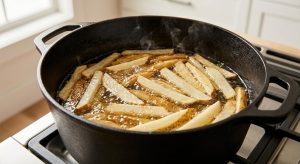
To achieve a rapid Maillard reaction, you need cookware with excellent thermal mass—meaning it can hold onto its heat when cold ingredients are added. A heavy carbon steel wok or a thick cast-iron skillet is mandatory here. Do not use a flimsy, lightweight aluminum pan; the temperature will drop too fast.
Place your pan on the stove and preheat it dry over medium-high heat. Once the metal is screaming hot, add a generous amount of a high-smoke-point fat, such as avocado oil, peanut oil, or refined grapeseed oil.
Step 5: The Sear
Carefully arrange your starch-coated tofu pieces in the pan in a single layer. Do not crowd the pan! Overcrowding traps steam, which, as we established earlier, caps the temperature at 212°F and prevents browning.
Once the tofu is in the pan, step away. Do not touch it. Do not aggressively shake the pan. You need continuous, uninterrupted thermal contact to achieve stick-free searing. The heat needs time to polymerize the starches and trigger the Maillard browning.
And let me be perfectly clear: under no circumstances should you use an aerosol spray oil for this process. Aerosol cooking spray is the enemy of high-heat searing. These sprays contain soy lecithin, an emulsifier that burns at low temperatures and polymerizes into a sticky, impossible-to-remove lacquer on your expensive cookware. Use real, liquid oil.
After 3 to 4 minutes, check the underside of a piece. If it is a deep, golden brown, flip it. Repeat until all sides are crispy.
Step 6: The Drain
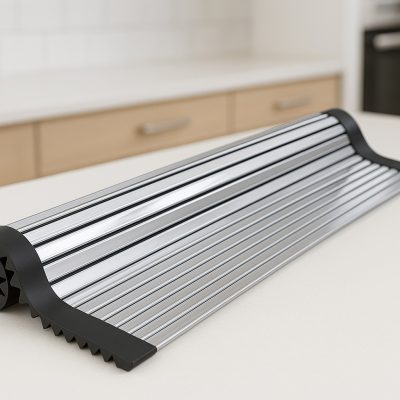
When the tofu is perfectly fried, remove it from the pan immediately. Do not set it on a plate lined with paper towels. The hot tofu is still releasing trace amounts of internal steam. If you place it on a flat paper towel, that steam is trapped directly against the bottom crust, turning it into a soggy, mushy mess that turns out greasy and unappetizing. Always transfer your fried foods to a wire cooling rack so the steam can escape freely from all sides.
Step 7: The Flavor
Now that you have perfectly textured, crispy protein, it is time to add the flavor. Because you pressed the tofu, the interior is ready to absorb whatever you throw at it. Toss the crispy chunks in a sweet soy glaze, a spicy peanut sauce, or a fiery chili crisp.
If you are building a pan sauce from scratch using whole cumin seeds, star anise, or Sichuan peppercorns, remember that the essential oils in these spices are fat-soluble, not water-soluble. Gently blooming them in oil for thirty seconds before adding your liquid ingredients will extract massive amounts of flavor, ensuring your sauce is robust enough to coat your perfectly engineered tofu.
The Final Bite
Cooking is not magic. It is simply the application of heat, physics, and chemistry. For decades, home cooks have been set up for failure by bad advice, cheap tools, and a fundamental misunderstanding of how moisture interacts with heat.
You do not have to settle for sad, spongy, flavorless dinners. By respecting the Maillard reaction, ditching the ridiculous cookbook balancing act, and investing in a high-quality spring-loaded tofu press, you are taking control of the thermodynamics in your kitchen. You are extracting the water, densifying the protein, and creating the perfect canvas for flavor absorption and a shattering, golden crust.
So throw away the paper towels, buy a proper press, and get back in the kitchen. You’ve got this.