It is a beautiful Friday evening. You’ve just spent a small fortune at the farmers’ market and the specialty grocery store. You bought a massive bouquet of vibrant, sweet-smelling fresh basil, a wedge of authentic Parmigiano-Reggiano that cost more than your first car, and a tiny bag of pine nuts that required taking out a second mortgage. You are ready to make the ultimate homemade pesto. You toss everything into your trusty food processor, hit the “high” button, and watch it whir into a beautiful, emerald-green emulsion.
You dip a spoon in, bring it to your lips, expecting a symphony of garlicky, herbal, nutty perfection. Instead, your face contorts. Your taste buds are assaulted by a harsh, astringent, aggressively bitter flavor that borderline tastes like battery acid. It’s metallic. It’s soapy. It’s completely ruined.
You stare at the machine, utterly betrayed. You didn’t burn anything. You followed the recipe. So why does your pesto taste like a punishment?
Welcome to my kitchen, darling. I am the Sassy Sous-Chef, and I am here to tell you that you didn’t buy bad basil. You didn’t buy rancid nuts. You committed one of the most common, yet least talked about, culinary crimes in the modern home kitchen: you blended your extra-virgin olive oil.
In this exhaustive masterclass, we are going to dive deep into the fascinating, microscopic food science of why high-speed blades are the mortal enemy of extra-virgin olive oil. I am going to teach you how to stop ruining expensive ingredients and give you a completely foolproof, absurdly simple technique adjustment that will yield sweet, vibrant, perfectly emulsified pesto every single time. We are completely transforming your daily cooking routine, starting right now. Grab a glass of wine, and let’s get into it.
The Expensive Tragedy of Ruined Pesto
Let’s talk about the sheer emotional and financial toll of a botched batch of pesto. For weekend culinary hobbyists, making a sauce from scratch is supposed to be a joyful, grounding experience. It’s the antithesis of ordering sad, lukewarm takeout. But when you are dealing with premium ingredients, the stakes are high.
In 2026, the global pine nut market is tighter than ever. With major production downturns and supply contractions, you are paying top dollar for those delicate kernels, with prices comfortably hovering between $30 to $50 a pound depending on the variety. Add in the cost of genuine Italian cheeses and cold-pressed, single-origin extra-virgin olive oil, and a single batch of pesto can easily represent a serious grocery investment. Throwing that straight into the compost bin because it tastes like bitter medicine is enough to make anyone cry over the kitchen counter.
This is exactly why so many home cooks retreat to the safety of store-bought jarred pesto. But let me be brutally honest: jarred pesto is a shadow of the real thing. It’s usually packed with cheap sunflower oil, potato flakes as a thickener, and citric acid to keep it shelf-stable, resulting in a dull, olive-drab paste that tastes more like sour grass than sweet basil. You deserve better. Your pasta deserves better. And you absolutely can achieve professional-level results in your standard home kitchen without a culinary degree. You just need to understand the science of your ingredients to avoid the rookie kitchen mistakes that hold you back.
The Fascinating Food Science of Extra Virgin Olive Oil
To understand why your pesto turned on you, we have to put on our lab coats and look at extra-virgin olive oil (EVOO) on a molecular level. Olive oil isn’t just liquid fat; it is a complex, living ingredient packed with chemical compounds that dictate its flavor, aroma, and health benefits.
Meet the Polyphenols: Your Bitter Frenemies
Extra-virgin olive oil is unique among culinary fats. Unlike highly refined vegetable oils or seed oils, EVOO is essentially fresh fruit juice. Because it is unrefined and cold-pressed, it retains a massive payload of natural antioxidants known as polyphenols. The two most prominent polyphenols in olive oil are oleuropein and oleocanthal.
These compounds are absolute rockstars for your health. They are powerfully anti-inflammatory, they protect your heart, and they are a massive reason why the Mediterranean diet is so revered. But here is the catch: they taste absolutely awful. In their raw, exposed form, polyphenols are incredibly astringent, pungent, and intensely bitter.
So why doesn’t a good bottle of olive oil taste like bitter poison when you dip a piece of crusty bread into it? Because nature is clever. In extra-virgin olive oil, these bitter, water-soluble polyphenols are safely locked away, suspended and coated within long chains of fatty acids. These fat molecules act like tiny little flavor shields. When you eat the oil normally, the fat coats your tongue, masking the bitterness of the polyphenols, allowing you to taste only the pleasant, fruity, and grassy notes of the oil.
The Violence of the Food Processor Blade
Enter the food processor. Or the high-speed blender. Or the immersion blender. These modern kitchen appliances are incredible time-savers, and I rely on them heavily for my weekday meal prep. But they are violent machines. A standard food processor blade spins at anywhere from 1,700 to 2,000 revolutions per minute.
When you pour your beautiful, expensive extra-virgin olive oil into the food processor and hit that button, you are subjecting the oil to extreme mechanical shear. The razor-sharp blades violently tear the oil apart, breaking it down into millions of microscopic droplets to force an emulsion.
As the oil is shattered on a microscopic level, those protective fatty acid chains are ripped apart. The bitter polyphenols are violently ejected from their fatty shields and dispersed directly into the liquid of your pesto (the water content from the fresh basil and the garlic juice). Because polyphenols are water-soluble, they immediately dissolve into the sauce, taking over the entire flavor profile. The smaller the oil droplets get, the more polyphenols are exposed, and the more aggressively bitter your sauce becomes.
Oxidation and the Emulsion Trap
If the mechanical shearing wasn’t bad enough, high-speed blending introduces another enemy: oxygen. As the blades spin, they create a vortex that whips a massive amount of air into the mixture. Extra-virgin olive oil is highly vulnerable to rapid oxidation. When you vigorously whip air into the sheared oil, you accelerate oxidative degradation. This rapid oxidation can manifest as stale, rancid, or metallic off-notes that compound the existing bitterness of the exposed polyphenols.
This is why your blended pesto doesn’t just taste a little “off”—it tastes like a chemical spill. You haven’t just mixed your ingredients; you have fundamentally altered their molecular structure in the worst possible way.
The Anatomy of Pesto Ingredients (And Why They Deserve Better)
Now that we know exactly why the oil throws a tantrum, let’s look at the rest of the bowl. Pesto alla Genovese is a masterpiece of simplicity. It relies on a delicate balance of just a few ingredients, which means there is nowhere for poor technique to hide. Let’s break down how to treat these ingredients with the respect they deserve.
Fresh Basil (The Delicate Star)
Basil is a notoriously fragile herb. Its leaves are prone to rapid enzymatic browning the second they are bruised or exposed to heat. When you use a food processor to chop basil, you need to ensure your blades are razor-sharp. Dull blades won’t cut the leaves; they will crush and mash them, releasing enzymes that turn your vibrant green pesto into a muddy, swampy brown. If you notice your basil turning black almost instantly, your appliance’s blades are likely the culprit.
Pine Nuts (The Buttery Gold)
Pine nuts (pignoli) provide the creamy, buttery backbone of the sauce. Their high fat content helps emulsify the pesto and provides a sweet, nutty counterbalance to the sharp garlic and pungent basil. Always, always lightly toast your pine nuts in a dry skillet before using them. Toasting awakens their natural oils and deepens their flavor exponentially. Just watch them like a hawk, because they will go from perfectly golden to charred ash in roughly four seconds.
Garlic (The Pungent Kick)
Garlic is the wild card. The allicin in garlic (the compound responsible for its spicy, pungent flavor) is created when the cell walls are ruptured. The more finely you crush or blend garlic, the more aggressive it becomes. If you throw whole cloves into a food processor and let it run, you risk creating a garlic paste that overpowers the delicate basil. (And as a side note, if you ever wonder why your garlic always burns in other recipes, it’s because minced garlic cooks in seconds and should never be the first thing in a hot pan). For pesto, I highly recommend grating your garlic on a microplane or crushing it into a paste before adding it to the mix, ensuring it distributes evenly without needing excessive blending time.
Parmigiano-Reggiano & Pecorino (The Salty Anchors)
Authentic pesto uses a blend of Parmigiano-Reggiano (for sweet, nutty depth) and Pecorino Romano (for a sharp, salty bite). Please, for the love of all things culinary, grate your own cheese. Pre-shredded cheeses are coated in anti-caking agents like cellulose, which will prevent your pesto from emulsifying properly and leave a gritty texture on your tongue.
The Foolproof Fix: How to Make Perfect Pesto Every Time
We have established that time is money, and while I love a romantic weekend cooking project, I am not going to tell you to throw away your food processor. We are busy people. We need clever, time-saving cooking hacks. You can absolutely use your food processor to make a stunning, professional-level pesto in five minutes. You just have to change the order of operations.
Here is the Sassy Sous-Chef’s definitive, scientifically-backed method for foolproof pesto.
Step One: The Dry Grind
Start by adding your toasted (and cooled) pine nuts, your grated garlic, and a generous pinch of coarse kosher salt to the bowl of your food processor. Pulse this mixture until it forms a coarse paste. The salt acts as an abrasive, helping to grind the nuts and garlic evenly.
Step Two: The Basil Breakdown
Next, add your fresh basil leaves. This is where things can get tricky. Without liquid, the basil will just fly around the bowl and stick to the sides. Do NOT reach for your extra-virgin olive oil. Instead, you have two options to get the blades moving.
Option A: Add a tiny splash of ice water (about a tablespoon). The ice water not only lubricates the blades, but the cold temperature helps shock the basil, keeping it bright green and preventing the heat of the motor from cooking the herbs.
Option B: Add a small amount of a neutral, refined oil. A tablespoon of grapeseed oil, avocado oil, or even regular (refined) olive oil will work perfectly. Because these oils are refined, their polyphenols have been stripped away during processing. They will not turn bitter when subjected to the high-speed blades.
Pulse the machine until the basil is finely chopped and incorporated into the nut and garlic paste. Scrape down the sides of the bowl with a high-quality spatula. (And while we’re on the subject of spatulas, if you’ve ever wondered why your food tastes like soap, it’s because cheap silicone absorbs dishwasher detergent. Invest in platinum-grade, odor-free silicone tools).
Step Three: The Cheese Fold
Add your finely grated Parmigiano-Reggiano and Pecorino Romano to the processor. Pulse it just two or three times to combine. You do not want to over-process the cheese, or it will heat up and turn gummy.
Step Four: The Manual Emulsion (The Golden Rule)
This is the most critical step of the entire process. Take the bowl off the food processor base. Remove the blade carefully.
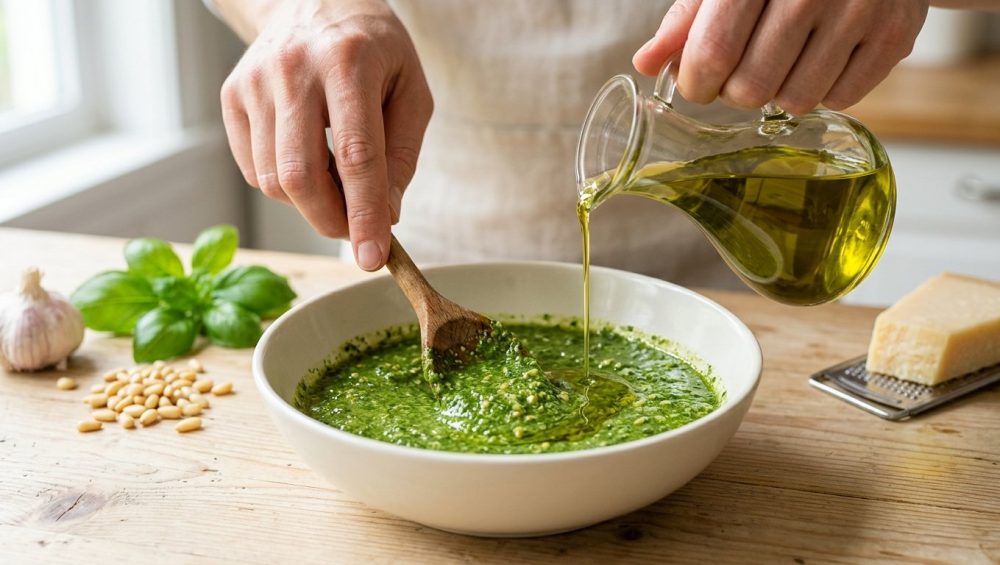
Now, take your beautiful, expensive, cold-pressed extra-virgin olive oil, and pour it into the basil paste. Using a spoon or a spatula, gently stir the oil into the paste by hand.
That’s it. That is the massive secret. By manually folding the oil into the pesto, you are gently coating the ingredients in fat rather than violently shearing the oil molecules apart. The fatty acid chains remain perfectly intact. The bitter polyphenols stay happily locked inside their lipid armor. The result is a lush, sweet, vibrant, perfectly balanced sauce that highlights the grassy, fruity notes of the olive oil without a single trace of bitterness.
The Traditional Alternative: The Mortar and Pestle Method
Now, if you have the luxury of time on a lazy Sunday afternoon, I highly encourage you to try making pesto the way it was originally intended. Pesto alla Genovese hails from Genoa, in the Liguria region of Italy. The word “pesto” actually comes from the Italian verb pestare, which literally translates “to pound” or “to crush.”
Crushing vs. Slicing
When you use a food processor, you are rapidly slicing the basil leaves. Slicing is efficient, but it doesn’t extract the maximum amount of flavor. When you use a heavy mortar and pestle, you are physically crushing the plant cells against stone. This slow, grinding friction releases the sweet essential oils trapped inside the basil leaves and the pine nuts in a way that a blade simply cannot replicate.
Furthermore, the gentle grinding motion of the pestle slowly works the extra-virgin olive oil into the paste, creating a beautiful, stable emulsion without ever subjecting the oil to the violent, high-speed shear that strips the polyphenols.
Is it Worth the Elbow Grease?
Yes and no. The flavor and texture of a mortar-and-pestle pesto are undeniably superior. It is silkier, creamier, and profoundly aromatic. However, it takes about 20 to 30 minutes of continuous, vigorous grinding to achieve a smooth paste. Your forearm will burn. You will question your life choices.
For a special occasion, absolutely do it. But for a quick Tuesday night dinner when you are trying to get food on the table before you pass out from exhaustion? Use the food processor hack I outlined above. It gets you 95% of the way there with 5% of the effort.
Rescuing a Bitter Batch (Can It Be Saved?)
Let’s say you are reading this article a little too late. You already dumped your EVOO into the blender, you hit the button, and now you are staring at a bowl of bitter green sadness. Can it be saved?
I am not going to lie to you: once those polyphenols are sheared and released into the emulsion, you cannot put the genie back in the bottle. The bitterness is there to stay. However, you can employ some culinary sleight-of-hand to mask the bitterness and salvage your expensive ingredients. I’ve had my share of disasters, and knowing brilliant ways to save ruined meals is a crucial skill for any home cook.
The Fat and Dairy Band-Aid
Bitterness is best masked by fat and salt. Your first line of defense is to add more cheese. A heavy handful of extra Parmigiano-Reggiano can do wonders to balance the harshness. If it is still aggressively bitter, you need to introduce a heavy dairy fat. Stirring in a few tablespoons of high-quality whole milk ricotta, heavy cream, or even mascarpone cheese will dilute the concentration of the polyphenols and coat the palate, significantly dulling the bitter receptors on your tongue.
The Acid Adjustment
Sometimes, you just need to distract the taste buds. A generous squeeze of fresh lemon juice won’t remove the bitterness, but the sharp, bright acidity will compete for attention on your palate, making the astringency less noticeable. Just be aware that adding acid to basil will eventually turn it a dull olive color, so only add the lemon right before serving.
The Starchy Water Trick
When tossing your bitter pesto with pasta, make sure you are heavily utilizing your pasta cooking water. The starches in the water help bind the sauce to the noodles and dilute the intensity of the sauce. (If you struggle with watery sauces, learning the secret power of starchy water will change your life). The starch acts as a buffer, mellowing out the harsh chemical bite of the sheared oil.
Upgrading Your Pesto Game: Equipment and Ingredient Rules
As your Sassy Sous-Chef, I have a strict “No-Go” rule when it comes to toxic, cheap, or useless kitchen gear. If you want to make incredible food, you need to stop sabotaging yourself with bad equipment.
Ditch the Cheap Plastic Blenders
If you are using a $20 plastic blender from a big-box store to make pesto, please stop. Cheap plastic blenders have weak motors and dull blades. Because the blades are dull, they don’t cut the basil; they pulverize and heat it. Furthermore, cheap plastic carafes can leach microplastics and endocrine disruptors into your food, especially when exposed to the acidity of garlic and lemon or the friction heat of the motor. Invest in a high-quality food processor with a BPA-free or glass bowl and razor-sharp stainless steel blades.
The Mortar and Pestle Mandate
If you decide to go the traditional route, do not buy a tiny, polished marble mortar and pestle that looks like a decorative paperweight. You need a large, heavy, unpolished granite mortar and pestle. The unpolished interior provides the necessary friction to actually grip and crush the ingredients. A smooth bowl will just have you chasing uncrushed pine nuts in circles for an hour.
Sourcing the Right Olive Oil
Not all extra-virgin olive oils are created equal. For cooking and sautéing, I love a robust, peppery, early-harvest olive oil. But for pesto, a peppery oil is a liability. That peppery kick in the back of your throat is literally the sensation of high polyphenol content (specifically oleocanthal). The higher the polyphenol count, the higher the risk of extreme bitterness if the oil is mishandled.
When shopping for an oil to use in delicate raw sauces like pesto or aioli, look for bottles labeled “late harvest,” “mild,” “fruity,” or “buttery.” Olives harvested later in the season are riper, sweeter, and naturally lower in those aggressive bitter compounds. Varieties like Arbequina or Taggiasca olives tend to produce much milder, sweeter oils that are perfect for pesto.
And please, store your olive oil properly. Light and heat are the enemies of oil. Keep it in a cool, dark pantry in an opaque glass or tin container. Never store it right next to your stove.
Essential Kitchen Maintenance
Having good gear is only half the battle; maintaining it is the other. Your food processor blades will dull over time, just like your chef’s knives. If you notice your herbs are looking bruised rather than chopped, it might be time to order a replacement blade. And speaking of knives, please stop scraping the edge of your expensive chef’s knife across your cutting board to scoop up garlic. That rolls the microscopic edge of the blade instantly. This is exactly why you need a bench scraper—a cheap piece of metal that will save your expensive blades.
Similarly, treat your other tools with respect. Buy solid hardwood utensils (and if your wooden spoons keep cracking, it is because you are putting them in the dishwasher). Stop buying cheap plastic storage containers that absorb stains and smells; if your plastic containers stay greasy no matter how much you scrub, it’s time to upgrade to tempered glass.
Beyond Pesto: Where Else Does Blended Olive Oil Ruin Dinner?
The rule of “never blend extra-virgin olive oil” extends far beyond pesto. This microscopic chemical reaction will ruin several other classic sauces if you aren’t careful.
Homemade Mayonnaise and Aioli
Making homemade mayonnaise in a food processor or with an immersion blender is a brilliant kitchen hack. It takes 60 seconds and tastes infinitely better than the jarred stuff. But if you use extra-virgin olive oil as your base fat, you are in for a nasty surprise. The intense shearing required to emulsify the egg yolks and oil will strip the polyphenols instantly, resulting in an incredibly bitter, inedible aioli.
The fix? Use a neutral oil (like avocado, grapeseed, or sunflower oil) for 90% of the emulsion. Once the mayonnaise is thick and creamy, turn off the blender, and manually whisk in a tablespoon or two of high-quality EVOO at the very end just for flavor.
Vinaigrettes and Chimichurri
If you like to use a blender to emulsify your salad dressings or make a quick chimichurri, proceed with extreme caution. A few pulses might be fine, but if you let the blender run to create a perfectly homogenous, creamy vinaigrette, you risk crossing the threshold where the fatty acids break down and release the bitter compounds.
For vinaigrettes, the traditional method is still the best: put your ingredients in a glass jar, screw the lid on tight, and shake it vigorously. The agitation of shaking is enough to create a temporary emulsion without generating the intense mechanical shear force that shatters the oil molecules.
Hummus and Baba Ganoush
When making hummus, process your chickpeas, tahini, lemon juice, and garlic until perfectly smooth. But just like with pesto, do not pour your expensive EVOO down the feed tube while the machine is running. Process the dip using a splash of ice water to get it light and fluffy, then transfer it to a serving bowl. Use the back of a spoon to create a beautiful swoosh in the hummus, and drizzle the extra-virgin olive oil generously over the top. It looks stunning, and it preserves the sweet, fruity integrity of the oil.
Ingredient Substitutions for the Budget-Conscious Cook
Let’s circle back to the elephant in the room: the cost of ingredients. I want you to make pesto, but I don’t want you to go bankrupt doing it. If premium pine nuts are not in the budget this week, you can absolutely pivot without sacrificing quality.
The Nut Swaps
Walnuts are the most traditional substitute for pine nuts. They are significantly cheaper and provide a wonderful, earthy depth. However, walnuts have a very astringent skin. To prevent your pesto from tasting tannic, lightly toast the walnuts and rub them in a clean kitchen towel to remove as much of the papery skin as possible before processing.
Pistachios are another phenomenal option. They yield a vibrant, sweet, and slightly floral pesto that pairs beautifully with roasted vegetables or grilled chicken. Almonds (specifically Marcona almonds) work well, though they are harder and will result in a slightly grainier texture.
The Greens Swaps
If fresh basil is out of season or prohibitively expensive, you can create stunning pestos using alternative greens. Arugula provides a fantastic peppery bite. Baby spinach creates a beautifully sweet, mild pesto with an electric green color. You can even use carrot tops or radish greens—just make sure to blanch them briefly in boiling water to soften their fibrous texture and mellow their natural bitterness.
The Cheese Swaps
Authentic Parmigiano-Reggiano is expensive. While I don’t recommend substituting it with the cheap, powdery stuff in the green plastic shaker, you can look for domestic Parmesan or Grana Padano. Grana Padano is produced in a similar way to Parmigiano-Reggiano but is aged for less time, making it slightly milder and significantly more affordable.
Conclusion: Reclaiming Your Kitchen Confidence
Cooking is not magic. It is a combination of chemistry, physics, and a little bit of intuition. When a recipe fails, it is almost never because you are a “bad cook.” It is simply because there was a microscopic reaction happening in the bowl that nobody bothered to explain to you.
Once you understand the “why” behind the food, the “how” becomes effortless. You don’t need a culinary degree to know that high-speed blades tear apart fatty acid chains and release bitter polyphenols. You just need a little bit of curiosity and the willingness to adjust your technique.
The next time you bring home a beautiful bunch of basil and a prized bottle of olive oil, you aren’t going to cross your fingers and hope for the best. You are going to grind your aromatics, chop your herbs, and then, with the quiet confidence of a true kitchen artist, you are going to take that bowl off the machine and fold your oil in by hand.
You are going to taste it, and it is going to be sweet, vibrant, nutty, and absolutely perfect. Your pasta will thank you. Your dinner guests will beg you for the recipe. And you will never, ever settle for sad, bitter, jarred pesto again.
Now get out of here, go toast some pine nuts, and start cooking. You’ve got this. If you want to keep upgrading your skills, go read about the brilliant trick to run it under water to revive old loaves of bread to serve with your perfect new pesto. Trust me, it’s a game-changer. Until next time, keep your knives sharp and your olive oil unblended!