If we are being completely honest, there are few things in the culinary world that strike more primal fear into the hearts of weekend home cooks than a raw, expensive piece of fish and a hot stainless steel skillet. I have seen incredibly competent adults—people who manage hedge funds, raise multiple children, and successfully assemble IKEA furniture without crying—completely lose their nerve when it comes to pan-frying a simple halibut fillet.
You stand there, staring at the pan, spatula in hand, sweating profusely as you wait for the exact right moment to flip it. And then, the tragedy strikes. You slide the spatula underneath, but the bottom half of the fish has aggressively welded itself to the metal. You panic. You scrape. You end up serving your guests a mangled, shredded pile of what can only be described as a “fish scramble,” furiously apologizing while pouring everyone significantly larger glasses of wine.
If this sounds familiar, you are not alone. According to the 2024 Clueless Cooks Report, a staggering 54% of Americans admit they are not proficient in the kitchen, and a massive portion of that anxiety is directed squarely at seafood. A recent Tasting Table survey revealed that over 30% of people consider lobster the most difficult seafood to cook, but when it comes to everyday weeknight dinners, it is the delicate, flaky, finned fish that truly makes people nervous.
But here is the truth, straight from your favorite sassy sous-chef: You do not need a culinary degree to cook restaurant-quality seafood at home. You do not need to rely on takeout, and you absolutely do not need to keep ruining your salmon on a busy Tuesday night. You just need to understand a little bit of food science, throw out your toxic cookware, and embrace a wildly effective, slightly unconventional secret weapon that is already sitting in your refrigerator door: Mayonnaise.
Yes, mayonnaise.
Ditch the cooking oil. Put away the butter. We are about to embark on a definitive, no-nonsense masterclass on exactly why a thin coating of mayonnaise is the ultimate, foolproof secret to achieving a perfectly seared, non-stick, golden-crusted piece of fish every single time.
The Science of the Stick: Why Fish Hates Your Frying Pan
Before we can solve the problem, we need to understand why fish behaves like industrial superglue the second it touches hot metal. I promise not to bore you with pretentious chef-speak, but we do need to talk about chemistry for a minute.
When a raw, moisture-rich piece of fish hits a hot pan, its surface proteins denature and undergo a rapid structural change. At this exact moment, the protein is soft, reactive, and looking for something to bond with. If it comes into contact with bare metal, it will literally form covalent bonds and van der Waals forces with the iron atoms in the pan.
Furthermore, even the most expensive, highly polished stainless steel pan is not actually smooth. Under a microscope, the surface of a stainless steel skillet looks like a rugged mountain range full of tiny pores, hills, and valleys. As the metal heats up, these microscopic pores expand. If the fish is added before the pan is properly heated, or if there is not a sufficient barrier of fat, those expanding pores will clamp down on the soft fish proteins like a microscopic bear trap. This is exactly why your meat sticks to stainless steel and refuses to let go.
To prevent this chemical bonding, traditional cooking relies on a generous pool of hot cooking oil. The goal is to create a liquid barrier that fills in the microscopic valleys of the metal and conducts heat rapidly enough to instantly vaporize the water on the surface of the fish. This rapid vaporization creates a cushion of steam—a phenomenon we need to master—that physically lifts the food away from the metal.
However, fish is uniquely problematic. Unlike a robust ribeye steak, fish is incredibly delicate, highly porous, and packed with water. When you place it into a pan of hot oil, the oil often gets pushed aside by the sheer weight and moisture of the fillet, allowing the proteins to bypass the fat barrier and chemically bond to the metal anyway.
The Toxic Trap: Why We Cannot Just Use Cheap Non-Stick Pans
At this point, you might be thinking, “This sounds exhausting. I’ll just use my non-stick pan.”
Stop right there. If you have been following my kitchen rants for any length of time, you know my strict “No-Go” rule on toxic gear. I have absolutely zero patience for cheap, peeling, chemical-laden non-stick pans. If you are still cooking your family’s dinners on a scratched-up Teflon skillet you bought at a big-box store five years ago, we need to have a serious intervention.
The vast majority of traditional non-stick pans are coated with PTFE (polytetrafluoroethylene), which belongs to a massive class of thousands of man-made “forever chemicals” known as PFAS. These chemicals do not break down in the environment, and they certainly do not break down in your body.
The regulatory landscape is finally catching up to what we have known for years. A 2025 Consumer Reports survey revealed that 65% of U.S. adults are now actively concerned about PFAS in their cookware. Governments are taking action: As of January 1, 2025, Minnesota became the first U.S. state to completely ban the sale of non-stick cookware coated with PFAS. Meanwhile, the European Union is pushing forward with sweeping restrictions aiming to ban PFAS-containing kitchenware entirely by 2025-2026.
Even if we ignore the alarming health and environmental statistics, cheap non-stick pans are just terrible culinary tools. They cannot safely handle the high heat required for a proper, restaurant-quality sear, and they start losing their slip after just a few months of standard weeknight use.
You deserve better. You deserve the unparalleled heat retention of cast iron and the precise temperature control of high-quality stainless steel. And with the mayonnaise trick, you can achieve a flawless, non-stick release on these professional-grade surfaces without exposing your salmon to forever chemicals.
The Mayonnaise Miracle: Food Science in a Jar
So, how does a humble condiment solve the greatest seafood dilemma in the home kitchen? To understand the magic, we have to look at what mayonnaise actually is.
Mayonnaise is not just a sandwich spread; from a culinary chemistry perspective, it is a highly stable emulsion. It is created by vigorously whisking together oil, egg yolks, and an acid (usually lemon juice or vinegar) until the microscopic droplets of fat are suspended in the water-based ingredients.
When you swap out your standard glug of olive oil for a thin coating of mayonnaise brushed directly onto the fish, you are deploying a scientifically perfect searing medium. Here is why it works so brilliantly:
1. The Viscosity Advantage: It Stays Put
When you pour oil into a hot skillet, it behaves like a liquid. It runs, it pools in the corners of the pan, and it easily slides right off the curved edges of a fish fillet. When you place your fish into the pan, the oil is violently displaced.
Mayonnaise, thanks to the emulsifying power of lecithin found in the egg yolks, is highly viscous. When you brush it onto a piece of fish, it clings to the flesh like a second skin. It does not drip off. It does not pool. It guarantees that there is an unbroken, perfectly even micro-layer of fat situated exactly between the delicate fish proteins and the harsh, hot metal of the pan.
2. The Built-In Protein Boost
Browning in the kitchen is primarily driven by a chemical process called the Maillard reaction. This is the complex reaction between amino acids (proteins) and reducing sugars under high heat, resulting in that deeply savory, golden-brown crust we all crave.
Fish flesh is relatively low in the specific types of proteins and sugars that brown quickly and evenly. Mayonnaise, however, is packed with egg yolk proteins. When the mayo-coated fish hits the hot pan, the egg proteins in the mayonnaise immediately go to work, jumpstarting the browning process. The mayo effectively acts as a sacrificial layer; the egg proteins brown and crisp up rapidly, forming a protective, structurally stable crust that shields the tender fish flesh underneath from chemically bonding to the steel.
3. Smoke Point Management
Butter is delicious, but its milk solids burn at a very low temperature, turning your beautiful fish into an acrid, blackened mess. Extra virgin olive oil is great for salads, but it degrades rapidly under high searing temperatures. Mayonnaise is typically made with neutral oils (like canola, grapeseed, or soybean oil) which have a much higher smoke point. Furthermore, the emulsion protects the fat, allowing it to withstand the intense heat of a cast iron or stainless steel skillet without immediately breaking down and smoking out your kitchen.
The Masterclass: Step-by-Step Guide to the Perfect Sear
Now that we have established the science, it is time to put it into practice. We are going to walk through the exact, step-by-step methodology to achieve a flawless, tear-free sear on any piece of fish. Time is money during the week, so this technique is designed to be efficient, stress-free, and perfectly repeatable.
Step 1: The Great Drying (Do Not Skip This)
Moisture is the absolute enemy of a good sear. If your fish is wet when it hits the pan, the heat energy will be entirely wasted on boiling the surface water rather than creating a crust. The fish will steam, turn gray, and stick to the pan instantly.
Remove your fish from the refrigerator about 15 minutes before cooking to take the chill off. Place the fillets on a cutting board and aggressively pat them completely dry. You must thoroughly dry the fillets with paper towels before doing anything else. Do not just dab them; press gently to extract as much surface moisture as humanly possible.
Step 2: The Mayo Application
Once the fish is bone-dry, season it generously with kosher salt and freshly ground black pepper.
Next, take a silicone basting brush (or just the back of a spoon) and apply a thin, even layer of mayonnaise to the side of the fish that will hit the pan first (usually the presentation side, or the skin side if you are crisping the skin).
Crucial Rule: Do not glob it on. You are not making potato salad. You want a very thin, translucent layer—just enough to coat the flesh entirely. If you use too much, the emulsion will break in the pan, leaving you with a greasy puddle.
What kind of mayo? Use full-fat, real mayonnaise. Hellmann’s, Best Foods, or Duke’s work perfectly. Do not use fat-free mayonnaise, and absolutely do not use sweet salad dressings like Miracle Whip, as the high sugar content will instantly burn and turn into a sticky, black disaster.
Step 3: Pan Selection and Thermodynamics
For this technique, you want a heavy-bottomed stainless steel skillet or a well-seasoned cast iron pan. These materials offer the necessary thermal mass to maintain their temperature when a cold piece of fish is dropped into them.
Place your dry, empty skillet on the stove over medium-high heat. Let it heat up for a few minutes. Heat control is the single most important variable when cooking with bare metals. We want to harness the Leidenfrost effect to create a vapor barrier that prevents sticking.
How do you know when the pan is ready? You can verify the temperature using the water drop test. Flick a few drops of water into the empty pan.
- If the water just sits there and slowly bubbles, the pan is too cold.
- If the water instantly explodes into a million tiny, violent droplets, the pan is too hot.
- If the water forms a single, cohesive bead that dances and glides smoothly across the surface like a mercury marble, your pan is perfectly preheated.
Step 4: The Drop and the Waiting Game
Because your fish is already coated in its own perfect layer of fat, you do not need to add any oil to the pan.
Gently lay the mayo-coated side of the fish into the hot skillet, laying it away from you so any microscopic splatters go toward the back of the stove, not onto your shirt.
As soon as the fish hits the pan, take your spatula and press down gently but firmly on the thickest part of the fillet for about 10 seconds. Raw fish naturally seizes and curls up when it hits high heat, which causes the center of the fillet to lift away from the metal, resulting in uneven browning. Pressing it flat ensures maximum contact.
Now comes the hardest part for any anxious home cook: Walk away.
Do not touch it. Do not nudge it. Do not try to peek underneath. Let the pan do its job. The mayonnaise is currently undergoing a rapid Maillard reaction, forming a golden crust that will act as a structural barrier between the delicate flesh and the hot metal. If you try to move the fish too early, you will tear it.
Step 5: The Flip
Depending on the thickness of the fillet, you will let it sear undisturbed for about 3 to 5 minutes. You will know it is ready to flip when you can see a golden-brown crust forming around the bottom edges, and the opaque, cooked color has crept about a third of the way up the side of the fish.
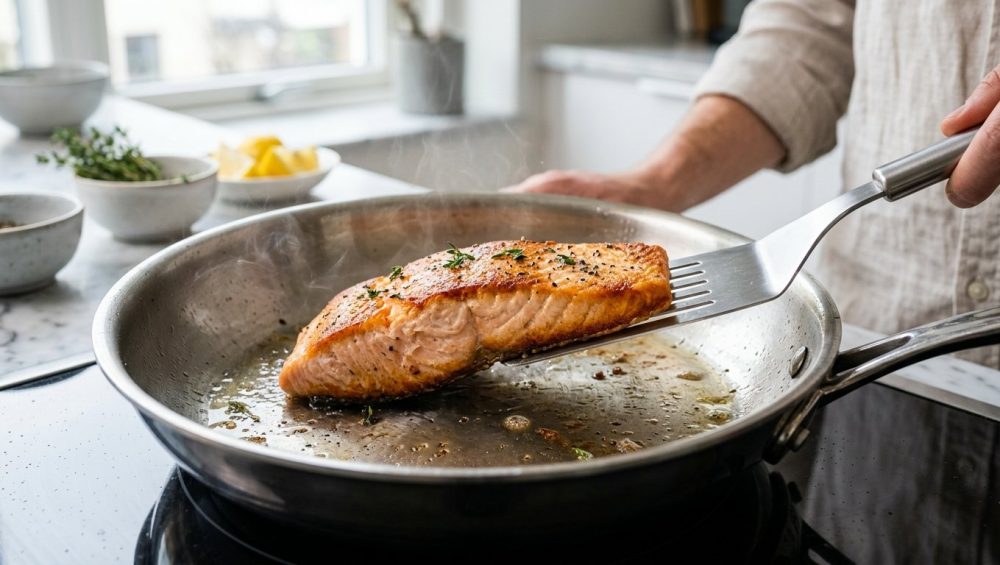
When it’s time to flip, use a flexible fish spatula to gently lift the filet. A thick, blunt wooden spoon or a clumsy silicone pancake turner will just mash the meat. A proper fish spatula has a thin, beveled metal edge that slides cleanly under the crust.
If the fish offers any serious resistance when you try to slide the spatula underneath, stop. It is not ready yet. The chemical bonds have not fully released. Give it another 30 to 60 seconds, and it will naturally un-stick itself when the crust is fully formed.
Once flipped, you can brush a tiny bit of mayo on the second side if you wish, or just let it finish cooking in the residual heat for another minute or two until it flakes easily with a fork.
Troubleshooting and Frequently Asked Questions
Even with a foolproof method, the kitchen can throw curveballs. Let’s address the most common concerns my readers have when trying this technique for the first time.
“Is my fish going to taste like a warm egg salad sandwich?”
Absolutely not. This is the number one fear people have about this hack. The mayonnaise completely transforms under the high heat of the skillet. The oil melts away to lubricate the pan, the water evaporates, and the egg proteins bake into a savory, neutral-tasting crust. Once the fish is cooked, there is absolutely zero residual “mayonnaise” flavor or texture. It just tastes like a perfectly seasoned, expertly pan-roasted piece of seafood.
“Can I use this trick for skin-on fish, like salmon?”
Yes, and it is a game-changer for crispy skin. Fish skin is notoriously sticky because it is packed with gelatin and moisture. Drying the skin thoroughly and applying a very thin layer of mayo before placing it skin-side down in a hot pan will yield shatteringly crisp, perfectly rendered skin that releases effortlessly from the metal.
“What if I am vegan or allergic to eggs?”
You can absolutely use a high-quality vegan mayonnaise. Traditional mayo relies on egg yolks (lecithin) as the emulsifier, but modern vegan mayos use aquafaba (chickpea water) or soy proteins to create a nearly identical emulsion. The plant-based proteins in vegan mayo will still trigger a beautiful browning reaction and provide the exact same viscous fat barrier as traditional egg-based mayo.
“My fish still stuck a little bit. What went wrong?”
If you followed the mayo trick and still experienced tearing, the culprit is almost certainly temperature control. Either your pan was not hot enough when you dropped the fish in (failing to create the necessary steam barrier), or you panicked and tried to flip the fish before the crust had fully formed. Just like how your kitchen knives get dull if you abuse them, your pans will fail you if you don’t prep them right. Have patience, trust the process, and let the heat do the heavy lifting.
“How do I clean my pan afterward?”
Because you achieved a clean release, your stainless steel or cast iron pan should just have a lovely fond (browned bits) left at the bottom. If you are using stainless steel, simply deglaze the hot pan with a splash of white wine or lemon juice, scrape up the bits, and you have an instant pan sauce. If you are using cast iron, let it cool slightly, then wash it out. Clean your cast iron with a chainmail scrubber rather than harsh detergents to protect your hard-earned seasoning.
Leveling Up: Flavor-Infused Mayo Crusts
Once you have mastered the basic technique, the mayonnaise trick opens up an entirely new world of weeknight culinary creativity. Because mayo is thick and sticky, it acts as the ultimate binder for aromatics and crusts.
Instead of just using plain mayonnaise, scoop a couple of tablespoons into a small bowl and mix in your favorite flavorings before brushing it onto the fish. The mayo will lock the ingredients against the flesh, preventing them from falling off into the pan and burning.
- The Herb Garden: Mix finely chopped fresh dill, parsley, a squeeze of lemon juice, and a dash of garlic powder into the mayo. This is spectacular on mild white fish like cod or haddock.
- The Spicy Sear: Whisk a teaspoon of smoked paprika, a pinch of cayenne pepper, and a dash of cumin into the mayo before coating a piece of tilapia or mahi-mahi. The paprika will amplify the browning reaction, giving you a gorgeous, blackened, Cajun-style crust.
- The Panko Crunch: Brush the fish with a slightly thicker layer of plain mayo, then firmly press the mayo-coated side into a plate of panko breadcrumbs mixed with grated parmesan cheese. Drop it carefully into the pan. The mayo acts as the glue, and the breadcrumbs fry up in the hot pan into a spectacularly crunchy, golden armor.
Final Thoughts from the Sassy Sous-Chef
Cooking should not be a source of anxiety. It certainly shouldn’t require you to compromise your family’s health by relying on degrading, chemical-coated cookware just to avoid a little bit of sticking.
The mayonnaise trick is the perfect embodiment of smart, efficient, science-backed home cooking. It takes a notoriously intimidating ingredient—delicate, expensive seafood—and makes it accessible for a frantic Wednesday night dinner. It proves that you don’t need to be a classically trained French chef to achieve a flawless, golden-brown sear.
So, the next time you are at the grocery store, do not walk past the seafood counter in fear. Buy that beautiful piece of salmon. Grab that delicate halibut fillet. Go home, dry it off, reach for the mayonnaise jar, and show that stainless steel skillet exactly who is boss. You’ve got this.