Listen, we need to have a serious talk about your chicken wings.
I know exactly what happens on a random Tuesday night. You are exhausted from work, you are craving the comfort of hot, crackling pub-style food, and you absolutely refuse to pay exorbitant delivery fees for a lukewarm styrofoam clamshell of disappointment. So, you decide to take matters into your own hands. You buy a pack of raw wings, toss them onto a baking sheet, throw them into a hot oven, and pray to the culinary gods that they miraculously transform into the deep-fried, golden masterpieces you get at your favorite local dive bar.
But the culinary gods are ignoring you. Forty-five minutes later, you pull the pan out of the oven only to find pale, flabby, unappetizing poultry. The skin feels less like a satisfying crunch and more like a soggy water balloon. You eat them anyway because you are hungry, but with every bite, you are quietly mourning the crispy dinner you actually wanted.
I am here to tell you that it does not have to be this way. You do not need to buy a messy, dangerous deep fryer that will make your entire house smell like a fast-food kitchen for three days. You do not need a culinary degree. You just need a basic understanding of kitchen chemistry and a little white powder sitting quietly in the back of your pantry.
Welcome to the definitive masterclass on the secret to extra crispy oven-roasted chicken. Today, we are talking about the absolute magic of aluminum-free baking powder.
The Universal Tragedy of Rubbery Oven-Baked Chicken
Before we can fix the problem, we have to understand why standard oven-roasting fails us so miserably when it comes to poultry skin. If you want to fix rubbery chicken skin, you have to look at the anatomy of the bird.
Chicken skin is essentially a thick matrix of water, fat, and connective tissue (primarily collagen and elastin). When you place raw chicken into a hot oven, you are initiating a race against time. The heat of the oven begins to cook the meat underneath the skin almost immediately. Meanwhile, the water trapped inside the skin begins to heat up and evaporate, turning into steam.
Here is the tragic part: ovens are relatively enclosed environments. As that moisture releases from the chicken, it creates a localized cloud of steam right directly above the meat. Instead of roasting or frying, your chicken skin is effectively taking a hot, humid sauna bath. By the time the water finally evaporates enough to allow the temperature of the skin to rise above the boiling point (212°F or 100°C) to begin the crisping process, the delicate meat underneath is already overcooked, dry, and stringy.
If you try to compensate by leaving the chicken in the oven even longer to force the skin to crisp, you end up with dry meat. If you pull it out early to save the meat, you end up with flabby, chewy skin. It is a lose-lose situation born of excess moisture. To win this battle, we have to aggressively attack the moisture and alter the chemical structure of the skin itself before the chicken ever sees the inside of the oven.
Enter the Hero: Aluminum-Free Baking Powder
Most weekend culinary hobbyists view baking powder strictly as a leavening agent. You use it to make your pancakes fluffy, your biscuits tall, and your cakes light. But in the savory cooking world, baking powder is a brilliant, completely legal textural manipulator.
When applied to the exterior of a chicken wing or thigh, baking powder acts as a chemical catalyst that fundamentally changes how the skin reacts to heat. It accelerates the breakdown of the skin, forces moisture to the surface, and supercharges the browning process. It is the closest thing to culinary magic you will ever witness in your own kitchen.
However, there is a massive, non-negotiable caveat here: you absolutely must use aluminum-free baking powder.
Many commercial baking powders contain sodium aluminum sulfate, an ingredient used to delay the leavening reaction until the batter hits the heat of the oven. In a cake batter masked by sugar and vanilla, you will never taste it. But when applied directly to the savory, exposed skin of a chicken wing and subjected to high roasting temperatures, that aluminum compound will leave a harsh, bitter, overwhelmingly metallic aftertaste that will completely ruin your dinner. Always check your labels. If it does not explicitly say “Aluminum-Free” on the front of the tin, put it back on the shelf.
The Food Science: Why Baking Powder Makes Chicken Crispy
I have zero patience for pretentious chef-speak, but I am a massive advocate for understanding the “why” behind the “what.” You do not need to be an organic chemist to cook like a pro, but knowing exactly how this trick works will make you a far more confident cook. Let us break down the brilliant food science behind this technique.
Raising the pH Level (The Power of Alkalinity)
The pH scale measures how acidic or alkaline a substance is, ranging from 0 (highly acidic) to 14 (highly alkaline), with 7 being perfectly neutral. Raw chicken skin is naturally slightly acidic, usually hovering around a pH of 6.0 to 6.5.
Baking powder is a mixture of a base (sodium bicarbonate) and a weak acid (like cream of tartar or sodium acid pyrophosphate), buffered by a starch. When it dissolves in the natural surface moisture of the chicken skin, it creates a slightly alkaline environment, raising the pH level of the skin’s surface. This shift in alkalinity is the trigger for everything good that is about to happen.
Breaking Down Peptide Bonds
Proteins in chicken skin are made up of long chains of amino acids held together by tight peptide bonds. In their natural, slightly acidic state, these bonds are strong and resilient—which is exactly why un-rendered chicken skin feels like a rubber band when you try to chew it.
When the baking powder raises the pH level, that alkaline environment begins to actively attack and weaken those peptide bonds. The tightly wound proteins begin to relax and break down. By chemically tenderizing the structural matrix of the skin before it even hits the heat, you are ensuring that the skin will shatter and crisp into a delicate crust rather than cooking into a leathery sheet.
The Moisture-Wicking Miracle
As we established earlier, moisture is the ultimate enemy of crispiness. Baking powder is highly hygroscopic, meaning it actively attracts and holds onto water molecules. When you toss your chicken in a mixture of baking powder and kosher salt, the salt begins to draw moisture out from the interior of the skin via osmosis, and the baking powder immediately absorbs it at the surface.
As the baking powder reacts with this drawn-out moisture, it creates tiny, microscopic bubbles of carbon dioxide gas. When you put the chicken in the hot oven, these tiny bubbles expand and harden, creating an incredibly textured, blistered surface area. More surface area means more exposure to the hot air, which directly translates to a much crunchier, shatter-in-your-mouth texture.
Accelerating the Maillard Reaction
The Maillard reaction is the complex chemical process that occurs when amino acids and reducing sugars are subjected to heat, resulting in the deep browning and complex, savory flavors we associate with roasted meats, toasted bread, and seared steaks.
Here is the secret that professional food scientists know: the Maillard reaction is heavily dependent on pH levels. In an acidic environment, the reaction is sluggish and slow. But in an alkaline environment (which we just created using our baking powder), the amino groups become deprotonated. This turns them into highly reactive nucleophiles, which drastically speeds up their reaction with the sugars in the meat.
The result? Your chicken skin achieves that beautiful, deep mahogany brown color and intensely savory flavor in a fraction of the time it would normally take, allowing you to pull the chicken out of the oven while the meat inside is still perfectly juicy and tender.
Baking Powder vs. Baking Soda: A Crucial Distinction
I need you to listen to me very carefully right now. Do not, under any circumstances, confuse baking powder with baking soda for this technique. If you make this mistake, you will ruin your dinner, your family will judge you, and you will end up ordering a sad pizza at 8:00 PM.
Baking soda (pure sodium bicarbonate) is intensely alkaline. It is roughly four times as strong as baking powder because it does not contain the neutralizing acids that baking powder does. If you coat your chicken in baking soda, the pH level of the skin will skyrocket to an extreme degree.
While this might theoretically give you incredible browning, it will also undergo a process called saponification. Saponification is the chemical reaction used to make soap out of fat. Yes, you read that correctly. If you use pure baking soda on your fatty chicken wings, the alkaline powder will react with the chicken fat and literally create soap on the surface of your meat. Your wings will taste like a horrifying mixture of pennies and dish detergent. Stick strictly to aluminum-free baking powder.
The Step-by-Step Masterclass for Flawless, Blistered Chicken
Now that we have thoroughly conquered the science, it is time to put it into practice. This method is incredibly simple, but it requires precision and patience. Follow these steps exactly, and you will be producing restaurant-quality, blistered chicken from a standard home oven.
Step 1: The Ultimate Dry-Off
You cannot skip this step. When you remove your chicken from its packaging, it will be swimming in its own juices. If you apply the baking powder to wet chicken, it will instantly turn into a thick, gummy paste that will steam rather than crisp.
Take the time to aggressively dry every single piece of chicken. Patting your meat dry with heavy-duty paper towels is the absolute foundation of a good sear or a crispy roast. Press down firmly on the skin to absorb as much surface moisture as humanly possible. The drier the chicken is at this stage, the crispier the final result will be.
Step 2: The Magic Ratio
You do not want to eyeball this. Too little baking powder, and the chemical reaction will not be strong enough to break down the peptide bonds. Too much, and you risk an unpleasant, chalky texture on the outside of your meat.
The golden, foolproof ratio is exactly 1 level teaspoon of aluminum-free baking powder and 1 teaspoon of kosher salt per pound of chicken wings or thighs. If you are cooking three pounds of wings, you need exactly one tablespoon of baking powder. I highly recommend using a digital kitchen scale to weigh your raw chicken so you know exactly how much seasoning mixture to make. Toss the dried chicken and the powder mixture in a large bowl, massaging it in with your hands until every millimeter of the skin is coated in a light, invisible dusting.
Step 3: The Resting Period (Optional but Highly Recommended)
If you are in a rush on a Tuesday night, you can technically throw the coated chicken straight into the oven and still get great results. But if you have the time, letting the chicken rest is what takes this technique from “great” to “mind-blowing.”
Arrange the coated chicken in a single layer on a wire rack and place it uncovered in your refrigerator for anywhere from 8 to 24 hours. The cold, continuously circulating air of your refrigerator is essentially a giant dehumidifier. This process of dry brining your poultry allows the salt to penetrate deep into the meat to season it from the inside out, while the baking powder works its magic on the surface, drawing out the last remaining bits of moisture. By the next day, the skin will look translucent, tight, and completely dry to the touch. That is exactly what you want.
Step 4: The Strategic Oven Setup
You cannot just throw these wings directly onto a flat baking tray and expect a miracle. If the chicken sits flat on the pan, the fat will render out, pool around the meat, and essentially boil the bottom half of your wings in their own juices. You need 360-degree air circulation.
You must elevate the meat. Place a stainless steel wire rack inside a heavy-duty, rimmed baking sheet lined with aluminum foil (the foil is just to save you from a miserable dishwashing experience later).
When greasing the rack to prevent sticking, please aerosol cooking sprays. Commercial sprays contain emulsifiers like soy lecithin that will bake onto your expensive wire racks and turn into a sticky, impossible-to-remove brown lacquer. Instead, just pour a little high-heat oil (like avocado or canola oil) onto a folded paper towel and gently rub it over the grates of the rack.
Step 5: The Two-Temperature Roasting Method
This roasting technique, famously popularized by the obsessive food scientists at Cook’s Illustrated, is the final key to the puzzle. We are going to use a two-stage temperature approach to handle the fat rendering and the skin crisping separately.
First, preheat your oven to a very low 250°F (120°C). Place the chicken on the middle rack and let it bake for 30 minutes. Why so low? Chicken skin is incredibly fatty. If you blast it at 425°F right out of the gate, the outside of the skin will sear and harden immediately, trapping a thick, gelatinous layer of unrendered fat underneath it. By starting at 250°F, you are creating a gentle rendering environment. The subcutaneous fat slowly melts and drips away into the foil-lined pan below, leaving behind the pure, thin structural matrix of the skin.
After 30 minutes, the chicken will look pale, slightly shriveled, and frankly, quite ugly. Do not panic. Leave the chicken in the oven and crank the heat up to 425°F (220°C).
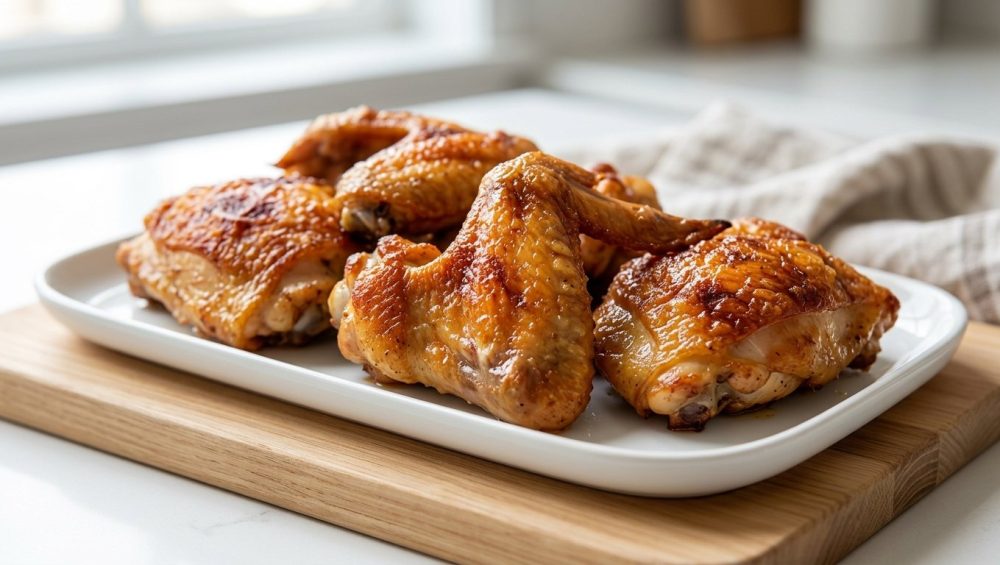
As the oven rapidly heats up, the now fat-free skin will begin to essentially dry-fry. Let it roast at this high temperature for 40 to 50 minutes, rotating the pan halfway through for even cooking. Because the baking powder has raised the pH, the Maillard reaction will kick into overdrive. The skin will blister, bubble, and turn a stunning, deep golden brown. When you pull them out, let them rest for 5 minutes on the rack so the crust can set and harden before you even think about tossing them in sauce.
The Gear You Actually Need (And the Junk to Throw Away)
As your Sassy Sous-Chef, I am legally obligated to remind you that your cooking is only as good as the tools you use. I have zero tolerance for cheap, gimmicky kitchen equipment that actively sabotages your dinners.
If you are still using lightweight, peeling, scratched non-stick baking sheets, you need to stop immediately. Heating cheap Teflon or mystery non-stick coatings above 400°F causes them to degrade and off-gas toxic fumes. Stop poisoning your family and toxic kitchen gear straight into the garbage bin.
You need to invest in heavy-duty, commercial-grade aluminum or tri-ply stainless steel half-sheet pans. Cheap, thin pans will aggressively warp and violently pop under the intense 425°F heat required for the second stage of this recipe. There is nothing worse than flimsy pans that warp mid-roast, sending hot, rendered chicken fat sloshing all over the bottom of your oven and starting a grease fire.
Furthermore, if you are buying whole chicken wings to save money (which you should), you will need to break them down by separating the drumette from the flat and discarding the wing tip. Trying to force your way through chicken joints with dull kitchen knives is a fantastic way to end up in the emergency room with a severed finger. Keep your chef’s knife razor-sharp, find the cartilage between the bones, and let the blade do the work.
Troubleshooting Your Crispy Chicken Journey
Even with a foolproof method, the realities of a home kitchen can sometimes throw a wrench into your plans. If your first batch does not come out looking like a magazine cover, do not get discouraged. Let us troubleshoot the most common issues.
“My chicken skin is still a little chewy.”
If you followed the baking powder ratio but still ended up with chewy skin, the culprit is almost certainly your oven temperature. Most home ovens are chronic liars. You might set it to 425°F, but the internal ambient temperature could be struggling to reach 390°F. If your oven runs cold, the skin will not fry properly. Buy an independent oven thermometer to verify your actual temperatures. Additionally, make sure you did not overcrowd the pan. If the wings are touching each other, they will steam instead of roast.
“My chicken is overcooked and dry inside.”
This happens when you leave the chicken in the high-heat stage for too long trying to chase the perfect crust. Chicken wings are forgiving because of their high fat content, but they can still dry out. To prevent this, always use an instant-read meat thermometer. You are looking for an internal temperature of about 165°F to 175°F for dark meat like wings and thighs.
“My kitchen is filling with smoke during the high-heat stage.”
This is a common issue when roasting fatty meats at 425°F. The fat renders out during the 250°F stage, drops onto the foil, and then begins to burn and smoke when you crank the heat up. To fix this, you have two options. You can either carefully remove the pan after the low-heat stage and pour off the rendered fat before returning it to the oven, or you can pour a tiny splash of water onto the foil beneath the wire rack. The water will prevent the drippings from burning without creating enough steam to ruin your crispy skin.
Frequently Asked Questions (Because I Know You’re Wondering)
Can I use this baking powder trick on other cuts of chicken?
Absolutely. This science applies to any skin-on poultry. It works brilliantly on bone-in, skin-on chicken thighs, whole roasted chickens, and even turkey. Just remember to scale the ratio (1 teaspoon of baking powder per pound of meat) and adjust your cooking times based on the size of the cut. However, do not use this on skinless chicken breasts. Without the fatty skin to react with, the baking powder will just dry out the lean meat and leave a terrible texture.
Can I do this in an air fryer instead of the oven?
Yes, and the results are spectacular. An air fryer is essentially just a miniature, highly efficient convection oven. The rapidly circulating fan speeds up the moisture evaporation process even further. If you are using an air fryer, you can skip the two-temperature method. Just air fry the baking-powder-coated wings at 380°F for about 20 minutes, flipping halfway, then crank it to 400°F for the last 3 to 5 minutes to blister the skin.
Do I need to add flour or cornstarch to the baking powder?
You do not need to, but you can if you want a different style of wing. Using just baking powder gives you a “naked” wing—the skin itself becomes the crispy element, much like a traditional Buffalo wing. If you mix the baking powder with an equal part of cornstarch, the starches will gelatinize and create a distinct, shatteringly crisp battered shell on the outside of the wing. Both methods are delicious, it just depends on whether you want a naked wing or a breaded texture.
When should I apply my sauce?
Never, ever sauce your chicken before baking it. Barbecue sauces, Buffalo sauces, and glazes are packed with water and sugars. If you coat the raw chicken in sauce, the water will completely negate the drying effect of the baking powder, and the sugars will burn to a bitter, black ash at 425°F long before the chicken is cooked through. Always bake the wings completely naked (just the dry rub). Once they are perfectly crisp, pull them out, let them rest for 5 minutes so the crust hardens, and then gently toss them in a bowl with your warmed sauce right before serving.
Conclusion
There you have it. You have officially graduated from the Sassy Sous-Chef’s masterclass on the science of crispy poultry. You now understand pH levels, peptide bonds, the Maillard reaction, and why a little white powder from your baking cabinet is the ultimate secret weapon for savory dinners.
Cooking does not have to be a stressful, chaotic guessing game, and you certainly do not need to rely on takeout to get restaurant-quality results. Armed with a little bit of food science, a reliable wire rack, and some aluminum-free baking powder, you can conquer the kitchen and produce mind-blowing, blistered, shatteringly crisp chicken any night of the week.
Now get out of here, go dry off some chicken wings, and prepare to absolutely amaze yourself. You’ve got this.