Listen, I love you, but we need to have a serious talk about your chicken.
There is nothing more tragic in the culinary world than spending your hard-earned money on a beautiful, pasture-raised bird, meticulously roasting it for an hour, and then biting into it only to experience the texture of a damp yoga mat. You know exactly what I am talking about. The meat underneath might be perfectly acceptable, but the skin—the part that is supposed to be the undisputed star of the show—slides off in one unappetizing, flabby, rubbery sheet. It is a textural nightmare that ruins the entire dining experience.
If you are constantly wondering why your chicken always turns out dry on the inside while remaining completely soggy on the outside, you are not alone. As a busy professional who learned to cook through trial, error, and setting off the smoke detector on countless weeknights, I can assure you that achieving shatteringly crisp, restaurant-quality poultry at home does not require a culinary degree. It does not require a deep fryer, and it certainly does not require you to stand over a spitting vat of hot oil.
What it does require is a fundamental understanding of food science, a little bit of patience, and the willingness to abandon the terrible habits you picked up from outdated recipes. Today, we are going to break down the exact thermodynamics, pH manipulations, and moisture-extraction techniques required to transform your sad weeknight chicken thighs into a crispy, golden masterpiece.
The Culinary Science of Flabby Skin: Why Your Chicken is Failing
To fix the rubbery skin problem, you first have to understand the anatomy of what you are actually cooking. Chicken skin is not just a uniform wrapper; it is a complex matrix composed primarily of water, fat, and collagen. For that skin to transform into a delicate, crackling crust, those three elements must undergo very specific chemical and physical changes.
The Moisture Trap and The Maillard Reaction
The single biggest enemy of crispy skin is surface moisture. When you pull a chicken out of its plastic packaging, it is typically swimming in a pool of its own juices. If you take that wet bird, throw some salt on it, and immediately shove it into a hot oven, you are setting yourself up for guaranteed failure.
Here is the science: Water evaporates at 212°F (100°C). However, the complex chemical process responsible for browning and crisping—known as the Maillard reaction—does not effectively kick into high gear until the surface temperature of the food reaches approximately 310°F (154°C).
When your chicken skin is wet, the oven’s thermal energy is entirely consumed by the arduous task of evaporating that surface water. As long as there is liquid water on the skin, the surface temperature cannot rise above 212°F. Instead of roasting, your chicken is literally steaming in its own localized sauna. By the time the water finally evaporates and the skin has a chance to reach 310°F, the delicate breast meat underneath is horribly overcooked. You must thoroughly dry the bird to naturally prevent protein adhesion to your pans and allow the browning process to begin immediately.
The Fat Rendering and Collagen Conversion Problem
Even if you pat the chicken dry with a paper towel, you still have to deal with what is underneath the surface. Chicken skin contains a thick layer of subcutaneous fat. If you cook the chicken too quickly or at the wrong temperature, that fat never has a chance to melt away (a process called rendering). If the fat does not render, it acts as a spongy barrier that prevents the skin from crisping.
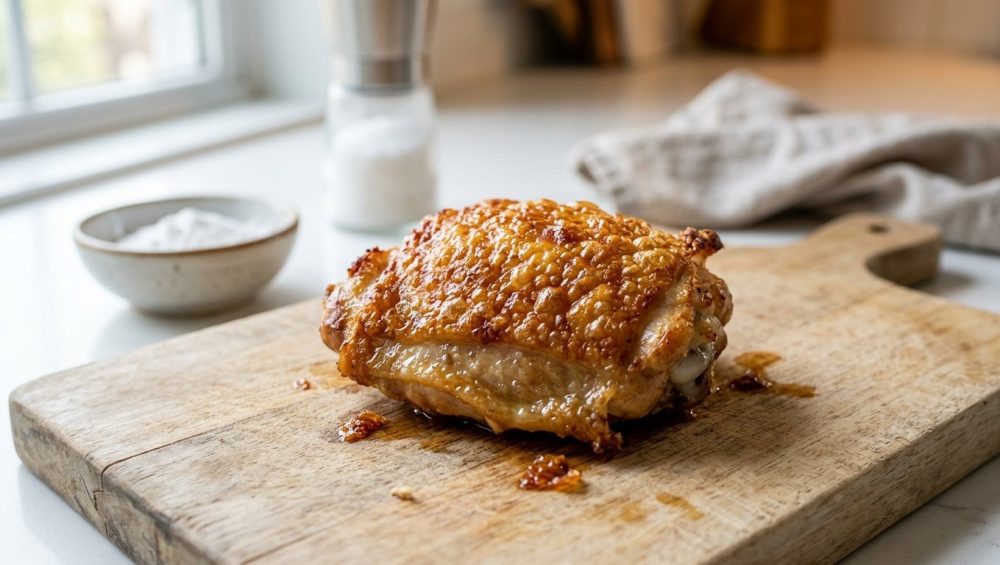
Furthermore, the skin is packed with tough collagen proteins. Through the application of heat and time, that tough collagen must be converted into gelatin. When the fat renders out, the water evaporates, and the collagen turns to gelatin, the remaining protein structure fries in its own rendered fat, resulting in that glorious, glass-like crunch.
The Holy Grail of Crunch: The Baking Powder Miracle
If you want to force your chicken skin to crisp up with absolute certainty, you need to turn to a pantry staple that you probably associate entirely with baking cookies: aluminum-free baking powder.
Hacking the pH Level for Accelerated Browning
This is not a gimmick; it is pure, quantifiable food physics. Raw chicken skin is slightly acidic, typically resting at a pH level of around 5.6 to 5.9. At this acidic level, the peptide bonds in the keratin and collagen are tightly folded, trapping water beneath the surface.
Baking powder is alkaline. When you lightly dust your raw chicken with a mixture of kosher salt and baking powder, it initiates a mild alkaline hydrolysis, raising the skin’s pH level to around 7.8 to 8.4. This alkaline shift disrupts the hydrogen bonds in the structural proteins, causing them to partially unfold and break down.
Why does this matter? Because broken-down proteins brown significantly faster. In fact, altering the pH level allows the Maillard reaction to begin at just 275°F instead of the usual 325°F. This alkaline trick isn’t just for poultry; it is the exact same mechanism you use to achieve the crispiest roasted potatoes for your Sunday brunch. Furthermore, as the baking powder reacts with the chicken’s natural juices, it creates microscopic bubbles of carbon dioxide gas. These tiny bubbles expand the surface area of the skin, creating a blistered, hyper-crunchy texture similar to what you would get from a deep fryer.
Baking Powder vs. Baking Soda (Do Not Mess This Up)
I need you to listen to me very carefully right now: You must use baking powder, not baking soda.
Baking soda is purely sodium bicarbonate. It is aggressively alkaline, shooting the pH level past 9.0 almost immediately. If you rub pure baking soda on your chicken, it will over-denature the proteins, leaving you with skin that is weirdly gray, intensely bitter, and tasting like a mouthful of harsh metallic chemicals.
Baking powder, on the other hand, is a buffered blend. It contains sodium bicarbonate mixed with a powdered acid (like calcium acid phosphate). This buffer controls the alkalinity, giving you all the textural benefits of the pH shift without ruining the flavor of your dinner. If you want to create crispy baked wings that rival your favorite sports bar, a dusting of aluminum-free baking powder is your secret weapon.
The Art of the Dry Brine: Extracting the Enemy
Now that we have hacked the pH level, we need to address the moisture problem on a cellular level. This is where the magic of the dry brine comes into play.
How Osmosis Saves Your Dinner
A wet brine involves submerging your chicken in a giant bucket of salty water. While this does make the meat juicy, it completely waterlogs the skin, guaranteeing a flabby, rubbery exterior. Once you understand the magic of dry brining, you will never submerge a bird in a sloshing bucket of saltwater again.
Dry brining is the process of aggressively salting the exterior of the raw meat and letting it rest in the refrigerator. When you apply kosher salt to the skin, it immediately goes to work via the process of osmosis. At first, the salt pulls the water out of the meat, bringing it to the surface. If you look at your chicken after 30 minutes, it will be covered in beads of moisture.
However, if you leave it alone, something incredible happens. The salt dissolves into that extracted water, creating a highly concentrated, flavorful brine right on the surface of the bird. Over the next several hours, the chicken reabsorbs that salty liquid deep into its muscle fibers. This internal seasoning alters the structure of the meat proteins, preventing them from contracting and squeezing out their juices during the cooking process. The result? The inside of the chicken stays incredibly moist, while the surface of the skin is left completely bone-dry and primed for roasting.
Time is Your Best Ingredient
For a dry brine to work its magic, you must give it time. If you salt a chicken and immediately throw it in the oven, you are cooking it right when the moisture has been drawn to the surface, resulting in steam.
For weeknight chicken thighs, try to give them at least an hour in the fridge. But for a weekend whole roasted chicken, you want to aim for 24 to 48 hours. The longer it sits, the deeper the seasoning penetrates, and the drier the skin becomes.
The Refrigerator Wind Tunnel: Air-Drying for Maximum Shatter
You have applied your salt. You have dusted the skin with baking powder. Now, you need to utilize the most effective dehydrator in your kitchen: your refrigerator.
Why Your Fridge is a Dehydrator
The ambient air inside a modern refrigerator is aggressively cold and incredibly dry. It is constantly circulating to maintain a safe temperature. By placing your seasoned chicken in the fridge completely uncovered, you are exposing it to a continuous wind tunnel of dry air.
Over the course of 24 hours, this environment evaporates the residual moisture from the epidermal layer of the chicken. The skin will begin to look slightly translucent, tight, and leathery. Do not panic; this is exactly what you want. That leathery texture is the visual confirmation that the moisture has been eradicated, meaning the oven’s heat can immediately trigger the Maillard reaction without fighting through a barrier of steam.
The Wire Rack Mandate
If you place your chicken directly on a flat baking sheet or a glass casserole dish to air-dry, you are making a massive rookie mistake. The bottom of the chicken will sit in its own juices, completely ruining the underside.
You must elevate the poultry on a stainless steel wire cooling rack set inside a rimmed baking sheet. This allows the dry refrigerator air to circulate a full 360 degrees around the bird, drying the bottom just as effectively as the top. And please, invest in heavy-duty, commercial-grade half-sheet pans. If your flimsy baking sheets keep warping the second they hit a 400-degree oven, they are going to launch your carefully prepped chicken right onto the bottom heating element.
Heat Dynamics: Roasting Your Way to Glassy Skin
You have done the prep work. The skin is alkaline, seasoned, and bone-dry. Now, we must apply the correct thermal energy to render the fat and shatter the skin.
The Two-Zone Temperature Strategy
There are two primary schools of thought when it comes to roasting poultry for crispy skin, and both rely on manipulating fat rendering.
The first method is the high-heat blast. By roasting your chicken parts at 400°F (200°C) or higher, you are forcing the subcutaneous fat to render rapidly while simultaneously triggering intense Maillard browning. This is excellent for smaller cuts like wings or boneless thighs, which cook through quickly before the skin has a chance to burn.
The second method, which is ideal for a whole roasted bird or thick, bone-in thighs, is the low-and-slow render followed by a high-heat sear. You start the chicken at a moderate temperature (around 300°F) to gently melt the fat and break down the collagen without aggressively contracting the muscle fibers. Once the internal temperature of the thighs reaches about 175°F to 180°F—the sweet spot where connective tissue melts into luscious gelatin—you crank the oven up to 450°F for the final 15 minutes to blister and fry the skin in its own rendered fat.
A Rant About Toxic Cookware and Proper Searing
If you are choosing to pan-sear your chicken thighs on the stovetop instead of roasting them, we need to have a very serious conversation about your equipment. I am fiercely passionate about banishing toxic kitchen gear from your home, and the absolute worst offender is the cheap, scratched-up, peeling non-stick skillet you bought at a big-box store five years ago.
You cannot achieve a proper, shattering sear on chicken skin in a cheap Teflon pan. Non-stick coatings are not designed to handle the high, sustained heat required to properly render poultry fat. If you push them past 500°F, they begin to off-gas toxic forever chemicals into your kitchen. Furthermore, because they lack the thermal mass of quality metals, the temperature of the pan plummets the second you add the cold chicken, causing the meat to steam in its own juices rather than fry.
If you want professional-level results, you must use a heavy-bottomed carbon steel skillet, a cast-iron pan, or a high-quality multi-clad stainless steel skillet. These materials hold incredible amounts of thermal energy. When you place a dry-brined, room-temperature chicken thigh skin-side down into a preheated carbon steel pan, the fat immediately begins to render, and the skin fries to a golden, crackling perfection. Remember that aerosol cooking spray is the enemy of a clean, polymer-free cooking surface; always use a high-smoke-point liquid fat like avocado oil or clarified butter when searing.
Actionable Weeknight Shortcuts vs. Weekend Perfection
I firmly believe that anyone can cook like an expert, but I am also a realist. You don’t always have 48 hours to prep your dinner. Here is how to apply these scientific principles based on the time you actually have.
The 30-Minute Weekday Hack
It is Tuesday night. You are exhausted, and you just want to eat some crispy chicken thighs without ordering takeout.
- Remove the chicken from the packaging and aggressively pat it dry with heavy-duty paper towels. Do not just dab it; squeeze the moisture out of the skin.
- Mix 1 teaspoon of kosher salt with 1/4 teaspoon of aluminum-free baking powder and a pinch of black pepper.
- Rub this mixture evenly over the skin of the chicken thighs.
- Let the chicken sit on a cutting board at room temperature for exactly 30 minutes. This gives the baking powder just enough time to alter the pH, and takes the chill off the meat so it doesn’t shock your pan.
- Preheat a carbon steel or cast-iron skillet over medium heat. Add a splash of avocado oil.
- Place the chicken skin-side down. Do not touch it. Let the fat render slowly for 12 to 15 minutes until the skin is a deep mahogany brown and releases naturally from the pan. Flip and finish cooking the meat.
The 48-Hour Weekend Masterpiece
It is Friday evening, and you are preparing a spectacular whole roasted chicken for Sunday dinner. This is where you become a perfectionist.
- Spatchcock (butterfly) the whole chicken to ensure even cooking and maximum skin exposure to the heat.
- Thoroughly dry the bird inside and out with paper towels.
- Create your dry brine: 1 tablespoon of kosher salt mixed with 1 teaspoon of aluminum-free baking powder.
- Massage this mixture into every inch of the skin, and a little bit inside the cavity.
- Place the chicken on a wire rack set inside a rimmed baking sheet.
- Place the entire setup into the refrigerator, completely uncovered, for 24 to 48 hours.
- On Sunday, roast the chicken in a 425°F oven until the breast registers 150°F and the thighs hit 175°F. The skin will be so crispy it will audibly shatter when you carve it.
Troubleshooting Your Disasters (Because We All Make Mistakes)
Even with the best science, things can go wrong if your technique is sloppy. If your skin is still turning out rubbery, you are likely committing one of these cardinal sins.
You Are Crowding the Pan:
Whether you are roasting on a sheet pan or searing in a skillet, you must leave adequate space between your pieces of chicken. If you cram eight massive chicken thighs into a 10-inch skillet, the moisture evaporating from the meat has nowhere to go. It becomes trapped between the pieces, creating a localized steam bath. Steam is the enemy of crunch. Give your food room to breathe.
You Are Using the Wrong Pans:
If you are tired of your pans losing their slip after a few months and ruining your dinner, it is because you are relying on cheap ceramic or Teflon to do the heavy lifting of high-heat searing. Invest in bare metals that can handle the thermal shock of raw poultry without dropping in temperature.
You Are Covering the Meat:
I do not care what your grandmother’s recipe from 1974 says. You must never, ever cover your chicken with aluminum foil or a heavy lid while it is cooking or resting. Covering the pan traps the evaporating moisture, turning your roasting pan into a steam room. Within three minutes, your perfectly crisp skin will turn back into a soggy, flabby mess. Let the chicken roast uncovered, and let it rest uncovered on a cutting board before serving.
You Are Basting with Liquid:
Basting a roasting bird with its own pan juices looks incredibly romantic on television, but it is a textural disaster in reality. Those pan juices are primarily composed of water. Every time you open the oven door (losing precious heat) to spoon watery juices over the skin, you are undoing all the hard work of your dry brine and baking powder. You are literally re-wetting the skin. If you absolutely must baste, use only pure, clarified butter or rendered animal fat—never the watery drippings from the bottom of the pan.
You Are Pulling the Meat Too Early:
Dark meat (legs and thighs) is incredibly forgiving because of its high fat and collagen content. While chicken breasts dry out if pushed past 155°F, thighs are actually tough and rubbery at 165°F. The collagen in the dark meat does not fully break down into tender gelatin until it reaches 175°F to 185°F. If the skin is flabby and the meat is chewy, you simply didn’t cook the dark meat long enough. And please, check the internal temperature accurately, because half the time your cheap meat thermometer is lying to you anyway. Upgrade to a highly responsive digital instant-read thermometer and temp the thickest part of the thigh without touching the bone.
The Final Bite
Achieving perfect, shatteringly crisp chicken skin is not a dark art reserved for Michelin-starred chefs. It is simply a matter of respecting the ingredients and applying basic food physics. By controlling the surface moisture, manipulating the pH level with baking powder, utilizing the osmotic power of a dry brine, and applying the correct thermal energy, you can completely eliminate rubbery poultry from your life forever.
Stop settling for mediocre weeknight dinners. Throw out your peeling toxic pans, buy a box of aluminum-free baking powder, and give your chicken the respect—and the dry, cold air—it deserves. Your tastebuds, and your dinner guests, will thank you.