Listen, we need to have a serious talk about your salads. I know it is a Tuesday night, you are exhausted from back-to-back meetings, and the absolute last thing you want to do is play kitchen chemist. You just want to eat your greens and move on with your life. But if you are still haphazardly shaking oil and vinegar in a jar, dumping it over your lettuce, and wondering why your vinaigrette separates before you even sit down at the table, we have a major culinary problem to solve.
There is nothing sadder than a beautiful, crisp bowl of expensive farmer’s market greens drowning in a broken, greasy puddle of separated oil and harsh, biting vinegar. It is a culinary tragedy. But here is the good news: you do not need a culinary degree, a Michelin star, or a ridiculous amount of free time to fix this. You just need to understand a tiny bit of food science and harness the secret power of a single, humble ingredient sitting in your fridge right now: Dijon mustard.
As a home cook, your time is money. During the week, we rely on smart, efficient hacks to get dinner on the table. But on the weekends, we have the luxury of geeking out over the exact chemical mechanics of our food. Today, we are going to do both. We are going to dive deep into the fascinating, science-driven breakdown of culinary emulsification, and I am going to teach you how to create stable, restaurant-quality vinaigrettes that will never pool into a greasy mess again.
The Physics of a Salad Dressing Disaster
Oil and Water: The Ultimate Frenemies
To understand how to fix a broken vinaigrette, we first have to understand why it breaks in the first place. I have zero patience for pretentious recipe jargon, so let us break this down into plain, highly practical English. At a molecular level, oil and water (or in this case, vinegar, which is mostly water and acetic acid) are fundamental opposites.
Vinegar is a polar molecule. The electronegative oxygen atoms in the water and acetic acid molecules pull electrons toward themselves, creating an uneven distribution of charge—a slightly negative pole and a slightly positive pole. Because of this, polar molecules love to bond with other polar molecules. They are hydrophilic, meaning “water-loving.”
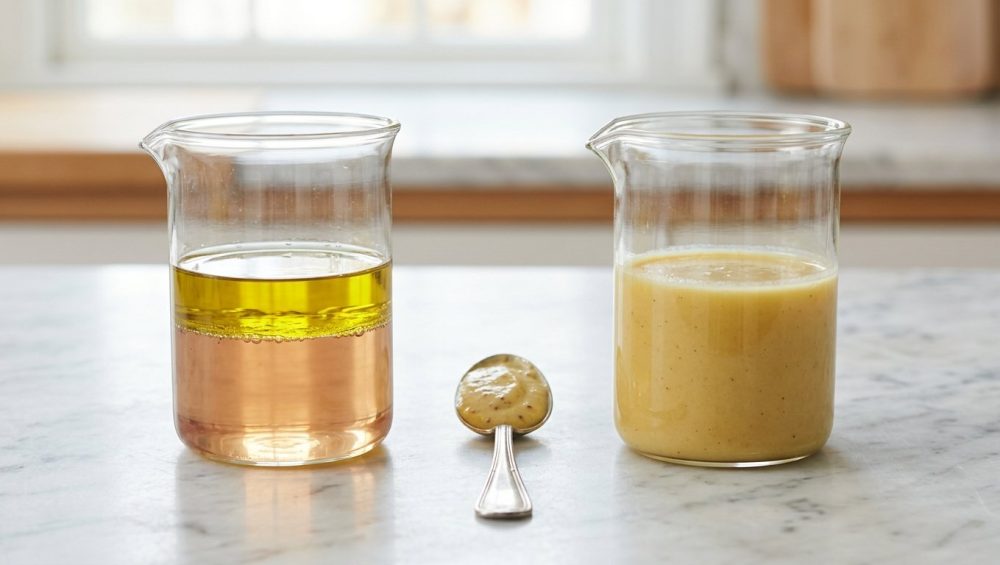
Oil, on the other hand, is non-polar. Fats and oils are composed primarily of long chains of fatty acids, usually bound together by glycerol molecules into triglycerides. These molecules share their electrons evenly, meaning they have no electrical charge. They are lipophilic (oil-loving) and hydrophobic (water-fearing). When you pour oil and vinegar into the same bowl, the polar vinegar molecules actively repel the non-polar oil molecules. They refuse to mix. If you whisk them aggressively, you are using mechanical shear force to temporarily smash the oil into millions of tiny droplets, suspending them in the vinegar. But the moment you stop whisking, those oil droplets immediately seek each other out, coalescing back together to escape the water, resulting in that dreaded layer of grease sitting on top of your acid.
What is Emulsification, Actually?
Emulsification is the culinary art of forcing two unblendable liquids to form a harmonious, unified mixture. In the kitchen, we deal with two types of emulsions: temporary and permanent.
A temporary emulsion is what happens when you just shake oil and vinegar together. It looks cloudy and mixed for about thirty seconds before the laws of physics take over and it violently separates. A permanent (or highly stable) emulsion is something like mayonnaise, where oil and water are bound together so tightly by an emulsifying agent (like egg yolk lecithin) that they defy liquid physics and turn into a thick, spreadable solid.
For a vinaigrette, we are aiming for a highly stable, semi-permanent emulsion. We want a dressing that is liquid enough to beautifully coat a delicate leaf of butter lettuce, but stable enough that it will not separate in the bowl or on the plate. To achieve this diplomatic miracle, we need an emulsifier—a molecular mediator that can hold the hands of both the oil and the water simultaneously.
The Secret Weapon: Why Dijon Mustard is Your Culinary Superglue
The Anatomy of a Mustard Seed
Enter the hero of our story: the mustard seed. Mustard belongs to the Brassica genus, which makes it a cousin to cabbage and broccoli. There are three main commercial varieties of mustard seeds: yellow (Sinapis alba), brown, and oriental (Brassica juncea).
A mustard seed is composed of protein, oil, carbohydrates, and the seed coat, also known as the bran, which makes up about 20% of the entire seed. While the inside of the seed provides that sharp, pungent flavor we love, it is actually the outer hull—the bran—that holds the magical properties required to save your salad dressing.
Mucilage: The Complex Carbohydrate That Saves Your Salad
The true secret to Dijon mustard’s emulsifying power lies in a substance called mucilage. Mucilage is a complex carbohydrate—specifically, a highly branched, water-soluble polysaccharide—found in the epidermal layer of the mustard seed coat.
When mustard seeds are milled and processed into mustard paste, this mucilage is released. In brown mustard seeds—the specific seeds legally required to make authentic Dijon mustard—the mucilage concentration is incredibly high, sitting at around 12.7% of the seed’s composition. This mucilage features a galactomannan backbone that remains beautifully hydrated and viscoelastic even in highly acidic environments.
Why does this matter to your Tuesday night dinner? Because mucilage is a structural powerhouse. It does not just add flavor; it physically alters the viscosity and binding capacity of your dressing. If you do not stabilize the mixture with this complex carbohydrate, the oil inevitably pools at the bottom of the bowl, ensuring your salads are always soggy and deeply unappetizing.
Amphiphilic Stabilizers Explained (No PhD Required)
So, how exactly does this mucilage force oil and water to play nicely? It acts as an amphipathic (or amphiphilic) stabilizer.
An amphiphilic molecule is the ultimate culinary diplomat. It features a unique molecular structure: one end of the molecule is polar (hydrophilic, or water-loving), and the other end is non-polar (lipophilic, or oil-loving). When you add Dijon mustard to your vinegar and begin to whisk in your olive oil, the mucilage molecules immediately go to work.
The lipophilic tails of the mucilage embed themselves into the microscopic droplets of olive oil that your whisk is creating. Meanwhile, the hydrophilic heads of the mucilage reach outward, bonding tightly with the water and acetic acid in the vinegar. The mucilage literally wraps a protective, stabilizing barrier around every single oil droplet, preventing them from touching each other and recombining. The result? A thick, creamy, perfectly suspended vinaigrette that clings beautifully to your greens instead of running off them.
The Golden Ratio: 3:1 Plus the Magic Teaspoon
Breaking Down the 3:1 Oil-to-Acid Rule
Now that we understand the chemistry, we have to talk about the math. You cannot just blindly dump ingredients into a bowl and expect the mucilage to save you. Emulsions rely on strict volumetric ratios to maintain their continuous phase.
The universally accepted, scientifically sound golden rule for a classic vinaigrette is a 3:1 ratio: three parts oil to one part acid.
If you are using three tablespoons of extra-virgin olive oil, you need one tablespoon of vinegar or citrus juice. If you are making a larger batch for a dinner party, you will use three-quarters of a cup of oil to one-quarter cup of vinegar. This ratio provides the exact amount of aqueous liquid needed to absorb and suspend the lipids without the mixture becoming overwhelmingly greasy or aggressively tart.
Some chefs prefer a 2:1 ratio for a sharper, more acid-forward bite, but if you are a beginner looking for foolproof stability, stick rigorously to the 3:1 baseline. Before we even get to the mixing stage, let me offer a crucial piece of advice: your greens must be completely, flawlessly dry. If you wash your lettuce and leave it dripping wet, that excess water will immediately throw off your carefully measured ratio and break the emulsion. Do yourself a massive favor and thoroughly dry your greens using a salad spinner before the dressing ever touches them.
Why One Teaspoon of Dijon is the Sweet Spot
So, where does the mustard fit into this mathematical equation? The magic number is exactly one teaspoon of authentic Dijon mustard for every standard batch of dressing (which usually equates to a 1/2 cup of oil and roughly 3 tablespoons of acid).
Why just one teaspoon? Because mustard is a potent flavor catalyst. Remember, authentic Dijon contains allyl isothiocyanate, a compound derived from sinigrin that enhances volatile flavor release. If you add a whole tablespoon of Dijon to a half-cup of oil, you are no longer making a classic vinaigrette; you are making a heavy mustard dressing. One teaspoon provides the exact concentration of mucilage required to achieve 92% droplet uniformity and stabilize the emulsion without overpowering the delicate, grassy notes of your olive oil or the fruity notes of your vinegar. It is the perfect, invisible structural scaffold.
The Mechanics of Mixing: How to Build an Unbreakable Vinaigrette
The Right Gear: Ditch the Toxic Plastics
You know by now that I am a relentless, unapologetic advocate for banishing toxic kitchen gear from your home. Emulsification requires friction, acidity, and mechanical force. If you are doing this in a cheap, scratched plastic bowl, the acid in the vinegar will interact poorly with the degraded plastic. If you are using a flimsy whisk with a peeling non-stick coating, you are literally whisking toxic polymer flakes directly into your beautiful, organic salad.
Do not do this. Use a heavy-bottomed glass or ceramic mixing bowl. Glass is non-reactive, meaning the low pH of the vinegar (around 3.6 to 3.9) will not strip metallic flavors or chemical compounds into your food.
The Drip Method vs. The Mason Jar Shake
There are two main schools of thought when it comes to combining your 3:1 ratio with your teaspoon of Dijon: the Mason Jar Shake and the Drip Method.
The Mason Jar Shake is the ultimate weekday shortcut. You throw your vinegar, Dijon, salt, pepper, and oil into a glass jar, screw the lid on tight, and shake it violently for twenty seconds. Because the Dijon mucilage is present, this will absolutely work and create a stable emulsion for your Wednesday night dinner.
However, if you are cooking on the weekend and want to achieve absolute culinary perfection, you must use the Drip Method. Place your vinegar, Dijon mustard, and a pinch of salt into your heavy glass bowl. Whisk them together first. The salt will dissolve in the water-based vinegar (salt does not dissolve in oil), and the Dijon will disperse evenly.
Then, while whisking constantly, begin adding your olive oil drop by drop. Literally, drop by drop. If you are still using a flimsy, poorly constructed tool where the whisk leaks dishwater from the handle into your pristine food, throw it in the trash immediately and invest in a seamless, professional-grade stainless steel wire whisk. You need the rigid tines of a good whisk to create maximum mechanical shear. By adding the oil incredibly slowly, you are allowing the whisk to smash the oil into microscopic droplets, giving the mucilage ample time to wrap around each droplet and suspend it in the vinegar. Once the emulsion begins to look thick and cloudy, you can increase the oil flow to a slow, steady stream.
Temperature Matters: Cold Oil is the Enemy
Here is a food science secret that most home cooks completely ignore: temperature plays a massive role in emulsification.
Peer-validated emulsion systems show that the optimal ambient temperature for mixing a stable vinaigrette is 22°C (about 72°F). If you store your extra-virgin olive oil in the refrigerator, or if your kitchen is freezing cold, the lipids in the oil will solidify and become highly viscous. Viscous oil resists the mechanical shear force of your whisk. The droplets will remain too large, the mucilage will not be able to coat them effectively, and the dressing will split. Always ensure your oil, vinegar, and mustard are at room temperature before you begin emulsifying.
Let’s Talk Ingredients: Not All Oils and Acids are Created Equal
Choosing the Right Olive Oil (And Avoiding the Fakes)
A vinaigrette is essentially a raw sauce, which means there is nowhere for cheap ingredients to hide. The bulk of your dressing is oil, so it needs to be exceptional.
You must use a high-quality, cold-pressed extra-virgin olive oil. However, you also need to treat it with respect. Stop leaving your expensive extra-virgin olive oil in a clear glass bottle right next to your hot stove, because the heat and UV light exposure is actively ruining your olive oil and turning it rancid. Store it in a cool, dark pantry in an opaque container. The fresh, grassy, slightly peppery notes of a well-preserved olive oil will perfectly balance the sharp tang of the acid.
The Acid Test: Vinegars, Citrus, and Beyond
The “1” in your 3:1 ratio represents the acid, and your choices here dictate the entire personality of the dressing.
White wine vinegar and champagne vinegar are the gold standards for a classic French Dijon vinaigrette. Their flavor profiles naturally complement the white wine and verjuice already present in authentic Dijon mustard.
Apple cider vinegar offers a fruitier, more robust punch, while fresh lemon or lime juice provides a bright, volatile acidity that pairs beautifully with seafood salads. Balsamic vinegar is deeply sweet and syrupy; if you use balsamic, you might find you need slightly less oil (closer to a 2:1 ratio) because the perceived acidity is lower, but the Dijon will still act as the perfect flavor catalyst, actively reducing the perceived bitterness in aged balsamic.
Why Yellow Mustard Won’t Cut It
I know what you are thinking: “Can I just use the bright yellow hot dog mustard sitting in my fridge door?”
Absolutely not.
While yellow mustard seeds (Sinapis alba) do contain mucilage, their concentration is drastically lower—around 4.1% to 5.5% compared to the 12.7% found in the brown seeds used for Dijon. Furthermore, generic yellow mustard is typically suspended in harsh distilled white vinegar and packed with turmeric for color. Authentic Dijon (like Maille or Grey Poupon) is crafted under strict standards using defatted brown mustard seed flour, white wine vinegar, and verjuice.
Yellow mustard will give your dressing an artificial, overpowering hot-dog flavor and a much weaker emulsion. Spend the extra three dollars on a jar of real Dijon. Your palate will thank you.
Troubleshooting the Broken Dressing: Can It Be Saved?
The “Splash of Water” Trick
Let us say you rushed the process. You dumped all the oil in at once, your whisking arm got tired, and now you are staring at a broken, separated mess. Do not throw it away. You can rescue it.
When an emulsion breaks, it usually means the dispersed phase (the oil droplets) has overwhelmed the continuous phase (the vinegar/water). The mucilage is stretched too thin. To fix this, you need to re-establish the continuous phase.
Grab a clean bowl. Add exactly one teaspoon of warm water and a tiny dab (about 1/4 teaspoon) of fresh Dijon mustard. Whisk this together. Now, take your broken, separated dressing and treat it like it is plain oil. Slowly, drop by drop, whisk the broken dressing into the new water-and-mustard mixture. The fresh mucilage and the extra water will re-suspend the runaway oil droplets, bringing the emulsion back together into a smooth, creamy state.
And please, when you finally achieve that perfect, creamy emulsion, store any leftovers in a glass jar. Acidic vinaigrettes degrade cheap plastics over time, which is exactly why your plastic containers stay greasy and permanently smell like garlic no matter how many times you run them through the dishwasher.
The Blender Rescue Mission
If the whisk method fails you, or if you are making a massive batch for a holiday gathering, turn to modern technology. A high-speed blender or an immersion blender is an emulsification machine.
The spinning blades of a blender create intense, high-velocity mechanical shear force that a human arm simply cannot replicate. If your dressing splits, pour it into the blender, turn it on high, and let the blades violently smash the oil into microscopic particles while the Dijon mucilage binds them instantly. The resulting dressing will be incredibly thick, almost resembling mayonnaise, and will stay stable in the fridge for days.
Beyond the Bowl: Other Surprising Ways to Use Dijon as a Stabilizer
Pan Sauces and Marinades
Once you understand that Dijon mustard is a functional structural ingredient and not just a condiment, a whole new world of culinary artistry opens up to you.
When you sear a steak or a chicken breast, you are left with delicious browned bits (fond) and rendered fat in the pan. If you deglaze that pan with wine or chicken stock, you are essentially creating a hot vinaigrette: fat (oil) and stock (water). If you just boil them together, the sauce will be thin, greasy, and broken.
But if you whisk in a teaspoon of Dijon mustard right at the end of cooking, the mucilage will instantly bind the rendered animal fat with the stock, creating a rich, glossy, restaurant-quality pan sauce. This is especially helpful on busy weeknights when you are trying to deglaze a pan in a hurry and your garlic always burns because you are distracted. The Dijon acts as an instant, foolproof binder.
Mayonnaise and Aioli Rescues
Mayonnaise is a permanent emulsion of oil and egg yolks (which contain the emulsifier lecithin). But making homemade mayo is notoriously tricky, and it is very easy to break the emulsion by adding the oil too quickly.
If your homemade mayonnaise splits into a curdled, oily mess, Dijon mustard is your ultimate fail-safe. Because Dijon has a higher mucilage content than yellow mustard, it is incredibly effective at holding oil and egg proteins together. Simply place one teaspoon of Dijon mustard in a clean bowl, and slowly whisk your broken mayonnaise into the mustard, drop by drop. The amphiphilic power of the mucilage will step in where the egg yolk lecithin failed, smoothing the mixture back into a thick, luxurious spread.
The Final Word
Cooking is not magic; it is just applied physics and chemistry. Once you understand the basic mechanics of how ingredients interact, you take complete control of your kitchen. You no longer have to cross your fingers and hope a recipe works. You will know exactly why it works.
By mastering the 3:1 ratio, utilizing the amphiphilic power of Dijon mucilage, and applying proper mechanical shear, you have officially elevated your cooking from amateur guesswork to scientific precision. Stop settling for mediocre, separated dressings, just like you need to stop cooking with those peeling, toxic non-stick pans you refuse to throw away. You deserve better. You deserve a perfectly emulsified, bright, punchy vinaigrette that makes eating a bowl of raw vegetables the absolute highlight of your day.
Now, ditch the store-bought bottles, grab your stainless steel whisk, and go make a salad dressing that actually stays together. You’ve got this.