Let’s get one thing straight right out of the gate: you are entirely capable of making mind-blowing, restaurant-quality food in your very own, standard-issue home kitchen. You do not need a culinary degree, you do not need a brigade of sous-chefs chopping your vegetables, and you absolutely do not need a $1,200 commercial blender that sounds like a jet engine taking off on your countertop. What you do need is a little bit of food science, a decent food processor, and a handful of ice cubes.
If you are reading this, you have probably experienced the profound, soul-crushing disappointment of homemade hummus. You dutifully rinsed your chickpeas, you measured your tahini, you squeezed your lemons, and you hit the blend button. And what did you get? A dense, gritty, heavy paste that tastes like wet sand and spreads like drywall spackle. It is enough to make anyone want to throw in the towel and just buy the sad, overpriced plastic tubs from the grocery store. But we are not going to do that. We are going to cure cooking anxiety by embracing a brilliantly simple, zero-cost trick that will fundamentally change the way you approach this classic dip.
The secret to ethereal, cloud-like, ultra-smooth hummus isn’t about peeling hundreds of chickpeas by hand. It isn’t about magical, imported ingredients. It is about temperature control, emulsion chemistry, and the sheer physical power of ice. Today, we are taking a brutally honest, incredibly deep dive into the food science of hummus. Pour yourself a glass of wine, grab a notebook, and let’s get to work.
The Great Hummus Heartbreak
Let’s talk about why your homemade hummus usually fails. And please, do not take this personally. I have ruined more batches of hummus than I care to admit. In my early days of cooking—back when my smoke detector was basically my kitchen timer—I assumed that making hummus was just a matter of throwing everything into a bowl and obliterating it until it looked like a dip.
The standard home cook’s approach usually goes like this: dump a can of drained chickpeas into a food processor, add a glob of tahini, a splash of olive oil, a squeezed lemon, and a raw clove of garlic. You turn the machine on. The mixture immediately clumps up into a dense ball that aggressively thumps against the sides of the plastic bowl. Panicking, you stream in more olive oil. Now it’s greasy. You add tap water. Now it’s runny, but somehow still gritty. You taste it, and the raw garlic aggressively burns your palate while the texture coats your mouth like chalk. You find yourself wondering hummus is always grainy when you make it, while the stuff at your local Mediterranean restaurant feels like a savory, whipped mousse.
The difference between your dense, grainy paste and that restaurant-quality silk comes down to a fundamental misunderstanding of what hummus actually is. Hummus is not a puree. It is an emulsion. It is a delicate, scientifically complex suspension of fats (from the tahini and olive oil), starches (from the chickpeas), and liquids (lemon juice and water). When you blindly throw all these elements into a machine and let it rip, you are ignoring the thermodynamic reality of what is happening inside that bowl.
What Actually Happens Inside Your Food Processor
To understand the ice cube trick, we first need to understand the enemy: friction heat. We tend to think of our food processors and blenders as purely mechanical chopping tools, but they are also incredibly efficient heat generators.
The Thermodynamics of a Spinning Blade
When you turn on a food processor, the metal blade spins at thousands of revolutions per minute. As that blade repeatedly strikes the dense, heavy mass of chickpeas and tahini, it encounters intense physical resistance. According to basic principles of mechanical engineering and fluid dynamics, this friction is converted directly into heat. If you run a standard food processor for three to five minutes—which is the absolute minimum amount of time required to properly break down the fibrous cellular structure of a chickpea—the temperature of the mixture inside the bowl will rise significantly.
Why is this a problem? Because heat is the ultimate destroyer of delicate food emulsions. As the temperature of the hummus rises, two disastrous things happen simultaneously. First, the starches inside the chickpeas begin to gelatinize and swell, turning gummy and sticky instead of smooth and creamy. Second, the tahini—which is a notoriously temperamental ingredient—begins to break. The natural oils separate from the sesame solids, causing the entire mixture to lose its structural integrity. Instead of a fluffy, cohesive dip, you get a hot, oily, separated mess. Learning how to manage this friction heat is one of those simple kitchen fixes that separates the weekend culinary hobbyist from the seasoned professional.
The Science of Seizing: Why Tahini Hates Heat
If you want to master hummus, you must first respect the tahini. Tahini is simply a paste made from toasted, ground hulled sesame seeds. But chemically speaking, it is a highly concentrated suspension of sesame oil and dry plant proteins.
When you open a fresh jar of high-quality tahini, it is usually separated, with a pool of oil sitting on top of a dense, concrete-like layer of solids. You stir it back together into a pourable liquid. But the moment you introduce a water-based ingredient to this oily paste—like lemon juice, tap water, or the moisture from cooked chickpeas—the tahini undergoes a chemical phenomenon known as an emulsion inversion.
The Emulsion Inversion
When a small amount of liquid meets the massive amount of fat in tahini, the carbohydrates and proteins instantly absorb the water and swell, causing the mixture to clump together and seize. It transforms from a smooth, runny liquid into a stiff, dull, unyielding putty that looks exactly like peanut butter.
If you add warm liquid to tahini, or if the tahini is heated up by the friction of your food processor blades, this seizing effect becomes exponentially worse. The heat causes the sesame oils to fully separate from the solids, breaking the emulsion beyond repair. The result is a grainy, curdled texture. To fix this, you need to forcefully whip a larger volume of liquid into the paste to invert the emulsion back to a smooth state. And to do this successfully without breaking the fats, that liquid needs to be ice cold. If you can decode pretentious recipe jargon, you’ll realize that “emulsification” is just a fancy term for forcing fat and water to play nicely together, and temperature is the ultimate referee.
Why Ice Cubes? The Dual-Action Magic
This brings us to the hero of our story: the humble ice cube. Adding whole ice cubes (or heavily iced water) to your food processor while blending hummus is a technique championed by culinary heavyweights like Yotam Ottolenghi and Michael Solomonov. It is not a gimmick; it is a highly effective, scientifically sound intervention that performs two crucial functions simultaneously.
1. The Ultimate Temperature Controller
As we established, a food processor running for five minutes will heat up your chickpea puree, causing the starches to turn gummy and the tahini emulsion to break. By dropping whole ice cubes into the spinning blades, you are introducing a constant, rapid cooling effect. The ice actively counteracts the friction heat generated by the motor and the blades. It keeps the ambient temperature of the puree low, which prevents the starches from gelatinizing and locks the tahini and olive oil into a stable, tightly bound emulsion. The cold temperature forces the fat molecules to stay suspended within the water molecules, resulting in a rich, glossy mouthfeel.
2. The Mechanical Aerator
The second benefit of ice cubes is purely structural. Ice cubes are solid, hard objects. When the heavy metal blades of your food processor strike the ice, they shatter it into thousands of microscopic shards. As these frozen shards are violently whipped through the dense chickpea paste, they act like tiny whisks. Furthermore, ice cubes naturally contain trapped microscopic air bubbles. As the ice is pulverized and melts into the mixture, it injects these air pockets directly into the hummus.
This physical aeration process is virtually identical to the way a churner whips air into heavy cream to create ice cream. The cold temperature keeps the fats firm enough to trap the air, while the physical crushing action folds that air into the matrix. The result? The hummus physically expands in the bowl. It transforms from a dense, heavy paste into a light, fluffy, whipped, cloud-like mousse. It is one of those foolproof cooking secrets that costs absolutely nothing but completely elevates your final dish.
The “No-Go” Rule: Your Food Processor Might Be Toxic
Before we get to the actual masterclass recipe, I need to pause for a moment. As your sassy, heavily-opinionated culinary guide, I have a strict, uncompromising rule: I absolutely despise cheap, toxic kitchenware. I am all for saving money, but I draw a hard line at equipment that actively poisons your food.
If you are going to run a food processor for five straight minutes to whip up this hummus, you need to take a long, hard look at the machine sitting on your counter. Many cheap, discount-bin food processors feature work bowls made from low-grade polycarbonate plastics. When these cheap plastics are subjected to the intense friction heat of a spinning blade, they can warp, degrade, and leach harmful endocrine-disrupting chemicals—like BPA, BPS, and phthalates—directly into your food.
Furthermore, cheap blades are often made from mystery metals coated in synthetic non-stick finishes. Over time, the hard friction of blending fibrous beans (and certainly shattering solid ice cubes) will cause these coatings to flake and peel off into your dips. You do not want to be serving your guests a beautiful mezze platter garnished with microplastics and chipped metal.
If your food processor bowl is cloudy, scratched, cracking, or if the blade is peeling, throw it in the garbage immediately. I am dead serious. Banishing toxic kitchen gear is the very first step to becoming a better cook. You do not need to spend a fortune, but you do need to invest in safety. Look for food processors that explicitly feature BPA-free Tritan plastic bowls, or even better, heavy-duty tempered glass bowls. Ensure the blades are constructed from solid, uncoated, high-carbon stainless steel. A safe, durable food processor is one of the essential tools every beginner needs to execute high-level techniques without compromising their health.
The Sassy Sous-Chef’s Definitive, No-Nonsense Hummus Masterclass
Alright, class is in session. We are going to make the fluffiest, silkiest hummus of your life.
Now, let’s talk about time. I firmly believe that time is money. On a lazy Sunday afternoon, I might have the patience to soak dried chickpeas overnight with a pinch of baking soda, boil them for two hours until they are mushy, and painstakingly pinch the translucent skins off of every single bean. And yes, removing the skins will yield a marginally smoother puree. But on a Tuesday night after a long day of work? Absolutely not. We are using canned chickpeas. Because we are utilizing the ice cube trick and blending for an extended period, the machine will pulverize the skins so thoroughly that you won’t even notice them. This is how you master simple weeknight dinners without sacrificing an ounce of quality.
The Ingredients You Need:
- 1 Can (15 oz) of High-Quality Chickpeas (Garbanzo Beans): Drained and rinsed very well in warm water.
- 1/2 Cup of Premium Tahini: Do not skimp here. Buy a high-quality, single-origin Ethiopian or Levantine tahini. It should be runny and deeply nutty, not bitter or chalky.
- 1/4 Cup of Fresh Squeezed Lemon Juice: Do not even think about using that sad, artificial lemon juice from the plastic squeeze bottle. I will know, and I will judge you.
- 1 to 2 Cloves of Fresh Garlic: Smashed.
- 1/2 Teaspoon of Ground Cumin: For that earthy backbone.
- 1 Teaspoon of Kosher Salt: Adjust to taste.
- 3 to 4 Whole Ice Cubes: The stars of the show.
- 2 Tablespoons of Ice Cold Water: Just in case we need to adjust the thickness.
- High-Quality Extra Virgin Olive Oil: For serving only. Do not put olive oil inside the blender.
Step 1: The Lemon-Garlic Mellowing Phase
This is a brilliant technique popularized by Chef Michael Solomonov of Zahav. Raw garlic is highly volatile. When you crush it, an enzyme called alliinase is released, creating that harsh, burning, pungent sulfur flavor that ruins bad hummus. Acid, however, deactivates this enzyme.
In your clean, non-toxic food processor bowl, add the fresh lemon juice, the kosher salt, and the smashed garlic cloves. Pulse it a few times until the garlic is roughly chopped into the juice. Now, walk away. Let this mixture sit undisturbed for exactly 10 minutes. The citric acid will essentially “cook” the garlic, mellowing its bite and leaving behind a sweet, savory, deeply aromatic garlic flavor without the aggressive burn.
Step 2: Whipping the Tahini Base
After 10 minutes, open the food processor. If you hate raw garlic bits, you can strain the chunks out and just keep the garlic-infused lemon juice, but I usually just leave them in.
Add your 1/2 cup of high-quality tahini to the lemon juice. Turn the food processor on. Almost immediately, you will see the emulsion inversion happen. The tahini will seize up, turning into a thick, dull, ugly paste. Do not panic. With the motor still running, stream in 2 tablespoons of your ice-cold water. Watch the magic happen. The cold water will shock the emulsion back into place. The tahini will suddenly loosen, lighten in color to a pale ivory, and whip into a beautifully smooth, creamy sauce.
Step 3: The Chickpea Integration and The Ice Drop
Now, dump in your drained, rinsed canned chickpeas and the ground cumin. Turn the food processor on high. Let it run for one full minute. The mixture will look thick and slightly grainy.
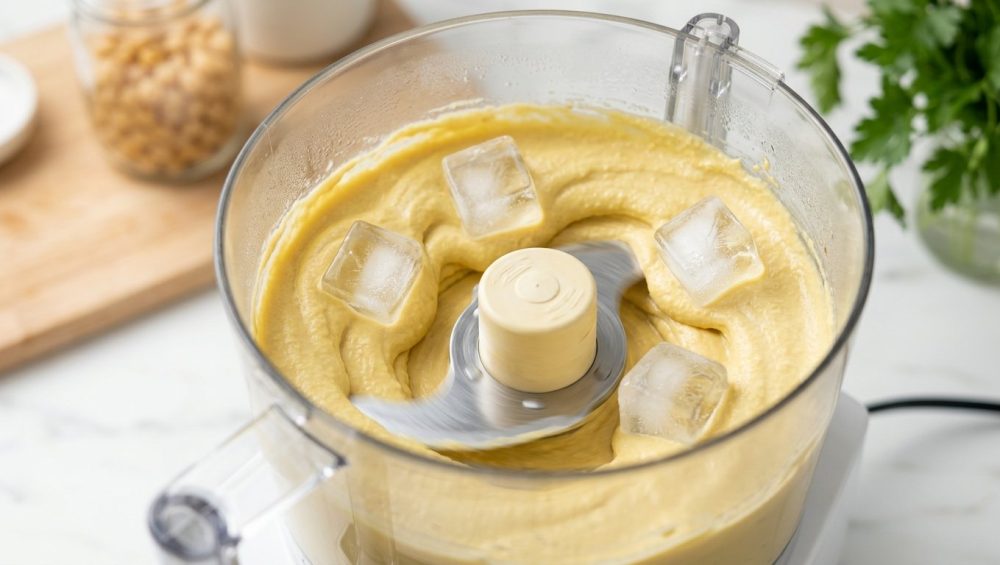
With the motor running, drop in your 3 to 4 whole ice cubes through the top feed tube. It will sound incredibly loud and violent as the blades shatter the ice. Let the machine run continuously for 3 to 5 full minutes. Do not stop it early. You need to give the blades time to obliterate the chickpea skins, while the melting ice keeps the temperature down and whips air into the matrix.
Stop the machine once to scrape down the sides with a silicone spatula. Turn it back on. As you watch, you will see the hummus physically transform. It will shift from a dull, heavy paste into a glossy, pale, whipped, cloud-like mousse. It will look almost like buttercream frosting.
Stop the machine. Taste it. It should be ethereal, light, and perfectly smooth. If it needs more salt or a tiny extra squeeze of lemon, add it now and pulse to combine.
Decoding the Pretentious Hummus Myths
Let’s take a moment to debunk some of the pretentious chef-speak surrounding hummus, because the culinary world loves to overcomplicate simple food.
Myth 1: You absolutely must peel your chickpeas.
False. If you are boiling dried chickpeas with baking soda until they disintegrate, the skins will melt away. But if you are using canned chickpeas, standing at the counter peeling them one by one is a ridiculous waste of your precious time. The heavy-duty blending combined with the ice cubes will break the skins down so finely that they become imperceptible.
Myth 2: You must blend olive oil into the hummus.
Absolutely false, and frankly, a rookie mistake. Extra virgin olive oil contains bitter polyphenols. When you subject olive oil to the high-speed, violent friction of a food processor blade, those polyphenols are physically sheared apart, releasing a highly bitter, metallic taste into your food. Furthermore, adding oil to the inside of the hummus makes it heavy and dense. Authentic, ultra-smooth hummus gets its fat entirely from the tahini. The olive oil is strictly a finishing garnish, poured generously over the top right before serving.
The Plating and The Payoff
You have just created a masterpiece, so do not disrespect it by scraping it into a deep, ugly plastic Tupperware container. You eat with your eyes first, and presentation is everything if you want to throw a flawless dinner party.
Spoon your freshly whipped, airy hummus into a wide, shallow, beautiful ceramic bowl. Take the back of a large spoon and gently swoop it in a circular motion through the hummus, creating a deep, continuous moat or crater in the center.
Now, grab your absolute best bottle of extra virgin olive oil—the grassy, peppery, expensive stuff you save for special occasions. Pour a generous pool of it directly into that swooped moat. The oil should pool beautifully, contrasting with the pale, fluffy hummus.
Garnish the edges with a dusting of smoky paprika or bright sumac. Toss on a handful of toasted pine nuts or finely chopped fresh parsley for texture. Serve it immediately alongside warm, pillowy pita bread, crisp cucumbers, and snappy bell peppers.
When your friends or family take their first bite, they are going to stop dead in their tracks. They will ask you which fancy artisanal deli you bought this from. They will marvel at how light, how intensely creamy, and how perfectly balanced it is. And you can just smile, take a sip of your wine, and know that you achieved culinary perfection using nothing more than a can of beans, a good machine, and a few frozen cubes of water.
Conclusion: You Are the Master of Your Kitchen
Cooking is not magic. It is just applied science, wrapped in a little bit of technique, and seasoned with confidence. By understanding the friction of your tools, the chemistry of your ingredients, and the simple thermodynamic power of ice, you have completely bypassed the frustrations that plague most home cooks.
You no longer have to settle for gritty, heavy, store-bought paste. You have the knowledge to manipulate temperature and emulsions to your advantage. This is the true art of effortless hosting—creating something profoundly delicious out of humble, everyday pantry staples.
So the next time you are craving a mezze platter, skip the supermarket deli aisle. Get out your safe, non-toxic food processor, grab your tahini, and head straight for the freezer. Your ice cubes are waiting to do the heavy lifting. Happy blending, and remember: you can absolutely cook like an expert. You just needed the right sassy sous-chef to show you how.