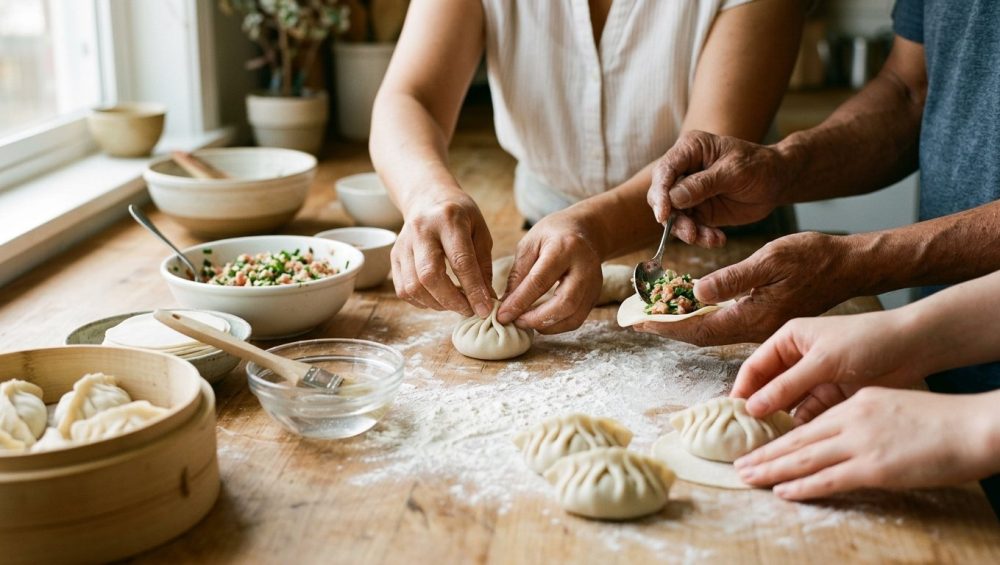
Listen up, weekend warriors. We have all been there: you decide to elevate your Friday night by inviting a few friends over for a chic, hands-on dumpling-making party. You envision a scene straight out of a glossy culinary magazine—glasses of crisp white wine clinking, flour lightly dusted across a beautiful wooden cutting board, and perfectly pleated dough pockets steaming away in rustic bamboo baskets.
Instead, it ends in a sticky, exploded massacre. Your wrappers tear the second you try to fold them. The filling leaks a mysterious, watery gray fluid all over your counter. By the time they hit the boiling water, the dumplings disintegrate into a sad, floating soup of boiled pork and shredded dough. You spend the rest of the evening sweating over the stove, apologizing to your guests, and secretly wishing you had just ordered takeout.
According to the 2025-2026 State of Home Cooking Report by HelloFresh, a staggering 93% of Americans expect to cook as much or more in the next twelve months, with many viewing home cooking as a vital, mindful ritual that fosters social connection and well-being. We are actively seeking out highly interactive, communal food experiences. But the reality is, if you don’t understand the fundamental food science behind what you are making, transforming your chaotic cooking routine into a mindful weekend project is going to end in tears—specifically, the tears in your dumpling wrappers.
As a home cook who learned these lessons by setting off the smoke detector and ruining more dinner parties than I care to admit, I am here to tell you that anyone can make mind-blowing, professional-level dumplings in a standard home kitchen. You do not need a culinary degree. You do not need pretentious chef-speak. You just need to understand the basic mechanics of wrapper hydration, gluten structure, and filling moisture limits.
Let’s fix the science behind this mess so your dumplings never burst again, and you can actually enjoy your own folding party.
The Anatomy of a Dumpling Disaster
Before we can build the perfect dumpling, we have to understand why your current ones are failing. A dumpling is a delicate feat of engineering. It relies on a precise balance between the structural integrity of the outer shell and the thermodynamic behavior of the inner filling. When a dumpling tears, falls apart, or explodes, it is almost always due to a catastrophic failure in one of three areas:
- Wrapper Hydration and Gluten Failure: Your dough is either too dry, resulting in a crumbly wrapper that cracks when folded, or it lacks the proper gluten network, meaning it has no elasticity to stretch around the filling.
- Moisture Overload in the Filling: Your vegetables (usually cabbage) released their internal water content after the dumpling was sealed. As the dumpling cooks, this water turns to steam, expands rapidly, and blows out the seams of the wrapper like a balloon popping.
- Violent Cooking Mechanics: You boiled your dumplings in a continuous, aggressive rolling boil that violently agitated the delicate wrappers, overcooking the starch into a dissolving mush before the raw meat inside even had a chance to reach a safe temperature.
To master the dumpling, we must master these three pillars. We will leave no stone unturned, starting with the very foundation: the dough.
The Science of the Wrapper: Gluten, Hydration, and Starch
Dumpling dough is deceptively simple. It contains exactly two ingredients: flour and water. Yet, the way these two ingredients interact dictates the entire fate of your meal.
Flour contains two vital proteins: gliadin and glutenin. When water is introduced, these proteins link together to form a complex, elastic network called gluten. The temperature of the water you use fundamentally alters how this gluten network forms, and choosing the wrong water temperature for your specific cooking method is the number one reason your wrappers fail.
Hot Water vs. Cold Water Dough: A Thermodynamic Showdown
In the world of Asian dumplings, there are two distinct schools of dough: cold water dough and hot water dough. You cannot use them interchangeably.
Cold Water Dough (For Boiling):
If you are making shui jiao (boiled dumplings), you must use cold or room-temperature water. When cold water mixes with all-purpose flour, it encourages maximum gluten development. The resulting dough is strong, highly elastic, and possesses a significant “snap-back” quality. This robust gluten network is absolutely critical for boiled dumplings because the boiling process is physically violent. The wrapper needs maximum structural integrity to survive tumbling around in bubbling water without dissolving or tearing open.
Hot Water Dough (For Pan-Frying and Steaming):
If you are making potstickers (guo tie) or steamed dumplings, you must use boiling hot water. When you pour boiling water (around 212°F) into flour, the intense heat instantly gelatinizes the starches in the flour. This gelatinization process actively inhibits the formation of gluten. The result is a dough that is incredibly tender, supple, and semi-elastic. It rolls out beautifully without springing back, and when pan-fried, it yields a delicate, crispy bottom rather than a tough, chewy one. However, because it lacks a strong gluten network, if you try to boil a hot water dough dumpling, it will turn into a gelatinous mush and disintegrate in the pot.
For a foolproof, all-purpose dough that gives you the best of both worlds, many experienced home cooks use a hybrid method: hydrating the flour with 50% boiling water to tenderize the starch, and then adding 50% cold water to build just enough gluten for structural stability. This ensures you spend your evening easily rolling out beautiful wrappers instead of fighting sticky dough all night.
The Critical Rest Period (Autolyse for Dumplings)
Once your dough is mixed, you must let it rest. I have zero patience for recipes that tell you to skip the resting phase to save time. Time is money on a Tuesday night, but on a weekend, skipping the dough rest is culinary sabotage.
When you first knead the dough, the gluten network becomes tight and tense. If you try to roll it out immediately, it will aggressively shrink back, and you will have to use immense physical force to flatten it. This excessive force damages the dough structure, leading to micro-tears that will split open later.
By wrapping the dough tightly in plastic wrap and letting it rest at room temperature for at least 30 to 45 minutes, you allow the gluten strands to relax. This process, similar to autolyse in bread making, causes the dough’s tensile strength to drop significantly. The flour fully absorbs the hydration, and the dough transforms into a smooth, pliable, effortlessly workable medium. If you understand why your batter needs to rest, you will understand why this step is the ultimate secret to wrappers that stretch without breaking.
The Architecture of the Fold: Mechanics of a Perfect Seal
Even with the perfect dough, poor physical architecture will doom your dumplings. A proper dumpling wrapper is not a uniform, flat circle. It must be engineered with specific thickness zones.
Portioning and Rolling: The Outer Edge Rule
When you divide your rested dough into small, 10-gram to 15-gram pieces, you will quickly see exactly why you need a bench scraper to portion the logs cleanly without tearing the gluten strands.
When rolling the dough out with a small wooden dowel, you must apply pressure only to the outer edges of the circle, rotating the dough with your non-dominant hand as you go. The goal is to create a wrapper that has a thick “belly” in the center and a paper-thin “skirt” around the perimeter.
Why? Because the center belly is the load-bearing foundation of the dumpling. It has to support the weight and moisture of the raw meat filling. If the center is too thin, the moisture will immediately seep through and tear the bottom. Conversely, the outer edges are going to be gathered, pleated, and pinched together. If the edges are too thick, your pleated seal will turn into a massive, dense knot of raw dough that will never cook through properly.
Hydrating the Edges: The Glue That Binds
If you are using store-bought, machine-made wrappers (which are heavily dusted with cornstarch to prevent sticking in the package), you absolutely must wet the edges with a finger dipped in water to create a seal. The water acts as a glue, hydrating the dried starch so the pleats fuse together.
However, if you are making fresh, homemade dough, you usually do not need water. Fresh dough is inherently tacky enough to seal to itself. Just ensure your fingers are completely dry; wet fingers will make fresh dough slippery and impossible to pinch shut.
The Pleat Physics: Why Air is the Enemy
When folding the dumpling, your primary objective is not just to make it look pretty—it is to eliminate all internal air pockets. As you pinch the pleats closed, you must gently press the wrapper flush against the filling, squeezing out any trapped air.
If you leave a large bubble of air inside the dumpling, that air will heat up during the cooking process. Heated air expands rapidly. Because the dumpling is sealed shut, the expanding air will act like a balloon inflating inside the wrapper, stretching the dough until it violently bursts open in your steamer or boiling pot.
The Filling: Moisture Management is Your Best Friend
You can have the most flawlessly engineered wrapper in the world, but if your filling is a watery, weeping mess, your dumplings will tear from the inside out. Moisture management is the hallmark of a seasoned home cook.
The Cabbage Conundrum: Osmosis in Action
The most traditional dumpling fillings pair rich ground pork with Napa cabbage. Cabbage is delicious, but it is composed of over 90% water. If you simply chop raw cabbage, mix it with raw meat, and stuff it into a dumpling, you are setting a timer on a water bomb. As the dumpling cooks, the heat breaks down the cell walls of the cabbage, releasing all that trapped water into the sealed dough pocket. The result? A soggy, exploded dumpling.
To prevent this, you must harness the power of osmosis. After finely chopping your cabbage (and while chopping onions and ginger for your aromatics), you must heavily salt the cabbage and let it sit in a colander for 20 to 30 minutes.
Salt acts as an osmotic agent. It creates a hypertonic environment on the outside of the cabbage cells, drawing the water out through the semi-permeable cell membranes. After 30 minutes, you will be shocked at the puddle of water beneath the colander. Take the salted cabbage in your hands or wrap it in a clean cheesecloth, and aggressively squeeze out the remaining liquid. By dehydrating the vegetables before they go into the filling, you ensure that your dumpling remains structurally sound.
Fat, Collagen, and the Gelatin Hack
A great dumpling filling should be incredibly juicy, but “juicy” does not mean “wet.” Wetness comes from unmanaged water (like the cabbage issue). Juiciness comes from emulsified fat and collagen.
If you use ultra-lean ground chicken or 99% lean ground turkey, your dumplings will taste like dry sawdust. You need fat—ideally ground pork with at least a 20% to 30% fat ratio.
To bind the filling, you must aggressively stir the meat mixture in one single direction. This is not an old wives’ tale; it is pure meat science. Stirring in one direction unravels the myosin proteins in the meat, causing them to link together and form a sticky, cohesive paste. This paste traps the fat and seasonings, preventing them from leaking out during cooking. Make sure your dry seasonings are fresh, lest they turn into hard bricks in the pantry, rendering them useless for flavoring the meat.
For an advanced “soup dumpling” hack, you can fold finely minced, solidified chicken or pork aspic (gelatinized broth) into the cold meat mixture. As the dumpling cooks, the gelatin melts into a rich, lip-smacking broth that stays perfectly contained within the sealed wrapper.
Cooking Mechanics: Steaming, Boiling, and Pan-Frying
You have successfully folded a tray of beautiful, intact dumplings. Now comes the final hurdle: the cooking process. This is where most weekend culinary hobbyists panic and ruin their hard work.
The Boiling Point: Why Cold Water Shocks Save Lives
If you are boiling your dumplings, you cannot simply drop them into a pot of violently boiling water and walk away. The wrapper of a dumpling cooks significantly faster than the dense ball of raw pork inside. If you maintain a continuous, aggressive rolling boil, the turbulent water will batter the dumplings against each other, and the high heat will overcook the starch in the wrappers until they turn to mush and dissolve, all while the pork inside remains dangerously raw.
To solve this, traditional Chinese cooking employs the “three shocks” method.
- Bring a large pot of water to a boil and drop in your dumplings.
- Wait for the water to return to a vigorous, rolling boil.
- Immediately pour in one cup of cold water. This “shocks” the pot, instantly dropping the temperature and stopping the aggressive boiling action.
- Wait for the water to come to a boil again, and add a second cup of cold water.
- Wait for the boil again, and add a third cup of cold water.
By repeatedly dropping the temperature of the water, you are effectively executing a primitive form of sous-vide cooking. You allow the ambient heat of the water to slowly penetrate the center of the dumpling and cook the meat thoroughly, while protecting the exterior wrapper from being obliterated by sustained, violent boiling temperatures. Once the water boils for the fourth time, the dumplings will be floating, the wrappers will be perfectly springy, and the meat will be fully cooked.
Steaming: Bamboo vs. Metal
If you are steaming your dumplings, the equipment you choose matters immensely. I highly recommend investing in a traditional bamboo steamer rather than using a cheap metal steaming insert.
Bamboo is a natural, porous material. As the steam rises and hits the lid of the bamboo steamer, the bamboo actively absorbs the excess condensation. A metal lid, on the other hand, cannot absorb moisture. The steam hits the cold metal, condenses into heavy water droplets, and rains back down directly onto your dumplings, turning your delicate wrappers into a soggy, waterlogged mess.
Always line your steamer with perforated parchment paper or napa cabbage leaves to prevent sticking. Trust me, this is why cooking spray is the enemy when lining a steamer—it leaves a nasty residue and does nothing to protect the delicate dough from tearing when you try to lift it out.
Pan-Frying and the Maillard Reaction
For potstickers, the goal is a beautiful, deeply browned, crispy bottom achieved through the Maillard reaction, combined with a perfectly steamed top.
You need a pan that retains heat exceptionally well. Heat a tablespoon of oil over medium-high heat. Place the dumplings in the pan, flat side down. Let them sear undisturbed until the bottoms are golden brown. Once browned, pour in a splash of water (or a highly diluted starch slurry if you want that famous crispy “skirt”), and immediately cover the pan with a tight-fitting lid. The water will instantly turn to steam, cooking the tops of the wrappers and the filling inside.
When the water evaporates, remove the lid and let the dumplings fry for one more minute in the remaining oil to re-crisp the bottoms. Doing this correctly in a high-quality pan using the magic of the water drop test ensures your potstickers release effortlessly without leaving their crispy bottoms permanently glued to the metal.
A Mandatory Rant on Toxic Cookware
Since we are discussing pan-frying, I must address my absolute biggest pet peeve. As the Sassy Sous-Chef, I have a strict “no-go” rule on cheap, toxic kitchenware, and I am passionate about banishing toxic kitchen gear from your home forever.
Do not, under any circumstances, fry your beautiful, lovingly handcrafted dumplings in a scratched, peeling Teflon non-stick pan you bought at a discount store five years ago. When those cheap chemical coatings degrade, they flake off directly into your food and off-gas toxic fumes at high heat. It is disgusting, it is dangerous, and it ruins the integrity of your cooking.
If you want a naturally non-stick surface that will last a lifetime, invest in a high-quality carbon steel skillet or a fully clad stainless steel pan. Yes, there is a slight learning curve to temperature control, but once you master it, your dumplings will sear beautifully, release cleanly, and you will never have to ingest mystery forever-chemicals again.
The Blueprint for a Stress-Free Dumpling Folding Party
Now that you have mastered the science of the dough, the moisture control of the filling, and the mechanics of the cooking process, it is time to actually host your gathering.
The beauty of a dumpling night is that the cooking itself is the entertainment. However, if you do not stage the event properly, you will end up stressed out, covered in flour, and isolated in the kitchen while your guests drink all your wine in the living room. Here is how to host a relaxed dinner party without losing your mind.
Station Setup and Prep Timelines
The Day Before:
Do not make the filling on the day of the party. Make your pork and cabbage filling 24 hours in advance and store it in an airtight container in the refrigerator. This allows the flavors (the ginger, garlic, soy sauce, and sesame oil) to meld and mature. More importantly, chilling the filling solidifies the pork fat, making the mixture firm, scoopable, and infinitely easier to fold into the wrappers without making a wet mess.
Two Hours Before Guests Arrive:
Make your dough. Let it rest on the counter wrapped in plastic. Set up your folding station at the kitchen island or dining table. You want everyone facing each other, not staring at a wall. Set out small bowls of water (if using store-bought wrappers), bamboo spatulas or butter knives for scooping the filling, and parchment-lined baking sheets for holding the finished dumplings.
Pacing the Evening (So You Actually Get to Eat)
When your guests arrive, pour the drinks and immediately get them involved. Give a quick, 30-second tutorial on how to pleat a dumpling. Assure them that ugly dumplings taste exactly the same as pretty ones. The goal is a mindful, communal activity, not a Michelin-star exam.
Do not wait until all 100 dumplings are folded to start cooking. This is a rookie mistake that results in a massive bottleneck. Once the first baking sheet is full (usually about 20 dumplings), take it to the stove and start your first batch of pan-frying or steaming.
Serve the dumplings in staggered courses as they finish cooking. This creates a relaxed, tapas-style pacing to the evening. You get to eat hot dumplings fresh out of the pan, your guests get the satisfaction of eating their own creations, and no one is left starving while waiting for a massive mountain of food to be finished all at once.
Making dumplings from scratch is a labor of love, but it does not have to be a frustrating one. By respecting the hydration of your flour, managing the moisture of your vegetables, and treating the cooking process with thermodynamic care, you can completely eliminate the anxiety of torn wrappers and exploded fillings. So ditch the takeout menus, gather your friends, and embrace the beautiful, messy, highly rewarding art of the mindful dumpling party.