Listen, I know you are incredibly busy. We all are. But if I have to stand in one more kitchen and watch a home cook try to saw through a perfectly innocent, ripe heirloom tomato with a chef’s knife that possesses the cutting power of a wooden spoon, I am going to completely lose my mind.
A dull knife is not just an annoyance; it is a kitchen hazard and the fastest way to turn a twenty-minute weeknight dinner prep into a forty-five-minute, agonizing chore. Time is money, my friends. And more importantly, time is wine. You should be spending your evenings enjoying your food, not wrestling with a blunt piece of mystery metal that crushes your bell peppers into a watery pulp. In fact, if you find yourself starting to cry chopping onions before you have even made the first slice, it is almost certainly not the onion’s fault—it is your battered, bruised, and aggressively blunt blade crushing the cell walls and releasing volatile sulfur compounds into the air.
You do not need a culinary degree to maintain a razor-sharp edge, but you do need to stop treating your primary kitchen tool like a crowbar. Today, we are taking a brutally honest, scientifically backed, no-nonsense deep dive into exactly why your kitchen knives are losing their edge prematurely, the microscopic damage you are unknowingly inflicting on them every single day, and the actionable, time-saving habits you need to adopt to stop the madness.
The Microscopic Reality of Your Knife’s Edge
To understand why your knife gets dull, you have to stop looking at it with your naked eye and start thinking about it on a microscopic level. It all comes down to basic blade geometry, metallurgy, and material science.
When a knife is professionally sharpened, the very edge of the blade—the apex—is ground down to an incredibly fine, microscopic “V” shape. We are talking about a cutting edge that is mere microns thick. Because this apex is so astonishingly thin, it is highly vulnerable to physical and chemical stress. Even the most premium, high-carbon steel in the world cannot defy the laws of physics.
When you use a knife, two primary mechanisms of dulling occur at this microscopic level: edge rolling and edge chipping.
Edge rolling, sometimes called deformation, happens predominantly with softer steels, such as the X50CrMoV15 stainless steel commonly used in heavy-duty German knives. These blades are tempered to a lower Rockwell Hardness (usually around 56 to 58 HRC). Because the steel is relatively soft and ductile, the microscopic apex does not snap when it hits a hard surface; instead, it folds or “rolls” over to one side. When you run your thumb gently across the side of a dull German knife, you can often feel a tiny burr catching your skin. That is the rolled edge. The knife is not necessarily missing metal; the cutting geometry is just bent out of alignment.
Edge chipping, on the other hand, is the primary failure mode for harder steels. Premium Japanese knives are often forged from high-carbon powder metallurgy steels (like SG2 or ZDP-189) and hardened to an impressive 60 to 65 HRC. At this hardness, the martensitic matrix of the steel is incredibly rigid, and the microscopic carbides—tiny, ultra-hard particles of carbon bonded with elements like vanadium or chromium—provide exceptional wear resistance. However, this extreme hardness comes at the cost of toughness. When a 63 HRC Japanese blade strikes a bone or a dense cutting board, the thin apex does not roll; it fractures, leaving microscopic chips along the cutting edge.
Whether your edge is rolling or chipping, the result is the same: the pristine, micron-thin “V” shape is destroyed, turning your precision cutting tool into a blunt instrument of culinary trauma.
The Cutting Board Crime Scene: What You Are Chopping On Matters
The single most common reason your knives are dulling at the speed of light is the surface you are cutting on. Every time your blade slices through a carrot, it inevitably slams into the cutting board beneath it. If that board is harder than the steel—or even just highly abrasive—your microscopic apex is going to suffer immediate, catastrophic damage.
Glass and Stone: The Ultimate Culinary Sin
Let us get this out of the way immediately: glass, marble, granite, and ceramic cutting boards are an absolute abomination. Using one of these is an actual crime against culinary humanity. I despise them with every fiber of my being.
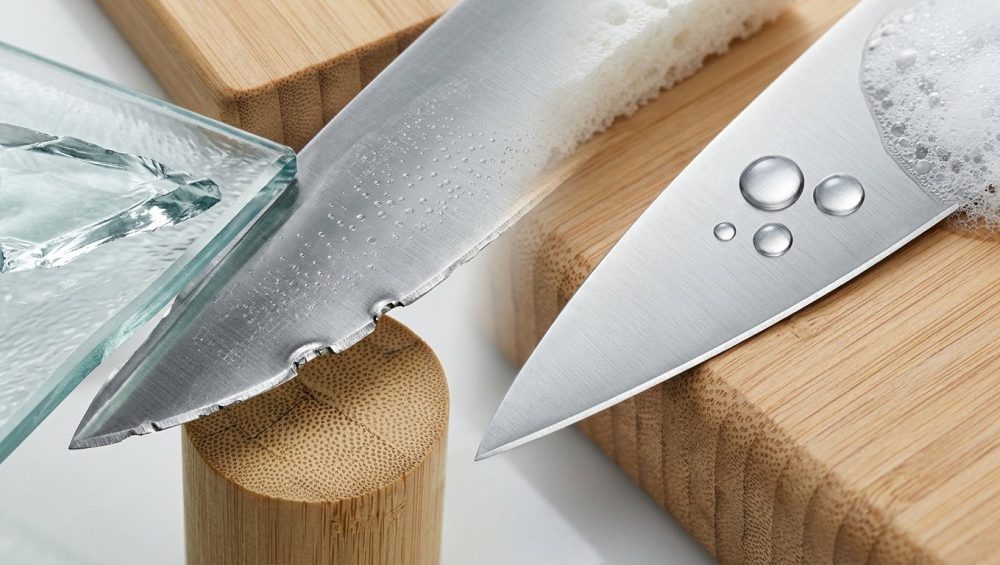
Glass and stone are incredibly dense and rank so high on the hardness scale that they are practically as hard as the steel of your knife itself. Because these materials have absolutely zero “give,” they do not absorb any of the impact when your blade strikes them. Instead, the force is reflected directly back into the microscopic apex of the knife, causing it to instantly roll, flatten, or chip. You can literally take a freshly sharpened, premium chef’s knife, chop an onion on a glass board, and ruin the edge in a single prep session. If you own a glass cutting board, do yourself a favor: throw it in the recycling bin right now, or use it exclusively as a serving platter for cheese. Keep your knives far away from it.
The Bamboo Betrayal
This brings us to the most deceptive villain in the modern kitchen. People love bamboo cutting boards because they are marketed as eco-friendly, sustainable, and aesthetically pleasing. But behind that stylish exterior, bamboo is secretly destroying your cutlery.
First of all, bamboo is not actually wood; it is a highly dense, fast-growing grass. On the Janka hardness scale—a standardized test that measures the resistance of wood to denting and wear—bamboo regularly scores between 1,400 and 1,700, making it significantly harder than many traditional hardwoods. But the hardness is only half the problem. Bamboo contains a naturally high concentration of silica. Silica is essentially the main component of sand and quartz. When you chop on a bamboo board, you are effectively dragging your knife’s delicate edge across microscopic sandpaper.
Furthermore, because bamboo stalks are hollow and narrow, manufacturing a cutting board requires slicing the grass into thin strips and pressing them together with massive amounts of glue and synthetic resins. These hardened resin seams act like invisible speed bumps of pure abrasive material, systematically dulling your blade with every slice.
The Superior Alternatives: Wood and Rubber
If you want to protect your investment and save yourself the agonizing time sink of constantly sharpening dull blades, you need a surface that absorbs impact.
The gold standard for the home cook is an end-grain hardwood board made of maple, walnut, or cherry. Hard maple sits right in the sweet spot of the Janka scale at around 1,450. It is dense enough to resist deep gouging and bacterial buildup, but forgiving enough to yield to a sharp knife. End-grain construction—where the wood fibers point upwards, resembling the bristles of a tightly packed paintbrush—is particularly brilliant. When the knife strikes the board, the blade slides between the vertical wood fibers rather than severing them, which preserves both the razor edge of the knife and the surface of the board. Plus, high-quality wood naturally pulls bacteria beneath the surface via capillary action, where the microbes quickly dry out and die, making it incredibly food-safe.
If you are prepping raw meat and want something you can easily sanitize, skip the cheap, hard plastic boards that scar easily and harbor bacteria. Instead, invest in a professional-grade synthetic rubber board, like a Hasegawa wood-core board or an Asahi rubber board. These are engineered specifically for high-end sushi chefs to provide a soft, forgiving landing pad for brittle Japanese steel, offering the ultimate edge retention.
The Dishwasher: A High-Tech Torture Chamber for Cutlery
The dishwasher is a miraculous time-saving invention for your weekday plates, bowls, and mugs. I am a massive advocate for letting appliances do the heavy lifting so you can reclaim your evening. However, the dishwasher is not a spa; it is a violent, highly caustic torture chamber, and putting your kitchen knives inside it is a guaranteed way to destroy them.
Chemical Warfare: Abrasive Detergents
Many people mistakenly believe that the hot water alone is what dulls a knife in the dishwasher. While the heat is problematic, the real culprit is the chemical makeup of dishwasher detergent.
Dishwasher pods and powders do not create suds like standard dish soap. Instead, they rely on highly alkaline chemical compounds, powerful bleaching agents, and abrasive salts (like sodium silicate) to aggressively scrub baked-on food off your plates,. These alkaline chemicals are incredibly caustic. When exposed to the microscopic, vulnerable apex of a knife blade, these detergents act like a corrosive sandblaster. They literally etch away at the thin steel, stripping off the protective chromium oxide layer of stainless knives and leaving the metal porous, pitted, and completely blunt.
Thermal Shock and Handle Destruction
A standard dishwasher cycle blasts your tools with water temperatures ranging from 130°F to 150°F, followed by a prolonged, intense heated drying cycle. This extreme thermal shock causes the metal of the blade to rapidly expand and contract.
If your knife has a wooden handle, this environment is a death sentence. The intense heat and humidity cause the natural wood fibers to swell dramatically, only to shrink rapidly during the drying phase. This violent fluctuation breaks down the structural integrity of the wood. This is exactly why your keep cracking after a few months in the machine. Furthermore, the heat melts and degrades the epoxy resin that holds the handle scales to the metal tang. The metal rivets expand at a different rate than the handle material, eventually popping loose and creating dangerous, wobbly handles that harbor trapped food and bacteria,.
The “Floating Rust” Phenomenon
Even if you own a high-quality “stainless” steel knife, you are not immune. Stainless steel is exactly that—stain-less, not stain-proof. The hot, humid, highly alkaline environment of a dishwasher is the perfect catalyst for oxidation.
Worse yet, dishwashers suffer from a phenomenon known as “floating rust” or galvanic corrosion. When dissimilar metals (like cheap pots, aluminum foil scraps, or low-grade cutlery) are bathed together in a hot, electrically conductive electrolyte solution (the salty, soapy dishwasher water), rust particles detach and circulate violently in the water jets. These rust particles inevitably slam into and bond with the high-carbon steel of your expensive chef’s knife, causing localized pitting corrosion along the delicate cutting edge.
The solution is aggressively simple: hand wash your knives. It takes exactly fifteen seconds of your time. Use warm water, a mild dish soap, and a soft sponge. Wipe the blade away from the edge, rinse it, and dry it immediately with a towel. Do not let it air dry. Those fifteen seconds will save you hours of frustrating prep work and hundreds of dollars in replacement costs.
The Scraping Habit and Other User Errors
Sometimes, the call is coming from inside the house. You can buy the most expensive end-grain maple board in the world and hand wash your blade with artisan spring water, but if your knife technique is flawed, you are still going to ruin your edge.
The Lateral Drag
Watch yourself the next time you mince a pile of garlic or dice an onion. Once the pile is chopped, what do you do? If you are like 90% of home cooks, you turn the blade sideways, press the sharp edge directly into the cutting board, and scrape the food into a neat little pile or drag it into your skillet.
Stop doing this immediately.
Knives are engineered to withstand vertical impact and slicing friction. They have absolutely zero lateral (side-to-side) structural integrity. When you drag the microscopic, micron-thin apex sideways across a hard wooden surface under the pressure of your hand, you are violently bending and rolling the edge over. You are effectively erasing your sharp edge in a matter of seconds.
If you need to move food across your board, simply flip the knife over and use the dull spine of the blade to scrape. Or, better yet, realize that you need a bench scraper for this exact task. A cheap, stainless steel bench scraper is the unsung hero of a fast, efficient kitchen, allowing you to scoop up massive amounts of prepped ingredients in one swift motion without ever compromising your expensive cutlery.
The Frozen Food Fiasco
Your chef’s knife is a precision slicing tool, not a meat cleaver, a pry bar, or a bone saw. Attempting to force a thin, hard Japanese blade through a frozen block of chicken breast, a rock-hard wheel of Parmesan cheese, or the dense pit of an avocado is a guaranteed recipe for catastrophic edge chipping. Hardened steel does not flex; it shatters. If you need to hack through frozen foods or heavy poultry bones, invest in a thick, heavy, low-HRC meat cleaver designed specifically to absorb massive blunt-force trauma without fracturing.
The Acid Attack and Sink Purgatory
Your kitchen sink is a dangerous place, and how you treat your knife immediately after you finish cutting is just as important as how you use it.
Leaving Knives in the Sink
Tossing a dirty knife into a sink full of soapy, lukewarm water to “soak” is a terrible habit. First, it is a massive safety hazard—reaching into cloudy water and slicing your hand open on a submerged blade is a fantastic way to ruin your evening. Second, prolonged exposure to moisture is the enemy of steel. Just like how your leftover Tupperware will stay greasy if you let it sit in a lukewarm sink rather than washing it properly, your knife will actively degrade the longer it marinates in dirty dishwater. The moisture penetrates the microscopic gaps in the handle, swelling the wood and rusting the tang from the inside out.
Citrus and Tomato Acid
Foods like lemons, limes, tomatoes, and onions are highly acidic. When you slice through them, you are coating your blade in corrosive juices. If you leave that knife sitting on the cutting board while you eat dinner, that acid goes to work immediately, eating away at the microscopic apex of the blade.
This is especially critical if you use carbon steel knives, which lack the protective chromium content of stainless steel. If you invest in beautiful Aogami Super steel, you cannot treat it like a cheap beater. High-carbon steel will develop a gorgeous, protective patina over time, but if left covered in raw citrus juice, it will aggressively rust and pit in a matter of minutes. The rule is simple: when the chopping is done, the knife gets washed and dried immediately.
Storage Nightmares: The Drawer of Doom
If you are meticulously hand-washing your knives, cutting on a beautiful end-grain maple board, and avoiding the lateral drag, but you are still ending up with a dull blade, look at how you are storing it.
Tossing a loose chef’s knife into a chaotic utensil drawer is a death sentence for the edge. Every time you open and close that drawer, the knife slides around, violently banging its delicate apex against metal whisks, ceramic peelers, and heavy spatulas. This metal-on-metal collision causes deep chips and severe edge rolling.
You have three acceptable storage options. The most space-efficient is a wall-mounted magnetic knife strip. It keeps your blades completely isolated, visible, and out of the way. If you rent and cannot drill into the wall, a heavy wooden knife block is fine, provided you insert the knives upside down (resting on their dull spines) rather than dragging the sharp edge against the wood every time you pull them out. Finally, if you absolutely must store your knives in a drawer, you must purchase cheap plastic or felt-lined blade guards (sayas) to physically shield the edge from ambient drawer trauma.
How to Actually Maintain That Edge (Without Wasting Your Weekend)
Even if you follow every single rule perfectly, the simple physics of friction dictate that your knife will eventually lose its bite. Cooking is an abrasive act. But maintaining that edge does not require a blacksmith’s forge or hours of tedious labor. You just need to understand the difference between maintaining an edge and creating a new one.
Honing vs. Sharpening: Know the Difference
The biggest misconception in the culinary world revolves around that long, metal rod that came with your knife block. That is a honing steel, and it does not sharpen your knife.
Remember our discussion about edge rolling? When the microscopic apex of your soft German steel knife folds over, the blade feels dull, but the metal is still there. A honing steel acts as a microscopic alignment tool. By gently swiping the blade down the steel rod at the correct angle, you are physically pushing that rolled edge back into a straight, vertical alignment. Honing removes almost zero metal; it simply straightens what is already there. You should be honing your German knives every few times you cook to keep the edge aligned. (Note: Do not use a standard steel honing rod on hard Japanese knives; the steel is too hard and brittle, and the rod will chip the blade. Use a fine ceramic rod instead, or skip honing entirely and rely on stropping).
Sharpening, however, is the act of physically grinding away steel to create a brand-new microscopic apex. You only need to sharpen your knives when honing no longer works—usually two to three times a year for a home cook.
Banishing the Pull-Through Sharpener
When it is time to sharpen, do not reach for that cheap, V-shaped carbide pull-through sharpener you bought at the grocery store. These carbide scrapers are the definition of toxic kitchen gear that strips off way too much metal. They do not create a smooth, refined edge; they violently tear chunks of steel off the blade, leaving a jagged, micro-serrated edge that feels sharp for exactly one day before collapsing entirely. Over time, a pull-through sharpener will literally hollow out the belly of your expensive chef’s knife, ruining its profile forever.
The only correct way to sharpen a kitchen knife is with a whetstone (water stone). Yes, there is a slight learning curve, but it is not rocket science. A simple combination stone (with a coarse 1000 grit side for establishing the bevel and a fine 6000 grit side for polishing the apex) is all you need to achieve terrifying, professional-level sharpness. Spend thirty minutes watching a tutorial, practice on a cheap paring knife, and you will quickly realize that sharpening your own tools is an incredibly satisfying, meditative process.
When you finally achieve a screaming sharp edge, your prep work becomes as effortless as nailing the water drop test on a hot skillet. Tomatoes yield without pressure, onions slice transparently thin without a single tear, and dense root vegetables glide apart like butter.
The Bottom Line: Respect Your Tools, Reclaim Your Time
You do not need to be a Michelin-starred chef to have world-class equipment in your home kitchen. You just need to stop sabotaging the equipment you already own.
Throw away the glass and bamboo cutting boards. Evict your cutlery from the caustic nightmare of the dishwasher. Stop scraping your blade sideways across the counter, and invest the fifteen seconds it takes to properly hand wash and dry your steel.
Cooking should be a joy, not a battle against blunt objects. Maintaining a sharp knife is the ultimate secret to breaking your takeout habit, because cooking is actually fun when you aren’t fighting your equipment. Treat your knives with the respect they deserve, understand the material science behind the steel, and I promise you: your prep time will be slashed in half, your food will look infinitely more professional, and you will finally feel like the absolute master of your own kitchen. Now go pour yourself a glass of wine, grab a whetstone, and fix that tragic butter knife you call a chef’s blade.