Listen, we need to have a serious heart-to-heart about the pale, rubbery, flavorless block of sadness currently sitting in your fridge. You bought it with the best of intentions. You told yourself you were going to eat healthier, maybe dabble in some plant-based cooking, and finally master those simple weeknight dinners that wellness influencers are always bragging about. But let’s be brutally honest: your tofu currently tastes like a wet mattress. It doesn’t matter how much expensive soy sauce you drown it in; the second you bite into it, you are met with a watery, bland disappointment.
I get it. I have been there. I have set off my smoke detector trying to aggressively sear a waterlogged block of soy, praying for a culinary miracle. I have chewed through aggressively mediocre stir-fries, wondering why I didn’t just order takeout. But before you throw that block into the trash and give up on vegetarian cooking entirely, I need you to step away from the cutting board and walk over to your freezer.
Yes, your freezer.
You don’t need a culinary degree, a $50 single-use plastic pressing gadget, or hours of free time to make restaurant-quality, mind-blowing tofu. You just need a basic understanding of food science and the patience to let your household appliances do the heavy lifting. We are about to dive deep into the brutally simple, highly scientific, and ridiculously hands-off prep hack that will permanently solve your tofu woes. By leveraging the physical properties of expanding ice crystals, we are going to transform that dense, watery block into a literal flavor sponge. Grab a glass of wine, take notes, and let’s get to work.
The Global Plant-Based Shift: Why We Need to Stop Disrespecting Tofu
Before we get into the thermodynamics of your icebox, we need to address why mastering tofu is no longer optional for the modern home cook. Tofu is not just a fringe ingredient for 1970s health food stores anymore. It is an absolute powerhouse of modern cuisine.
The global tofu market is exploding, valued at roughly $2.61 billion in 2025 and projected to reach a staggering $4.16 billion by 2034. In Europe alone, the market is expected to pass the $2 billion mark by 2034, driven by a massive shift toward sustainable, plant-based lifestyles. We are seeing a massive resurgence in vegetable-led scratch cooking, with shoppers actively moving away from heavily processed, lab-grown meat alternatives and returning to natural, whole-food proteins like tofu and tempeh.
People want to eat better, and they want to cook real food. But here is the disconnect: while consumers are buying tofu in record numbers, a vast majority of them have absolutely no idea how to prepare it correctly. They treat it like a chicken breast, completely ignoring the fundamental chemistry of soy curd. If you want to participate in this culinary shift without subjecting yourself to miserable, tasteless dinners, you have to learn how to manipulate the ingredient.
The Anatomy of a Culinary Disappointment: Why Your Tofu is Currently Bland
Before we can fix the problem, we need to understand why you keep making the same rookie kitchen mistakes when it comes to plant-based proteins. To put it bluntly, you are fundamentally misunderstanding what tofu actually is on a structural level.
The High-Water Reality of Soy Curd
Tofu is, at its core, a set protein gel. It is made by curdling fresh, hot soy milk with coagulants (like calcium or magnesium salts) and pressing the resulting curds into solid blocks. Depending on the firmness level you purchase, standard tofu is composed of roughly 85% to 90% water.
I need you to internalize that statistic. When you pull a block of firm tofu out of its plastic tub, you are essentially holding a fragile, protein-webbed water balloon. Because that dense protein matrix is already filled to absolute maximum capacity with its own internal moisture, it physically cannot take on anything else. It is a nightclub at maximum fire code capacity; the bouncer is simply not letting your delicious garlic-ginger marinade through the front door.
The “Sponge” Myth: Why Fresh Tofu Rejects Marinades
There is a pervasive, highly annoying myth in beginner cooking circles that fresh tofu acts like a dry sponge, ready to soak up whatever liquid you drop it into. This is a complete lie. If you take a fresh block of tofu, cube it, and let it sit in a bath of teriyaki sauce for three hours, you are entirely wasting your time.
Because the tofu is already saturated with water, the diffusion process of the marinade is agonizingly slow, incredibly shallow, and limited almost entirely to the outermost surface of the cube. When you eventually cook that marinated fresh tofu, the heat will drive the surface water out, leaving a microscopically thin layer of flavor on the outside while the inside remains a watery, tasteless void. If you’ve ever wondered why your dinner tastes boring despite using a full cup of expensive marinade, this is exactly why. You are fighting the tofu’s natural structure instead of manipulating it.
The Food Science of Freezing: What Actually Happens in the Icebox
This is where the magic happens. We are going to use basic thermodynamics to forcibly evict the water from the premises and permanently restructure the soy protein matrix. I promise I won’t get too pretentious with the chef-speak, but a little deep science is required to understand why this hack is absolutely non-negotiable.
Thermodynamics and Ice Crystal Formation
When you place a block of tofu into the freezer, the ambient temperature drops, and the massive amount of water trapped inside the soy protein matrix begins to freeze. As you likely remember from middle school science class, water is chemically unique because it expands as it freezes. As the internal moisture turns into solid ice, it forms jagged, expanding crystals.
Here is a fascinating quirk of food science: in commercial frozen food production, companies use blast chillers to freeze food incredibly fast, which creates microscopic ice crystals. They do this because large ice crystals destroy the cellular structure of food. But your standard home freezer is relatively warm and freezes food slowly. This slow freeze creates massive, highly destructive ice crystals. In almost any other culinary scenario—like freezing a fresh strawberry or a piece of steak—this cellular destruction is a tragedy that leads to mushy food. But for tofu? This slow, destructive freeze is our greatest weapon.
Puncturing the Protein Matrix
Those massive, expanding ice crystals need room to grow, and they do not care about the delicate soy protein walls standing in their way. As the ice expands, it physically pushes the coagulated proteins apart, stretching, tearing, and micro-puncturing the cell walls of the tofu.
Simultaneously, the freezing process actually concentrates the proteins, pressing them tightly together and making the overall remaining structure significantly stronger and denser. It is a highly traumatic event for the block of soy, but it is exactly what we want.
The Thaw: Birth of the Flavor Sponge
The real transformation reveals itself when you take the tofu out of the freezer and let it thaw. The ice crystals melt back into liquid water, but the structural damage to the protein matrix is completely permanent. The stretched, punctured pockets remain exactly where the ice used to be.
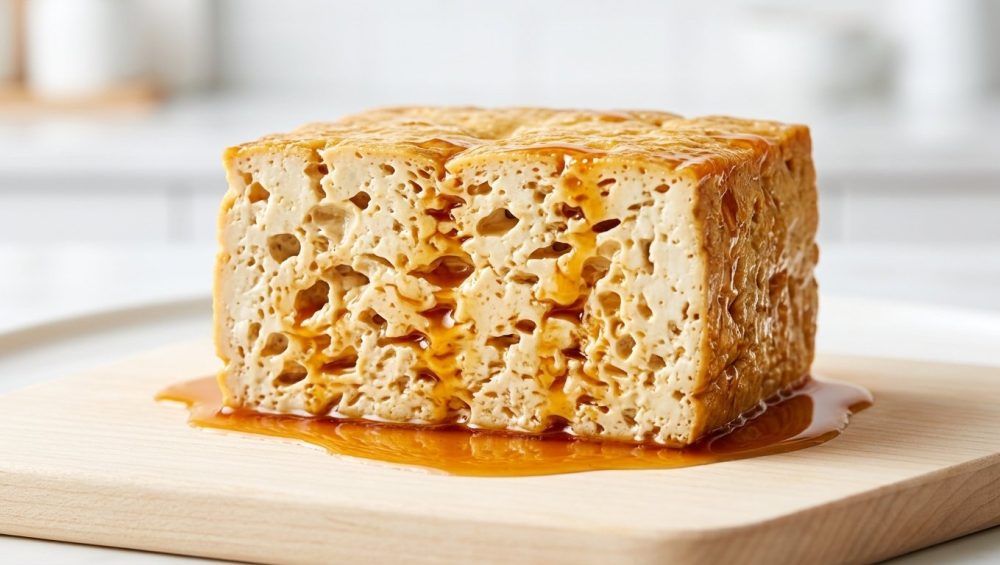
When you press the thawed water out of the block, you are left with a dense, highly porous, sponge-like network of empty air pockets. The nightclub has been cleared out, the doors have been blown off the hinges, and there is finally room for your marinade to penetrate deep into the very center of the block. As a brilliant bonus, the concentrated proteins give the thawed tofu a remarkably meaty, chewy texture that holds up brilliantly to aggressive, high-heat cooking methods.
The Sassy Sous-Chef’s Definitive Guide to Freezing Tofu
Now that you understand the “why,” let’s talk about the “how.” Because time is money, and I refuse to let you overcomplicate this. Freezing tofu is the ultimate lazy cook’s prep hack, but there are still a few strict ground rules you need to follow to avoid a culinary disaster.
Choosing the Right Block (Firm vs. Extra-Firm vs. Silken)
Not all tofu is created equal, and throwing the wrong type into your freezer will result in a tragic mess.
- Extra-Firm and Firm Tofu: These are your golden children. They have a robust enough protein structure to withstand the expanding ice crystals without completely disintegrating into dust. Extra-firm will yield a dense, almost chicken-like chew, while firm will be slightly softer but still wonderfully porous.
- Medium Tofu: You can technically freeze it, but it’s a massive gamble. It tends to become highly crumbly and fragile upon thawing. Proceed at your own risk.
- Silken and Soft Tofu: Absolutely not. Do not pass go. Do not put this in your freezer. Silken tofu is unpressed and has a highly delicate, custard-like texture. If you freeze it, the ice crystals will completely obliterate what little structure it has, leaving you with a grainy, weeping, entirely unusable mess.
The Prep: To Drain or Not to Drain?
You have two options here, depending entirely on your level of weeknight exhaustion.
Option 1: The “I Have Zero Energy” Method.
Take the unopened, sealed plastic package of extra-firm tofu straight from your grocery bag and chuck it directly into the freezer. That’s it. The water inside the package will freeze around the block, acting as a protective barrier against freezer burn. It takes zero effort, though it will take slightly longer to thaw later.
Option 2: The “Type-A Meal Prepper” Method.
Open the package, drain the packing water, and give the block a quick pat dry with a paper towel. Slice the tofu into slabs or cubes, arrange them in a single layer on a parchment-lined baking sheet, and freeze them until solid. Once frozen, transfer the pieces to an airtight container. This method requires five minutes of upfront work, but the frozen pieces will thaw incredibly fast when you need them on a busy Tuesday night.
The Cut: Slabs, Cubes, or Torn?
If you choose to prep before freezing, think strategically about your end goal.
- Slabs: Perfect for grilling, making heavy-duty vegan “steaks,” or building massive sandwiches.
- Cubes: The standard go-to for stir-fries, coconut curries, and grain bowls.
- Torn: My absolute personal favorite. Instead of using a knife, use your bare hands to literally tear the tofu block into jagged, irregular chunks. The rough, uneven edges create exponentially more surface area for marinades to cling to, and those little jagged bits crisp up beautifully in a hot pan.
The Freeze: Timing and Temperature
Your tofu needs a minimum of six hours in the freezer for the water to fully crystallize and do its necessary structural damage. Honestly, just leave it in there overnight. Tofu can live happily in your freezer for up to five months without degrading in quality, making it the ultimate emergency protein stash for lazy evenings.
Thawing and Pressing: Extracting the Water Without Ruining the Curd
You have successfully frozen your tofu. The ice crystals have done their brutal job. Now, we need to carefully reverse the temperature and evict the melted water to make room for flavor.
The Slow Thaw vs. The Emergency Thaw
If you have your life together and possess the gift of foresight, the best way to thaw tofu is to move the frozen block (or pre-cut pieces) to the refrigerator 24 hours before you plan to cook. It will thaw gently, evenly, and perfectly.
If you are a normal, chaotic human being who forgot to take the tofu out of the freezer until 5:30 PM, do not panic. You can execute an emergency thaw. Place the frozen block (still wrapped in its original plastic, or transferred to a sealed ziplock bag) into a large bowl of hot tap water. Change the water every 10 minutes as it cools down. Alternatively, if you are truly desperate, you can microwave the frozen block on the defrost setting in two-minute intervals until it yields to the touch. Just be incredibly careful not to actually cook the edges of the tofu in the microwave.
The Gentle Press (No Fancy Gadgets Required)
Once the tofu is completely thawed, you will notice it looks fundamentally different. It will have a slightly yellowish tint, and it will feel significantly spongier to the touch. Now, you must extract the water.
Because the freezing process has already permanently altered the structure, you do not need to balance a towering stack of heavy cookbooks on top of your tofu for two hours, and you certainly don’t need a single-use plastic tofu press. The water will release much more willingly now.
Place the thawed block between two clean kitchen towels (or heavy-duty paper towels) and press down firmly with the palms of your hands over the sink. You will be absolutely shocked by how much liquid aggressively pours out of it, exactly like a wrung-out dishcloth. Do not squeeze it so hard that you pulverize the block into paste, but apply enough firm, even, downward pressure to empty those newly formed internal pockets. Congratulations, you now possess a dry, thirsty flavor sponge.
Marination Mastery: How to Exploit Your Newly Porous Tofu
Now that we have successfully created a structural vacuum inside the tofu, it is time to fill it. But if you think you can just pour a bottle of watery, store-bought salad dressing over it and call it a day, we need to have another intervention.
Viscosity Matters: Why Thin Liquids Fail
Your newly porous tofu is incredibly eager to absorb liquid, but if your marinade is as thin as tap water, it will simply run right back out of the pockets the second you transfer the tofu to a hot frying pan. You need a marinade with enough physical viscosity to cling to the internal structures of the sponge.
Instead of a purely water-based soak, build a marinade that has some actual body to it. A touch of maple syrup, agave nectar, or a small dab of cornstarch whisked directly into the liquid will help the flavor aggressively adhere to the internal walls of the tofu.
The Role of Fat, Acid, and Salt
A successful, mind-blowing marinade requires a scientific balance of the holy trinity: fat, acid, and salt.
- Salt/Umami: This is your absolute foundation. Soy sauce, tamari, liquid aminos, or miso paste provide the deep, savory baseline that soy curd desperately needs.
- Acid: Tofu is inherently heavy and earthy on the palate. You need a sharp acidic element—like rice vinegar, fresh lime juice, or black vinegar—to slice through the density and brighten the overall flavor profile.
- Fat: A small amount of toasted sesame oil or chili crisp oil is crucial. Fat carries fat-soluble flavor compounds deep into the tofu’s pores and helps lubricate the newly dried-out interior.
My Go-To “Flavor Bomb” Marinade Formula
If you need a foolproof, guaranteed-to-impress starting point, whisk together the following in a large bowl:
- 3 tablespoons of low-sodium soy sauce (or tamari)
- 1 tablespoon of rice vinegar
- 1 tablespoon of maple syrup or dark brown sugar
- 1 teaspoon of toasted sesame oil
- 1 tablespoon of freshly grated ginger (use a carbon steel y-peeler to easily remove the ginger skin first)
- 2 large cloves of freshly minced garlic
Toss your thawed, pressed, and cubed tofu directly into this mixture. Because of the freezing process, you do not need to let it sit in the fridge for hours. Ten to fifteen minutes on the counter is more than enough time for the spongy tofu to aggressively drink up the liquid.
Cooking the Sponge: Searing, Baking, and Frying Like a Pro
We have scientifically prepped. We have perfectly marinated. Now, we must apply heat. This is where many home cooks completely stumble, turning a perfectly prepped piece of tofu into a sticky, burnt, crumbling disaster on the bottom of a cheap pan.
The Non-Negotiable Rule of Safe Cookware
Before we talk about searing, I need to address the elephant in the kitchen. I have a strict, uncompromising rule when it comes to the gear you use: I absolutely despise cheap, toxic kitchenware. If you are currently cooking on a $15 non-stick skillet that you bought at a discount store five years ago, and the coating is visibly flaking off into your food, throw it in the garbage immediately.
Do not ingest mystery chemical polymers just because you are afraid of your food sticking. You should be actively banishing toxic kitchen gear from your home. Not only are scratched Teflon pans a massive health hazard, but they also physically prevent you from getting a proper, high-heat sear on your proteins. You cannot achieve culinary greatness on a peeling layer of forever chemicals.
The Stainless Steel Sear and Temperature Control
To get that gorgeous, golden-brown, crispy crust on your frozen tofu, you need a high-quality stainless steel or carbon steel skillet. Yes, tofu has a notorious reputation for sticking to stainless steel, but that only happens if you lack basic temperature control skills.
You must heat your stainless steel pan before adding the oil. Let the dry pan heat up over medium-high heat until a drop of water flicked onto the surface instantly forms a bead and dances rapidly across the metal. This is called the Leidenfrost effect, and mastering it is the ultimate scientific secret to preventing protein adhesion.
Once the pan is properly heated, add a high-smoke-point oil (like avocado oil or grapeseed oil). Let the oil shimmer, then carefully add your marinated tofu cubes. Do not touch them. Let them sear completely undisturbed for 3 to 4 minutes until a thick, golden crust forms. If you try to flip them too early, they will tear. Once the Maillard reaction has successfully created that crust, the tofu will naturally release from the metal.
Baking for Maximum Crunch
If you despise standing over a hot stove and dodging tiny oil splatters, the oven is your absolute best friend. Baking frozen, thawed tofu yields an incredibly satisfying, chewy, jerky-like texture that is perfect for heavy salads and grain bowls.
Toss your marinated tofu chunks with a tablespoon of cornstarch or arrowroot powder. This creates a dry exterior barrier that crisps up beautifully in the dry heat of the oven. Spread the pieces evenly on a heavy-duty baking sheet. (Side note: if your cheap, thin pans constantly warp in the oven, you know exactly why your baking sheets pop and ruin your even heat distribution. Invest in heavy-gauge aluminized steel).
Bake at 400°F (200°C) for 25 to 30 minutes, flipping halfway through, until the edges are dark, crispy, and sizzling.
Troubleshooting Common Frozen Tofu Disasters
Even with a foolproof, scientifically backed method, things can go wrong if you rush the process or ignore the rules. If your tofu isn’t turning out like a culinary masterpiece, let’s diagnose the issue so you can quickly rescue a ruined dinner.
Why Is My Tofu Crumbling?
If your thawed tofu is falling apart into a grainy, crumbly mess when you try to press or cook it, you committed one of two cardinal sins:
- You froze the wrong type. You almost certainly froze silken or soft tofu, which completely lacks the dense protein structure required to survive the ice crystal expansion. Stick strictly to firm or extra-firm.
- You over-pressed it. Frozen and thawed tofu is inherently more fragile than fresh tofu because of the internal pockets. If you squeezed it with the force of a hydraulic press, you shattered the remaining protein walls. Be firm, but gentle.
Why Is It Too Chewy?
Freezing tofu makes it significantly denser and chewier. For most people, this “meaty” texture is the primary appeal of the hack. However, if it feels like you are chewing on a rubber tire, you likely overcooked it. Because the frozen and thawed tofu has far less internal water to begin with, it dries out much faster in a hot pan or oven. Cut your cooking time down by a few minutes, or make sure your marinade has enough fat to keep the interior lubricated.
Why Does It Still Taste Boring?
If you went through the trouble of freezing, thawing, pressing, and marinating, and your tofu still tastes like a void of sadness, your marinade is the sole culprit. You either didn’t use enough salt (soy sauce/miso), you skipped the acid, or your marinade was too watery to cling to the internal pores. Remember, tofu is a blank canvas. If you paint it with watered-down, flavorless gray paint, you are going to get a flavorless gray meal. Be aggressive and unapologetic with your seasonings.
The Weeknight Efficiency Factor: Meal Prep for Busy Humans
As a busy professional, I am absolutely militant about kitchen efficiency. I do not have the time or the patience to baby a block of tofu for an hour on a Wednesday night. The freezer method is not just a brilliant flavor hack; it is a profound time-saving strategy.
Batch Freezing and Storing
Whenever you return from the grocery store, do not put your extra-firm tofu in the fridge. Put it directly into the freezer. If you buy three blocks, freeze all three. You are instantly extending their shelf life by up to five months, completely eliminating the risk of them going bad and turning slimy in the back of your crisper drawer.
By keeping a rotating stock of frozen tofu, you always have a high-quality, readily available protein source that requires zero last-minute emergency grocery runs.
From Freezer to Skillet: The Ultimate Shortcut
Let’s walk through the ultimate efficient weeknight timeline to prove how easy this is.
- Morning (8:00 AM): Move a frozen block of tofu from the freezer to the fridge before you leave for work.
- Evening (6:00 PM): The tofu is mostly thawed. Give it a quick emergency hot-water bath in the sink if the very center is still icy.
- 6:10 PM: Press the water out using your hands and a kitchen towel over the sink. Tear it into jagged chunks.
- 6:15 PM: Toss the chunks in your high-viscosity marinade. Let it sit while you chop some broccoli.
- 6:25 PM: Sear in a properly heated, non-toxic skillet until perfectly crispy.
In less than 30 minutes of active prep and cooking time, you have produced a deeply flavored, texturally magnificent plant-based protein that aggressively rivals anything you could order from an overpriced restaurant.
Final Thoughts: Elevating the Everyday Home Kitchen
Cooking should never be an exercise in frustration. You do not need to be a classically trained chef to make incredible food in your own home, but you do need to understand the basic physical properties of the ingredients you are working with.
By utilizing the freezer, you are taking absolute control of the food science. You are weaponizing ice crystals to dismantle the stubborn, waterlogged structure of raw soy curd, transforming it into a highly receptive, deeply flavorful sponge. It is a zero-cost, zero-effort technique that completely changes the trajectory of your plant-based cooking.
Stop settling for bland, rubbery, disappointing meals. Throw out your peeling, toxic pans. Stop buying cheap plastic gear that ensures your plastic containers stay greasy no matter how hard you scrub them. And for the love of all things culinary, stop using glass or bamboo cutting boards that are actively ruining your knives. Respect your ingredients, respect your tools, and let your freezer do the heavy lifting.
Now go freeze your tofu. You can thank me later.