Have you ever bought a beautiful, pristine punnet of cremini mushrooms, envisioning a steakhouse-quality side dish, only to throw them in a pan and end up staring at a grey, watery, rubbery pile of despair? Instead of a rich, caramelized crust, you are left chewing on something that resembles a chopped-up pencil eraser. We have all been there. It is one of the most common rookie kitchen mistakes that plagues weekend culinary hobbyists. But here is the good news: it is not a lack of culinary talent that is ruining your dinner. It is a fundamental misunderstanding of biology, thermodynamics, and heat management.
As a home cook who learned the hard way—by setting off the smoke detector more times than I care to admit and serving my fair share of questionable side dishes—I am here to tell you that you do not need a culinary degree from Le Cordon Bleu to achieve deeply browned, meaty, umami-packed mushrooms. You just need to stop treating them like normal vegetables. Because, spoiler alert, they aren’t vegetables at all.
Today, we are going to completely deconstruct the science of searing. We are going to look at the cellular structure of fungi, identify the exact mistakes that are turning your food into a watery mess, and teach you a foolproof, scientifically backed method to get that perfect, golden-brown crust every single time. Grab your favorite skillet, pour yourself a glass of wine, and let’s get to work.
The Biology of a Betrayal: Why Mushrooms Turn into Sponges
To understand why your mushrooms are betraying you on the stovetop, we have to take a quick detour into high school biology. I promise I will keep the pretentious chef-speak to an absolute minimum, but you need to know what you are working with. Fungi are biologically closer to animals than they are to the leafy greens in your crisper drawer.
Chitin vs. Pectin: The Indestructible Cell Wall
When you cook a vegetable—say, a zucchini or a carrot—the heat breaks down a carbohydrate called pectin. Pectin is the structural glue that holds plant cells together. Expose a zucchini to heat for too long, and that pectin completely disintegrates, turning your squash into a structureless, mushy glob. When you cook a piece of meat, the heat causes the proteins to tightly contract and squeeze out moisture, eventually turning a beautiful steak into a tough, chewy hockey puck if left on the stove too long.
Mushrooms play by an entirely different set of rules. Their cell walls are not made of pectin or cellulose. They are made of a polymer called chitin. If that word sounds familiar, it is because chitin is the exact same tough, rigid substance that makes up the exoskeletons of crabs, lobsters, and insects.
Because of this chitin structure, mushrooms are incredibly heat-stable. In fact, the brilliant minds at America’s Test Kitchen ran an experiment where they steamed portobello mushrooms, beef tenderloin, and zucchini for 40 straight minutes. The zucchini turned to absolute mush. The beef became unchewable. The mushroom? It barely changed its texture at all. You literally cannot overcook a mushroom to the point of structural collapse.
The 92 Percent Problem
So, if you can’t overcook them, why do they get so soggy and rubbery? It comes down to water weight. Fresh mushrooms are essentially tiny, delicious water balloons. Depending on the variety, a fresh mushroom is composed of roughly 90 to 92 percent water.
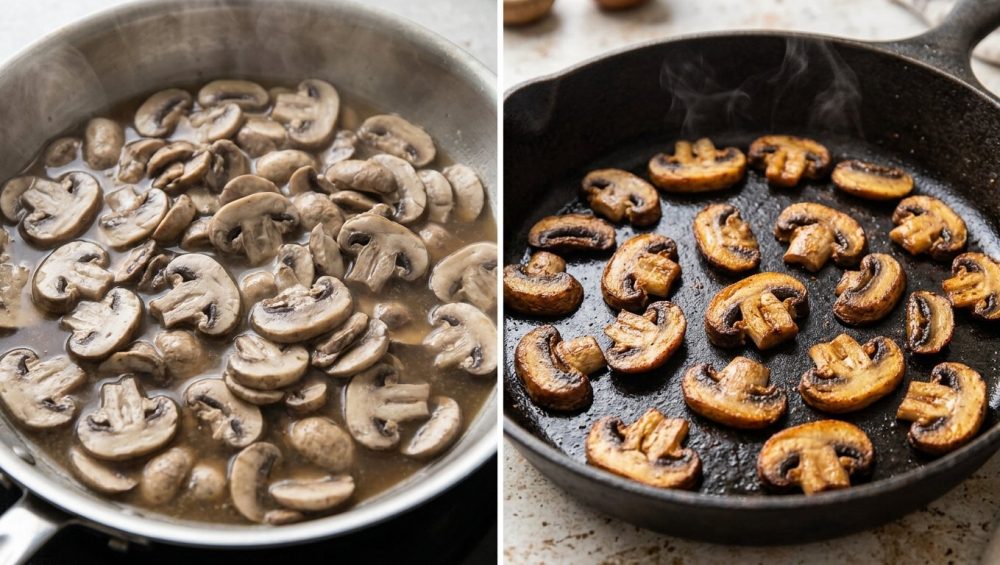
When you chop up these water balloons and throw them into a hot pan, the heat causes the internal moisture to rapidly expand and burst through the cellular structure. Suddenly, your pan is flooded with liquid. If your pan is not hot enough to instantly evaporate that liquid, your mushrooms stop searing and start boiling in their own juices. And because they are essentially little sponges, if you added fat (like butter or oil) to the pan too early, the mushrooms will absorb all the fat while simultaneously weeping water. You are left with a greasy, watery, gray disaster. Understanding this basic biology is one of the most foolproof cooking secrets you can master.
The Three Cardinal Sins of Cooking Mushrooms
Now that we know we are dealing with indestructible, water-logged sponges, let’s look at the three most common ways home cooks completely sabotage their sear. If you want professional-level results in a standard home kitchen, you must avoid these sins at all costs.
Sin #1: The Crowded Pan Steambath
This is the number one reason your food is soggy. You have a standard 10-inch skillet, and you dump an entire pound of freshly sliced cremini mushrooms into it. They are piled on top of each other, overlapping, fighting for space.
Here is the thermodynamic reality: your stovetop burner only outputs a finite amount of thermal energy. When you drop a massive payload of cold, wet ingredients into a hot pan, the temperature of the metal plummets instantly. The mushrooms begin to release their 92 percent water content. Because the pan is no longer blazing hot, that water pools at the bottom instead of evaporating into steam. The mushrooms that are trapped under the pile are now effectively being steamed, not seared.
The Maillard reaction—the chemical reaction between amino acids and reducing sugars that gives browned food its distinctive, savory flavor—only occurs efficiently at temperatures above 280°F (140°C). Water boils and turns to steam at 212°F (100°C). As long as there is liquid water pooling in your pan, the temperature of your food cannot exceed 212°F. Therefore, browning is physically impossible. You must give your ingredients enough space so that the water they release can immediately hit the hot metal and vaporize.
Sin #2: Premature Salting (The Osmosis Trap)
I know, I know. Every cooking show on television drills the phrase “season as you go” into your brain. And generally, that is excellent advice. But when it comes to fungi, premature salting is a death sentence for your sear.
Remember osmosis from middle school science class? Salt draws out moisture. If you sprinkle salt over your raw mushrooms the second they hit the pan, you are aggressively accelerating the rate at which they weep water. You are opening the floodgates before the pan has had a chance to build up enough heat to handle the deluge.
Wait to salt your mushrooms until after they have released their water, the water has evaporated, and they have developed a deep, golden-brown crust. Seasoning at the very end ensures maximum flavor without sabotaging the texture.
Sin #3: The Nervous Stirrer
Put the spatula down and step away from the stove. I mean it.
For some reason, home cooks have a compulsion to constantly push food around the pan, treating their skillet like a DJ turntable. If you want a deep, crusty, caramelized sear, the food needs uninterrupted, prolonged contact with the hot metal. Every time you stir, you are breaking that contact and cooling down the surface of the food. Let them sit undisturbed for several minutes. Let them squeak. Let them brown. Have a sip of your wine. They will let you know when they are ready to be flipped.
The Plot Twist: Why You Should Actually Boil Your Fungi
Okay, here is where we get to the absolute game-changer. If you want to bypass the stress of overcrowding and temperature management entirely, there is a modern, scientifically backed technique that sounds completely insane but works flawlessly.
For decades, classical French culinary doctrine dictated that you should never, ever let a mushroom touch water. We were told to painstakingly wipe the dirt off each individual cap with a damp paper towel or a special, overpriced little brush. We were told that washing them would make them waterlogged.
Well, science has finally called out that bluff. Mycologist and chef Jim Fuller, along with the brilliant culinary scientists at America’s Test Kitchen, proved that since mushrooms are already 92 percent water, giving them a quick rinse isn’t going to hurt them. But they took it a step further. They discovered that the absolute best way to guarantee a perfect sear is to actually boil them first.
Yes, you read that correctly.
The Science Behind the Water-First Method
It sounds completely counterintuitive to add water to a pan when moisture is the enemy of browning. But here is why the boiling method is pure genius:
When you add raw mushrooms to a skillet with a little bit of water and bring it to a rapid boil, the heat causes the microscopic air pockets inside the spongy mushroom tissue to collapse. The boiling water essentially cooks the mushroom’s own internal water out of it. Because chitin is heat-stable, the mushrooms don’t turn to mush; they just become perfectly tender and shrink down significantly.
As the water rapidly boils away and fully evaporates, you are left with a pan full of cooked, dense, structurally sound mushrooms that have already expelled their excess moisture. At this exact moment, the pan goes dry, and you add your fat (oil or butter). Because the mushrooms have already collapsed their sponge-like structure, they will not absorb the oil like a greasy sponge. Instead, the oil coats the outside, and the mushrooms immediately begin to fry and brown beautifully, evenly, and rapidly.
Step-by-Step: The Boiling Method
If you want to save time on a busy weeknight and guarantee a meaty texture, follow this exact protocol:
- Prep the Fungi: Clean your mushrooms (yes, you can just rinse them in a colander) and slice or tear them into uniform pieces.
- The Cold Pan Start: Place the mushrooms in a wide skillet. Add just enough water to barely cover the bottom of the pan (about 1/4 cup for a pound of mushrooms). Do not add oil or butter yet.
- The Boil: Turn the heat to medium-high. Bring the water to a vigorous boil. Let the mushrooms cook in the bubbling water. You will see them shrink as they release their own juices into the pan.
- The Evaporation: Keep cooking until every single drop of liquid has evaporated from the pan. Listen closely; the sound will change from a wet, bubbling boil to a dry, aggressive sizzle.
- The Sear: Now, push the mushrooms to the side and add your high-heat cooking fat (like avocado oil, ghee, or beef tallow). Toss the mushrooms to coat them. Because the water is gone, the Maillard reaction will kick into overdrive. Let them sit undisturbed to develop a deep, dark crust.
- The Finish: Once deeply browned, lower the heat, add a pat of butter, your aromatics, and finally, your salt.
This method is practically foolproof and completely eliminates the anxiety of a crowded pan. It is one of those essential tools every beginner needs in their mental culinary arsenal.
The Traditional Dry-Sear Method (For the Purists)
If you are a traditionalist and the idea of boiling your fungi offends your culinary sensibilities, you can still achieve a magnificent sear using the dry method. But you must be incredibly disciplined with your heat management.
The Dry Pan Squeak
To do this correctly, you need a heavy-bottomed skillet that retains heat brilliantly. Place your dry skillet on the stove over medium-high heat and let it get smoking hot.
Do not add oil. Do not add butter.
Drop your dry, sliced mushrooms directly into the screaming hot, dry pan. They will immediately begin to squeak and whistle as the heat forces the moisture out of their cells. Because the pan is so hot, the moisture will instantly vaporize into steam rather than pooling at the bottom.
Toss them occasionally, but mostly let them sit. After about 4 to 5 minutes, they will have shrunk by half and will have taken on a slightly toasted color. Only now do you introduce your fat. Drizzle in your oil, let it heat up for three seconds, and then toss the mushrooms to coat. They will immediately begin to fry and develop that beautiful, crispy, golden-brown exterior.
The “No-Go” Rule: Ditch the Toxic Cookware
We need to have a serious heart-to-heart about your kitchen equipment. I have zero patience for cheap, toxic kitchenware. If you are trying to execute a high-heat sear on a flimsy, scratched-up, $15 non-stick pan you bought at a big-box store five years ago, you are not just ruining your dinner—you are actively endangering your health.
Why Cheap Non-Stick Pans Ruin Your Sear (And Your Health)
Traditional non-stick coatings (like Teflon, which is made from PTFE, a type of PFAS or “forever chemical”) are designed for low-to-medium heat cooking. They are great for scrambling eggs or flipping pancakes. They are absolutely atrocious for searing.
To trigger the Maillard reaction and get a proper crust on your mushrooms, you need sustained, high heat. When you heat a cheap non-stick pan past 500°F (260°C)—which happens very quickly when a pan is left empty or dry on a hot burner—the chemical coating begins to break down and degrade. It releases toxic, invisible fumes into your kitchen that can cause flu-like symptoms in humans and are famously fatal to pet birds.
Furthermore, as these pans degrade, the coating begins to flake and peel directly into your food. If you have ever wondered about the losing their slip phenomenon where your non-stick pan suddenly becomes a sticky nightmare, it is because you have cooked the coating to death.
The Holy Trinity of Searing Pans
If you want to cook like an expert, you need to invest in durable, safe, high-thermal-mass cookware. Consider this your official mandate for toxic kitchen gear removal. Throw away the scratched Teflon and upgrade to one of these three safe alternatives:
- Cast Iron: The undisputed king of heat retention. A thick cast iron skillet takes a long time to heat up, but once it gets hot, it stays hot. When you drop a pound of cold mushrooms into a cast iron pan, the temperature barely drops. This guarantees a rapid evaporation of moisture and a beautiful, aggressive sear.
- Carbon Steel: The professional restaurant chef’s best friend. Carbon steel is lighter and more responsive than cast iron but offers similar naturally non-stick properties once seasoned. If you want to toss and flip your ingredients like a pro without breaking your wrist, carbon steel pans are an absolute game-changer for high-heat stovetop cooking.
- Fully Clad Stainless Steel: Stainless steel is fantastic for building a “fond”—the sticky, caramelized bits of food that adhere to the bottom of the pan during cooking. Stainless steel requires a bit more fat to prevent sticking, but it allows you to create incredible pan sauces by deglazing those browned bits later.
Mushroom Varieties and How to Prep Them
Not all fungi are created equal, and how you prep them heavily influences the quality of your sear. Stop buying pre-sliced mushrooms in plastic wrap. They dry out, oxidize, and lose their flavor. Buy whole mushrooms and prep them right before cooking.
The Supermarket Staples: Button, Cremini, and Portobello
Fun fact: White button, cremini (baby bella), and portobello mushrooms are all the exact same species of fungus. The only difference is their age. White buttons are harvested young, creminis are slightly older and browner, and portobellos are fully mature with fully developed gills.
For buttons and creminis, quartering them is usually better than slicing them thin. A thicker quartered chunk gives you more surface area to sear while maintaining a meaty, satisfying chew in the center. For portobellos, scrape out the dark black gills with a spoon before slicing; otherwise, they will turn your entire dish an unappetizing muddy brown color.
The Exotics: Oyster, Shiitake, and Maitake
When dealing with delicate, petal-like varieties such as Oyster or Maitake (Hen of the Woods), put the knife away. Use your hands to gently tear them into bite-sized clusters. Tearing along the natural fibrous grain of the mushroom creates jagged, irregular edges. These thin, ragged edges crisp up in the hot oil beautifully, creating a textural crunch that a clean knife cut simply cannot replicate.
For Shiitakes, always remove the stems. Unlike the caps, shiitake stems are incredibly tough and woody, and no amount of cooking will make them pleasant to chew. Save the stems in a freezer bag to toss into your next batch of homemade vegetable or chicken stock.
Building the Ultimate Umami Bomb: Flavor Upgrades
You have successfully boiled off the water. You have introduced the fat. You have achieved a deep, mahogany-brown crust. You have officially mastered the sear. But we are not done yet. Now, it is time to build a complex, restaurant-quality flavor profile.
Fat Management: The Butter Finish
While you should always start your sear with a high-smoke-point oil (like avocado, grapeseed, or clarified butter/ghee) to prevent burning, you should always finish with whole butter.
Once the mushrooms are deeply browned, drop the heat to medium-low and toss in a generous knob of unsalted butter. As the butter melts, the milk solids will begin to toast and brown, enveloping the mushrooms in a rich, nutty flavor profile that elevates the earthiness of the fungi.
Aromatics: Timing is Everything
This is the stage where you introduce your flavor builders: minced shallots, fresh thyme leaves, and minced garlic.
Do not add your garlic at the beginning of the cooking process! Garlic contains a high amount of natural sugars and cooks incredibly fast. If you add it while you are trying to sear the mushrooms over high heat, it will incinerate into bitter, acrid carbon before the mushrooms even begin to brown. If you have ever wondered why your garlic always burns when you cook, it is because you are adding it way too early. Add your aromatics in the last 60 seconds of cooking, just letting them gently bloom in the hot butter until fragrant.
Deglazing: Liquid Gold
As your mushrooms sear, they will inevitably leave behind a sticky, dark brown residue on the bottom of your skillet. This is called the fond, and it is pure, concentrated umami. Do not leave it behind in the pan to be scrubbed down the sink later.
To capture that flavor, you need to deglaze. Pour a splash of liquid into the hot pan—a dry white wine, a robust red wine, a splash of sherry, or even just some high-quality chicken or vegetable stock. The liquid will immediately bubble and hiss. Use a wooden spoon to scrape the bottom of the pan, dissolving that fond directly into the liquid. Let the liquid reduce until it forms a glossy, thick glaze that coats every single mushroom. This is the ultimate trick for turning burnt bits into sauce, and it is what separates a bland home-cooked meal from a professional culinary experience.
The Acid Drop: Waking Up the Dish
Finally, we arrive at the most crucial and most frequently forgotten step in home cooking: the acid drop.
Mushrooms are incredibly earthy, heavy, and savory. When you cook them in fat and butter, the resulting dish can feel a bit muddy and rich on the palate. To make those flavors pop, you need to introduce a bright, sharp contrast.
Right before you pull the pan off the stove, hit the mushrooms with a squeeze of fresh lemon juice, a dash of sherry vinegar, or a few drops of balsamic glaze. This subtle hit of acidity cuts through the richness of the fat, balances the heavy umami notes, and instantly brightens the entire dish. If your food ever tastes flat or boring, remember that your dinner actually needs acid, not more salt.
Finish with a sprinkle of flaky sea salt and some freshly chopped parsley or chives for a hit of herbaceous color.
The Final Verdict
Cooking is not magic; it is simply applied physics and chemistry. Once you understand the biological reality that mushrooms are heat-indestructible sponges made of chitin and water, the entire process demystifies itself.
You no longer have to fear the watery, grey, squeaky side dishes of your past. Whether you choose the modern, stress-free boiling method to expertly collapse the cell walls, or you opt for the traditional, high-heat dry sear in a blistering hot carbon steel skillet, you now possess the knowledge to control the moisture instead of letting the moisture control you.
Stop crowding your toxic non-stick pans. Stop salting too early. Stop stirring like a maniac. Give your ingredients the heat, space, and respect they deserve, and I promise you, you will be churning out deeply roasted, meaty, steakhouse-caliber mushrooms that will blow your dinner guests away. Now get into the kitchen, turn on the exhaust fan, and go sear something spectacular. You’ve got this.