Listen, we need to have a serious talk about the contents of your kitchen drawers. As a home cook, you are probably juggling a chaotic weekday schedule, trying to get a decent, flavorful meal on the table without ordering takeout for the third time this week. I get it. Time is money, and convenience is king. But somewhere along the line, we were all sold a lie. A heavy, clunky, hard-to-clean lie that currently resides in the back of your utensil drawer, likely jamming it shut. I am talking about the traditional garlic press.
You probably bought one thinking it was a brilliant shortcut. Why spend precious minutes mincing garlic with a knife when you can just squeeze it through a metal sieve in three seconds flat? It seems logical, right? Wrong. The garlic press is a culinary crime scene. It is a one-trick pony that doesn’t even perform its one trick correctly. Not only does it yield an inferior, harsh-tasting ingredient that actively sabotages the flavor profile of your dinner, but it is also an absolute nightmare to clean. If you are looking for the easiest aesthetic kitchen upgrades, start by throwing that medieval torture device directly into the recycling bin.
Today, we are going to dive deep into the fascinating, volatile chemistry of garlic. I am going to explain exactly why that blunt-force gadget is making your food taste bitter, metallic, and overly pungent. More importantly, because I am your biggest culinary cheerleader and I firmly believe you can achieve restaurant-quality results in your own home, I am going to introduce you to the ultimate tool upgrade. We are going to replace that flawed unitasker with a precise, multi-functional, scientifically superior alternative that will instantly elevate your cooking. Grab a glass of wine, pull up a stool, and let’s get into it.
The Anatomy of a Kitchen Crime: What the Garlic Press Actually Does
Let us examine the mechanics of the traditional garlic press. At its core, it is a simple lever-based extrusion device. You place a beautiful, plump clove of garlic into a small hopper, and you squeeze two handles together to force a blunt plunger down onto the clove. The garlic has nowhere to go but through a grid of tiny, circular holes.
The Blunt Force Trauma Approach
Here is the fundamental problem: a garlic press does not cut. It bludgeons. It relies entirely on sheer, unadulterated blunt force trauma to crush the structural integrity of the garlic clove until it liquefies and bursts through the perforations. You are essentially putting the garlic through a miniature trash compactor. This aggressive crushing action pulverizes the cellular walls of the plant material in a way that a sharp blade never would. As we will explore in the chemistry section, this catastrophic cellular destruction is the exact catalyst for bitter, acrid flavors. You are squeezing out the juice and leaving behind the fibrous, papery membrane, resulting in a wet, mushy paste that cooks unevenly and tastes unnecessarily harsh.
The “Mystery Metal” Problem
Beyond the mechanical flaws, there is a much darker, more insidious issue with most traditional garlic presses: the materials they are made from. You know my strict “No-Go” rule on cheap, toxic kitchenware. I absolutely despise mystery metals, peeling coatings, and low-grade alloys that have no business touching human food. Many budget-friendly garlic presses are manufactured using cheap cast aluminum or zinc alloys coated in non-stick paints or faux-chrome finishes.
These materials are highly reactive, especially when exposed to the acidic, sulfur-rich juices of crushed garlic. Over time, the acidic juice pits the metal, causing the shiny coating to blister, flake, and peel directly into your food. In fact, the problem of cheap materials is so severe that in August 2025, a massive recall was issued for over 54,000 IKEA garlic presses across the United States and Canada because the zinc-coated metal pieces were literally breaking off during use, creating severe laceration and ingestion hazards. Let me be perfectly clear: if your kitchen gadget is shedding metal shrapnel into your marinara sauce, it is time to start banishing toxic kitchen gear from your life forever. You deserve safe, high-quality, durable equipment that offers real value, not a hazardous hunk of degrading zinc.
The Science of Stink: Understanding Garlic Chemistry
To truly understand why the garlic press is ruining your dinner, we need to put on our lab coats and look at what happens on a microscopic level. Garlic (Allium sativum) is a botanical marvel. It evolved its potent, pungent aroma not to delight our palates, but as a biological defense mechanism to deter hungry pests and herbivores from eating it in the wild.
Meet Alliin and Alliinase
Inside a whole, unbroken garlic clove, the chemistry is completely dormant. The clove is actually quite mild and sweet. This is because the two key chemical components responsible for garlic’s signature stink—a sulfur-containing amino acid derivative called alliin and an enzyme called alliinase—are securely isolated from one another in separate cellular compartments. As long as the cell walls remain intact, these two compounds never meet, and the garlic remains odorless and tame.
The Allicin Explosion
The moment you breach those cell walls—whether by biting, slicing, or crushing—you trigger the plant’s tripwire. The compartmentalized walls break down, allowing the alliin and the alliinase enzyme to mix. The enzyme instantly acts as a catalyst, converting the alliin into a highly volatile, potent new compound known as allicin. Allicin is the flavor bomb. It is the exact chemical responsible for the sharp, pungent, spicy, and sometimes bitter taste of raw garlic.
Here is the crucial scientific fact that every home cook needs to memorize: the amount of allicin produced is directly proportional to the amount of cellular damage inflicted on the clove.
If you gently slice a garlic clove with a razor-sharp knife, you are only rupturing the cells directly along the blade’s path. This minimal damage produces a small, controlled amount of allicin, resulting in a mellow, sweet, and nuanced garlic flavor. However, if you load that clove into a garlic press and subject it to maximum blunt-force crushing, you are instantaneously annihilating nearly every single cell in the clove. This triggers a massive, uncontrolled chemical reaction, creating an absolute flood of allicin.
According to food biochemistry data, crushing garlic through the tight tolerances of a stainless steel press can even generate localized friction heat (exceeding 42°C), which prematurely denatures the enzymes and alters the sulfur volatiles, leading to a drastically sharper, more acrid, and highly bitter flavor profile. You are no longer adding a background note of savory umami to your dish; you are dropping a bitter sulfur bomb into your pan.
The Role of Heat and Time
Furthermore, the wet, pulverized mush that exits a garlic press is highly problematic when it hits a hot pan. Because the press squeezes out so much cellular water and essential oil, the resulting paste cooks incredibly fast. If you toss pressed garlic into hot olive oil, it will transition from fragrant to burnt and intensely bitter in a matter of seconds. If you want to prevent your garlic from burning, you need distinct, evenly sized pieces that can withstand the heat of sautéing, not a wet puree of pulverized plant fibers.
Taste Test: Minced vs. Pressed vs. Grated
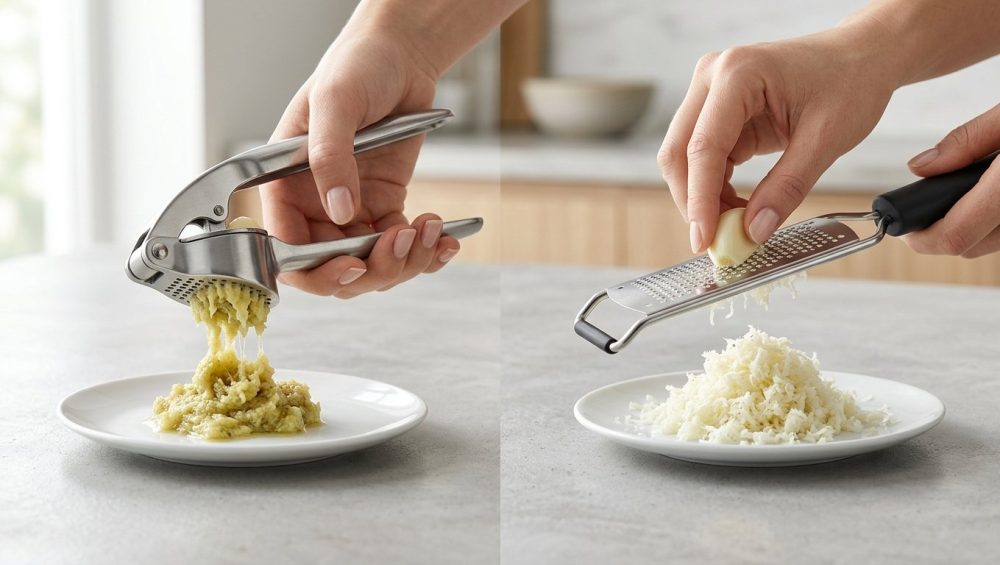
If you do not believe the chemistry, trust your own palate. I challenge you to a simple taste test in your own kitchen. Take three cloves of garlic. Slice one thinly with a knife, press one through your garlic press, and grate the third using a micro-grater. Let them sit for five minutes to allow the allicin to fully develop, and then smell and taste a tiny fraction of each.
The Flavor Profiles
The sliced garlic will smell pleasantly aromatic and taste surprisingly sweet, with a gentle, warming bite. The grated garlic will have a strong, robust, and evenly distributed pungency—perfect for dissolving into salad dressings or marinades. But the pressed garlic? It will smell aggressive, almost metallic, and tasting it will likely make your tongue recoil. It is astringent, harsh, and overwhelmingly bitter.
How Your Dish is Secretly Suffering
When you use a garlic press for a delicate recipe like a classic Spaghetti Aglio e Olio or a light vinaigrette, that overwhelming bitterness permeates the entire dish. You might think you just bought a bad batch of garlic, or that you accidentally over-salted the pasta, but the culprit is the tool. By simply changing the mechanical way you process your ingredients, you can instantly upgrade the flavor of your food. Avoiding these tool-based errors is one of the easiest ways to fix common beginner cooking mistakes and start producing restaurant-quality meals.
The Nightmare of Cleaning a Traditional Garlic Press
Let us step away from the chemistry for a moment and talk about practicality. As a busy professional, I live by the mantra that time is money. Weekday cooking needs to be efficient, streamlined, and stress-free. The absolute last thing I want to do after enjoying a lovely home-cooked meal is stand over the sink for ten minutes, aggressively wielding a toothpick to dig out the fibrous, gluey garlic skins permanently wedged into the tiny holes of a metal press.
Wasting Time and Ingredients
A garlic press is notoriously difficult to clean. The plunger forces the fibrous membrane of the clove to the bottom, matting it into a dense, sticky puck that blocks the extrusion holes. If you do not clean it immediately—if you dare to leave it on the counter while you eat dinner—that garlic residue dries into a cement-like substance that is virtually impossible to scrub out.
And do not even think about relying on your dishwasher to save you. If you put a cheap aluminum garlic press into a dishwasher, the high heat and highly alkaline detergent will cause a chemical reaction that oxidizes the aluminum, covering it in a dark, powdery black residue that rubs off on your hands and food. If it is made of low-grade stainless steel, the prolonged steam exposure and trapped moisture in the hinge crevices will rapidly accelerate chloride-induced pitting and rust. It is the same frustrating degradation process that leads to silicone tools tasting like soap when washed improperly. You end up with a ruined tool, wasted ingredients left inside the hopper, and a massive loss of your precious time.
The Ultimate Upgrade: Enter the Photo-Etched Micro-Grater
So, if the garlic press is a flavor-destroying, toxic, hard-to-clean nightmare, what is the solution? How do we achieve the convenience of a quick garlic paste without the bitter allicin overload and the tedious cleanup?
Enter the greatest tool in the modern home cook’s arsenal: the photo-etched micro-grater, most famously produced by the brand Microplane. This is not just a replacement; it is a monumental upgrade.
What is Photo-Etching?
To appreciate why a micro-grater is superior, you have to understand how it is made. Traditional cheap box graters are manufactured using a stamping process. A machine punches holes into a sheet of metal, creating blunt, recessed, double-sided teeth. When you drag food across a stamped grater, those blunt holes compress, tear, and shred the food, creating friction and mush.
High-quality micro-graters, on the other hand, utilize a signature chemical process called photo-etching. The manufacturer applies a photosensitive resist film to a sheet of high-grade surgical stainless steel, projecting the exact microscopic shape of the teeth onto the film. The sheet is then sprayed with a ferric chloride solution, which chemically dissolves the unprotected metal. This precise chemical etching creates ultra-sharp, single-sided cutting edges that behave exactly like hundreds of microscopic chef’s knives.
Why Slicing Beats Crushing Every Time
Because the teeth on a photo-etched micro-grater are razor-sharp, they do not crush or bludgeon the garlic. They cleanly slice it. When you glide a garlic clove across a micro-grater, those tiny blades shave off microscopic ribbons of garlic. This slicing action drastically reduces the amount of cellular trauma compared to a blunt press. You still release enough allicin to get a robust, beautiful garlic flavor, but you avoid the catastrophic cellular destruction that leads to extreme bitterness.
The result is a fluffy, snow-like garlic paste that melts seamlessly into hot oil, salad dressings, and marinades, providing a perfectly balanced, sweet, and pungent flavor profile. Plus, because the tool is made of high-quality, solid stainless steel, there is zero risk of toxic mystery metals flaking into your dinner. It is a mandatory addition to your essential beginner kitchen tools.
How to Use a Micro-Grater Like a Professional
Using a micro-grater is incredibly simple, but there is a slight learning curve to ensure you get the best results (and keep your fingertips intact).
The Technique for Perfect Garlic Paste
Hold the micro-grater securely by its handle, resting the rubberized tip on your cutting board at a 45-degree angle. Take a peeled clove of garlic and, using light downward pressure, glide it down the track of the blades. Do not force it or press too hard; let the razor-sharp teeth do the work. As you get closer to the root of the clove, slow down to protect your knuckles. Once you have grated the clove, simply tap the metal frame of the grater against the edge of your cutting board, and the fluffy garlic paste will fall right off.
Cleanup is an absolute breeze. Because the etched teeth are single-sided and open, food does not get trapped. You simply run the grater under warm water in the opposite direction of the blades, give it a quick swipe with a sponge, and it is perfectly clean in under ten seconds.
Beyond Garlic: The Ultimate Multi-Tasker
The true beauty of the micro-grater, and the reason I champion it so fiercely, is that it is the ultimate multi-tasker. I despise unitaskers that clutter up drawer space. The micro-grater earns its keep ten times over.
Need to zest a lemon for a bright pasta dish? The micro-grater flawlessly shaves off the aromatic, oil-rich zest while leaving the bitter white pith behind. Need a garnish for pasta? It shreds hard cheeses like Parmigiano-Reggiano into ethereal, melting clouds without clogging. It effortlessly handles tough, fibrous ginger root, turning it into a smooth puree. It grates whole nutmeg, cinnamon sticks, and dark chocolate. It is one of those foolproof daily cooking secrets that professional chefs rely on constantly, and it is entirely accessible to the weekend culinary hobbyist.
Other Acceptable Garlic Prep Methods (If You’re Feeling Ambitious)
While the micro-grater is my absolute go-to for efficient, high-quality weekday cooking, there are other perfectly acceptable ways to process garlic if you have a bit more time on your hands during a weekend cooking project.
The Classic Chef’s Knife Mince and Smash
If you want to practice your knife skills, the classic chef’s knife technique is fantastic. Start by crushing the garlic clove gently under the flat blade of your knife to remove the skin. Then, finely mince the garlic. To turn it into a paste, sprinkle a generous pinch of coarse kosher salt over the minced garlic. The salt acts as a natural abrasive. Using the flat side of your knife blade, repeatedly scrape and press the garlic and salt mixture against the cutting board. Within a minute, the garlic will break down into a beautiful, sticky paste. Because you are using a sharp blade and controlled pressure, you avoid the bitter allicin overload of a mechanical press. This is a great way to decode pretentious recipe jargon when a cookbook asks for “garlic processed to a paste.”
The Mortar and Pestle Approach
For dishes where garlic is the absolute star—like a traditional basil pesto, a Spanish romesco, or a classic French aioli—the mortar and pestle is king. Yes, it involves crushing, but it is a slow, grinding, shearing action rather than a violent, localized high-heat extrusion. The heavy stone or marble pestle breaks down the cell walls gradually, releasing the oils and allicin in a controlled manner that results in a deeply aromatic, intensely flavorful paste. It requires elbow grease, but the results are undeniably spectacular.
Just like relying on unreliable kitchen meat thermometers can ruin a beautiful roast, relying on a cheap garlic press can ruin a beautiful sauce. Take the time to use the right tool for the job.
The Final Verdict: Ditch the Press, Elevate Your Cooking
Cooking at home should be a joyful, rewarding experience, not a frustrating battle against poorly designed gadgets that sabotage your ingredients. The traditional garlic press is a relic of a bygone era of kitchen marketing. It is a unitasker that damages the delicate cellular chemistry of garlic, floods your food with bitter, harsh allicin, introduces the risk of toxic flaking metals, and steals your precious time during cleanup.
You do not need a culinary degree to make mind-blowing food. You just need to respect your ingredients and use tools that work with them, not against them. By swapping out that clunky press for a high-quality, photo-etched micro-grater, you are instantly upgrading the flavor profile of every savory dish you cook. You will get sweeter, more balanced garlic flavor, effortless zesting and grating capabilities, and a cleanup routine that takes seconds instead of minutes.
Do yourself a favor: open that utensil drawer, take out the garlic press, and throw it away. Replace it with a tool that actually deserves a spot in your permanently organized kitchen setup. Your tastebuds, your sanity, and your weeknight dinner guests will thank you. Now go pour yourself that glass of wine, grab a fresh bulb of garlic, and start grating. You’ve got this.