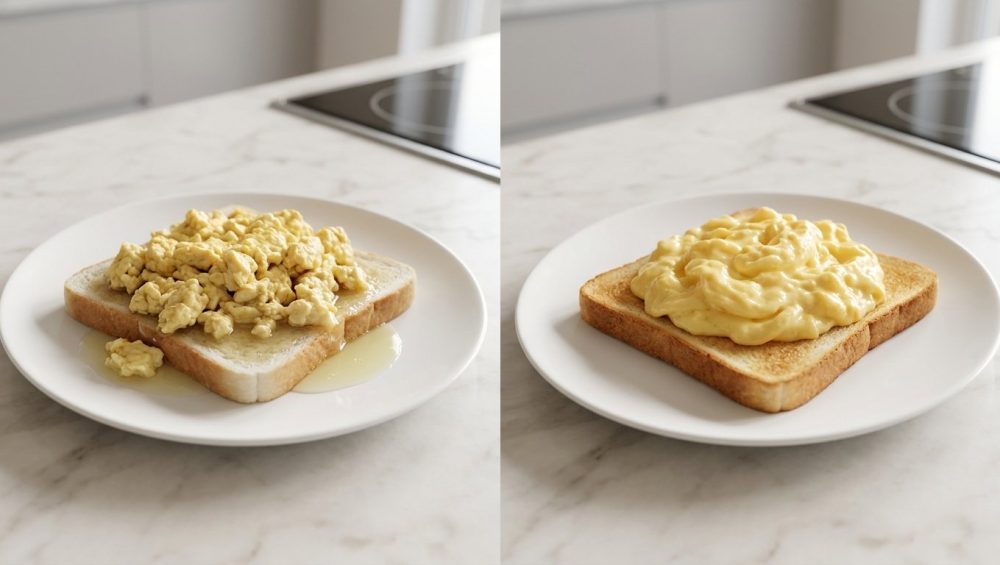
Let me paint a highly specific, universally tragic picture for you. It is a beautiful Sunday morning. You have finally decided to treat yourself to a proper, sit-down breakfast instead of inhaling a granola bar over the kitchen sink. You whisk up a few eggs, toss them into a hot skillet, push them around until they look sufficiently cooked, and slide them onto a plate next to a perfectly toasted, artisanal slice of sourdough bread. You turn your back for thirty seconds to pour a cup of coffee. When you return, a disaster has occurred. A translucent, yellowish puddle of lukewarm water has mysteriously crept across your plate, transforming the bottom of your pristine sourdough toast into a soggy, unappetizing sponge. Your eggs, meanwhile, have taken on the texture of a cheap foam mattress.
You have just fallen victim to the “weeping egg.”
It is disgusting. It is incredibly frustrating. And worst of all, it makes you feel like you lack the basic culinary competence to execute the simplest dish in the world. But as your resident snarky sous-chef, I am here to tell you that you are not a bad cook. You are simply fighting a losing battle against molecular biology and thermodynamics. Fixing frequent novice culinary errors like this does not require a degree from Le Cordon Bleu; it requires a basic understanding of what is actually happening in your frying pan.
Today, we are going to leave absolutely no stone unturned. We are diving deep into the science of egg proteins, the precise temperature thresholds of coagulation, and the undeniable physics of your kitchenware. By the time you finish reading this masterclass, you will possess the knowledge to permanently banish weeping, rubbery eggs from your kitchen and achieve perfectly creamy, custard-like results every single time.
The Scene of the Crime: What Is “Weeping” (Syneresis)?
In the culinary world, we do not just call it “weeping.” We use the scientific term: syneresis. Syneresis is the process by which a gel or a coagulated protein matrix contracts, tightly binding its internal structures together and violently expelling the liquid that was previously trapped inside of it.
To understand why this happens to your breakfast, you have to understand the microscopic architecture of an egg. When an egg is raw, its proteins are tightly folded up like microscopic balls of yarn, floating peacefully in a vast ocean of water. When you introduce heat, these proteins begin to denature. The balls of yarn unfurl into long, stringy strands. As the heat continues to rise, these unfurled strands begin to bump into one another and bond, creating a three-dimensional, interconnected mesh. This is called coagulation.
Think of this newly formed protein mesh as a kitchen sponge. When the sponge is relaxed and open, it can hold a massive amount of water. This is what gives perfectly cooked scrambled eggs their soft, fluffy, and moist mouthfeel. The water is suspended within the gentle embrace of the protein matrix.
However, proteins are highly sensitive to temperature. If you continue to apply heat, those protein strands will bond tighter, and tighter, and tighter. The mesh shrinks. The “sponge” is aggressively squeezed. And because water cannot be compressed, it has nowhere to go but out. It is forcibly expelled from the protein matrix, leaking out of the curds and pooling onto your plate. The proteins that remain behind are now densely packed and cross-linked, which is exactly why overcooked eggs feel rubbery, dry, and squeaky against your teeth. You have essentially wrung out the sponge.
The Anatomy of an Egg: A Moisture Bomb Waiting to Explode
To truly grasp the sheer volume of water we are dealing with, we need to look at the precise anatomical composition of the egg. We eat a staggering amount of these things, so we should probably know what is inside them. According to the USDA’s 2026 projections, the average American will consume roughly 273.7 eggs per capita this year. If you think that is a lot, look at the Netherlands, where the average person consumes over 33 kilograms of eggs annually—which translates to well over 500 eggs per person.
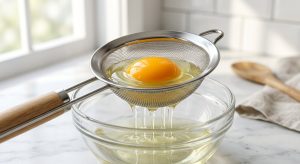
Despite their solid appearance when cooked, eggs are essentially little water balloons. The egg white (albumen) makes up about 60% of the egg’s total weight, and it is composed of roughly 88% to 90% water. The remaining 10% is almost entirely protein. There is virtually zero fat in an egg white.
The yolk, on the other hand, is the nutritional powerhouse. It is denser, but it still contains about 52% water. The rest of the yolk is a complex emulsion of proteins, lipids (fats), and cholesterol.
Because the egg white is essentially a highly concentrated water-delivery system, it is incredibly vulnerable to syneresis. The white contains roughly 40 different proteins, but the two heavy hitters are ovalbumin (which makes up about 54% of the egg white protein) and ovotransferrin (which makes up about 12%). These proteins dictate the rules of engagement. Ovotransferrin is the delicate one; it begins to denature and set at a mere 140°F (60°C). Ovalbumin, the dominant structural protein, requires a bit more heat, beginning to coagulate around 145°F (63°C) and fully setting as the temperature climbs.
The moment you crack an egg into a bowl and whisk the whites and yolks together, you are creating a highly volatile, moisture-rich suspension. You have perfectly integrated the fat of the yolk with the massive water reserves of the white. If you treat this mixture with respect, the fat will lubricate the protein strands, and the water will remain trapped, yielding a creamy delight. If you abuse it with high heat, the water bomb detonates, and your breakfast is ruined.
The Usual Suspects: What Triggers the Big Squeeze?
Now that we know the egg is primed to leak if mishandled, we need to identify the specific kitchen crimes that cause the protein matrix to collapse. There are four primary culprits behind syneresis, and I guarantee you are committing at least two of them.
High Heat: The Absolute Worst Offender
Time is money, and I know you want your breakfast ready in three minutes so you can get to work. But blasting your skillet on medium-high heat is the fastest way to ruin your meal.
As we established, the delicate ovotransferrin proteins in your eggs begin to set at 140°F (60°C). The yolk proteins thicken around 149°F to 158°F (65°C to 70°C). At 165°F (73°C), the entire egg is firmly set. If the internal temperature of your scrambled eggs exceeds 170°F, the proteins cross-link irreversibly, and syneresis is guaranteed.
Now, consider your frying pan. A standard skillet placed over medium-high heat can easily reach surface temperatures of 350°F to 400°F within minutes. When you pour liquid eggs into a 400°F pan, the proteins that make contact with the metal experience massive thermal shock. They instantly denature, violently contract, and squeeze out their water before the top layer of the egg has even begun to warm up. You are left with a tough, browned, leathery skin on the bottom and a watery, separated mess on top.
The Overcooking Epidemic and Carryover Cooking
Let’s say you actually listen to me and turn your burner down to medium-low. You stand there, gently stirring your eggs until they look perfectly dry, fluffy, and fully cooked in the pan. You turn off the heat, plate them, and sit down. Five minutes later: a puddle. Why?
You forgot about the unforgiving laws of thermodynamics, specifically carryover cooking.
When you remove food from a heat source, it does not instantly stop cooking. The residual heat trapped within the food itself, combined with the heat of the pan (if you leave the eggs in it for even a few seconds too long), continues to drive the internal temperature upward. If you wait to pull your eggs until they look 100% finished in the pan, carryover cooking will push their internal temperature well past the 165°F threshold once they are on your plate. The proteins will continue to tighten as you carry your plate to the table, and the weeping will commence.
The Great Pre-Salting Debate
If you grew up watching old-school culinary television, you were likely told to never, ever salt your eggs before cooking them. The conventional wisdom claimed that seasoning your food prematurely would draw out moisture and make the eggs impossibly tough.
Science has definitively proven this to be a myth. In fact, the exact opposite is true.
Food science legends like Harold McGee and J. Kenji López-Alt have extensively tested the effects of sodium on egg proteins. Their findings are a triumph for the home cook. When you whisk salt into raw eggs and let them sit for about 15 minutes, the salt dissolves into sodium and chloride ions. These ions cluster around the electrically charged regions of the egg proteins.
Normally, when proteins denature from heat, they seek each other out and bond tightly. But the presence of these salt ions acts as a chemical buffer. They essentially get in the way, preventing the proteins from binding too closely together. Because the proteins cannot form a hyper-tight, restrictive mesh, they cannot squeeze out their water. Pre-salting your eggs actually lowers the temperature at which they coagulate, but results in a significantly more tender, moisture-retaining curd.
The Dairy Dilemma: Milk, Cream, or Nothing?
Many home cooks splash a tablespoon of milk into their raw eggs, assuming the added liquid will make the scramble fluffier. This is a structural mistake.
Remember that egg whites are already 90% water. When you add standard cow’s milk (which is about 87% water itself), you are introducing a massive amount of excess liquid into a protein matrix that is already struggling to hold onto its native moisture. Furthermore, milk contains casein proteins, which compete with the natural lecithin in the egg yolks, weakening the overall emulsion. When the eggs inevitably overcook, all that extra milk-water immediately separates and floods your plate.
If you insist on adding dairy for richness, you must use heavy cream. Heavy cream is primarily butterfat, not water. The fat coats the protein strands, physically inhibiting them from cross-linking too tightly, which buys you a wider margin of error against syneresis. But honestly? A properly cooked egg needs absolutely no dairy at all.
The Hardware Check: Ditch the Toxic Pans
Before we get to the masterclass technique, we need to have a serious conversation about your equipment. I have zero patience for cheap, peeling, toxic kitchenware. If you are cooking your eggs in a scratched, five-year-old bargain-bin non-stick pan that you bought at a supermarket, you are actively sabotaging your food and potentially your health.
Traditional non-stick pans are coated with polytetrafluoroethylene (PTFE), commonly known by the brand name Teflon. While manufacturers will swear up and down that modern PTFE is safe, the science tells a highly conditional story. PTFE is stable at low temperatures, but it begins to degrade and break down when the pan reaches temperatures above 500°F (260°C).
When PTFE degrades, it releases highly toxic fumes into the air. Inhaling these fumes can cause a condition literally known as “polymer fume fever” or the “Teflon flu,” characterized by chills, headaches, and chest tightness. Furthermore, the historical manufacturing of PTFE relied heavily on PFOA (perfluorooctanoic acid), a dangerous “forever chemical” linked to kidney disease, thyroid disorders, and various cancers. While PFOA was phased out of cookware manufacturing around 2013, the alternative PFAS chemicals used today still raise significant environmental and health concerns.
The moment your cheap non-stick pan gets a scratch, or the moment you absentmindedly leave it empty on a high burner, you are compromising your kitchen. I strongly advocate for purging dangerous cooking equipment and investing in cookware that will last a lifetime without poisoning your breakfast.
If you want a naturally non-stick surface, you need to understand the heat retention of carbon steel. A properly seasoned carbon steel skillet develops a polymerized layer of oil that is just as slick as Teflon, but can withstand searing restaurant temperatures without off-gassing chemicals. Alternatively, if you prefer modern convenience, high-quality ceramic-coated pans are a fantastic, PTFE-free option, though you must treat them gently to avoid degraded ceramic cooking surfaces over time.
Even a standard stainless steel skillet can cook flawless eggs if you master temperature control. By preheating the pan correctly and stopping food from adhering via the Leidenfrost effect (where a microscopic layer of steam creates a barrier between the food and the metal), you can achieve perfect release without a drop of synthetic chemicals.
The Sassy Sous-Chef’s Masterclass Technique: Flawless, Leak-Proof Eggs
We have covered the biology, the thermodynamics, and the hardware. Now, it is time to cook. This is my definitive, science-backed method for producing rich, creamy, tightly emulsified scrambled eggs that will never, ever leak a drop of water. Mastering this process is a massive step toward overcoming daily meal prep stress.
Step 1: The 15-Minute Salt Window
Crack your eggs into a mixing bowl. Immediately add your salt (a generous pinch of kosher salt per two eggs). Whisk the eggs vigorously until the yolks and whites are completely homogenized and the mixture is a uniform, pale yellow. You do not want distinct streaks of egg white remaining, as those isolated pockets of albumen will coagulate faster than the yolks and create weeping hot-spots.
Once whisked, let the bowl sit on the counter for exactly 15 minutes. Use this time to brew your coffee or toast your bread. This resting period allows the salt ions to dissolve and adequately buffer the protein matrix, ensuring a tender curd.
Step 2: Temperature Control (The Room Temp Rule)
That 15-minute rest serves a secondary, equally crucial purpose: it takes the chill off the eggs. Throwing 38°F (3°C) eggs straight from the refrigerator into a warm pan causes immediate thermal shock. The massive temperature differential forces the pan to rapidly drop in heat, leading to uneven cooking and patchy coagulation. Allowing your eggs to approach room temperature ensures a smooth, predictable thermal transfer.
Step 3: The Fat Buffer
Place your clean, safe skillet (carbon steel or ceramic) over medium-low heat. Do not rush this. Let the pan warm up gently. Add about one tablespoon of high-quality European butter or clarified butter (ghee).
I prefer clarified butter for this specific task because the milk solids have been removed. Regular butter contains water and milk solids that can brown and sputter. Clarified butter is pure, anhydrous butterfat. It coats the pan perfectly, acting as a thermal buffer that gently transfers heat to the eggs without scorching them. Wait until the butter is fully melted and slightly shimmering, but absolutely not browning.
Step 4: The Agitation
Pour the room-temperature, pre-salted eggs into the center of the pan. Do not walk away. Do not look at your phone.
Using a flexible silicone spatula (never a wooden spoon, which is too blunt, and never metal, which will destroy your pan), immediately begin stirring the eggs. Use slow, deliberate, sweeping figure-eight motions. You want to constantly scrape the bottom and the sides of the pan, moving the cooked curds into the center and allowing the liquid egg to flow back onto the hot surface.
This constant mechanical agitation is vital. By keeping the eggs moving, you are preventing the proteins from forming massive, tight, interconnected sheets. Instead, you are forcing them to coagulate into thousands of tiny, soft, independent curds. Smaller curds mean a looser overall network, which means the water remains safely trapped inside the matrix.
Step 5: The 158°F Pull
This is the most critical moment in the entire process. You must account for carryover cooking.
Do not wait until the eggs look like the dry, hard scrambles you get at a cheap diner. You need to pull the pan entirely off the heat source while the eggs still look slightly wet, glossy, and loosely set. If you were to hit them with an infrared thermometer, the thickest part of the curds should register right around 158°F to 159°F.
The moment they reach this glossy, soft-scrambled stage, immediately transfer them out of the hot pan and onto your plate. The residual heat within the eggs will carry their internal temperature up to a perfect 160°F to 165°F as they sit on the plate. The wetness will gently evaporate and set, leaving you with a phenomenally creamy, rich, and structurally sound scramble. Not a single drop of water will leak.
Advanced Troubleshooting: Mix-Ins and Holding for a Crowd
Even if you perfect the technique above, you can still introduce syneresis through external factors. Let’s troubleshoot the two most common advanced pitfalls.
The Watery Vegetable Crisis
I highly encourage eating vegetables with your breakfast, but throwing raw mushrooms, spinach, and diced tomatoes directly into your raw egg mixture is a culinary death sentence.
Vegetables are practically made of water. When they hit the heat, their cellular walls rupture, instantly flooding your pan with liquid. If your eggs are in the pan at the same time, they will boil in the vegetable juice, overcook, and weep simultaneously.
If you want a veggie scramble, you must respect the ingredients. Sauté your vegetables completely first. Cook the water out of them until they are tender and slightly caramelized. If you have a habit of rescuing wilted produce from the back of your crisper drawer, make sure you cook off all that excess moisture. Only after the vegetables are fully cooked and the pan is dry should you lower the heat, add a touch more butter, and pour in your pre-salted eggs.
Holding Eggs for a Buffet
Cooking for a crowd is a nightmare when it comes to scrambled eggs. If you are entertaining guests without stress, you likely want to make a massive batch of eggs and leave them in a warming chafing dish.
The problem is that chafing dishes apply continuous heat. If you put perfectly cooked eggs into a hot chafing dish, they will continue to cook, cross-link, and eventually weep all over the buffet line.
To prevent this, you must drastically alter the emulsion. When cooking eggs specifically for hot-holding, you actually should incorporate a heavy fat. Whisking a tablespoon of heavy cream or even a spoonful of crème fraîche into the eggs right at the end of the cooking process coats the denatured proteins in a thick layer of milk fat. This fat barrier physically prevents the proteins from tightening further, even when exposed to the prolonged, low heat of a warming tray. They will remain soft, luxurious, and leak-free for the duration of your brunch.
Conclusion
The “weeping egg” is not a curse, and it is not a reflection of your worth as a home cook. It is simply a chemical reaction—a predictable response from a delicate protein matrix that has been subjected to too much heat, too much time, or the wrong kind of seasoning.
By taking a step back, ditching your toxic, overheated pans, pre-salting your eggs to buffer the proteins, and managing your heat to account for carryover cooking, you can completely eliminate syneresis from your culinary repertoire. You do not need a professional kitchen to make professional food. You just need to respect the science of the ingredients in front of you.
Take these principles to heart. Apply them this weekend. I promise that mastering the humble scrambled egg is the foundational first step toward building your fundamental skillset as a confident, capable, and entirely snark-approved home cook. Now go make some breakfast, and keep that plate dry.