Listen up, weekend culinary hobbyists. We need to have a serious conversation about the snacks you are serving your guests. We have all been there: you invite friends over for a movie night, you hype up your homemade snack bar, and then you confidently serve them a bowl of something that squeaks against their teeth like packing peanuts. Chewy, leathery popcorn is a culinary tragedy, and frankly, it is entirely preventable.
I get it. You are busy, and throwing a pre-packaged bag of mystery chemicals into the microwave seems like the easiest route. But if you want to elevate a budget-friendly pantry staple into a mind-blowing, interactive centerpiece for your next get-together, you have to ditch the shortcuts. You do not need a culinary degree to make popcorn that shatters with a satisfying, delicate crunch. You just need to stop actively sabotaging yourself with terrible cookware and basic thermodynamic errors.
The difference between a sad, squeaky kernel and a flawless, airy crunch comes down to mastering steam release, respecting starch gelatinization, and throwing your peeling Teflon pan into the trash where it belongs. Let’s break down the science of the perfect pop.
The Biology and Thermodynamics of the Pop
To understand why your popcorn tastes like a damp sponge, we have to look at the anatomy of Zea mays everta—the only type of maize that possesses the structural integrity required to actually pop. A popcorn kernel is a marvel of natural engineering, consisting of three main parts: the germ (the living embryo of the plant), the endosperm (a dense matrix of hard starch granules that serves as food for the germ), and the pericarp (the incredibly tough, moisture-resistant outer hull).
The absolute secret to the pop lies in the moisture trapped inside that starchy endosperm. According to agricultural science, the ideal internal moisture content for a popcorn kernel is between 13.5% and 14.5%. If the moisture drops below 13%—which happens when you leave a bag half-open in your pantry for six months—there simply is not enough water to create the requisite steam pressure. The kernel will just sit in the hot oil and burn, becoming one of those tooth-shattering “old maids”. Conversely, if the moisture is too high, say 16% or above, the expansion ratio plummets, and the resulting popcorn is dense, small, and inherently chewy right out of the gate.
The Pressure Cooker Effect
Assuming your kernels are perfectly hydrated, let’s track the thermodynamic journey. As you apply heat to the pan, the moisture inside the endosperm begins to warm up. At 212°F (100°C), that internal water converts into steam. Because the pericarp is remarkably strong and non-porous, the steam cannot escape. The kernel effectively becomes a microscopic, high-stress pressure cooker.
As the temperature climbs toward the critical threshold of 347°F to 356°F (175°C to 180°C), the internal pressure reaches an astonishing 135 pounds per square inch (PSI). Under this immense heat and pressure, the hard starch granules in the endosperm literally melt into a highly pressurized, molten gel.
Then, critical failure occurs. The pericarp can no longer hold back the force. It ruptures. In a fraction of a second, the sudden, violent drop in pressure causes that superheated, gelatinized starch to flash-boil and expand up to 38 times its original volume. As this explosive starch foam meets the cooler air outside the hull, it solidifies almost instantly, creating the light, airy, crunchy matrix we know and love.
The Chemistry of the Crunch
Why does it get chewy? When those kernels explode, they release a massive cloud of steam. If you are popping corn in a standard saucepan and covering it with a tight-fitting, heavy glass lid, you are creating an impenetrable moisture dome. The steam hits the cold lid, condenses, and rains right back down onto your freshly popped corn. Covering your pot with a tight-fitting lid is one of those classic rookie kitchen mistakes that ruins the texture before you even take the pot off the stove.
Because the newly expanded starch matrix is incredibly porous, it acts like a high-capacity desiccant. It eagerly sucks that trapped moisture right out of the humid air. Within seconds, the delicate, crystalline crunch collapses into a soggy, leathery sponge. You have essentially steamed your popcorn instead of frying it. The fix is remarkably simple: you must let the steam escape.
The “No-Go” Rule: Banishing Toxic Cookware from Your Snack Routine
Before we talk about the right vessel for the job, we need to have a serious intervention about the wrong ones. I have a strict “No-Go” rule in my kitchen, and I am enforcing it in yours right now. There is absolutely no excuse for holding onto toxic kitchen gear in 2026.
If you are currently reaching for a lightweight, scratched, non-stick Teflon pot to make your popcorn, put it down and step away from the stove. To achieve the explosive starch gelatinization we just discussed, your cooking oil needs to reach temperatures between 400°F and 460°F. Do you know what happens to standard polytetrafluoroethylene (PTFE) non-stick coatings at those temperatures? They undergo severe thermal degradation.
The chemical bonds holding that slick surface together begin to break down, releasing per- and polyfluoroalkyl substances (PFAS)—infamous “forever chemicals”—directly into your food and the ambient air. Recent 2025 and 2026 environmental health studies have exhaustively documented the dangers of these heated fluoropolymers. Exposure to PFAS is linked to a horrifying array of systemic health issues, including liver disease, abnormal thyroid function, elevated cholesterol, and reduced fertility. Furthermore, overheating these pans produces toxic fumes that are famously lethal to pet birds and cause polymer fume fever (often called “Teflon flu”) in humans.
If you notice your cheap non-stick pans keep losing their slip, it is not because you washed them wrong; it is because the coating is literally vaporizing and micro-flaking into your meals under high heat. Throw them away. Even if you bought into the greenwashing and your lost its non-stick ceramic pan is supposedly “chemical-free,” it is still the wrong tool for the job. Ceramic is a thermal insulator, meaning it heats unevenly and responds sluggishly to temperature changes—a death sentence for perfect popcorn.
The Ultimate Popping Vessel: The Unlined Carbon Steel Wok
So, if non-stick is out and heavy stainless steel pots trap too much steam, what is the everyday cook supposed to use? The undisputed champion of stovetop popping is the carbon steel wok.
You might think a wok is only for weeknight stir-fries, but its geometry and metallurgical properties make it the ultimate popcorn machine. Carbon steel boasts exceptional thermal conductivity. It heats up incredibly fast and, more importantly, it cools down the second you take it off the heat. This responsiveness gives you absolute control over the popping environment.
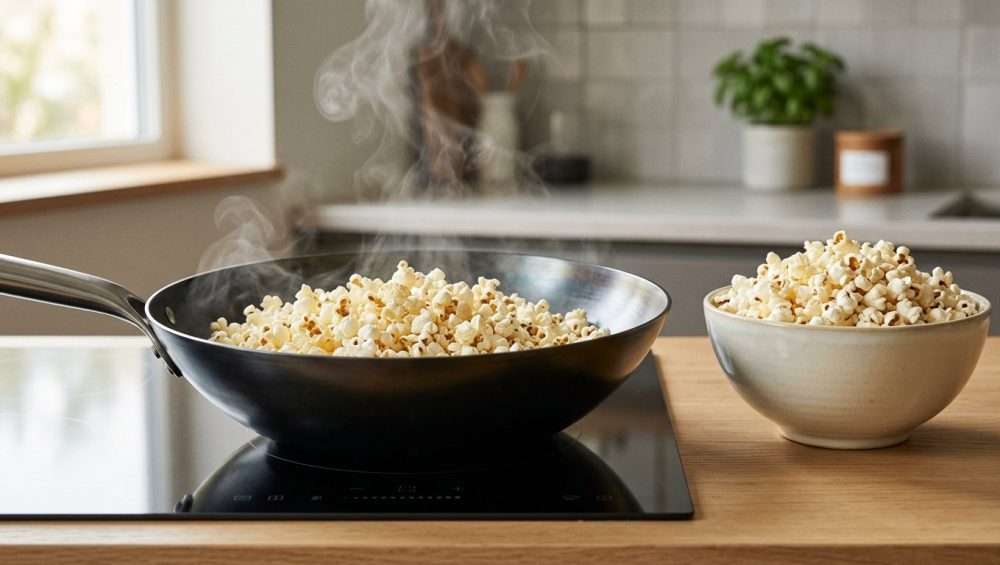
The real magic, however, lies in the wok’s shape. A wok features a small, intensely hot concave bottom that gently slopes up into wide, cooler sides. When you add your kernels and oil to the bottom, they sit directly in the primary heat zone. As the kernels pop, they expand massively in volume and drop in density. The physical agitation of the popping process naturally forces the dense, unpopped kernels down into the hot oil, while the light, fluffy, popped corn is pushed up the sloping sides of the wok, safely away from the scorching heat source. This kinematic sorting mechanism practically eliminates the risk of burning your snack.
Furthermore, the wide, expansive mouth of the wok provides a massive surface area for steam evaporation. To keep the oil from splattering your backsplash while still allowing 100% of the steam to escape, simply place a cheap stainless steel splatter screen over the top. If you do not own a splatter screen, you can use a lightweight aluminum lid, but you MUST keep it significantly skewed or ajar to create a generous venting gap. Remember: trapped steam equals chewy popcorn. Let it breathe.
The Lipid Equation: Smoke Points and Heat Transfer
You cannot pop corn with hot air alone if you want flavor and crunch; you need a highly conductive cooking medium. Oil acts as the thermal bridge between the hot carbon steel and the tough pericarp of the kernel, ensuring rapid, even heat transfer. But not all fats are created equal.
As we established, the optimal popping temperature requires the oil to sit comfortably in the 400°F to 460°F range. This immediately disqualifies several beloved fats. If you try to pop corn in whole butter, the milk solids will aggressively burn and turn bitter at 302°F. If you use extra virgin olive oil, it will begin to smoke, degrade, and release acrid free radicals around 320°F to 375°F.
You need high-performance, high-heat lipids. While we usually talk about high heat in the context of accelerating the Maillard reaction for a perfect pan-seared steak, here, the heat is purely mechanical—it is about building steam pressure fast without oxidizing the fat.
The Science of Smoke Points
A smoke point is the temperature at which volatile compounds in the fat begin to break down and burn, producing visible smoke and releasing acrolein—a bitter, noxious chemical that will absolutely ruin the flavor of your popcorn. To avoid this, your best options are:
- Avocado Oil (Smoke Point: 510°F): The undisputed king of high-heat cooking. It is neutral in flavor, packed with monounsaturated fats, and can withstand the intense heat of a wok without breaking a sweat.
- Refined Safflower or Sunflower Oil (Smoke Point: 460°F): Excellent, neutral-tasting workhorses that allow the natural corn flavor to shine.
- Peanut Oil (Smoke Point: 450°F): Adds a very subtle, pleasant nuttiness that pairs beautifully with savory toppings.
- Ghee or Clarified Butter (Smoke Point: 450°F+): Because the burn-prone milk solids have been removed, ghee gives you that authentic, rich movie-theater butter flavor without the risk of a smoke alarm.
- Refined Coconut Oil (Smoke Point: 400°F): Notice the word refined. Unrefined (virgin) coconut oil smokes at 350°F, which is too low for our needs. Refined coconut oil, however, safely hits 400°F and is the industry standard for achieving that slightly sweet, traditional theater crunch.
Do not drown your kernels. For a standard 1/2 cup of popcorn kernels, you need exactly 3 tablespoons of oil. This is enough to coat the kernels and facilitate heat transfer, but not so much that you end up deep-frying the popped starch into a greasy, heavy mess.
The Sassy Sous-Chef’s Masterclass Stovetop Method
Alright, you have your carbon steel wok, your high-smoke-point oil, and your perfectly hydrated kernels. It is time to execute. We are not going to stand around babysitting a pot for twenty minutes. We are going to use precision timing and rapid agitation to get this done flawlessly in under three minutes.
Step 1: The Three-Kernel Calibration
Do not dump all your kernels into cold oil. Cold-starting causes the kernels to absorb oil as it heats up, resulting in greasy, unpopped duds. Instead, place your wok on medium heat, add your 3 tablespoons of oil, and drop in exactly three popcorn kernels. Wait and listen. When those three kernels pop in rapid succession, your oil has reached the perfect thermodynamic window of 350°F to 365°F.
Step 2: The Dump and Shake
The moment the third kernel pops, immediately dump in the rest of your 1/2 cup of kernels in a single, even layer. Do not overcrowd the pan. If you stack kernels on top of each other, the ones on top will not get enough heat, and the ones on the bottom will scorch. Shake the wok vigorously to coat every single kernel in the hot oil.
Step 3: The Kinematics of the Shake and Vent
Place your splatter screen over the wok. If using a lid, leave a generous gap. As the popping begins in earnest, keep the wok moving. Slide it back and forth over the burner. This constant agitation utilizes granular convection (the Brazil nut effect). When you shake a granular mixture, the larger items (popped corn) rise to the top, while the smaller, denser items (unpopped kernels) fall to the bottom. This forces the unpopped kernels down into the heat zone and protects the delicate popped corn from the hot steel.
Step 4: The Immediate Evacuation
Listen to the cadence of the pops. When the explosive crescendo slows down to one pop every 2 to 3 seconds, turn off the heat immediately. Do not wait for every last kernel to pop—chasing those final three old maids will guarantee you burn the rest of the batch.
I have written extensively about surviving kitchen disasters, and let me tell you, burnt popcorn is one of the smelliest, most persistent errors you can make. The acrid smoke will linger in your curtains for days. To prevent carryover cooking, immediately dump the popped corn into a massive, wide mixing bowl. Do not leave it in the hot wok, or the residual heat will scorch the bottom layer and the trapped steam will ruin the crunch.
Elevating the Humble Kernel: Building a Low-Stress Popcorn Station
Now that you have mastered the material science of the perfect crunch, let’s talk about why you went through all this effort. When planning mindful gatherings, the goal is connection—not spending four hours sweating over a hot stove while your friends mingle in the other room. You want to serve something impressive, interactive, and universally beloved.
A highly customizable, DIY popcorn station is the ultimate cheat code for hosting a relaxed dinner party without breaking your budget. It transforms a dirt-cheap pantry staple into a culinary event. But to pull it off, you need to understand the mechanics of flavor adhesion.
The Binder
Dry seasonings will not stick to dry popcorn; they will just sink to the bottom of the bowl in a sad, salty pile. You need a binder. However, if you use a water-based binder (like straight hot sauce, lime juice, or soy sauce), you will instantly melt the gelatinized starch and ruin the crunch you just worked so hard to protect.
You must use a fat-based binder. The best method is to use a continuous spray bottle filled with avocado oil or melted clarified butter. Mist the popcorn lightly while tossing it continuously. This creates a microscopic, sticky lipid layer that will grab onto your seasonings without introducing a single drop of water.
The Flavor Profiles
Set up a bar with small bowls of custom seasoning blends. Here are three foolproof profiles to get you started:
- The Umami Bomb: Combine nutritional yeast, pulverized dried porcini mushrooms, garlic powder, and a pinch of MSG. This creates a deeply savory, cheesy, earthy profile that is completely dairy-free.
- The Herbaceous Kick: Instead of dusting raw spices over the top, try blooming them in oil first. Gently heat olive oil with fresh rosemary, thyme, and red pepper flakes for five minutes. Strain the infused oil, put it in a spray bottle, mist the popcorn, and toss with flaky sea salt.
- The Sweet Heat: Whisk together finely ground maple sugar (which has less moisture than brown sugar), smoked paprika, cayenne pepper, and fine sea salt. The ultra-fine grind of the sugar ensures it adheres perfectly to the misted kernels without turning gritty.
Troubleshooting Your Snack Bar Nightmares
Even with the best tools, science can sometimes throw you a curveball. Here is how to fix the most common popcorn issues.
The “Old Maid” Crisis
If you followed my instructions perfectly but ended up with a wok full of unpopped, blackened kernels, your corn is dehydrated. Do not throw the bag away. Agricultural extension educators recommend a simple rehydration trick: place the stubborn kernels in a glass jar, add exactly one tablespoon of water, seal the lid tightly, and shake vigorously. Let the jar sit on your counter for two to three days, shaking it once a day. The pericarp will absorb the moisture, restoring the internal water content to that ideal 14% range, and they will pop beautifully.
The Scorched Earth
If the bottom of your popcorn is burnt but the top is fine, you failed to agitate the wok. The heat transfer from carbon steel is intense. If you let the kernels sit static, the hulls will carbonize against the metal. You must keep the wok moving. Shake it, slide it, shimmy it—whatever it takes to keep the contents tumbling.
The Soggy Bottom
If your popcorn is perfectly crunchy on the top of the serving bowl but chewy at the bottom, you salted it too early while it was still in the hot pot. Salt draws out moisture. If you salt popcorn while it is still steaming in the wok, it will pull residual moisture out of the starch, creating a humid microclimate at the bottom of the bowl. Always wait to mist and season your popcorn until it has been transferred to the wide, room-temperature serving bowl and has had a minute to fully vent its steam.
Listen, I get it. We are all busy, and throwing a bag of microwave popcorn into the machine is easy. But you are better than that, and your guests deserve better than that. By understanding the simple thermodynamics of steam release, respecting the critical role of starch gelatinization, and using a proper, non-toxic carbon steel wok, you can elevate a budget-friendly snack into a mind-blowing culinary experience. You do not need a culinary degree to cook like an expert. You just need to ditch the cheap Teflon, control your moisture, and let the steam escape. Now go set up that snack bar, invite some friends over, and show them what a real crunch sounds like. Class dismissed.