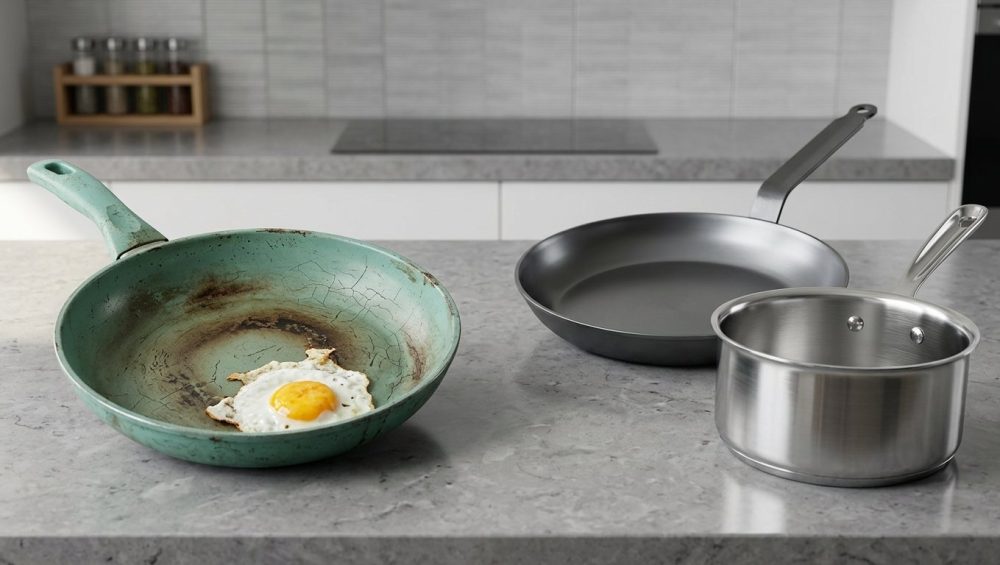
Listen up. I know exactly why you are here, reading this right now. You bought that gorgeous, aesthetically pleasing, pastel-colored “ceramic” pan about six months ago. The marketing promised you the moon and the stars: a toxin-free, eco-friendly, completely effortless cooking experience where fried eggs would magically glide off the surface like Olympic figure skaters on fresh ice. For the first few weeks, it was an absolute dream. You were tossing omelets with the casual flick of a wrist, feeling like a culinary genius.
But then, the honeymoon phase abruptly ended. Suddenly, your scrambled eggs started cementing themselves to the dead center of the skillet. Your quick weekday searing attempts resulted in torn chicken skin permanently fused to the pan. Now, you find yourself standing over the sink at 8:00 PM on a Tuesday, aggressively scrubbing a pan that was explicitly sold to you as “wipe clean,” wondering if you somehow ruined it by using the wrong spatula or washing it with water that was slightly too hot.
Let me stop you right there, pour you a virtual glass of wine, and tell you the truth: it is not your fault. You did not ruin your pan. Your cooking skills are fine. The pan was doomed by design from the very moment it rolled off the assembly line.
As a home cook who has survived countless kitchen disasters, set off the smoke detector more times than I care to admit, and has absolutely zero patience for pretentious chef-speak, I am here to deliver the harsh, scientifically validated truth about modern cookware. I have made it my personal mission to advocate for the everyday home cook, and that means banishing toxic kitchen gear and calling out the greenwashed marketing garbage that tricks weekend culinary hobbyists into buying disposable junk.
Today, we are going to dive incredibly deep into the objective, heavily researched reality of why your ceramic pan lost its non-stick capabilities in record time. We are going to break down the literal chemistry of its inevitable failure, the environmental hypocrisy of its manufacturing, and exactly what lifetime-durable, professional-grade materials you should be using instead. Grab your drink, get comfortable, and let’s thoroughly dissect the greatest cookware deception of the modern era.
The Great Pastel Pan Deception: What Is “Ceramic” Cookware, Anyway?
It Is Not Actually Ceramic
When you hear the word “ceramic,” your brain naturally conjures up images of pottery kilns, ancient clay vessels, or the heavy, indestructible enameled cast-iron Dutch ovens that your grandmother passed down to you. The modern cookware industry banks heavily on this psychological association. They desperately want you to believe that their lightweight, pastel-pink skillet is forged from the earth itself, offering a natural, holistic way to cook your food.
But here is the brutal reality check: the non-stick coating on your trendy pan is not traditional fired ceramic.
Traditional ceramics are inorganic materials, usually clay or silica-based, that are fired in kilns at extreme temperatures exceeding 2,000°F (1,093°C) until the microscopic particles fuse together into a solid, glass-like structure. The coating on your “ceramic” frying pan, however, is created using a highly synthetic chemical procedure known as the sol-gel (solution-gelation) process.
This process converts an inorganic liquid solution—primarily derived from silica (sand) and water—into a gel that is sprayed onto a metal pan core, which is almost always a cheap, thin disc of anodized aluminum. The pan is then cured in an oven at relatively low temperatures, typically between 400°F and 800°F (204°C to 426°C). The end result is a hard, glass-like silica network bonded to the metal. But here is the kicker, and the most important thing you need to understand: that hard silica network is not inherently non-stick. If you tried to fry an egg on pure, untreated silica, it would stick instantly and permanently.
The Silicone Oil Secret: How the Non-Stick Actually Works
So, if the silica matrix itself is not non-stick, what exactly makes the eggs slide around so beautifully during those first few glorious weeks of ownership? The secret lies in chemical modifiers embedded within the sol-gel matrix. During the manufacturing process, low surface energy additives—most commonly Polydimethylsiloxane (PDMS), a type of silicone oil—are infused into the coating.
This silicone oil is the true, unsung hero of your ceramic pan. It has a surface energy of about 19 to 21 Dyne/cm, which is incredibly low and very close to the 18 Dyne/cm surface energy of traditional PTFE (Teflon) coatings. However, unlike traditional PTFE, which is a solid, continuous hydrophobic plastic layer baked onto the pan, the sol-gel coating relies on a self-depleting release mechanism.
The silicone oil is not chemically bonded to the ceramic matrix; it is essentially free-floating within the microscopic pores of the coating. Every single time you heat the pan on your stove, the matrix expands slightly and releases a microscopic amount of this silicone oil to the surface, creating a slick, temporary barrier between your food and the pan.
This means your pan is literally consuming its own non-stick properties every time you use it. There is a finite, highly limited amount of silicone oil trapped in that matrix. Once it is gone, it is gone forever. This is the sneaky, underlying reason your pans keep losing their slip so rapidly. You are cooking on a ticking clock, and the countdown started the moment you took it out of the box.
The Anatomy of a Failure: Tracking the Three-to-Six-Month Death Spiral
Heat is the Enemy: The 400°F Death Sentence
If you are trying to whip up simple weeknight dinners, you are probably trying to get a good, flavorful sear on a chicken breast, a pork chop, or a steak. A proper Maillard reaction—the complex chemical process between amino acids and reducing sugars that gives browned food its distinctive, mouth-watering flavor—requires high heat, typically well over 300°F (150°C). But high heat is the absolute executioner of sol-gel ceramic coatings.
While the manufacturers proudly boast on the packaging that their pans are “oven safe up to 600°F,” they are conveniently omitting a crucial, catastrophic detail. The aluminum core and the silica matrix might survive those temperatures without physically melting into a puddle, but the free-floating silicone oil infused within the coating absolutely will not. Sustained exposure to temperatures exceeding 400°F (204°C) causes the silicone oil to rapidly migrate to the surface, evaporate, or thermally decompose.
When you preheat a ceramic pan on medium-high heat on a standard gas or induction stove, the surface temperature can easily spike past 400°F in a matter of minutes. Every single time you aggressively sear a piece of meat, you are rapidly boiling off the pan’s only defense against sticking. Within three to six months of regular, high-heat cooking, the silicone reserves are completely and utterly depleted. What you are left with is a porous, rough silica network that grips onto proteins like superglue.
In recent years, some manufacturers have attempted to prolong the inevitable death of the ceramic pan by introducing advanced grafting modifications, such as tetramethyl divinyl disiloxane (TMDS). In plain English, they are trying to chemically bond the methyl groups directly to the coating rather than letting the silicone oil float freely. While this can extend the non-stick lifespan slightly—maybe buying you an extra few months—it does not solve the fundamental vulnerability of the silica matrix to heat and abrasion. It is the equivalent of putting a premium, expensive bandage on a fatal wound.
Micro-Abrasions and the Myth of “Metal Utensil Safe”
You will often see premium ceramic pans heavily marketed as “metal utensil safe.” This is a masterclass in deceptive advertising. The sol-gel layer is incredibly rigid and brittle. It does not have the slight flexibility or give that traditional polymer coatings possess. When you scrape a metal spatula across the surface, you might not see massive flakes of coating peeling off immediately, but you are creating thousands of microscopic abrasions in the glass-like silica structure.
These micro-scratches do two highly destructive things. First, they dramatically increase the surface area of the pan, providing more microscopic nooks and crannies for food proteins to latch onto. Second, they breach the protective matrix, allowing the trapped silicone oil to escape even faster.
Even if you switch to alternative tools to protect the surface, you have to be careful. Cheap silicone tools can break down or degrade under high heat, making your food taste like soap, but high-quality wooden spatulas are your absolute best bet for any coated pan. Regardless of what you use, once the micro-abrasions form, the pan’s non-stick lifespan plummets from months to mere weeks.
The Detergent Disaster: Dishwashers and Thermal Shock
Dishwashers are the ultimate modern convenience, but they are an absolute death sentence for sol-gel coatings. Let’s talk about the specific chemistry of your dishwasher. Dishwasher detergents do not work like the gentle, sudsy liquid dish soap sitting next to your sink. They are highly alkaline, often containing aggressive sodium carbonate and various enzymes designed to aggressively dissolve baked-on organic matter.
When these harsh alkaline salts come into contact with the silica-based sol-gel coating, a chemical degradation occurs. The hot water and aggressive spray jets blast away the protective silicone oils, while the alkaline chemicals slowly etch the glass-like surface. After just a few dozen cycles, a ceramic pan that originally felt as smooth as glass will start to feel chalky and rough to the touch.
Furthermore, the combination of high-heat washing and cold-water rinsing creates massive thermal shock. While high-quality metals can withstand this if engineered correctly—which is why understanding how to handle temperature shifts is key to preventing deformation in your cookware—the rigid, brittle sol-gel layer on a cheap aluminum core cannot. The differing expansion and contraction rates between the aluminum base and the ceramic coating cause microscopic stress fractures. This is the exact same physical phenomenon that makes your cheap baking sheets keep warping in the oven, but on a microscopic scale. These fractures accelerate the depletion of the silicone oil and eventually lead to visible chipping around the edges of the pan.
The Environmental Irony of Disposable “Eco-Friendly” Cookware
The Landfill Problem
Perhaps the most infuriating aspect of the entire ceramic cookware trend is the pervasive “eco-friendly” marketing angle. Because these pans are manufactured without PFAS (per- and polyfluoroalkyl substances, often referred to as “forever chemicals”), they are aggressively branded as the ultimate green choice for the conscious consumer. But let us take a brutally honest, macroscopic look at the environmental impact of a product that is literally designed to fail.
When a ceramic pan loses its non-stick properties after three to six months, it becomes virtually unusable for its intended purpose. You cannot magically re-coat it at home. You cannot inject more silicone oil into the silica matrix. The pan is dead. So, what happens to it? It gets thrown into the trash.
We are talking about millions of heavy, anodized aluminum pans being shipped across the globe, packaged in layers of cardboard and plastic, only to end up sitting in a landfill less than a year later. The energy required to mine the bauxite for the aluminum, smelt it, manufacture the pan, apply the sol-gel coating, and transport it to your doorstep is astronomical.
If your genuine goal is to be environmentally conscious while breaking your takeout habit, buying a disposable aluminum pan twice a year is the most counterproductive thing you can possibly do. True sustainability in the kitchen does not come from a pastel-colored pan with a six-month expiration date; it comes from investing in high-utility, material-driven cookware that will outlive you. Time is money, and spending $135 every six months on a pan that is destined for the garbage is a terrible investment.
Stop Buying Trash: The Lifetime Alternatives You Actually Need
I have established that sol-gel ceramic pans are a temporary crutch that will inevitably fail you. So, what is the solution? You need to graduate to professional-grade, lifetime-durable materials. I promise you, you do not need a culinary degree to master these. You just need a basic understanding of heat and the willingness to let go of the “wipe-clean” fantasy. Here are the two undisputed champions of the home kitchen that you should be using instead.
Nitrided Carbon Steel: The Naturally Non-Stick Powerhouse
If you want the lightweight maneuverability of a typical non-stick pan combined with the indestructible, heat-retaining nature of cast iron, nitrided carbon steel is your holy grail. Carbon steel is an alloy composed of roughly 99% iron and 1% carbon. It has been the workhorse of professional French kitchens and high-heat Asian wok cooking for centuries because of its exceptional thermal conductivity and its ability to withstand blistering heat without warping.
But standard carbon steel requires meticulous seasoning and is highly prone to rusting if you look at it wrong. Enter the modern metallurgical marvel of carbonitriding. Nitrided carbon steel undergoes a rigorous, extreme heat treatment. The raw carbon steel pan is placed in a specialized furnace and heated to roughly 1,472°F (800°C). In this extreme environment, nitrogen and carbon atoms diffuse directly into the crystalline surface of the steel.
The result is nothing short of scientific magic. This process increases the surface hardness of the pan by up to 22%, making it virtually immune to scratches from metal spatulas. More importantly, the nitriding process creates a highly rust-resistant barrier and an incredibly smooth micro-surface. While it is not a synthetic coating, this smoothed, hardened surface gives you a massive head start on building a natural patina.
With just a thin layer of cooking oil, you can achieve perfect polymerization, resulting in a naturally non-stick surface where eggs will slide freely. There are no toxic chemicals, no sol-gel degradation, and no silicone oils to deplete. It is just pure, hardened steel that actually gets better, darker, and more non-stick with every single meal you cook. If you ever accidentally damage your carbon steel seasoning, you don’t throw the pan away. You just spend five minutes re-seasoning it on the stove, and it is literally as good as new.
Multi-Clad 18/10 Stainless Steel: The Indestructible Workhorse
For everything else—acidic tomato sauces, heavy searing, deglazing with wine, and building rich, complex pan sauces—you need multi-clad stainless steel. Do not buy cheap, single-ply stainless steel; it will scorch your food and warp instantly. You want fully clad cookware, which features a highly conductive core (usually aluminum or copper) sandwiched between layers of premium 18/10 stainless steel. The “18/10” refers to the alloy’s composition: 18% chromium for rust resistance and 10% nickel for a polished, corrosion-resistant finish.
Stainless steel is chemically inert. It will never react with your food, it will never leach synthetic compounds into your dinner, and it can withstand the highest heat your stove can possibly produce. You can take a metal whisk to it, you can throw it in the dishwasher (though hand washing is always better for longevity), and you can aggressively scrub it with steel wool. It is the very definition of lifetime durability.
But I can hear you groaning already: “Everything sticks to stainless steel!” That brings us to the most important technique you will ever learn in your culinary journey.
Relearning How to Cook Without the Crutch
The Leidenfrost Effect: Your New Best Friend
The reason your food sticks to stainless steel is not because the pan is defective; it is because you are putting cold food into a cold pan and turning on the heat. To unlock the non-stick capabilities of bare metal, you must harness the laws of thermodynamics. Specifically, you need to master the Leidenfrost effect.
When you preheat a stainless steel skillet to the correct temperature (usually medium heat for about two to three minutes) and add a few drops of water, the water should not instantly aggressively sizzle and evaporate. If you drop water in and it just sits there and slowly bubbles away, the pan is too cold. Your food will stick. If you drop water in and it instantly shatters into a million tiny, violently exploding droplets, the pan is too hot. Your food will burn and stick.
You are looking for that perfect Goldilocks zone where the water forms a single, cohesive bead that dances around the pan like a hockey puck on ice. This happens because the pan is hot enough to instantly vaporize the very bottom layer of the water droplet, creating a microscopic cushion of steam that insulates the rest of the droplet from the hot metal.
When you add your cooking oil and then your protein (like a chicken breast) to a pan at this exact temperature, the moisture in the food creates that same microscopic vapor barrier. This barrier is exactly what is needed to prevent protein adhesion. The meat will sear beautifully, form a deep golden crust, and naturally release from the pan when it is ready to be flipped. If you try to force it with your spatula and it resists, it simply needs another minute.
Temperature Control is Everything
The transition away from sol-gel coatings requires a fundamental shift in how you view heat. Ceramic pans taught you to be lazy. They allowed you to throw ingredients into a lukewarm pan and still get away with it—until the pan inevitably died, of course. Cooking on real, professional materials requires patience and temperature control.
Always preheat your pans dry. Once the metal is properly heated, add your fat (oil or butter). Wait for the oil to shimmer—not smoke, just shimmer. Then, add your food. Do not overcrowd the pan, as this will drop the temperature too rapidly, causing the food to boil in its own juices rather than sear. These are the foundational techniques that elevate you from someone who just heats up food to someone who is truly engaged in the art of the home kitchen.
The Final Verdict: Break Up With Sol-Gel For Good
Here is the bottom line: your ceramic pan did not fail because you washed it wrong once or because you accidentally used a metal fork to flip a sausage. It failed because it is a chemically flawed product designed for a short, photogenic lifespan. The sol-gel matrix is brittle, the silicone oil release mechanism is self-depleting, and the structural integrity is fundamentally incompatible with the high heat required for proper cooking.
As a home cook, your time, money, and energy are far too valuable to be wasted on a subscription model for disposable cookware. It is time to break the cycle. Stop buying into the pastel-colored, greenwashed marketing hype. Invest your hard-earned money in a high-quality nitrided carbon steel skillet for your eggs and delicate proteins, and a heavy-bottomed multi-clad stainless steel pan for your searing and sauces.
Yes, there will be a slight learning curve. Yes, you will have to actually learn how to preheat a pan properly. But once you master the basic thermodynamics of real metal, you will never have to scrape burnt eggs off a ruined “eco-friendly” pan ever again. You will cook better food, you will stop contributing to the aluminum landfill crisis, and you will finally have equipment that works as hard as you do. Now, get back in the kitchen, turn on the stove, and start cooking like you mean it.