
Listen up, folks. We need to have a serious talk about the communal pot of melted cheese that has been striking fear into the hearts of home cooks for decades. You know the scenario. You’ve invited your favorite people over for a cozy, interactive dinner party. You spent a small fortune on authentic Swiss cheeses. You grated, you minced, you heated, and you stirred. But instead of a silky, luxurious pool of molten dairy, you are staring into a pot of culinary despair: a rubbery, seized-up wad of protein swimming in a depressing lake of separated yellow grease. Your guests politely pretend it’s fine while trying to saw off a piece of the cheese-boulder with a bread cube. It is not fine.
Melting cheese for a crowd shouldn’t require a culinary degree, nor should it feel like playing Russian roulette with your dinner party. The truth is, a flawless fondue isn’t about luck, kitchen witchcraft, or whispering sweet nothings to your Gruyère. It is entirely about chemistry, thermodynamics, and using the right equipment. Once you understand the underlying science of cheese emulsions, you can easily prevent broken emulsions and achieve professional-level results in your very own home kitchen.
We are going to completely deconstruct the science of melting cheese. We will look at why your fondue splits, the holy trinity of stabilizers that will save it, the exact cheeses you should be buying, and why that cheap, toxic fondue pot you bought on clearance is actively sabotaging your night. Grab a whisk and pay attention.
The Anatomy of a Cheese Emulsion (Why Fondue Breaks)
To understand why your fondue turns into a greasy oil slick, you first have to understand what cheese actually is. At a microscopic level, cheese is essentially a delicate emulsion of water, fat, and protein. Specifically, it relies on a protein called casein.
Think of casein proteins as a microscopic net. In cheese, these casein proteins are bundled together into clusters called micelles, and they are glued together by calcium phosphate bridges. Trapped inside this tight protein net are globules of milk fat and moisture. As long as the cheese is cold or at room temperature, everyone is happy, and the structure holds together perfectly.
But when you introduce heat, the dynamic completely changes. Melting cheese actually happens in two distinct stages. First, as the cheese hits around 90°F (32°C), the milk fat inside the protein net begins to soften and melt. If you have ever watched a slice of cheese “sweat” on top of a burger, that is the milk fat liquefying and trying to escape.
The second stage occurs between 130°F and 150°F (54°C to 65°C), depending on the moisture content of the cheese. At this temperature, the casein proteins begin to vibrate and move, loosening the calcium bonds. The protein net relaxes, allowing the cheese to flow and stretch. This is the sweet spot. This is the silky, pourable fondue texture we are chasing.
So, why does it break? Because home cooks are impatient and apply too much heat. If the temperature of the cheese exceeds that delicate sweet spot and gets too hot, the casein proteins abruptly tighten up and coagulate, effectively wringing themselves out like a wet sponge. When the protein net forcefully contracts, it completely expels all the liquefied fat and water. The proteins bind together into a tough, rubbery clump, leaving the fat to pool on the surface as an unappetizing oil slick. Once the emulsion breaks and the calcium bridges have tightened, it is incredibly difficult to force the fat back into the protein matrix.
The Holy Trinity of Fondue Stability
If heat is the enemy of a stable cheese emulsion, how do we melt a massive pot of it without it splitting? We have to alter the chemical environment of the pot to give the proteins a little breathing room. There are three primary ways to stabilize a cheese sauce, ranging from traditional alpine methods to modern culinary science.
Acid: Wine, Lemon, and the pH Sweet Spot
The traditional Swiss method for stabilizing fondue relies heavily on dry, highly acidic white wine. This isn’t just for flavor; it is a vital chemical component.
Cheese typically melts best and most homogenously at a slightly acidic pH level, usually around 5.0 to 5.4. When you add a dry white wine (like a Sauvignon Blanc or a crisp Chasselas), you are introducing tartaric and malic acids to the mixture. These acids effectively lower the pH of the cheese. At a chemical level, the hydrogen ions from the acid actively replace the calcium that is gluing the casein proteins together.
By stripping away some of that calcium glue, the acid prevents the proteins from clumping together too tightly when heated. A splash of lemon juice achieves the exact same effect with its citric acid. If your fondue looks like it is starting to seize, a quick squeeze of lemon juice can rapidly drop the pH and save the emulsion.
Starch: The Traditional Safety Net
Acid alone is usually not enough to protect a delicate cheese emulsion from the high heat of a fondue pot, which is why traditional recipes call for tossing the grated cheese in cornstarch, or adding a slurry of cornstarch and Kirsch (cherry brandy).
Starch acts as a physical barrier. As the fondue heats up, the starch granules absorb the water from the wine and swell up. These swollen starch molecules physically wedge themselves between the casein proteins, preventing them from linking up and forming those dreaded rubbery clumps. Furthermore, the starch thickens the water phase of the fondue, creating a more viscous liquid that helps hold the melted fat in suspension. It is a simple, effective, and entirely traditional safeguard.
Sodium Citrate: The Modern Culinary Cheat Code
If you want an absolutely bulletproof, incredibly smooth cheese sauce that will not break even if you boil it, you need to look at modern food science. Enter sodium citrate.
Sodium citrate (often referred to as sour salt or E331) is the sodium salt of citric acid. It was originally used in the early 1900s as an anticoagulant for blood transfusions, but the processed cheese industry quickly realized its miraculous potential in the kitchen. Sodium citrate is a highly potent “melting salt”.
When added to melted cheese, sodium citrate aggressively binds to the calcium ions that hold the casein proteins together, swapping them out for sodium ions. Without that calcium pulling them together, the proteins become highly water-soluble and remain completely relaxed. The result is a flawless, creamy emulsion that will never separate into grease and rubber, no matter how much you heat it.
If you are interested in demystifying modern recipes, using sodium citrate is the ultimate trick. For a perfect fondue consistency, the golden ratio is roughly 85% liquid (wine, water, or beer) and 4% sodium citrate, calculated by the total weight of your cheese. For example, if you are melting 500 grams of cheese, you would use 425 grams of liquid and 20 grams of sodium citrate. You simply dissolve the sodium citrate into the simmering liquid, gradually whisk in your cheese, and watch in amazement as it melts into a perfectly glossy, uniform sauce.
Selecting the Right Cheese: Age and Moisture Matter
You cannot make a good fondue with bad cheese. More importantly, you cannot make a stable fondue with the wrong type of cheese. The melting capability of a cheese is directly dictated by its moisture content and its age.
Young, high-moisture cheeses (like a young Gruyère, Fontina, or a mild Gouda) have a moisture content of around 40% to 45%. Because they haven’t aged long, their casein protein networks are completely intact, and they contain plenty of water to help thin out the proteins as they melt. These cheeses melt beautifully and smoothly at lower temperatures. The problem? They are relatively mild in flavor.
Aged cheeses (like an extra-sharp Cheddar, Parmesan, or a heavily aged Gruyère) pack a massive punch of complex, nutty flavor. However, during the aging process, they lose a significant amount of moisture. Furthermore, enzymes break down their protein networks over time. When you try to melt an old, dry cheese, there isn’t enough water to maintain an emulsion, and the degraded proteins instantly separate from the fat.
The secret to a perfect fondue is a strategic blend. You want a ratio of roughly 70% young, high-moisture alpine cheese (for that smooth, flawless melt) and 30% aged cheese (for that robust, funky flavor). A classic Swiss “moitié-moitié” (half-and-half) blends equal parts Gruyère and Vacherin Fribourgeois, striking a perfect balance of flavor and meltability.
And let me be absolutely crystal clear about one unbreakable rule: you must grate the cheese yourself. Do not ever bring pre-shredded bagged cheese into my kitchen. Pre-shredded cheeses are heavily coated in anti-caking agents like cellulose or potato starch to prevent them from clumping in the bag. While a little starch is good for fondue, the industrial coatings on bagged cheese will cause your fondue to turn into a gritty, grainy paste. Buy blocks of high-quality cheese and use a box grater. If you are serious about upgrading your prep game, investing in solid beginner kitchen tools like a sharp, heavy-duty grater is non-negotiable.
The Gear: Why Your Pot is Sabotaging You
We have covered the chemistry and the ingredients. Now we must address the elephant in the room: your equipment. The vessel you use to melt and serve your fondue is arguably just as important as the cheese itself.
The “No-Go” Rule on Toxic Fondue Pots
I have zero patience for cheap, poorly manufactured kitchenware, and I will take every opportunity to warn you against it. The market is absolutely flooded with inexpensive, electric fondue pots made from thin spun aluminum and coated in cheap polytetrafluoroethylene (PTFE), commonly known as Teflon. Throw them away.
First, thin aluminum is a terrible material for melting delicate dairy. Aluminum has an exceptionally high thermal conductivity (around 205 W/mK). This means it transfers heat from the burner to the food almost instantly. When you put a thin aluminum pot over a heat source, it creates aggressive hot spots. The cheese directly above the heating element will scorch and break its emulsion before the cheese on the edges even begins to melt.
More importantly, PTFE coatings are a massive health hazard when subjected to improper heat. While stable at lower temperatures, PTFE begins to thermally degrade at around 500°F (260°C). When heated past this threshold—which can happen in mere minutes on a stovetop—the coating breaks apart and releases highly toxic fluoropolymer fumes. Inhaling these fumes causes a condition known as “polymer fume fever” or “Teflon flu,” characterized by severe chills, headaches, and chest tightness. These fumes are so incredibly toxic that they are rapidly fatal to pet birds.
Furthermore, as you drag sharp metal fondue forks across the bottom of a cheap non-stick pot, you inevitably scratch and peel the coating, depositing flakes of degraded synthetic polymers directly into your expensive cheese. Absolutely not. If you are committed to banishing toxic kitchen gear, the cheap non-stick fondue pot is the very first thing that needs to go.
The Superiority of Enameled Cast Iron
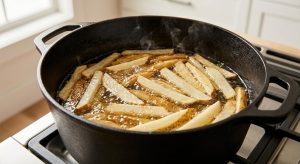
If you want professional results, you must use enameled cast iron. A heavy, thick-walled enameled cast iron caquelon (the traditional Swiss fondue pot) is the only vessel you should be using for communal cheese melting.
Unlike aluminum, cast iron has a very low thermal conductivity and an incredibly high specific heat capacity. This means it takes a long time to heat up, but once it is hot, it holds that heat remarkably well and distributes it evenly across the entire surface of the pot. There are no hot spots. The heat gently and uniformly radiates into the cheese, allowing you to slowly coax the proteins into melting without shocking them into seizing.
Because cast iron is so dense, it also excels at optimizing thermal retention. When you move the pot from the stove to the dining table and place it over a small gel burner, the cast iron retains its core temperature beautifully. It keeps the cheese in that perfect 130°F to 150°F fluid sweet spot for hours.
The enamel coating—essentially a layer of baked glass—is completely non-toxic, highly durable, and completely non-reactive. You can simmer highly acidic white wines in it all day long without any metallic flavors leaching into your food, and it will not degrade or release toxic fumes no matter how hot it gets.
Step-by-Step: The Foolproof Fondue Protocol
You have your high-moisture cheese. You have your acid, your starch, or your sodium citrate. You have your enameled cast iron pot. Now, let’s execute the perfect melt.
Step 1: The Prep.
Grate your cheese while it is cold (it grates much easier) and let it sit on the counter for 30 minutes to take the chill off. If you are using the traditional method, toss the grated cheese thoroughly with one to two tablespoons of cornstarch until every shred is lightly coated.
Step 2: The Aromatic Base.
Rub the inside of your enameled cast iron pot with a halved clove of raw garlic. This leaves behind volatile garlic oils that will perfume the entire dish without overpowering it. Pour in your acidic liquid—usually about 1 cup of dry white wine per pound of cheese. Place the pot on the stove over medium-low heat and bring the wine to a gentle, barely-there simmer. Do not let it boil rapidly, or you will evaporate the water you desperately need for the emulsion.
Step 3: The Slow Integration.
Turn the heat down to low. This is a game of patience. Grab a small handful of the starch-coated cheese and drop it into the simmering wine.
Step 4: The Figure-Eight Stir.
Do not whisk aggressively. Whisking incorporates air, which lowers the temperature and can create a weird, foamy texture. Instead, use a wooden spoon or a silicone spatula and stir continuously in a figure-eight pattern. This mechanical agitation keeps the proteins moving and prevents them from linking up, while gently encouraging the fat and water to emulsify.
Wait until the first handful of cheese is completely melted and smooth before adding the next. If you dump all the cheese in at once, you will drastically drop the temperature of the pot, the cheese will clump together into a massive ball, and you will spend the next twenty minutes desperately trying to melt the core of a dairy-meteorite.
Keep adding, handful by handful, stirring in a figure-eight, until all the cheese is incorporated. Finish with a squeeze of fresh lemon juice (for extra acid security), a grating of fresh nutmeg, and a splash of Kirsch if you are feeling traditional.
Troubleshooting: How to Rescue a Ruined Dinner
Even with the best intentions, sometimes things go sideways. Perhaps your stove runs too hot, or you got distracted pouring drinks and the cheese boiled. Suddenly, the fondue splits. You have a rubbery clump of protein and a layer of grease. Do not panic, and do not throw it away. You can save this. Knowing how to troubleshoot on the fly is an essential kitchen survival guide skill that separates the amateurs from the pros.
If your fondue separates, it means the proteins have tightened up because of too much heat, and there isn’t enough water or acid to keep them relaxed.
The Fix: Immediately remove the pot from the heat source to stop the proteins from contracting further. You need to rapidly reintroduce water and acid to cool the mixture and lower the pH. Whisk together one tablespoon of very warm water and one teaspoon of lemon juice (or white wine vinegar). Pour this directly into the broken fondue and whisk vigorously. Yes, I told you not to whisk earlier, but this is an emergency. The sudden influx of acidic liquid will force the casein proteins to relax their grip, and the vigorous whisking will physically force the fat droplets back into the protein matrix.
If it is still stubbornly broken, and you have sodium citrate in your pantry, you have a magic wand. Dissolve a teaspoon of sodium citrate into a splash of warm water, pour it into the pot, and blend it with an immersion blender. The sodium citrate will instantly obliterate the calcium bonds, and the immersion blender will forcefully homogenize the fat and water. It will become smoother than it was when you started. Learning these chemical shortcuts provides brilliant ways to save ruined meals without breaking a sweat.
Beyond the Bread: Mindful Dipping and Hosting
A truly spectacular fondue night isn’t just about the cheese; it is about the entire interactive experience. You are not just feeding people; you are curating a communal gathering.
While crusty, day-old French bread is the traditional dipper (stale bread holds up better to the heavy cheese without falling apart), serving only bread is a heavy, monochromatic rookie mistake. You need to provide textural and acidic contrast to cut through the immense richness of the dairy.
The Dippers:
- Roasted Baby Potatoes: Boil them until tender, then smash them slightly and roast them in a hot oven until the skins are crispy. The contrast of the crispy skin and fluffy interior against the melted cheese is phenomenal.
- Blanched Vegetables: Raw vegetables are too watery and crisp for fondue. Lightly blanch broccoli florets, cauliflower, and asparagus in heavily salted water for two minutes, then shock them in ice water. They retain their bright color and snap, but are tender enough to bite through easily.
- Acidic Accents: You absolutely must have a bowl of cornichons (tiny, tart French pickles) and pickled cocktail onions on the table. The sharp vinegar bite cleanses the palate between heavy bites of cheese. Crisp, tart Granny Smith apple slices serve a similar purpose.
When it comes to the flow of the evening, the beauty of fondue is that the cooking is the entertainment. You don’t have to be isolated in the kitchen sweating over a multi-course meal while your guests have all the fun in the dining room. Pre-chop all your dippers, blanch your vegetables, and arrange your platters hours before anyone arrives. Mastering this kind of prep is the true art of effortless hosting.
When your guests sit down, bring the enameled cast iron pot to the table, light the gel burner, and let everyone participate. It forces people to slow down, share a single vessel, and engage in actual conversation while they wait for their bread to soak up the cheese.
Melting cheese doesn’t have to be an anxiety-inducing gamble. By respecting the delicate protein structures, utilizing the chemical power of acids or sodium citrate, and investing in high-quality, high-thermal-mass enameled cast iron, you can completely eliminate the guesswork. You have the science, you have the technique, and you have the sass. Now go buy some decent Gruyère, throw away that peeling Teflon pot, and start hosting mindful gatherings that your friends will actually remember for the food, rather than the culinary disasters.