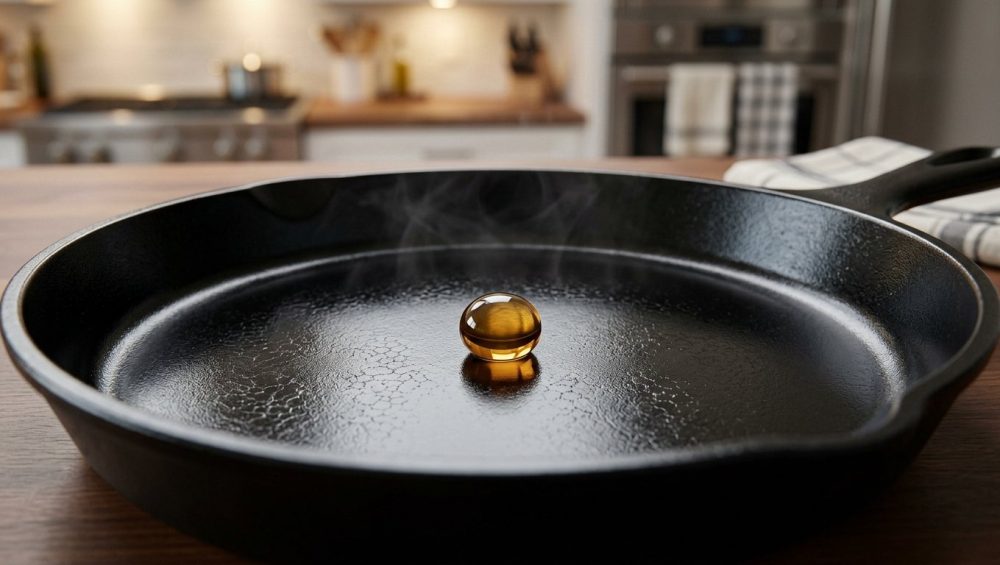
Let’s get one thing straight before we dive into the deep end of the culinary science pool: cooking is basically applied chemistry for hungry people. If you have ever stared at a dull, gray, newly stripped cast iron skillet or a raw carbon steel pan and wondered how on earth it transforms into that slick, jet-black, mirror-finish cooking surface, you are in the right place.
You do not need a degree in materials science to understand this, but you do need to abandon the kitchen folklore your grandmother taught you. We are going to replace those old wives’ tales with hard, verifiable chemistry. As a home cook, your time is your most valuable asset during the week, which means you need equipment that works flawlessly without constant babysitting. But on the weekend? That is when we have the luxury of geeking out over lipid profiles, thermal oxidation, and molecular cross-linking.
Building a durable, non-stick layer on reactive cookware is not magic. It is a highly specific, repeatable chemical reaction. If you understand the variables—the type of fat, the ambient temperature, the surface morphology of the metal, and the duration of heat exposure—you can manipulate them to create a cooking surface that will outlast you. Let’s break down the exact science of lipid polymerization and turn that raw chunk of iron into the ultimate culinary workhorse.
The “No-Go” Rule: Why We Are Ditching Toxic Non-Stick Chemistry
I have zero patience for pretentious chef-speak, but I have even less patience for toxic, disposable kitchenware. If you are still buying cheap, lightweight aluminum pans coated in synthetic polymers that inevitably flake off into your scrambled eggs after six months, we need to have a serious intervention.
Modern non-stick coatings are predominantly made of PTFE (polytetrafluoroethylene), part of the broader PFAS family of “forever chemicals.” When these pans are heated past 500°F (260°C)—a temperature incredibly easy to reach when pre-heating a pan for a hard sear—the chemical bonds begin to degrade. They release invisible, toxic fumes that are literally lethal to pet birds and certainly not doing your respiratory system any favors. The coating chips, the pan loses its non-stick properties, and it ends up in a landfill. It is a complete waste of your hard-earned money.
If you are tired of eating microscopic flakes of mystery chemicals, it is time to get serious about banishing toxic kitchen gear from your life forever. Raw cast iron and carbon steel are heirloom-quality materials. They are completely safe, highly durable, and capable of achieving a non-stick surface that rivals any synthetic coating on the market. The catch? You have to build that non-stick surface yourself. But once you understand the science of how it works, you will never go back to peeling Teflon again.
What Exactly is Seasoning? (Hint: It’s Not Salt and Pepper)
When culinary novices hear the word “seasoning,” they usually think of kosher salt, freshly cracked black pepper, and maybe a dash of paprika. In the realm of metallurgy and cookware, seasoning has absolutely nothing to do with flavor.
Seasoning is the physical and chemical process of transforming a liquid fat (oil) into a solid, hard, protective plastic-like coating bonded directly to the surface of the metal. Yes, I said plastic. But before you panic, this is a naturally occurring, safe, organic polymer, not a synthetic industrial chemical. The goal here is to create a hydrophobic, slick surface that will naturally prevent protein sticking when you are aggressively searing a weeknight salmon fillet or sliding a delicate French omelet onto a plate.
The Metallurgical Canvas: Iron Oxide and Pores
To understand how this organic plastic sticks to the pan, you have to look at the metal itself at a microscopic level. Cast iron is an alloy of iron and carbon (usually around 2.5% to 4% carbon). If you were to look at the surface of a cast iron skillet under a scanning electron microscope, it would not look flat. It looks like a rugged mountain range full of jagged peaks, deep valleys, and microscopic fissures.
These microscopic imperfections are crucial. They provide the mechanical “tooth” or anchor points for the polymerized oil to grab onto. When you apply oil and heat the pan, the metal expands slightly, and the liquid fat seeps deep into these microscopic valleys. As the oil polymerizes and hardens, it physically locks itself into the topography of the iron, creating a resilient, unified barrier that protects the reactive iron from oxygen and water (the two ingredients required for rust).
The Core Science: Lipid Polymerization Explained
Alright, put on your lab goggles, because we are diving into the molecular deep end. The transformation of a slippery liquid oil into a hard, slick, polymerized matrix is governed by a process called thermal auto-oxidation. Once you understand the thermodynamics of carbon steel and cast iron, you realize that heat is just a catalyst for a much larger chemical reaction involving the molecular structure of the fat itself.
Fatty Acids, Double Bonds, and Free Radicals
Cooking oils are made of triglycerides—molecules consisting of a glycerol backbone attached to three fatty acid chains. These fatty acid chains are primarily made of carbon atoms linked together, flanked by hydrogen atoms.
Here is the critical distinction:
Saturated fats (like butter or fully hydrogenated shortening) have carbon chains completely saturated with hydrogen atoms. There are only single bonds between the carbon atoms. Because their molecular structure is rigid and straight, they pack tightly together, which is why they are solid at room temperature.
Unsaturated fats (like canola, grapeseed, or flaxseed oil) are missing some hydrogen atoms. This creates “double bonds” between certain carbon atoms. These double bonds create kinks in the molecular chain, keeping the fat liquid at room temperature.
For the purpose of seasoning cookware, those double bonds are the magic ingredient. They are chemically reactive sites. When you expose an unsaturated fat to high heat and oxygen, the heat energy breaks those double bonds, creating highly reactive molecules known as free radicals.
The Cross-Linking Process: Building a Plastic Matrix
Once those free radicals are generated, chaos ensues—but it is a highly productive chaos. The reactive free radicals desperately want to stabilize, so they attack neighboring fatty acid chains. They link up, carbon atom to carbon atom, forming massive, sprawling, three-dimensional webs of interconnected molecules.
This process is called cross-linking. As more and more fatty acid chains bond together, the liquid oil thickens, then turns into a tacky gel, and finally cures into a hard, dense, solid polymer shell. This matrix is chemically inert, hydrophobic (water-repelling), and incredibly smooth. You have successfully synthesized a biological plastic right on top of your skillet.
The Great Oil Debate: Iodine Values and Smoke Points
If you spend more than five minutes on a cookware forum, you will witness blood-boiling arguments over the “best” oil for seasoning. Some swear by vintage lard; others insist on expensive artisanal oils. The truth is not subjective; it is measurable. Choosing the wrong lipid profile is the fastest way to ruin your weekend project, but preventing polymerization failure is incredibly simple once you look at the fatty acid breakdown.
The Iodine Value (IV) Cheat Sheet
Chemists measure the amount of unsaturation (the number of double bonds) in a fat using something called the Iodine Value (IV). The higher the IV, the more double bonds the oil has, and the faster and harder it will polymerize.
- Non-Drying Oils (IV < 115): Olive oil, avocado oil, coconut oil, butter. These have very few double bonds. If you try to season a pan with extra virgin olive oil, it will likely just burn or remain a sticky, gummy mess.
- Semi-Drying Oils (IV 115 – 130): Canola oil, sunflower oil, corn oil, soybean oil. These have a moderate amount of double bonds. They polymerize well under heat and create a durable, flexible coating.
- Drying Oils (IV > 130): Grapeseed oil, walnut oil, flaxseed oil. These have a massive amount of double bonds. They polymerize rapidly and form extremely hard coatings.
The Flaxseed Oil Fallacy: Why Harder Isn’t Always Better
Around 2010, a wildly popular blog post went viral, claiming that unrefined organic flaxseed oil (which has an incredibly high IV of around 170) was the ultimate seasoning oil because it created the hardest possible polymer. The internet took this as gospel, and suddenly everyone was spending $20 on refrigerated flaxseed oil supplements to coat their skillets.
Here is the brutal, scientifically proven truth: flaxseed oil creates a polymer that is too hard. In materials science, hardness often comes at the expense of elasticity. Because cast iron and carbon steel expand and contract rapidly when exposed to thermal shock (like tossing a cold steak into a blazing hot pan), the seasoning layer needs to have some microscopic flexibility. The flaxseed polymer is so rigid and brittle that it cannot stretch with the metal. After a few months of standard cooking, it inevitably shatters, micro-fractures, and flakes off into your food like black dandruff. Skip the flaxseed oil.
The Sweet Spot: Grapeseed, Canola, and Sunflower Oils
For the absolute best results, you want an oil that sits right on the border of semi-drying and drying. Grapeseed oil (IV ~130) and Canola oil (IV ~110) are the undisputed champions of modern cookware seasoning. They possess enough double bonds to form a robust, slick polymer matrix, but the resulting plastic retains just enough elasticity to survive the thermal expansion of the metal underneath. Furthermore, they are cheap, neutral in flavor, and have high smoke points.
The Traditionalist’s Corner: Lard, Tallow, and Saturated Fats
What about the folks who claim their great-grandmother only used bacon grease and lard, and her pans were flawless? They aren’t lying, but the chemistry is different. Animal fats are highly saturated, meaning they lack the double bonds necessary for rapid cross-linking. However, they do contain a moderate amount of oleic acid (a monounsaturated fat).
When you season with lard or Wagyu beef tallow, it requires significantly more time and repeated heating cycles to build a polymer. The resulting layer is softer and slightly less durable than a grapeseed oil polymer, but it is incredibly slick and perfectly functional. The danger with unrefined animal fats (especially bacon grease) is that they contain proteins, salts, and impurities that can burn and turn rancid if not fully carbonized. If you go the traditional route, use purified, rendered tallow or lard.
The Thermodynamics of Seasoning: Heat, Smoke Points, and Time
Now that we have selected our lipid, we need to introduce thermal energy to kickstart the auto-oxidation. There is a massive misconception in the culinary world regarding smoke points. The smoke point is the exact temperature at which the volatile compounds in an oil begin to break down, oxidize rapidly, and produce visible bluish smoke.
Do You Actually Need to Hit the Smoke Point?
Many guides will tell you that you must exceed the smoke point of your oil to trigger polymerization. This is chemically false. Polymerization happens at any temperature—even room temperature! (This is why a rag soaked in linseed oil will eventually harden and can even spontaneously combust as the cross-linking reaction releases exothermic heat).
However, at room temperature, it takes months. Heat acts as a catalyst. This principle applies universally, whether you are restoring an antique skillet or perfecting your carbon steel wok seasoning over a high-BTU gas burner. You want to bring the ambient temperature of your oven right up to the edge of the oil’s smoke point, or slightly above it, to accelerate the free radical generation.
If you use grapeseed oil (smoke point ~420°F), baking the pan at 450°F is perfect. The heat forces the molecular bonds to snap, the cross-linking goes into overdrive, and the oil transforms into a polymer in about an hour. If you blast the pan at 550°F, you will bypass polymerization entirely and undergo thermal degradation, literally burning the oil into useless carbon ash.
The Role of Time and Annealing
A rushed seasoning job is a failed seasoning job. The chemical reaction requires time to stabilize. Baking the pan for one hour at 450°F is standard, but the real secret lies in the cool-down phase. If you rip a 450°F pan out of the oven and let it rapidly cool on the counter, you introduce thermal stress to the newly formed polymer matrix. By simply turning the oven off and letting the pan slowly drop to room temperature inside the insulated cavity over two hours, you effectively anneal the polymer, relieving internal stresses and ensuring maximum adhesion to the iron.
Cast Iron vs. Carbon Steel: Surface Morphology and Adhesion
While the chemical process of lipid polymerization is identical whether you are coating a Griswold skillet or a Matfer Bourgeat crepe pan, the physical application requires different strategies due to the surface morphology of the metals.
The Sand-Casted Topography of Cast Iron
Cast iron is manufactured by pouring molten iron into molds made of compressed sand. When the pan is released from the mold, the surface retains the microscopic imprint of the sand grains. Vintage cast iron (pre-1950s) was subsequently tumbled and machine-milled to a smooth finish, but modern budget cast iron skips this expensive step, leaving a pebbly, rough texture.
Because of the unique thermal conductivity and emissivity of these dense ferrous alloys, the metal expands, allowing the polymer to anchor itself into the microscopic fissures. The rough texture of modern cast iron actually makes it easier for the initial seasoning layers to adhere, though it may take more layers (and more cooking) to fill in the valleys and achieve a glassy, non-stick surface.
The Smooth Challenge of Carbon Steel
Carbon steel, on the other hand, is stamped or spun from sheets of smooth, cold-rolled metal. Under a microscope, it lacks the deep, jagged valleys of cast iron. Because the surface is so smooth, the polymer matrix has fewer mechanical anchor points to grab onto. This is why carbon steel is notoriously prone to dropping its seasoning if you cook highly acidic foods or scrub it too aggressively.
To compensate for this, carbon steel requires exceptionally thin layers of oil during the seasoning process. If the layer is too thick, the polymer will lack the structural integrity to hold onto the smooth steel and will peel off like a sunburn.
The Step-by-Step Scientific Method for Bulletproof Seasoning
We have covered the theory. Now it is time for the practical application. If you follow this methodology with clinical precision, you will achieve a flawless, jet-black, hydrophobic surface. Slathering a quarter-cup of oil into a cold pan is one of those disastrous beginner cooking mistakes that will leave you scrubbing sticky, rancid grease for hours. Precision is mandatory.
Phase 1: The Strip Down (Optional but Recommended for Rescues)
If you are dealing with a rusted thrift-store find or a pan with thick, flaking, uneven crusts of burnt carbon, you must strip it down to bare metal. You cannot build a stable house on a crumbling foundation. You can use an electrolysis tank if you are an engineering nerd, or simply spray the pan with heavy-duty lye-based oven cleaner (wear heavy gloves and a respirator), tie it in a trash bag for 24 hours, and scrub it down to the pristine gray iron. Wash it thoroughly with cold water and dry it immediately to prevent flash rusting.
Phase 2: The Micro-Layer Application
Warm your bare pan in a 200°F oven for 15 minutes. This drives off any microscopic moisture trapped in the pores of the metal and opens the surface up slightly.
Take the pan out. Pour a dime-sized drop of your chosen oil (grapeseed or canola) into the center of the pan. Using a lint-free cotton cloth or heavy-duty paper towel, aggressively rub the oil into every square inch of the pan—inside, outside, the handle, the bottom.
Now, here is the most critical step in the entire process: take a clean, dry cloth and wipe all the oil off. Wipe it as if you just realized you made a terrible mistake and you are frantically trying to hide the evidence. The pan should look completely dry. There is still a microscopic layer of oil on the surface, measuring mere microns thick. This is exactly what you want. If the oil is thick enough to pool, bead, or run, it will cure into sticky, uneven splotches.
Phase 3: The Thermal Bake
Place the pan upside down on the middle rack of your oven. Place a sheet of aluminum foil on the bottom rack to catch any potential microscopic drips (if you wiped it properly, there shouldn’t be any, but we are being thorough).
Set the oven to 450°F (or slightly above the smoke point of your specific oil). Leave it in there for exactly one hour. Your kitchen will smell like hot metal and slightly toasted oil. This is the smell of free radicals forming covalent bonds.
Phase 4: The Cool Down and Anneal
After one hour, turn the oven off. Do not open the door. Leave the pan inside for at least two hours until it is completely cool to the touch. Congratulations, you have laid down your first cross-linked polymer matrix. For a brand new or freshly stripped pan, repeat Phases 2 through 4 three to five times. Yes, it takes an entire weekend. Perfection takes time.
Troubleshooting the Polymer Matrix: When Good Chemistry Goes Bad
Even with a strong grasp of the science, environmental variables can sometimes throw a wrench in the gears. When gathering the essential tools every beginner needs for this process, skip the expensive specialized waxes and grab a roll of heavy-duty paper towels and basic canola oil. If things go wrong, the solution is usually simple. Let’s diagnose common failures.
The Sticky Pan Syndrome
If your pan comes out of the oven feeling tacky, sticky, or looking like it has a brown, gummy residue, you have suffered a polymerization failure. This happens for two reasons:
- Too Much Oil: You didn’t wipe off enough oil in Phase 2. The layer was too thick, and the heat could not penetrate evenly to fully cross-link the entire depth of the fat.
- Insufficient Heat/Time: You baked it at 300°F, or you only left it in for 20 minutes. The chemical reaction was halted halfway through.
The Fix: Put the pan back in the oven at 450°F for another hour to force the remaining liquid fats to finish polymerizing.
The Flaking Disaster
If your seasoning looks beautiful but starts chipping off in black shards the first time you sear a steak, your polymer matrix is too brittle or lacks adhesion. This is almost always caused by using flaxseed oil, or by attempting to season over a layer of existing food grime or rust.
The Fix: You have to scrub off the loose flakes using coarse steel wool or a chainmail scrubber, and start over with a proper semi-drying oil like grapeseed.
The Flash Rust Emergency
If you strip a pan and it turns orange within minutes of drying it, you are witnessing flash oxidation. Bare iron reacts aggressively with atmospheric moisture.
The Fix: Always dry bare iron immediately with a towel, and then place it on a warm stovetop burner for a few minutes to evaporate any residual microscopic moisture before applying your first layer of oil.
The Soap Myth: Modern Surfactants vs. Lye
We cannot have a definitive masterclass on cast iron chemistry without violently debunking the most pervasive, annoying myth in the culinary world: the idea that you cannot wash your cast iron skillet with dish soap.
The Chemistry of Saponification
Your grandmother told you never to use soap on cast iron, and in 1945, she was absolutely right. Early 20th-century dish soaps were made by mixing animal fats with lye (sodium hydroxide). Lye is a highly caustic, alkaline chemical with a pH north of 12. When lye comes into contact with fats, it triggers a chemical reaction called saponification, which literally dissolves the fats and turns them into soap. If you washed a 1940s skillet with lye soap, it would strip the polymerized seasoning right off the metal.
We do not use lye in dish soap anymore. Modern dish liquids (like Dawn) are synthetic surfactants. They are pH-neutral (or very mildly alkaline) and are engineered to reduce the surface tension of water, allowing it to lift away loose food particles and un-polymerized liquid grease.
A fully cured, cross-linked polymer matrix is a hard plastic. It is completely insoluble in water and utterly impervious to mild surfactants. Washing your seasoned cast iron with modern dish soap will not harm the seasoning. In fact, it is required.
The Biofilm Danger of “Water Only” Washing
If you only wipe your pan out with a dirty paper towel or rinse it with hot water, you are leaving behind un-polymerized, liquid food fats (like bacon grease or butter). Over a few days, these fats will go rancid. Furthermore, recent FDA food safety studies have shown that skipping soap on porous cooking surfaces increases the risk of bacterial biofilms by nearly 400%.
One of my favorite foolproof cooking secrets is to simply let the pan cool down naturally inside the closed oven, which effectively anneals the polymer layer. But when it comes to cleaning, wash your pan with soap and warm water. Scrub it with a sponge. You are removing rancid surface grease, not your hard-earned polymer matrix. If your “seasoning” washes off with Dawn dish soap, it wasn’t seasoning; it was just burnt, gross grease.
Maintenance: Cooking as Continuous Polymerization
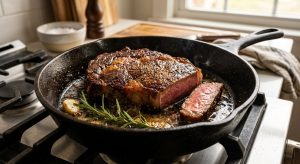
The beauty of reactive cookware is that it is a living surface. Every single time you cook with fat, you are micro-seasoning the pan. As you sear chicken thighs or fry eggs, the high heat of the stove is constantly breaking down the cooking oils and adding microscopic layers of fresh polymer to the matrix.
The Weeknight Wipe-Down Routine
On a busy Tuesday night, you do not have time for a two-hour oven baking cycle. Your maintenance routine should take less than three minutes.
- Wash the pan with warm water, a sponge, and a drop of modern dish soap.
- Dry it thoroughly with a towel.
- Place the pan on a stovetop burner over medium-low heat for two minutes to evaporate any invisible moisture.
- While the pan is warm, add three drops of grapeseed oil. Wipe it across the interior surface with a paper towel, and then immediately wipe it completely dry with a clean paper towel.
- Turn off the heat and walk away.
When to Re-Season
You only need to perform the intensive, multi-hour oven seasoning process if you have stripped the pan to bare metal, or if you accidentally left the pan soaking in the sink for three days and caused massive rust damage. If you accidentally strip a small patch of your seasoning, don’t panic; there are plenty of simple kitchen fixes that involve just a quick stovetop touch-up. Just heat the pan on the stove, wipe a micro-layer of oil over the bald spot, let it smoke for a minute, and let it cool.
Ultimately, cast iron and carbon steel are practically indestructible. By understanding the underlying chemistry of lipid polymerization, you have unlocked the ability to manipulate these metals to your exact specifications. Stop fearing your cookware, stop babying it, and stop listening to outdated myths. Grab a bottle of high-iodine oil, crank up the oven, and go build a cooking surface that will outlast your entire kitchen. Happy searing.