Welcome to the culinary thunderdome, my friends. If you are reading this, you probably fall into one of two categories: you either survive exclusively on a diet of overpriced takeout and microwaved sadness, or you occasionally attempt to cook, only to end up crying over a scorched pan while the smoke detector sings the song of its people. I see you. I was you. Before I became the culinary authority you are currently reading, I was a busy professional who thought “al dente” was a men’s cologne and considered boiling water to be a high-risk activity.
But here is the unfiltered truth: cooking is not magic. It is not an exclusive club reserved for people who grew up rolling their own pasta in a rustic Tuscan villa. It is a fundamental life skill, a daily necessity, and, if you do it right, an incredibly rewarding hobby. You do not need a culinary degree to make mind-blowing food. You just need a little bit of science, a lot of common sense, and the willingness to fail a few times before you succeed. This masterclass is your definitive roadmap. We are going to strip away the pretentious chef-speak, throw out the toxic garbage cluttering your cabinets, and build your foundation from the ground up. Grab a glass of wine, tie your apron, and let us get to work.
The Psychology of Cooking: Why You Are Terrified and How to Stop
Let us address the elephant in the room: the kitchen can be an incredibly intimidating place. If you break out in a cold sweat every time you have to mince a clove of garlic, you are experiencing a very real, very paralyzing phenomenon. Studies and recent data from food security experts and culinary psychologists highlight that a massive part of cooking anxiety comes from simply not knowing if you are doing things “right”. You stare at a recipe, second-guess your heat levels, and wonder if your chicken is going to give your loved ones food poisoning. We need to cure cooking anxiety right now, because fear is the enemy of flavor.
The Myth of the “Natural” Chef
The myth of the “natural” chef is a lie propagated by heavily edited food television and carefully curated social media feeds. Nobody is born knowing how to perfectly execute a French omelet or how to break down a whole chicken. Culinary prowess is built on a mountain of ruined dinners. When you see a professional chef effortlessly tossing vegetables in a saute pan without a spatula, you are witnessing muscle memory forged through thousands of hours of repetitive labor, not divine intervention.
Social media has completely warped our perception of what home cooking should look like. You do not need to forage for wild mushrooms at dawn or hand-churn your own butter to be a good cook. You just need to understand the basic principles of heat, fat, acid, and salt. Once you accept that cooking is a learned skill rather than an innate talent, the pressure completely dissipates.
Embracing the Burn (And Other Inevitable Mistakes)
You are going to mess up. I need you to accept this right now. You are going to burn the garlic, which will turn bitter and ruin your sauce. You are going to overcook a beautiful, expensive piece of steak until it resembles a leather shoe. You are going to attempt to flip a pancake and end up scraping it off the ceiling. This is not a sign that you should give up; it is a sign that you are actually trying.
A big part of overcoming your fear is realizing that very few kitchen disasters are truly fatal. Most mistakes can be eaten, hidden, or drowned in hot sauce. Guided cooking tools, step-by-step techniques, and a healthy dose of self-forgiveness are the antidotes to this anxiety. When you inevitably make a mistake, do not panic. Analyze what went wrong. Was the pan too hot? Did you walk away to check your phone? Learn from it, order a pizza, and try again tomorrow.
The “No-Toxic-Trash” Policy: Curating Your Culinary Arsenal
I have a zero-tolerance policy for toxic garbage in the kitchen. If you are still using a scratched-up, peeling non-stick pan that you bought for ten dollars at a discount store five years ago, throw it away immediately. I am completely serious. Stop feeding yourself flakes of mystery chemical coatings.
The Non-Stick Nightmare and the PFAS Reckoning
The regulatory landscape surrounding per- and polyfluoroalkyl substances (PFAS)—often referred to as “forever chemicals”—is rapidly changing, and for good reason. As of 2025 and moving into 2026, sweeping state-level bans are taking effect across the United States. States like Minnesota, Maine, Vermont, and California have enacted strict laws prohibiting the sale of cookware with intentionally added PFAS. These chemicals do not break down naturally, they accumulate in your body and the environment over time, and they have no business anywhere near your dinner.
In Minnesota, for instance, “Amara’s Law” mandates that manufacturers completely halt PFAS cookware sales, and improper disposal of these toxic pans by businesses can even be treated as hazardous waste under the state’s Superfund law. Banishing toxic kitchen gear is the very first step to taking yourself seriously as a home cook. You cannot expect to produce high-quality, nourishing meals using equipment that actively degrades your health.
The Holy Trinity of Pans
Instead of relying on a chemical wasteland, you need to invest in the holy trinity of pans: cast iron, stainless steel, and enameled cast iron.
First, the bare cast-iron skillet. A well-seasoned cast-iron skillet will outlive you, your children, and your grandchildren. It is practically indestructible. Cast iron holds onto heat like a vault, making it the absolute best tool for getting a deeply caramelized, aggressive crust on a steak or a smash burger. Yes, it requires a tiny bit of maintenance—you have to dry it thoroughly and rub it with a drop of oil so it doesn’t rust—but it is worth the effort.
Second, the stainless steel skillet. This is your everyday workhorse. Unlike non-stick pans, stainless steel is actually designed to make food stick just a little bit. When you sear a piece of chicken, those browned, caramelized bits stuck to the bottom of the pan are called the “fond.” That fond is pure, concentrated flavor. You deglaze the pan by pouring in a splash of wine or broth, scraping up those bits, and instantly creating a restaurant-quality pan sauce. You cannot do that in a non-stick pan.
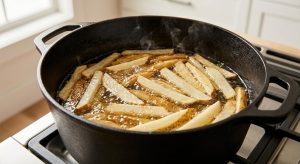
Third, the enameled cast-iron Dutch oven. This is a heavy, thick-walled pot coated in a durable glass enamel. It is your low-and-slow braising champion. Whether you are making a Sunday beef stew, simmering a batch of chili, or baking a crusty loaf of sourdough bread, the Dutch oven provides gentle, even, radiant heat.
Knives: Stop Hacking Your Produce to Pieces
Please, I am begging you, stop hacking your onions to pieces with a dull, flimsy serrated steak knife. It is embarrassing, it is inefficient, and it is incredibly dangerous. A dull knife requires you to apply excessive force to cut through food. When you push too hard, the blade slips, and suddenly you are spending your Tuesday evening in the emergency room getting stitches.
You only need three beginner kitchen tools when it comes to cutlery: an 8-inch chef’s knife, a paring knife, and a serrated bread knife. The chef’s knife is your primary weapon; it will handle 90% of your cutting tasks, from dicing carrots to slicing meat. The paring knife is for delicate, off-the-board work, like peeling an apple or hulling strawberries. The serrated knife is for slicing crusty bread and delicate tomatoes without crushing them. Buy the best chef’s knife you can afford, learn how to hone it on a steel to keep the edge aligned, and never, ever put it in the dishwasher.
Spatial Organization: Making Your Kitchen Work For You
You do not need a sprawling, custom-built kitchen with double islands and marble countertops to cook like a professional. I have produced Thanksgiving dinners out of kitchens so small I could touch the fridge and the oven at the same time. What you need is rigorous, uncompromising organization.
The Triangle is Dead, Long Live “Zones”
For decades, kitchen designers preached the gospel of the “kitchen triangle”—the imaginary lines connecting the sink, the stove, and the refrigerator. This concept is outdated. Modern culinary efficiency relies on a zone-based system. Creating a permanently organized kitchen means dividing your physical space by function rather than just geometry.
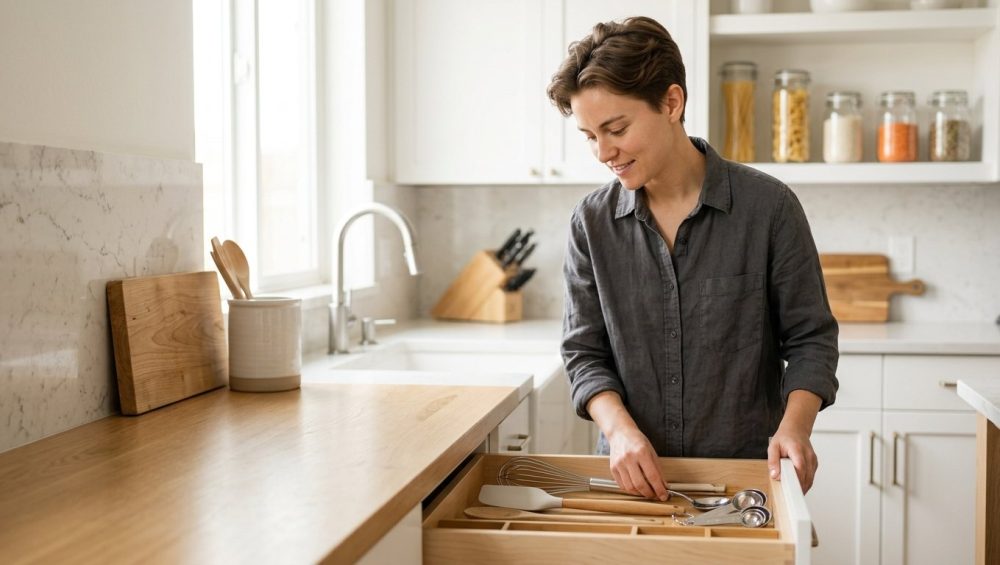
You need a Prep Zone, a Cook Zone, a Clean Zone, a Consumables Zone (pantry and fridge), and a Non-Consumables Zone (dishes and glassware). Your Prep Zone should be the largest uninterrupted stretch of countertop you have, ideally located near a trash can and the sink. This is where your cutting board lives. Your Cook Zone surrounds the stove; this is where your spatulas, wooden spoons, cooking oils, and salt cellar should be within arm’s reach. Do not store your spices directly above the stove, as the rising heat and humidity will destroy their volatile essential oils and render them tasteless.
Countertop Real Estate and the “Mise en Place” Mindset
Countertop space is the most valuable real estate in your home. Treat it with respect. If you have appliances sitting on your counter that you use less than once a week—I am looking at you, massive stand mixer and novelty waffle iron—evict them to a cabinet. Clear counters equal a clear mind.
Once your space is clear, you must adopt the French philosophy of “mise en place,” which translates to “everything in its place.” Before you ever turn on the stove, read the entire recipe. Chop all your vegetables, measure out your spices into little bowls, and have your proteins ready to go. Cooking becomes infinitely less stressful when you are not frantically trying to dice an onion while your garlic is actively burning in the skillet.
Decoding Pretentious Recipe Jargon
The culinary world loves to gatekeep its knowledge behind a wall of confusing terminology. If you have ever felt personally victimized by a recipe that casually tells you to “sweat the aromatics” without explaining what that means or what heat level to use, you are not alone. It is time to learn how to decode pretentious recipe jargon so you can navigate any cookbook with confidence.
“Sweat the Onions” and Other Vague Instructions
When a recipe tells you to “sweat” vegetables, it sounds gross, but it is actually a crucial foundational technique. Sweating means cooking finely chopped vegetables (usually onions, celery, and carrots) in a little bit of fat over medium-low heat. The goal is to soften them and draw out their moisture without letting them brown. You want them to become translucent and sweet, creating a flavor base for soups, stews, and sauces. If they start getting crispy and brown, you are no longer sweating; you are sautéing. Turn the heat down.
“Deglazing” is another term that terrifies beginners. As mentioned earlier, when you sear meat, it leaves behind a sticky brown residue on the bottom of the pan. Deglazing is simply the act of pouring a cold liquid (wine, broth, or even water) into the hot pan. The liquid instantly boils and creates steam, which loosens that brown residue. You scrape it up with a wooden spoon, and congratulations, you have just created a flavor bomb.
The Difference Between Dicing, Mincing, and Julienne (Who Cares?)
Recipes love to demand specific knife cuts. A “dice” usually means cutting food into uniform cubes. A “mince” means chopping something as finely as humanly possible, almost into a paste (usually reserved for garlic or ginger). “Julienne” means cutting vegetables into thin, matchstick-like strips.
Here is the secret: unless you are cooking in a Michelin-starred restaurant, the exact geometric perfection of your vegetables does not matter. What matters is uniformity. If you chop one piece of potato into a massive chunk and another into a tiny sliver, the tiny sliver will turn to mush before the massive chunk is even cooked through. Cut your ingredients to roughly the same size, and you will be fine.
Weekday Survival vs. Weekend Artistry
My culinary philosophy is incredibly strict on this point: time is money during the workweek, but weekends are reserved for culinary art. You must separate your cooking routines based on the reality of your schedule.
The Weekday Hustle: Time-Saving Hacks That Actually Work
Let us look at the data. In the 1950s, a home cook might have spent 2 to 3 hours daily preparing meals from scratch. Fast forward to today, and the average time spent cooking dinner hovers around a mere 30 to 45 minutes on weekdays. We are exhausted, we are overworked, and we do not have the patience for a multi-step braise on a Tuesday evening.
If a weekday recipe claims it takes 20 minutes but requires you to use three different pans, a food processor, and an immersion blender, it is a lie. Close the tab. You need a reliable step-by-step guide for quick, healthy, sheet-pan meals or one-pot wonders.
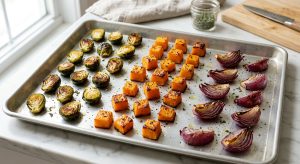
The key to weekday survival is strategic prep. On Sunday afternoon, roast a massive tray of vegetables, cook a large batch of a versatile grain like quinoa or brown rice, and make a highly seasoned vinaigrette. During the week, all you have to do is quickly sear a piece of fish or chicken, throw it on top of your pre-cooked grains and veggies, drizzle with your dressing, and you have a spectacular meal in 15 minutes flat.
The Weekend Flex: When to Actually Try Hard
The weekend is when you get to slow down, pour that glass of wine, and actually enjoy the tactile process of cooking. This is when you tackle the intimidating projects. Make a rich, gelatinous chicken stock from scratch using leftover bones. Spend three hours hovering over a bubbling pot of authentic Bolognese sauce. Bake a loaf of crusty, artisanal bread.
Weekend cooking is not about efficiency; it is about mindfulness and technique. It is the time to experiment with new flavor profiles and push your boundaries. It is the time to focus on unlocking kitchen creativity without the looming pressure of an early morning alarm clock.
Flavor 101: How to Stop Making Bland Food
Now, we arrive at the most important lesson you will ever learn in your culinary journey. If you take absolutely nothing else away from this masterclass, memorize this section. The reason restaurant food tastes so much better than your home-cooked food is not magic. It is not a secret ingredient. It is a masterful understanding of salt, acid, fat, and umami.
Salt is Your Friend, Not Your Enemy
A shocking number of home cooks drastically under-season their food. You have been conditioned by diet culture to fear salt, but in the kitchen, salt is the ultimate flavor amplifier. According to culinary science, the saliva on our palate contains about 0.4% salt by weight. If you season your food below this threshold, it will literally taste less salty than your own mouth, registering to your brain as completely bland, lifeless, and stale.
Salt does not just make food taste “salty.” It actively suppresses bitterness, enhances sweetness, and highlights savory umami notes. Furthermore, the timing of your salt application is critical. You cannot just dump a teaspoon of table salt onto a finished dish and expect it to taste good. Salt needs time to penetrate the cellular structure of your ingredients through the processes of diffusion and osmosis.
When you salt a piece of meat well before cooking—a technique known as dry brining—the salt initially draws moisture out of the muscle cells to the surface. Over time, that moisture dissolves the salt, and the now-salty liquid is reabsorbed deep into the protein structure, seasoning the meat from the inside out and helping it retain moisture during the brutal heat of cooking. For vegetables, adding salt early draws out excess water, concentrating their natural flavors and preventing them from becoming soggy. Incorporating these foolproof cooking secrets will elevate your meals from amateur to exceptional instantly. Throw away your iodized table salt—which tastes metallic—and buy a box of kosher salt. Its larger, coarser flakes are easier to pinch and distribute evenly.
Acid: The Missing Link in Your Dinner
If you taste a dish you have cooked and think, “This is missing something, but I don’t know what,” I can almost guarantee you it is missing acid. Acid is the bright, high-note frequency that cuts through heavy, rich, fatty foods and wakes up your palate.
If you make a rich beef stew or a heavy cream sauce, it can quickly become cloying and exhausting to eat. A squeeze of fresh lemon juice, a dash of apple cider vinegar, or a splash of dry white wine stirred in right at the end of cooking provides a necessary contrast. Acid makes your mouth water. It balances the entire flavor profile. Keep a bowl of lemons and limes on your counter, and stock your pantry with a variety of vinegars (balsamic, red wine, rice vinegar). They are your secret weapons.
Umami and Heat: Building Complexity
Umami is the elusive “fifth taste.” It translates from Japanese as a “pleasant savory taste” and is the deeply satisfying, meaty flavor found in ingredients rich in glutamates. If you want to make a dish taste more complex and robust, you need to build layers of umami.
You do this by adding ingredients like tomato paste, soy sauce, Worcestershire sauce, dried mushrooms, Parmesan cheese, or even anchovies. Do not be afraid of anchovies; they dissolve completely into hot oil and leave behind a rich, savory backbone without making your food taste like fish. Heat, provided by black pepper, chili flakes, or hot sauce, should be used not to inflict pain, but to provide a warm, lingering tingle that forces you to slow down and appreciate the flavors.
The Art of Forgiveness in the Kitchen
Even armed with the best tools and a deep understanding of flavor science, you are still going to face disasters. Committing rookie kitchen mistakes is a permanent rite of passage. The true difference between a novice who panics and a seasoned home cook who succeeds is the ability to pivot and salvage a situation.
Salvaging the Unsalvageable
Let us run through some common triage scenarios. Did you accidentally dump way too much salt into your soup? Do not panic. You cannot “remove” salt, but you can dilute it. Add more unsalted broth, toss in some cubed potatoes (which act as tiny sponges to absorb some of the salinity), or add a splash of acid like vinegar to trick your palate and balance the harshness.
Did you make a curry or a chili that is aggressively, painfully spicy? Capsaicin, the chemical that makes chilies hot, is fat-soluble. Do not drink water; it will just spread the fire. Instead, stir in a heavy dairy component like heavy cream, full-fat yogurt, or coconut milk. The fat will bind to the capsaicin and instantly mellow the heat.
Did your beautiful pan sauce suddenly “break” and separate into a greasy, oily mess? This happens when an emulsion fails. Take it off the heat immediately, add a splash of boiling water or a tablespoon of heavy cream, and whisk it violently until it comes back together.
The Final Polish: Presentation Matters
Finally, we must talk about the finish line. You spend all this time curating safe cookware, organizing your zones, and balancing your acids and salts. Do not ruin it by aggressively slopping the food onto a paper plate. We eat with our eyes first.
Taking an extra thirty seconds to understand the art of food plating changes the entire dining experience. You do not need tweezers to arrange microgreens, but you should wipe the rim of the plate. You should garnish your rich, brown stews with a handful of vibrantly green, freshly chopped parsley or cilantro to provide visual contrast. You should slice your steak against the grain and fan it out beautifully so it looks intentional.
Cooking is an act of transformation. You are taking raw, disparate ingredients from the earth and using fire, chemistry, and sheer willpower to turn them into something that brings joy, comfort, and nourishment. It is a messy, chaotic, beautiful process. So stop letting the kitchen intimidate you. Throw out your toxic pans, sharpen your chef’s knife, buy a box of kosher salt, and get to work. You have got this.