Listen up, culinary hopefuls. I see you standing in the middle of your new kitchen, staring blankly at the empty countertops, wondering if surviving on takeout and microwave popcorn is a sustainable lifestyle choice. Spoiler alert: it is not. But before you panic-buy a forty-five-piece plastic utensil set from a discount bin or drop half your rent on a shiny, celebrity-endorsed cookware bundle that promises to change your life (it will not), take a breath. We need to have a little chat.
I learned to cook through sheer stubbornness, trial, error, and setting off my apartment’s smoke detector enough times that the local fire department practically knew me by name. I did not have a culinary degree, and guess what? You do not need one either to conquer the modern kitchen. What you actually need is a thoughtfully curated collection of reliable, high-quality, and visually stunning tools that make sense for a beginner. We are building a space that is as beautiful as it is functional. You want a kitchen that makes you want to pour a glass of wine, turn on a great playlist, and chop onions like you are starring in your own cooking show.
Let’s get one thing straight right out of the gate: I have absolutely zero patience for cheap, toxic garbage. If your current non-stick pan is peeling like a bad sunburn, throw it away. Right now. I will wait. We are not serving a side of mystery chemicals with our Tuesday night stir-fry. In this comprehensive, definitive masterclass, I am going to walk you through exactly what you need to build a gorgeous, hyper-functional, and entirely safe cooking space. No fluff, no pretentious chef-speak, just the hard, researched truths about what actually works.
The Philosophy of the Starter Kitchen
When you are starting from scratch, the temptation to buy everything all at once is overwhelming. Retailers prey on this anxiety by pushing massive, matching sets that look great inside a cardboard box but perform terribly on a hot stove. The secret to a beautiful, functional space is intentionality. You are not outfitting a commercial restaurant line; you are creating a minimalist kitchen setup tailored strictly to your actual life.
Time is money, especially on a Wednesday night when you are exhausted from work and the last thing you want to do is scrub a dozen useless gadgets. You need tools that perform efficiently, clean up quickly, and do not require an advanced degree in metallurgy to maintain. At the same time, when the weekend rolls around and you decide to tackle a complicated braise or an artisanal loaf of sourdough bread, your equipment needs to step up to the plate. Every single item we discuss today has been selected because it earns its keep. If a tool only does one highly specific thing—I am looking directly at you, avocado slicers, strawberry hullers, and banana slicers—it has absolutely no place cluttering up your drawers.
The “Holy Trinity” of Knives (And Why You Don’t Need a 15-Piece Block)
Let’s talk about the giant, wooden elephant sitting on your counter: the knife block. Those massive fifteen-piece sets are an absolute scam. You are paying a premium for a block of cheap wood and a dozen flimsy, unbalanced blades you will never, ever use. To execute professional-level cuts, you realistically only need three knives. I call them the Holy Trinity.
The 8-Inch Chef’s Knife
If your kitchen was a movie, the eight-inch chef’s knife would be the lead actor. You will use this blade for ninety percent of your prep work. From dicing onions to slicing through thick cuts of meat, a high-quality chef’s knife is your best friend. Look for a forged blade, which means it is crafted from a single piece of heated metal, rather than being stamped out of a sheet like a cookie cutter. You also want a full tang, meaning the metal of the blade extends all the way through the handle. This provides essential balance and durability. Whether you prefer a heavy, curved German-style blade for rocking chops or a lighter, thinner Japanese-style Santoku for precise, straight slicing, invest your money here. Keep it sharp, hand-wash it immediately after use (never put it in the dishwasher), and it will last you a lifetime.
The Paring Knife
For tasks that require a little more finesse, the three-and-a-half to four-inch paring knife steps in. You are not going to use an eight-inch blade to hull a strawberry, peel a stubborn apple, or devein a shrimp unless you have a personal vendetta against your own fingers. The paring knife is the nimble sidekick, perfect for delicate, off-the-board work where precision is far more important than brute force.
The Serrated Bread Knife
Have you ever tried to slice a crusty artisan sourdough boule or a delicate, ripe heirloom tomato with a dull chef’s knife? It is a massacre. A ten-inch serrated knife features aggressive teeth that grip and saw through tough exteriors without crushing the soft, delicate interior. You do not need to spend a fortune on a serrated knife. Because the teeth are notoriously difficult to sharpen at home, many professional chefs treat them as semi-disposable tools and replace them every few years when they finally lose their edge.
Knife Maintenance: Honing vs. Sharpening
Owning good knives is pointless if you let them get as dull as a butter knife. You need a honing steel. Let’s clear up a common misconception: a honing steel does not actually sharpen your knife. As you chop, the microscopic edge of your blade bends out of alignment. Swiping the blade along a honing steel simply pushes those microscopic teeth back into a straight line, instantly restoring the cutting feel. You should hone your chef’s knife every few times you use it. Actual sharpening, which removes metal to create a brand new edge, can be done once or twice a year using a whetstone or by taking it to a local professional.
Aesthetic Storage: The Magnetic Strip
Ditch the bulky wooden block that eats up your precious counter space and harbors mystery bacteria in its dark, un-cleanable crevices. Instead, mount a beautiful wooden or stainless steel magnetic knife strip on the wall. It keeps your blades sharp because they are not scraping against wood every time you pull them out, it frees up your workspace, and it turns your beautiful knives into a piece of functional wall art. It is one of those aesthetic kitchen upgrades that instantly makes you look like you know exactly what you are doing.
Cookware That Won’t Poison You (The Anti-Toxic Manifesto)
We need to address the most insidious issue in the modern home kitchen: non-stick cookware. I despise cheap Teflon pans. They are flimsy, they warp if you look at them wrong, and most importantly, they are a chemical hazard waiting to happen.
The Dangers of “Forever Chemicals”
If you have been paying attention to recent environmental health studies, you know that traditional non-stick coatings are often made with PFAS (per- and polyfluoroalkyl substances). These are known as “forever chemicals” because they take thousands of years to break down in the environment and in the human body due to their incredibly strong carbon-fluorine bonds. Studies have linked PFAS exposure to a terrifying laundry list of health issues, including weakened immune function, liver toxicity, reproductive problems, high cholesterol, and certain types of cancer.
When a cheap non-stick pan is overheated—which happens quickly when you are trying to sear meat—or scratched by a metal spatula, it can release toxic fumes and leach millions of microplastics directly into your dinner. Even pans labeled “PFOA-free” often just substitute one forever chemical for another, like GenX, which carries similar health risks and remains in the environment just as long. Major retailers are finally waking up to this nightmare, with companies like Target and Walmart pledging to ban intentionally added PFAS from their cookware lines by 2025. I refuse to compromise on this. Your starter kitchen must be a safe zone.
The Stainless Steel Skillet
Your daily driver should be a fully clad, tri-ply stainless steel skillet, ideally in a ten-inch or twelve-inch size. “Tri-ply” means it has an aluminum core sandwiched securely between layers of stainless steel. The aluminum conducts heat beautifully and evenly, while the stainless steel provides a durable, non-reactive cooking surface. A stainless steel pan will not rust, it will not peel toxic flakes into your food, and it can go from the stovetop straight into a roaring oven without breaking a sweat.
Yes, there is a learning curve to cooking on stainless without your food sticking horribly. You have to heat the pan properly before adding oil using the “mercury ball test”—flicking a drop of water into the pan until it beads up and glides around like mercury. But once you master temperature control, you will achieve the kind of golden-brown crust on a pan-seared salmon that you previously thought was only possible in a high-end restaurant.
The Essential Saucepans and Stockpot
You cannot build a kitchen on skillets alone. You need vessels with high sides for boiling, simmering, and reducing. Skip the massive, unnecessary sets and buy three specific pieces: a two-quart saucepan, a four-quart saucepan, and an eight-quart stockpot. The two-quart is your workhorse for making a quick batch of rice, warming up soup, or melting butter. The four-quart is perfect for boiling smaller portions of pasta or making a quick weeknight chili. The eight-quart stockpot is mandatory for boiling a full pound of spaghetti, making homemade chicken stock, or boiling potatoes. Just like your skillet, insist on tri-ply stainless steel so the bottoms do not scorch your sauces.
Enameled Cast Iron Dutch Oven
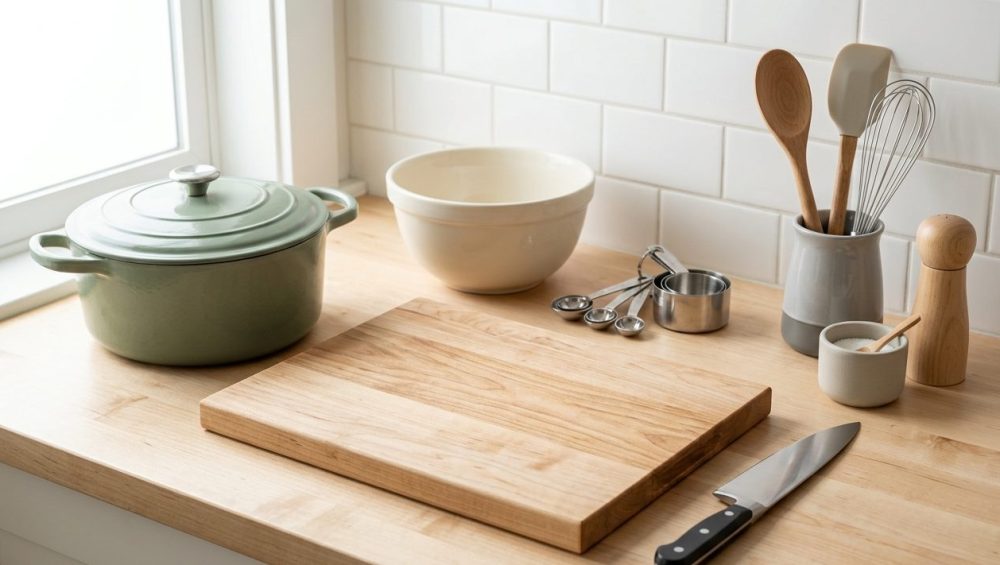
If there is one piece of cookware that embodies both rustic beauty and absolute, undeniable utility, it is the enameled cast iron Dutch oven. A five-and-a-half to six-quart size is perfect for a beginner. This heavy, gorgeous pot is your go-to for hearty soups, slow-simmered stews, braised short ribs, and even baking crusty artisan bread. The cast iron core retains heat like a thermal battery, ensuring even cooking over long periods, while the glass-like enamel coating means you do not have to worry about seasoning the iron or reacting with highly acidic foods like tomato sauce. Leave it sitting on your stovetop twenty-four-seven; it comes in stunning, vibrant colors and serves as a literal centerpiece for your kitchen design.
Carbon Steel vs. Cast Iron Skillets
Since we are ditching toxic non-stick pans, you need a safe, natural alternative for cooking eggs, delicate fish, and quick weeknight stir-fries. Enter the battle of the raw metals: cast iron versus carbon steel. Both require a process called “seasoning”—baking on micro-thin layers of polymerized oil—to create a naturally slick, chemical-free non-stick surface. But they perform very differently in practice.
A traditional cast iron skillet is a ten-pound workhorse. It takes ten to fifteen minutes to preheat properly, but once it gets hot, it stays hot. It is the ultimate tool for getting an aggressive, steakhouse-quality crust on a ribeye or baking a perfect skillet cornbread. However, it is heavy, cumbersome to clean, and terrible at adjusting to quick temperature changes.
Carbon steel, on the other hand, is the darling of professional restaurant kitchens. It is composed of roughly ninety-nine percent iron and one percent carbon, making it significantly lighter and thinner than cast iron. A carbon steel pan heats up in minutes and responds almost instantly when you turn the dial on your stove up or down. Its incredibly smooth, glass-like surface takes a non-stick seasoning beautifully, making it the perfect pan for tossing vegetables, frying delicate eggs, and executing swift, high-heat techniques. For a beginner prioritizing speed and maneuverability on a weeknight, a carbon steel skillet is an absolute game-changer.
The Prep Station: Boards and Bowls
You cannot build a beautiful meal if your prep space is chaotic, cramped, and disorganized. The foundation of a peaceful cooking experience relies entirely on having the right staging area before you even turn on a burner.
The Wooden Cutting Board
Throw away those flimsy, warped plastic cutting boards that slip dangerously around on your counter and harbor deep, un-washable grooves of bacteria. You need a substantial, heavy wooden cutting board. Wood is naturally antimicrobial, incredibly gentle on your expensive knife blades, and visually stunning. Look for edge-grain or end-grain boards made from dense hardwoods like maple, walnut, or teak. Avoid bamboo; while it is marketed as eco-friendly, it is actually a grass bound together with hard glues that will rapidly dull your knives.
A large board—at least fifteen by twenty inches—gives you the runway you need to chop multiple vegetables without them spilling over the sides onto the floor. To keep it from slipping while you chop, simply place a damp paper towel underneath it. Treat it with food-grade mineral oil once a month, and it will outlive you.
Nesting Prep Bowls
Mise en place—the French culinary philosophy of having all your ingredients prepped, measured, and organized before you turn on the heat—is the absolute secret to surviving kitchen disasters. When you are frantically trying to mince garlic while your onions are rapidly burning in the pan, you have already lost the battle. Invest in a set of nesting glass or stainless steel mixing bowls. You need a variety of sizes: tiny ones for spices and minced garlic, medium ones for whisking salad dressings or scrambling eggs, and large ones for tossing salads or marinating meats. Because they nest neatly inside one another, they take up minimal cabinet space while maximizing your efficiency.
The Salad Spinner
I know it is bulky. I know it takes up an annoying amount of cabinet real estate. But a salad spinner is non-negotiable. If you wash your greens and do not dry them completely, the residual water will repel your oil-based vinaigrettes, leaving you with a sad, soggy, flavorless puddle at the bottom of your bowl. A good pump-action salad spinner uses centrifugal force to strip every drop of water from your lettuce, ensuring crisp, restaurant-quality salads every single time. You can also use it to dry freshly washed herbs or berries.
The Unsung Heroes: Utensils That Actually Matter
Your utensil drawer does not need to look like a chaotic junk drawer full of plastic novelty items. We are eliminating the clutter and focusing strictly on high-performance tools that you will reach for daily.
Seamless Silicone Spatulas
Forget the cheap spatulas with wooden handles and removable rubber heads. Water and food particles get trapped inside the joint, creating a horrifying breeding ground for black mold. You need seamless, one-piece silicone spatulas. Silicone is heat-resistant up to six hundred degrees Fahrenheit, meaning you can use it to scramble eggs in your hot carbon steel pan or fold thick, heavy cake batter without melting the edge or snapping the handle.
The Fish Spatula
If you buy only one metal turner for your kitchen, make it a fish spatula. Also known as a slotted offset spatula, this brilliant tool features a thin, flexible, angled metal head. Despite the highly specific name, it is not just for flipping delicate fish fillets. Its sharp, beveled edge is perfect for sliding under roasted vegetables on a sheet pan, flipping pancakes with precision, or pressing down aggressively on a smash burger. It offers a level of tactile feedback and control that a thick, clunky plastic turner simply cannot match.
Spring-Loaded Tongs
Tongs are the literal extensions of your hands in the kitchen. You want sturdy, stainless steel, spring-loaded tongs. I highly recommend buying two pairs: a nine-inch pair for precision work like flipping bacon or tossing pasta, and a twelve-inch pair for reaching into a hot oven or managing a sputtering steak without burning your forearms. Skip the ones with silicone tips unless you are exclusively using non-stick pans; bare stainless steel tips provide a much more secure, confident grip on heavy foods.
The Microplane Grater
This long, rasp-style grater was originally invented as a woodworking tool, but it is an absolute culinary powerhouse. A Microplane grater will change your life. You will use it to zest lemons without hitting the bitter white pith, grate blocks of hard parmesan cheese into light, airy clouds that melt instantly into pasta, and turn whole cloves of garlic or knobs of fresh ginger into a fine paste in mere seconds. It is sharp, efficient, and infinitely better than trying to mince ginger with a knife.
Wooden Spoons and Flat Turners
A kitchen without a wooden spoon has no soul. You need a sturdy wooden spoon for stirring thick, heavy stews, tasting simmering sauces, and generally looking rustic and charming. Even better is a wooden flat turner with a straight edge. This is the perfect tool for scraping fond—those incredibly delicious, caramelized browned bits—off the bottom of your stainless steel pan when you are deglazing with wine or broth. Olive wood and acacia wood are incredibly durable and boast gorgeous grain patterns that look beautiful displayed in a ceramic crock on your counter.
The Bench Scraper
If you want to know a professional chef’s absolute favorite cheap tool, this is it. A bench scraper is essentially a rectangular piece of rigid stainless steel with a handle along the top edge. While bakers use it to portion sticky bread dough, its true value in the home kitchen lies in prep and cleanup. After you chop a massive mountain of vegetables, you use the bench scraper to scoop them all up and transfer them to your pan in one swift, clean motion. It is undeniably your kitchen’s unsung hero. Once you start using one to effortlessly clear scraps off your cutting board directly into the trash, you will wonder how you ever lived without it.
Small Appliances That Are Actually Worth The Counter Space
Most small appliances are gimmicks designed to extract money from well-meaning beginners. However, there are two motorized workhorses that actually justify their existence and the storage space they demand.
The Immersion Blender
Also known as a stick blender, this compact genius allows you to blend hot liquids directly in the pot. Instead of precariously transferring batches of boiling hot butternut squash soup into a traditional countertop blender—and inevitably painting your ceiling orange when the lid blows off—you simply submerge the immersion blender into your Dutch oven and pull the trigger. It is also the ultimate shortcut tool for making a perfect, foolproof mayonnaise or hollandaise sauce in under sixty seconds. When you are done, the blending wand detaches and rinses clean in moments.
A High-Quality Food Processor
While you do not need a food processor for basic chopping, it is an invaluable tool for heavy-duty tasks that would otherwise take hours by hand. A good food processor will shred a one-pound block of cheddar cheese in ten seconds, saving your knuckles from the box grater. It will blitz chickpeas into silky smooth hummus, easily cut cold butter into flour for perfectly flaky pie dough, and finely chop massive quantities of herbs for pesto. It takes the tedious, time-consuming manual labor out of weekend cooking projects.
Bakeware for the Weekend Warrior
Even if you swear you are not a baker, you need proper bakeware. Roasting root vegetables, baking crispy chicken thighs, and making a quick batch of chocolate chip cookies all require the exact same fundamental equipment.
Heavy-Duty Aluminum Half-Sheet Pans
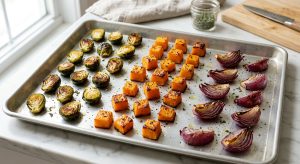
Do not buy those flimsy, dark-coated “cookie sheets” from the baking aisle of the grocery store. They warp with a terrifying, loud bang in a hot oven, and their dark finish absorbs too much heat, burning the bottoms of your food before the top is cooked. You need commercial-grade, heavy-gauge aluminum half-sheet pans, which measure eighteen by thirteen inches. Aluminum is a phenomenal conductor of heat, ensuring your roasted broccoli gets perfectly crispy and your cookies bake evenly. They are incredibly cheap, virtually indestructible workhorses that you will use for everything.
Wire Cooling Racks
A stainless steel wire rack that fits perfectly inside your half-sheet pan is a mandatory accessory. Yes, it cools your baked goods so the bottoms do not get soggy, but more importantly, it elevates your savory proteins. If you want to dry-brine a thick steak in the fridge overnight or bake incredibly crispy chicken wings, placing the meat on a wire rack allows air to circulate underneath. This prevents the bottom of the meat from steaming in its own juices, guaranteeing a crispy exterior all the way around.
The 9×13 Baking Dish
For casseroles, lasagnas, baked ziti, and fruit cobblers, you need a standard nine-by-thirteen-inch baking dish. While metal is best for roasting, ceramic or tempered glass is superior for these types of dishes. Ceramic provides gentle, even heat that prevents the edges of your lasagna from burning before the center is bubbly and hot. Plus, a beautiful enameled ceramic dish can go straight from the oven to the dining table, doubling as an elegant serving vessel.
Precision and Measurement (Because Baking is Science)
Cooking is an art; you can add a splash of wine here or an extra handful of cheese there, and the dish will survive. Baking, however, is a ruthless science. If you try to eyeball your flour measurements or guess the ratio of yeast to water, you are going to end up with a dense, inedible brick. Precision is absolutely non-negotiable.
The Digital Kitchen Scale
Throw away your volumetric measuring cups for dry ingredients right now. Scooping flour into a cup can result in wildly different amounts depending on how densely you pack it. A cup of loosely scooped flour might weigh four ounces, while a tightly packed cup could weigh six. That twenty-percent difference will ruin your cake. A sleek, slim-profile digital kitchen scale solves this problem entirely. Weighing your ingredients in grams is faster, creates significantly fewer dishes to wash (since you just tare the scale to zero and add the next ingredient directly into the bowl), and guarantees perfect, repeatable results every single time. Plus, a good digital scale is incredibly thin and can be tucked away into a drawer or stored vertically on a shelf like a book.
Liquid vs. Dry Measuring Cups
For liquid ingredients like milk, oil, or broth, you need a glass liquid measuring cup with a spout. Liquids behave differently than dry goods; to measure them accurately, you must view the liquid at eye level and check the meniscus (the slight curve at the surface of the liquid). You cannot do this accurately with a metal dry measuring cup.
Stainless Steel Measuring Spoons
For small amounts of spices, baking soda, or vanilla extract, you still need measuring spoons. Skip the cheap plastic ones attached to a frustrating plastic ring—they warp in the dishwasher, their printed labels rub off, and they absorb strong, lingering odors like cumin and raw garlic. Invest in heavy-duty stainless steel measuring spoons. Look for a set with a narrow, rectangular design rather than round bowls; the narrow shape allows them to fit easily inside the mouths of standard spice jars without spilling.
Organizational Systems for the Aesthetically Inclined
You can own the absolute best culinary tools in the world, but if you cannot find them when you desperately need them, your cooking experience will be miserable. An intentionally organized space is the ultimate key to turning cooking into a peaceful daily habit. Visual clutter translates directly to mental clutter.
Decanting and Labeling
Nothing ruins the carefully curated aesthetic of a beautiful kitchen faster than a pantry crammed with half-open, brightly colored cardboard boxes, torn bags of rice, and leaking sacks of flour. Decanting your dry goods—flour, sugar, oats, pasta, and lentils—into matching glass jars with airtight bamboo or silicone lids is visually soothing and practically brilliant. It keeps your ingredients significantly fresher, protects against dreaded pantry pests, and allows you to see exactly how much inventory you have at a single glance. Pair them with minimalist, waterproof labels, and your pantry will instantly look like a high-end artisanal boutique.
Drawer Dividers and Tension Rods
Stop throwing your utensils haphazardly into a drawer and hoping for the best. Adjustable bamboo drawer dividers allow you to customize compartments to fit your specific tools perfectly, keeping your silicone spatulas separated from your whisk and your wooden spoons.
For your heavy bakeware, utilize vertical tension rods or specialized wire dividers in your lower cabinets. Storing your sheet pans, heavy wooden cutting boards, and wire cooling racks vertically—like files in a filing cabinet—prevents that deafening, frustrating clatter when you try to violently pull one out from the very bottom of a heavy stack.
The 5-Zone Kitchen Method
If you really want to master your workflow and move like a professional, you need to implement a spatial strategy like the 5-zone system. This philosophy means organizing your kitchen strictly by task. You create a preparation zone near the trash and sink with your knives and cutting boards; a cooking zone right next to the stove holding your pots, pans, and spatulas; a baking zone housing your flour, sugar, and digital scale; a consumable storage zone (the pantry and fridge); and a non-consumable storage zone for your everyday plates and glassware. It minimizes unnecessary walking back and forth across the kitchen and keeps you entirely focused on the food in front of you.
Conclusion: Your Kitchen, Your Rules
Building your dream kitchen does not require an unlimited budget, nor does it require buying a hundred different highly-specialized, single-use gadgets that will just gather dust. It requires patience, intentionality, and a stubborn refusal to settle for toxic, poorly made equipment. By focusing heavily on high-quality basics—a razor-sharp chef’s knife, a reliable and safe stainless steel skillet, a heavy wooden cutting board, and smart organizational systems—you are setting yourself up for a lifetime of culinary success.
Let us be brutally honest: you are going to make mistakes. You will occasionally burn the garlic, overcook a very expensive steak, or accidentally drop a carton of eggs on the floor. That is all part of the messy, beautiful process of learning. Identifying and fixing rookie kitchen mistakes is exactly how you learn, grow, and eventually develop the deep intuition required to cook a masterpiece without ever looking at a recipe. But when you equip yourself with the right tools, those inevitable mistakes become minor, laughable speed bumps rather than total evening-ruining disasters.
The goal here is not to create a sterile, untouchable, museum-like showroom. The goal is to build a warm, inviting, and highly functional space where you can pour your creative energy into making incredible meals for yourself and the people you love. When you have the right tools, cooking stops being a stressful chore and becomes a genuine joy. Now, get out of the takeout line, clean out those chaotic drawers, and start building the kitchen you actually deserve. The beautiful art of effortless hosting begins long before your guests ever arrive—it begins the exact moment you decide to treat your kitchen with the respect it deserves. Now go chop something.