Listen up, folks. We need to have a serious conversation about your breakfast. You spend all week surviving on stale granola bars, lukewarm coffee, and whatever questionable leftovers you can microwave in under two minutes. But the weekend? The weekend is sacred. The weekend is when we don the apron, pour a proper cup of coffee, and set out to create a culinary masterpiece. And at the center of that masterpiece is the undisputed king of the breakfast table: bacon.
Yet, despite its legendary status, most of you are absolutely butchering it. I’ve seen the photos you post. I’ve seen the curled, blackened, shriveled little meat-pucks you try to pass off as a side dish. I’ve witnessed the tragic skillet scenes where half the strip is flabby, translucent rubber, and the other half is carbonized beyond recognition. It is a culinary crime, and frankly, I am tired of watching you suffer. Throwing raw pork into a blistering hot, dry skillet is one of the most common rookie kitchen mistakes out there.
But do not despair. I am not here to judge you (okay, maybe just a little). I am here to save you. I am here to tell you that you do not need a culinary degree to achieve professional-level results in your standard home kitchen. You just need a little bit of science, a dash of patience, and a technique that will completely revolutionize your Sunday mornings. The secret to perfectly flat, evenly crisped, shatteringly beautiful bacon isn’t a heavy cast-iron press or a magical spatula.
The secret is water.
Yes, you heard me correctly. We are going to boil your bacon. Before you close this tab in disgust, grab a glass of wine (or a mimosa, it’s brunch after all), sit down, and let me explain the thermodynamics of rendering fat. Because once you understand the “why,” the “how” becomes effortless.
The Anatomy of a Strip: Muscle, Fat, and the Flaws of Dry Frying
To understand why the water method works, we first need to dissect what bacon actually is. Bacon is not a uniform piece of meat. It is a highly complex, heterogeneous cut derived from the belly of a pig. It consists of two entirely distinct components that behave completely differently when exposed to heat: the lean muscle tissue and the adipose tissue (the fat).
The Lean Muscle
The dark pink streaks in your bacon are the lean muscle fibers. This meat is packed with proteins and moisture. When exposed to high heat, the proteins denature, coagulate, and rapidly expel their internal water. If heated too quickly, these muscle fibers seize up, shrink violently, and dry out. This rapid contraction is exactly what causes your bacon to curl up into a chaotic, unmanageable shape. Once the moisture is gone, the muscle begins to burn, turning bitter and acrid.
The Adipose Tissue
The white sections of the bacon are the adipose tissue. Unlike muscle, fat does not contain much water. Instead, it is a matrix of lipid cells held together by a network of connective tissue. In order for the fat to become palatable—crispy, light, and meltingly tender—it must be “rendered.” Rendering is the process of slowly melting the solid fat out of the cellular matrix, leaving behind a delicate, crispy structure.
Herein lies the fundamental problem with dry-frying bacon: these two components have vastly different cooking timelines. Lean muscle cooks in mere minutes and burns shortly thereafter. Adipose tissue, on the other hand, takes its sweet, sweet time to render.
When you drop a slice of cold bacon into a hot, dry skillet, the pan’s temperature immediately attacks the lean muscle. The meat seizes, curls, and begins to burn before the fat has even had a chance to warm up. The curling lifts sections of the bacon off the surface of the pan, leading to wildly uneven cooking. You are left with a strip that is burnt on the edges, raw in the middle, and structurally compromised. It is a disaster.
Wet-Cured vs. Dry-Cured: A Historical Context
Before we even get to the pan, we must address the profound difference between modern supermarket bacon and traditional artisan bacon. Historically, bacon was preserved using a dry-cure method. Pork bellies were rigorously rubbed with a mixture of salt, sugar, and nitrates, then left to cure for weeks. The salt naturally pulled moisture out of the meat through osmosis, resulting in a dense, intensely flavored slab that was then slowly smoked over hardwood.
In the mid-20th century, the industrial food complex realized that time is money. To speed up production and increase profit margins, they invented the wet-curing process. Instead of drawing moisture out, industrial producers inject the pork bellies with a liquid brine solution using hundreds of hypodermic needles. This plumps up the meat, adding significant water weight (which you unfortunately pay for by the pound).
When you attempt to dry-fry wet-cured bacon, you are essentially throwing a water-logged sponge into a searing hot pan. The injected water violently boils out of the muscle fibers, causing chaotic splattering, while the temperature of the pan wildly fluctuates. This makes the water-start method even more critical for modern home cooks. By starting with water in the pan, you are gently coaxing that industrial brine out of the meat, normalizing the moisture content before the high-heat frying phase begins.
The Thermodynamics of the Water Method: A Scientific Deep Dive
This is where our magical ingredient comes into play. By adding a shallow layer of water to the pan with your raw bacon, you are fundamentally altering the thermodynamic environment of the skillet. You are introducing a thermal buffer that forces the pan to play by a new set of rules.
The 212°F Ceiling
As any high school physics student knows, liquid water under normal atmospheric conditions cannot exceed its boiling point of 212°F (100°C). No matter how high you crank the dial on your stove, as long as there is liquid water in that pan, the temperature of the cooking environment is strictly capped at 212°F.
This temperature ceiling is an absolute godsend for the adipose tissue. Pork fat begins to soften and melt at around 130°F, and it renders beautifully and efficiently between 140°F and 190°F. By holding the pan at a steady 212°F, the water creates a gentle, simmering jacuzzi for the bacon. The stubborn fat has all the time in the world to break down, melt, and release its liquid gold into the pan.
Meanwhile, the lean muscle is protected. Because the temperature cannot spike to searing levels, the muscle fibers cook gently. They do not seize. They do not violently contract. The bacon remains perfectly flat, relaxing into the pan as the fat slowly dissolves.
The Evaporation Phase
As the bacon simmers, the water is slowly evaporating. This is a crucial phase. You are not boiling the bacon into a soggy, gray oblivion. You are using the water as a temporary shield. By the time the water has completely boiled off and evaporated into the atmosphere, the fat has fully rendered. The pan is now coated in a generous layer of liquid pork fat, and the bacon strips are relaxed, flat, and structurally prepped for the final stage.
The Maillard Reaction: From Simmer to Sear
Once the water is entirely gone, the thermodynamic brakes are released. The temperature of the pan, no longer held back by the boiling point of water, begins to rise rapidly. But this time, the environment is perfectly primed for culinary magic.
The bacon is now sitting in a shallow pool of its own rendered fat. Fat can reach much higher temperatures than water without evaporating. As the temperature climbs past 284°F (140°C), we enter the holy grail of food science: the Maillard reaction.
The Chemistry of Flavor
The Maillard reaction is a complex chemical cascade that occurs between amino acids (proteins) and reducing sugars when exposed to high heat. It is the exact same reaction that gives a seared steak its crust, a loaf of bread its golden exterior, and roasted coffee its deep, intoxicating aroma. The optimal temperature zone to achieve this reaction without burning sits between 284°F and 330°F (140°C – 165°C).
Because the bacon is lying perfectly flat, submerged in its own evenly distributed fat, the Maillard reaction occurs uniformly across the entire surface of the strip. There are no curled edges lifting away from the heat. There are no dry spots burning into charcoal. The rendered fat acts as a highly efficient conductive medium, transferring heat directly into the meat. This is the ultimate, scientifically validated method for accelerating the Maillard reaction without risking a burnt, bitter disaster.
The result is a strip of bacon that is evenly caramelized, shatteringly crisp, and deeply flavorful from edge to edge.
The “No-Go” Rule: Stop Poisoning Your Breakfast
Before we get to the step-by-step instructions, we need to have a serious talk about your equipment. As your resident Sassy Sous-Chef, I have a strict “No-Go” rule when it comes to cheap, toxic kitchenware. I do not care how convenient you think it is; if you are cooking your bacon in a flaky, scratched, ten-dollar non-stick pan you bought at a discount store five years ago, you need to throw it in the garbage immediately.
The Dangers of PTFE and Teflon
Traditional non-stick pans are coated with polytetrafluoroethylene (PTFE), most commonly known by the brand name Teflon. While manufacturers claim these pans are safe for everyday use, the science tells a much darker story when high heat is involved.
When a PTFE-coated pan is heated above 500°F (260°C), the chemical bonds in the coating begin to break down. As the coating degrades, it off-gasses a cocktail of highly toxic fumes, including perfluoroisobutylene (PFIB) and other per- and polyfluoroalkyl substances (PFAS). These fumes are so toxic that they are famously known to be fatal to pet birds kept in the vicinity of the kitchen. In humans, inhaling these fumes causes a condition known as “polymer fume fever,” or “Teflon flu,” characterized by severe chills, headaches, and respiratory distress.
You might be thinking, “But I never cook my bacon at 500 degrees!” Think again. A dry non-stick pan placed on a high stovetop burner can easily exceed 700°F in less than five minutes. The moment you preheat that flimsy pan to get a sear on your meat, you are crossing into dangerous territory.
The Upgrade You Deserve
It is time to take your health and your cooking seriously by banishing toxic kitchen gear from your home once and for all. You do not need a synthetic chemical coating to prevent your food from sticking. You need quality materials and proper technique.
For the water method—and frankly, for almost all of your searing needs—you should be using heavy, durable cookware. A high-quality cast iron skillet is a classic choice, offering incredible heat retention. Alternatively, tri-ply stainless steel pans are brilliant for even heat distribution and building a beautiful fond. If you want the ultimate combination of naturally non-stick properties and professional durability, invest in carbon steel cookware. Once properly seasoned, carbon steel will release a fried egg just as easily as Teflon, without the risk of toxic off-gassing. Plus, you will never have to worry about accidentally ruining your nonstick pans with a metal spatula ever again.
The Definitive Masterclass: The Water-Start Technique Step-by-Step
Alright, we have covered the biology, the thermodynamics, the chemistry, and the equipment. It is time to put on your apron and get to work. Here is the foolproof, step-by-step guide to executing the water-start method flawlessly.
Step 1: Sourcing the Right Bacon
Great cooking starts with great ingredients. Leave the paper-thin, artificially injected, watery supermarket bacon on the shelf. You want thick-cut, dry-cured bacon. Dry-cured bacon has had the moisture naturally drawn out of it through a traditional curing process involving salt and time. It has a significantly deeper, more concentrated pork flavor and far less excess water than the cheap, wet-cured alternatives that are pumped full of brine.
Step 2: The Cold Start
Place your heavy-bottomed skillet (cast iron, carbon steel, or stainless steel) on the stove. Do not turn the heat on yet. Arrange your strips of bacon in the cold pan. It is perfectly fine if they overlap slightly; as the fat renders and the meat cooks, the strips will shrink and naturally create more space in the pan. Starting cold allows the temperature to rise gradually, giving the fat a head start on the rendering process before the water even begins to boil.
Step 3: The Hydration Phase
Pour cold tap water directly into the skillet. How much water? You do not want to drown the bacon. You are not making a pork soup. You want just enough water to barely cover the bottom of the pan and coat the strips. A shallow puddle, roughly a quarter-inch deep, is the perfect amount.
Step 4: The Simmer
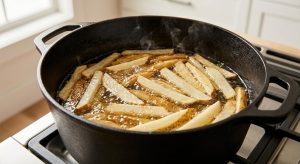
Turn the burner to medium-high heat. Stand back and watch the science unfold. The water will quickly come to a rolling boil. As it boils, you will notice the white, opaque fat of the bacon beginning to turn translucent. This is the visual confirmation that the adipose tissue is breaking down and releasing its rendered fat into the water. The meat will begin to look slightly gray and unappetizing. Do not panic. Trust the process.
Step 5: The Evaporation and the Sizzle
Keep a close eye on the pan. Over the next several minutes, the water will vigorously boil off. You need to use your ears for this next transition. The sound of boiling water is a low, rolling, bubbly rumble. The moment the last drop of water evaporates, the sound will abruptly change. It will transition into a sharp, aggressive, high-pitched crackle and hiss. That is the sound of the rendered pork fat taking over. The boiling phase has ended; the frying phase has begun.
Step 6: The Golden Sear
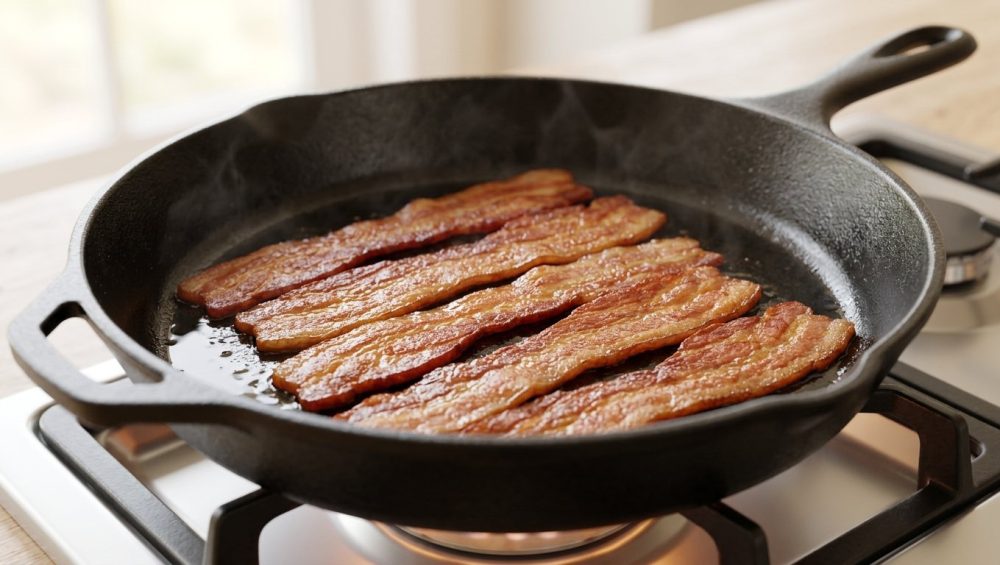
As soon as you hear that sharp sizzle, immediately reduce the heat to medium-low. The pan is now coated in hot liquid fat, and the Maillard reaction is engaging. Because the bacon is already fully cooked through from the boiling phase, your only job now is to crisp the exterior. Let the bacon fry in its own fat for about two to three minutes per side. You will notice that the strips are lying perfectly flat against the metal. Flip them gently with a pair of tongs. They will develop a deep, rich, mahogany-brown crust that is evenly distributed from edge to edge.
Step 7: The Drain and Rest
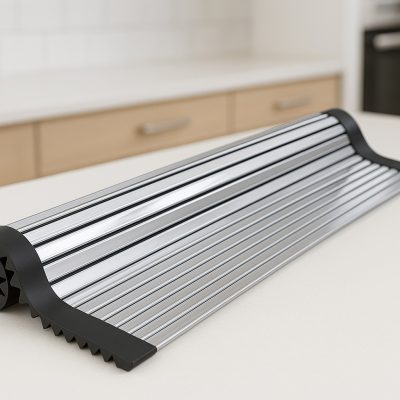
Once the bacon has reached your desired level of crispness, remove the skillet from the heat. Do not transfer the bacon to a plate lined with a mountain of paper towels. Paper towels trap steam, and steam is the enemy of crispness. Instead, transfer the strips to a wire cooling rack set over a baking sheet. This allows the excess grease to drip away while air circulates entirely around the meat, ensuring that the shattering crunch is preserved as the bacon cools.
Weekday Efficiency vs. Weekend Perfectionism
Now, let me be completely transparent with you. I am a realist. I know that time is money. When it is 7:00 AM on a Tuesday, you are rushing to get out the door, and you just need some quick protein to fuel your morning, I do not expect you to stand over a stove monitoring the evaporation rate of a skillet. If you are focused on throwing together simple weeknight dinners or a lightning-fast breakfast, the oven-baking method (laying bacon on a parchment-lined sheet pan at 400°F) or even the dreaded microwave method (sandwiched between paper towels) are acceptable compromises for the sake of efficiency.
But cooking is not always about mere survival. Sometimes, cooking is about craftsmanship. When Sunday morning rolls around, and you have the time to pour a second cup of coffee and put on a good record, you owe it to yourself to do things the right way. The water method is for the weekend perfectionist. It is for the cook who understands that the best things in life require a little bit of intention.
Troubleshooting Your Bacon Woes: FAQs
Even with a foolproof method, questions arise. Let’s address the most common concerns.
“Won’t the water make my bacon soggy?”
This is the number one objection I hear, and it completely ignores the laws of physics. Water evaporates at 212°F. The Maillard reaction (browning and crisping) happens at around 300°F. By the time your bacon is actually crisping up, there is absolutely zero water left in the pan. The water is a temporary vehicle for temperature control, not a permanent marinade. The final product will be crispier than anything you have ever dry-fried.
“What about the grease splatter? I hate cleaning the stove.”
Here is a beautiful bonus of the water method: it drastically reduces grease splatter. Splatter occurs when microscopic pockets of water inside the bacon violently expand into steam and pop through the surrounding fat. Because the water method slowly and gently renders the fat out before the high-heat frying begins, there are very few violent moisture pockets left to explode. The frying phase is a controlled, gentle sizzle rather than a chaotic grease-volcano.
“My bacon is still curling! What did I do wrong?”
If you used the water method and your bacon still resembles a corkscrew, there are two potential culprits. First, you may have sliced the bacon far too thin. Paper-thin bacon lacks the structural integrity to hold its shape, even under gentle heat. Always opt for thick-cut. Second, you may have rushed the evaporation phase by cranking the heat to “High.” The water method relies on a controlled, medium-high simmer. If the heat is too aggressive, the water boils off too rapidly, and the muscle fibers are subjected to a violent temperature spike before the fat has had adequate time to render. Patience is your greatest tool in the kitchen.
“Can I use this method for turkey bacon or vegan bacon alternatives?”
Absolutely not. Let me be perfectly clear: the thermodynamics of this method are entirely dependent on the presence of abundant, renderable animal fat (adipose tissue). Turkey bacon is highly processed, ultra-lean meat that has been ground up and reformed to vaguely resemble a strip of pork. It contains virtually no renderable fat. If you boil turkey bacon, you will simply end up with hot, wet, gray turkey meat. The same applies to plant-based alternatives, which rely on added oils that behave completely differently than cellular animal lipids. The water method is strictly for the real deal: authentic, glorious pork belly.
“What should I do with the leftover fat in the pan?”
If you throw that fat down the drain, I will personally come to your house and revoke your cooking privileges. That rendered fat is culinary liquid gold. Because the water method prevents the bacon from burning, the leftover fat is incredibly clean, clear, and pure. Let it cool slightly, then strain it through a fine-mesh sieve or a coffee filter into a glass mason jar. Store it in the fridge. You can use it to roast potatoes, fry eggs, or even as a base for turning burnt bits into sauce when deglazing a pan after searing a pork chop.
Advanced Flavor Manipulations: Elevating the Classic
Once you have mastered the basic water-start technique, the pan becomes your canvas. Because the bacon lies perfectly flat and cooks so evenly, it is the ideal foundation for advanced flavor profiles. Even a clueless cook can execute these upgrades with ease.
The Black Pepper and Maple Glaze
During the final two minutes of the frying phase, after the water has evaporated and the bacon is crisping in its own fat, use a pastry brush to lightly coat the top side of the strips with pure, high-quality maple syrup. Immediately hit it with a heavy dusting of freshly cracked black pepper. Flip the bacon for exactly thirty seconds to let the sugars in the syrup aggressively caramelize in the hot fat, then remove immediately to your wire rack. The result is a complex, sweet, spicy, and savory masterpiece.
The Bourbon Finish
For a truly decadent brunch, wait until the water has evaporated and the bacon is just beginning to brown. Carefully pour one tablespoon of good quality bourbon into the pan. The alcohol will rapidly deglaze the skillet and evaporate, leaving behind the deep, oaky, vanilla notes of the liquor infused directly into the meat.
The Final Bite
Cooking does not have to be a source of anxiety. You do not need a Michelin star to make mind-blowing food in your own home. You just need to respect the ingredients, understand the basic science of how heat interacts with your food, and refuse to settle for mediocre results.
By simply adding a splash of water to your skillet, you are taking control of the thermodynamic environment. You are dictating the terms of the cook, rather than letting a wildly fluctuating pan dictate them to you. It is these small, deliberate, scientifically sound adjustments that elevate your food from edible to extraordinary.
So, this weekend, I challenge you to ditch the dry-fry. Throw out that peeling, toxic non-stick pan. Grab your heaviest cast iron, source some beautiful thick-cut bacon, and turn on the tap. It is time to stop burning your breakfast and start treating your food with the respect it deserves. Welcome to a whole new world of culinary confidence. It is time to transform your daily cooking into an art form, one perfectly rendered strip of bacon at a time.