Picture this: It is Friday night. You have spent the better part of the last hour diligently setting up a breading station, dodging rogue grease splatters, and carefully babysitting a bubbling vat of hot oil. You finally pull a piece of fried chicken out of the skillet. It looks absolutely magnificent. The crust is a craggy, golden-brown landscape of pure perfection. You set it down on a paper-towel-lined plate, feeling like an absolute culinary deity.
Ten minutes later, you sit down at the table, ready to reap the rewards of your hard work. You take a bite, fully expecting a deafening, shatteringly crisp crunch. Instead, your teeth sink into a wet, flabby, sad sponge. The breading slides right off the meat in a greasy, soggy sheet. Your masterpiece is ruined, and you are left wondering why you didn’t just order takeout.
Welcome to the heartbreak of the soggy bottom.
As a home cook who learned the ropes by setting off the smoke detector more times than I care to admit, I have zero patience for pretentious chef-speak. However, I do have a profound, uncompromising respect for basic physics. You absolutely do not need a culinary degree to make mind-blowing, restaurant-quality food in your own kitchen. You just need to stop making the same rookie kitchen mistakes that are quietly sabotaging your meals. And the biggest, most tragic mistake of all? Letting your hot food suffocate in its own steam.
If you want to banish soggy breading from your life forever, it is time to throw away the paper plates and embrace the absolute magic of a heavy-duty wire cooling rack. But to understand why this simple tool is so revolutionary, we need to take a deep dive into the science of why your food gets soggy in the first place.
The Physics of the Fry: How Crispiness is Born
To understand how to keep food crispy, we first have to look at what frying actually is. It is a common misconception that frying is simply “cooking food in fat.” From a thermodynamic standpoint, deep-frying and pan-frying are actually violent, high-speed dehydration processes.
The Myth of Boiling Oil
When you drop a piece of battered chicken into a skillet of 350°F oil, the surface moisture of the food instantly reacts. Water boils and turns to steam at 212°F. Because the oil is vastly hotter than the boiling point of water, the moisture on the exterior of the chicken flashes into a gas in milliseconds. When water makes that phase change from a liquid to a gas, it expands to roughly 1,600 times its original volume.
Those furious, aggressive, rolling bubbles you see in the deep fryer? That is not the oil boiling. Oil doesn’t boil at those temperatures; it smokes and catches fire. Those bubbles are actually the water inside your food violently turning into steam and fighting its way out into the atmosphere.
The Maillard Reaction and Structural Integrity
As this water rapidly vacates the premises, it leaves behind a network of tiny, microscopic empty spaces in the flour or batter. The intense heat causes the proteins in the breading to coagulate and the starches to gelatinize and harden into a rigid matrix. Simultaneously, the Maillard reaction—that magical, complex chemical process between amino acids and reducing sugars—kicks into overdrive, turning the exterior a beautiful, savory, aromatic golden brown.
This rigid, dehydrated, porous, sponge-like structure is what we experience in our mouths as “crispiness.” You have essentially built a delicate, crunchy armor around your food. But this armor has a fatal weakness: water.
The Thermodynamics of the Sog: Why Your Crust is Sweating
Here is where the tragedy begins. The outside of your chicken (or french fry, or mozzarella stick) might be perfectly dry and shatteringly crisp the moment it leaves the oil, but the inside is a completely different story. The interior of the meat is still piping hot and packed with moisture.
Moisture Migration: The Enemy Within
Thanks to a thermodynamic principle known as moisture migration, water always wants to move from an area of high concentration to an area of low concentration. In the context of your dinner, that means the steaming hot juices inside the chicken are actively trying to push their way outward into the bone-dry crust you just worked so hard to create.
Even after you pull the food out of the hot oil, the residual internal heat continues to drive moisture outward in the form of steam. If that steam hits the open air, it harmlessly evaporates into the room. But what happens when you take that hot, actively steaming piece of chicken and set it down flat on a cold dinner plate?
The Condensation Trap
When the escaping steam hits the impenetrable, flat barrier of the plate, it has absolutely nowhere to go. Because the surface of the plate is significantly cooler than the escaping gas, the thermodynamics of condensation immediately kick in. The steam rapidly cools, loses its thermal energy, and converts right back into liquid water.
That water pools directly underneath your food. Remember that beautiful, porous, dehydrated crust we talked about earlier? In a matter of minutes, it acts exactly like a dry sponge, aggressively soaking up that puddle of condensation. Congratulations. You just steamed your own fried chicken.
The Paper Towel Trap: A Generational Culinary Lie
“But wait!” I can hear you screaming through the screen. “I don’t put my fried food directly on a plate! I put it on a paper towel! My grandmother always used paper towels!”
I am sure your grandmother is a lovely woman who makes a fantastic pie, but on this specific issue, she was dead wrong. The paper towel method is one of the most pervasive, stubbornly held myths in home cooking history.
Capillary Action vs. Vapor Lock
Yes, paper towels serve a legitimate mechanical purpose. Through the physics of capillary action, paper towels are incredibly effective at wicking away liquid fat. When you first pull food from the fryer, there is always a bit of residual surface oil clinging to the crust. A quick, three-second dab on a paper towel will brilliantly absorb that excess grease.
But leaving the food to sit, rest, and cool on a flat layer of paper towels is a one-way ticket to Mushville.
A paper towel lying flat on a plate still creates an impenetrable barrier to airflow. It creates a vapor lock. As the steam escapes from the bottom of the hot food, it hits the paper towel. The towel absorbs the steam and immediately becomes damp. Now, instead of your chicken sitting in a puddle of water, it is sitting on a hot, wet, greasy sponge. The moisture migration continues unabated, the steam remains trapped, and the bottom of your food turns into absolute sludge.
If your chicken always turns out dry and stringy on the inside but inexplicably soggy on the outside, this is exactly why. You likely overcooked the meat trying to get the crust extra crispy in the pan, and then immediately ruined that hard-earned crust by smothering it on a paper plate. Sogginess is rarely a grease problem; it is almost exclusively a water condensation problem.
The 360-Degree Airflow Solution: Convective Cooling Explained
If trapped steam is the undisputed enemy of crispiness, then unobstructed airflow is the ultimate hero. This is where the stainless steel wire cooling rack steps into the spotlight as one of the most essential tools every beginner needs in their kitchen arsenal.
How Convection Saves Your Crust
By elevating your hot food an inch or two above the countertop or baking sheet, you are fundamentally altering the physics of the cooling process. Instead of conducting heat directly into a flat, solid surface, the food is allowed to undergo convective cooling.
Air acts as a fluid. As the intense heat radiating from the fried food warms the air immediately surrounding it, that warm air naturally rises. Cooler, drier room-temperature air rushes in from underneath the open wire rack to replace it. This continuous thermodynamic loop creates a gentle, constant, 360-degree circulation of air around the entire piece of food.
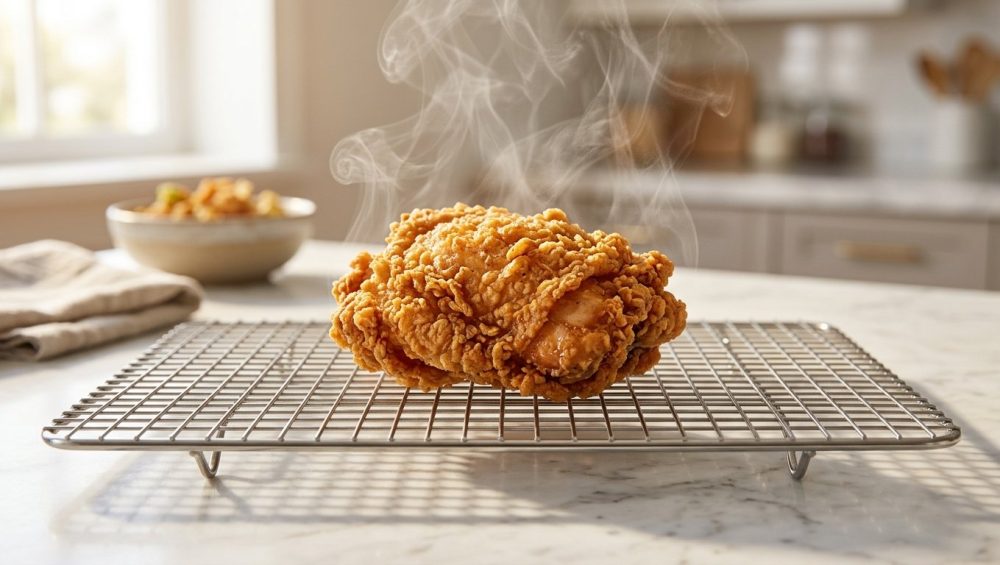
When the steam escapes from the bottom of the crust, it no longer hits a brick wall. It simply drifts downward and is carried away by the circulating air currents. Because the steam is allowed to vent freely into the atmosphere, condensation never has a chance to form. The crust remains completely dry, the internal starch structure stays rigid, and that glorious, deafening crunch is preserved perfectly.
To achieve the absolute extra crispy chicken of your dreams, your workflow should look like this: pull the food from the hot oil, give it a rapid toss in a paper-towel-lined bowl just to dab off the surface grease, and then immediately transfer it to a wire cooling rack set over a baking sheet. The rack lets the food breathe, while the sheet catches any stray drips of oil.
The “No-Go” Rule: Why Your Cheap Rack is Toxic and Ruining Your Food
Now, we need to have a very serious conversation about your equipment. As your resident Sassy Sous-Chef, I have a strict, uncompromising “No-Go” rule: I absolutely despise cheap, toxic, poorly manufactured kitchenware.
Most weekend cooks will grab whatever flimsy, five-dollar shiny rack they happen to find hanging in the baking aisle of the local grocery store. This is a massive mistake. Not all wire racks are created equal, and the cheap ones are actively ruining your food, testing your sanity, and potentially leaching garbage into your meals.
The Danger of Chrome-Plated Steel
The vast majority of budget cooling racks are made of cheap carbon steel that has been dipped in a micro-thin layer of chrome plating to make it look shiny and professional on the shelf. They look great for exactly one week. But the moment you put a chrome-plated rack in the dishwasher, the harsh, highly alkaline detergents strip the plating right off. The chrome begins to blister and flake—often directly into your food—exposing the raw, unprotected steel underneath.
Once that raw steel is exposed to moisture, it rusts instantly. There is nothing quite as appetizing as pulling your gorgeous fried chicken off a rack and finding a thick streak of orange iron oxide permanently stained into the breading. Chrome-plated racks are disposable, toxic garbage. Do not buy them.
The Aluminum Warping Disaster
Some racks are manufactured from aluminum. While aluminum is a fantastic conductor of heat for baking pans, it is incredibly soft and structurally weak when drawn into thin wires. When exposed to the high heat of an oven (if you are using the rack for roasting) or the sudden thermal shock of hot food, thin aluminum racks will warp dramatically.
When a rack warps and bows in the middle, it loses its flat stability. Your food slides around, and worse, if you are using it to cool a delicate pastry, the uneven surface will literally snap your sponge cake in half. You need absolute rigidity, and aluminum simply cannot provide it.
The Non-Stick Nightmare
I will shout this from the rooftops until I lose my voice: stop buying non-stick coated cooling racks. Non-stick coatings (like PTFE or Teflon) are entirely unnecessary for a cooling rack. More importantly, these chemical coatings degrade rapidly at high temperatures. If you decide to use your non-stick rack in a 425°F oven to roast chicken wings, that cheap coating is going to blister, peel, and release toxic fumes into your kitchen. Keep the mystery chemicals far away from your food. If you find that delicate food sticks to your stainless steel racks, a light brush of neutral cooking oil before use is all you will ever need.
Anatomy of the Perfect Wire Cooling Rack
So, if chrome, aluminum, and non-stick coatings are strictly forbidden, what exactly is the holy grail of wire racks? When you are shopping to upgrade your kitchen, you need to look for three specific, non-negotiable features.
304-Grade Stainless Steel: The Non-Negotiable Standard
This is the absolute gold standard. 304-grade stainless steel (often labeled as 18/8 or 18/10) contains 18% chromium and 8% to 10% nickel. This specific metallurgical blend makes the steel incredibly resistant to corrosion, rust, and thermal shock. True stainless steel has no chemical plating to chip off; it is solid metal all the way through. It is highly durable, oven-safe up to 500°F, and 100% dishwasher safe. Buy it once, and it will last you a lifetime.
The Cross-Wire Grid Pattern
Look closely at the design of the rack. Many cheap racks feature parallel wires running in only one single direction. These are practically useless. If you try to cool a fresh, warm chocolate chip cookie on a parallel wire rack, the soft, molten dough will sag heavily between the wires, creating deep, permanent, ugly grooves in the bottom of your cookie.
You need a tight, cross-wire grid pattern. The intersecting wires provide maximum structural support for delicate baked goods, prevent small items (like french fries or roasted nuts) from slipping through the cracks, and offer superior weight distribution for heavy cuts of meat.
Heavy-Gauge Construction and the Half-Sheet Fit
You want a rack that feels noticeably heavy in your hands. It should be constructed from thick-gauge wire with multiple cross-support bars welded underneath for reinforcement. A heavy-duty rack will not warp, bend, or buckle, even if you drop a massive ten-pound holiday roast on it.
Size also matters immensely. The most versatile size for a home kitchen is a rack designed to fit perfectly inside a standard half-sheet pan (roughly 12 x 17 inches). This allows you to nest the rack inside the pan, turning it into a contained system for catching grease drips or roasting meats without making a catastrophic mess of your oven floor. If your cheap baking sheets keep warping under the broiler, make sure you are upgrading to heavy-duty commercial aluminum half-sheets to pair perfectly with your new heavy-duty stainless racks.
Beyond Fried Chicken: The Ultimate Multitasking Tool
If you think a cooling rack is just a highly specific unitasker meant only for deep-frying days, you are severely underestimating its power. Transforming a stressful chore into kitchen artistry is all about utilizing clever tools that work overtime. A heavy-duty wire rack is the secret weapon for almost every thermal process in your kitchen.
Halting the Bake: Saving Your Pastries
There is a reason it is officially called a “cooling rack” in the baking world. When you pull a tray of cookies out of the oven, the metal pan is still screaming hot at 350°F. If you leave the cookies sitting on that pan, the residual thermal mass of the metal will continue to bake the bottoms, turning them from perfectly chewy to bitterly burnt.
Furthermore, just like fried chicken, baked goods release a massive amount of steam as they cool. If you leave a loaf of bread or a batch of muffins in their baking tins, the steam gets trapped against the metal walls. Condensation forms, and suddenly your beautiful banana bread has a wet, gummy, dense bottom. Transferring baked goods to a wire rack immediately halts the cooking process and allows the steam to vent, preserving the perfect crumb structure. If your cookies always spread flat and then turn to mush, leaving them to sweat on a hot sheet pan is a massive part of the problem.
Resting Seared Meats Without Boiling Them
You just spent twenty minutes getting a flawless, hard-seared, mahogany crust on a beautiful ribeye steak. You know you have to let the meat rest so the muscle fibers can relax and retain their internal juices. But if you rest that hot steak on a flat dinner plate, the juices will inevitably leak out and pool around the meat. The bottom of your steak ends up boiling in its own lukewarm juices, completely destroying the sear you worked so hard to build. Resting your meat on a wire rack keeps it elevated above the purge, keeping the crust dry and intact while the inside reaches a perfect medium-rare.
High-Heat Roasting and Convection Crisping
A wire rack isn’t just for cooling; it is a phenomenal active cooking tool. Dropping an oven-safe wire rack into a rimmed half-sheet pan instantly creates a makeshift roasting rack. Want to cook a massive batch of bacon without it swimming in a pool of its own rendered fat? Lay it on a rack. The fat drips down, the hot oven air circulates underneath, and you get perfectly flat, crispy bacon every time.
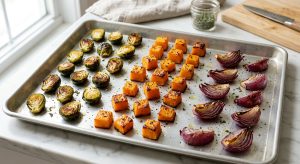
This technique is also an absolute game-changer for side dishes. If your roasted veggies turn out soggy, it is almost certainly because they are sitting flat against the pan, steaming in the water they release during cooking. Elevating them on a rack allows the dry heat of the oven to hit them from all 360 degrees, resulting in a blistered, caramelized exterior. Just remember to stop trusting your oven dial and verify your actual roasting temperatures, because convection airflow cooks things significantly faster than radiant heat from a flat pan.
Care and Maintenance for the Lazy Cook
I am all about weekday efficiency. Cooking is about survival and joy, and absolutely nobody has the time or energy to spend thirty minutes scrubbing baked-on grease out of a wire grid with a toothbrush.
Because you followed my strict advice and bought a 304-grade stainless steel rack, cleaning is an absolute breeze. If you only used it for cooling cookies or resting a steak, just throw it directly into the dishwasher. It will not rust, it will not flake, and it will not degrade.
The Upside-Down Soak Method
If you used it in a hot oven to roast sticky, sugar-glazed BBQ chicken wings, you might have some stubborn, polymerized grease welded to the grid. Do not waste your elbow grease scrubbing it. Take your rimmed baking sheet, fill it with an inch of warm water and a generous squirt of dish soap, and place the dirty wire rack upside down in the pan. Let it soak for 20 to 30 minutes. The soapy water will soften and lift the baked-on crud, and a quick swipe with a sponge will take it right off.
For absolute worst-case scenarios, make a thick paste of baking soda and water, spread it over the stubborn spots, and let it sit. The mild alkaline and abrasive nature of the baking soda will break down the grease without ever scratching the stainless steel.
Conclusion
Cooking does not have to be a mysterious, frustrating endeavor where you cross your fingers, throw things in a pan, and pray your food turns out right. It is just applied science.
When your fried chicken turns out soggy, it isn’t because you used the wrong recipe, and it certainly isn’t because you aren’t a “good cook.” It is simply because you let the thermodynamics of condensation work against you instead of for you. By understanding how steam, heat transfer, and moisture migration operate at a microscopic level, you can take total control of your kitchen.
Ditch the paper towels. Throw out that rusty, peeling, chrome-plated nightmare currently hiding in the back of your baking cabinet. Invest in a heavy-duty, stainless steel cross-wire rack. Elevate your food, let the air circulate, and give that beautiful, hard-earned crust the respect it actually deserves.
Your weekend culinary projects are about to get a whole lot crunchier. Now go fry something delicious, and for the love of all things holy, let it breathe.