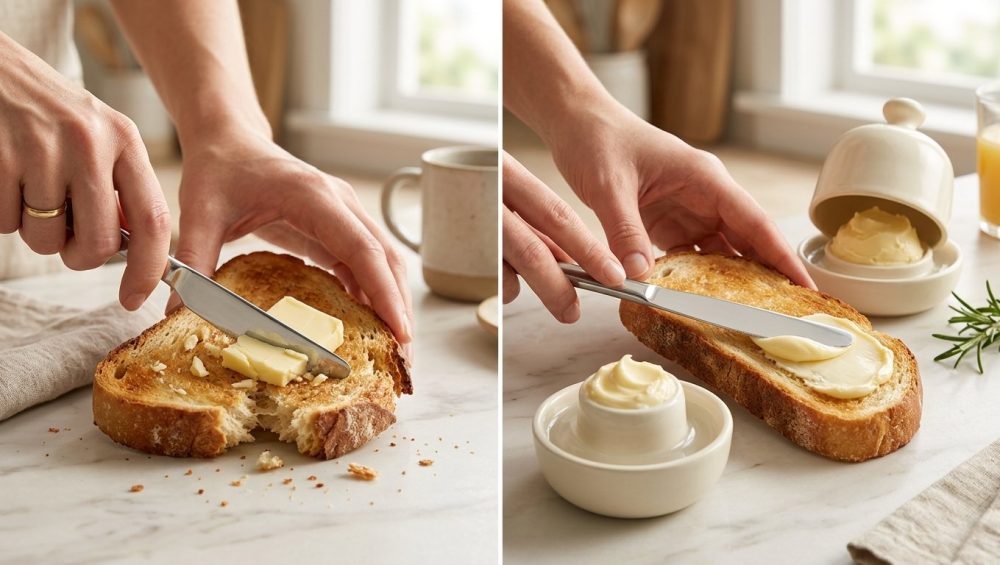
Let’s set the scene. It’s a Tuesday morning. You are already running fifteen minutes behind schedule, you haven’t had your coffee yet, and you just want a simple, comforting slice of toast before you face the chaos of the day. You pull a beautiful, artisanal slice of sourdough from the toaster. It is golden, fragrant, and perfectly crisp. You open the refrigerator, grab a rock-hard stick of cold butter, and attempt to spread it.
What happens next is a culinary tragedy that plays out in millions of kitchens every single day. The cold butter refuses to yield. Instead of melting into a luxurious, golden glaze, it acts like a dairy bulldozer, tearing your pristine sourdough into a mangled, crumbly mess. In a moment of sheer desperation, you toss the butter into the microwave for “just a few seconds,” only to pull out a sad, separated puddle of hot milk fat.
It is 2026, and according to the latest data from the USDA’s Economic Research Service, American butter consumption has hit a near-historic high of 6.8 pounds per person annually. Globally, the butter market is booming, valued at over $56 billion and projected to cross $70 billion by 2034. We are eating more butter than ever before, yet somehow, the vast majority of home cooks are still fighting their food.
Listen to me: you do not need a fancy culinary degree to achieve perfection in your home kitchen, and you certainly do not need to start your day wrestling with a cold block of dairy. Time is money, especially on a frantic weekday morning. You deserve better toast. The solution to this daily frustration is not a microwave, and it is certainly not switching to those heavily processed, oil-based spreads. The answer is a brilliant, centuries-old piece of low-tech kitchenware known as the French butter bell.
The Physics of Cold Butter and the Anatomy of Ruined Toast
To understand why we need a French butter bell, we first have to understand the enemy: cold temperatures. Butter is, at its core, a water-in-oil emulsion. It consists of roughly 80 to 82 percent milk fat, 15 to 18 percent water, and 1 to 2 percent milk solids (proteins and sugars).
When you place butter in a refrigerator, the ambient temperature drops well below 40°F (4°C). At this temperature, the complex network of lipid molecules (the milk fat) crystallizes and hardens into a rigid, solid state. The fat crystals lock together, trapping the tiny water droplets in a tight, unyielding matrix. This is why a cold stick of butter feels like a literal brick.
When you take that brick and drag it across a delicate, porous surface—like a fresh slice of bread—the sheer mechanical force required to move the solid fat exceeds the structural integrity of the bread itself. The result? The bread tears. It doesn’t matter if you are preparing a quick breakfast or crafting the ultimate grilled cheese for a weekend lunch; cold butter will destroy your canvas every single time.
Professional bakers and chefs know that the optimal temperature for butter spreadability and creaming is between 65°F and 68°F (18°C to 20°C). At this exact thermal range, the fat crystals relax just enough to become pliable, while the water and milk solids remain perfectly suspended in the emulsion. This is the magic zone. This is where butter becomes a silky, spreadable dream. But achieving and maintaining this temperature in a modern kitchen is where most home cooks fail.
The FDA, the Refrigerator, and the Great Butter Debate
If room-temperature butter is so vastly superior, why do we all instinctively throw it in the fridge? You can blame a combination of outdated regulations, modern paranoia, and a fundamental misunderstanding of food science.
In 1924, the United States Public Health Service and the Food and Drug Administration (FDA) issued a Standard Milk Ordinance, which eventually evolved into the Grade “A” Pasteurized Milk Ordinance (PMO). This ordinance required all packages containing milk or milk products to carry a strict “keep refrigerated” label. Because butter is sold in the refrigerated dairy aisle and carries this label, consumers have been conditioned for a century to believe that leaving butter on the counter is a one-way ticket to food poisoning.
But science tells a completely different story.
Because butter is composed of at least 80 percent fat and has a relatively low moisture content, it is an incredibly hostile environment for bacterial growth. Bacteria, including dangerous pathogens like Staphylococcus aureus (which the FDA monitors closely in its Bacteriological Analytical Manual), require high levels of free water (water activity) to thrive and multiply. The churning process of butter-making disperses the water into microscopic droplets surrounded by impenetrable walls of fat, effectively cutting off the water supply to any opportunistic microbes. Furthermore, commercial butter is made from pasteurized cream, meaning the baseline bacterial load is already virtually non-existent.
In a recent, highly publicized 21-day study conducted by Michelson Laboratories Inc. (an ISO-17025 accredited food safety lab), researchers tested multiple brands of butter stored at ambient room temperatures (68°F to 78°F). They tested for general bacteria, coliforms, yeast, and mold. The results? Microbial growth was completely non-detectable up to 21 days.
So, if bacteria aren’t the problem, what is? Why does butter eventually go bad on the counter? The answer is oxidation.
The Science of Butter Spoilage: Oxidation and Rancidity
While your butter won’t grow a terrifying colony of bacteria at room temperature, it is highly susceptible to chemical degradation. When the complex lipids in butter are exposed to three specific environmental triggers—oxygen, light, and heat—they begin to break down.
This breakdown leads to two distinct types of spoilage:
Oxidative Rancidity
When oxygen molecules interact with the unsaturated fatty acids in butter, it triggers a chain reaction that produces aldehydes and ketones. These volatile compounds are responsible for that stale, metallic, or almost soapy flavor you get when butter has been sitting out too long. It is the exact same chemical process that occurs when you are ruining your olive oil by leaving it in a clear glass bottle next to a hot stove.
Hydrolytic Rancidity
This occurs when moisture and naturally occurring enzymes (or ambient heat) cause the triglycerides in the butter to split into free fatty acids. This results in a harsh, bitter, and distinctively sour taste.
If you just leave a stick of butter on a plate on your counter, it is fully exposed to the oxygen in the air, the UV light streaming through your kitchen window, and the fluctuating temperatures of your home. Within 48 to 72 hours, the lipid oxidation process will accelerate, and the butter will begin to turn rancid.
This is the exact problem that peasant farmers in 16th-century France needed to solve. And their solution was nothing short of brilliant.
Enter the Beurrier Breton: A 16th-Century French Masterpiece
Long before the invention of the electric refrigerator, dairy farmers in the Brittany and Normandy regions of France—areas globally renowned for their exceptionally rich, high-fat butter—faced a serious dilemma. They needed a way to keep their butter soft and spreadable for daily use without it turning rancid in the warm summer months.
Their answer was the beurrier Breton, which translates to the Breton butter dish, known today as the French butter bell or butter crock.
The design is a masterclass in functional, low-tech engineering. The device consists of two interlocking ceramic pieces. The base is a sturdy, flat-bottomed crock designed to hold a small amount of cold water. The top piece is an inverted, bell-shaped cup (the “bell”) attached to a wider lid. You pack the softened butter tightly into the bell, and then you invert the lid and plunge it directly into the water-filled base.
When closed, the water rises up around the outside of the bell, completely submerging the rim and creating an airtight, oxygen-free seal around the butter. It is elegant, it is incredibly effective, and it requires absolutely no electricity.
The Fluid Dynamics of the Anaerobic Water Seal
I am a massive nerd when it comes to the physics of cooking, and the science behind the French butter bell is fascinating. This isn’t just a quaint, cottagecore kitchen accessory; it is a highly functional tool that leverages applied colloid science, hydrostatic sealing, and thermodynamics.
Hydrostatic Sealing and Anaerobic Isolation
When you place the butter-filled bell into the water base, the water acts as a liquid gasket. Because water has a high surface tension (measuring 72.8 mN/m at 20°C), it forms a continuous, self-renewing barrier that physically blocks the exchange of air. This active displacement forces the ambient oxygen out of the crock.
By submerging the rim, the water seal reduces the headspace oxygen concentration inside the bell to less than 0.5 percent. Without oxygen, the chemical chain reaction of oxidative rancidity is stopped dead in its tracks. USDA research has shown that this anaerobic (oxygen-free) environment slows peroxide formation in the butter by more than 92 percent.
Evaporative Cooling and Thermal Mass
The second scientific principle at play is evaporative cooling. A high-quality French butter bell is made from dense, opaque ceramic or stoneware. Ceramics have an excellent thermal mass, meaning they absorb and hold temperatures very well.
As the small amount of water in the base slowly evaporates through the microscopic pores of the unglazed portions of the ceramic, it pulls heat energy away from the interior of the crock. This subtle endothermic reaction creates a microclimate inside the bell that is actually a few degrees cooler than the ambient temperature of your kitchen. It keeps the butter hovering right in that optimal 65°F to 68°F zone—perfectly spreadable, but never melted.
This thermal regulation is crucial. If butter gets too warm (above 72°F), the emulsion breaks, the milk solids begin to migrate into the aqueous phase, and the butter separates.
The Flawed Alternatives: Why Other Butter Dishes Fail
Before we dive into how to use a French butter bell, we need to address the other “solutions” on the market. Home cooks have tried for decades to reinvent the wheel, and nearly all of these modern iterations fall completely flat.
The Standard Glass Cloche:
A traditional glass dish with a lid looks pretty, but it is functionally useless for long-term storage. The lid does not create an airtight seal, meaning oxygen is constantly interacting with the fats. Worse, the clear glass allows UV light to penetrate the butter, acting as a catalyst for lipid oxidation. It is a greenhouse for rancidity.
The Bamboo-Lidded Ceramic Dish:
These have become wildly popular on social media, but they are a nightmare in practice. While the ceramic base blocks light, the bamboo lid is problematic. Wood is porous, and unless it is rigorously maintained, it will absorb ambient moisture and food odors. Eventually, the bamboo will warp, destroying whatever weak seal it originally had, or worse, it will grow mold. This is exactly what happens when your wooden cutting board keeps cracking due to improper oiling and maintenance.
The “Butter Boat”:
This is a modern gadget where the butter sits in a ceramic dish that is suspended over a reservoir of water. While it successfully utilizes evaporative cooling to keep the butter chilled, it completely fails to create an anaerobic seal. The butter is still fully exposed to the oxygen in your kitchen, meaning it will spoil much faster than it would in a true French bell.
The “No-Go” Rule: Toxic Butter Dishes I Absolutely Despise
If you have read my blog before, you know I have a strict, zero-tolerance policy when it comes to cheap, toxic kitchenware. I am a firm believer that you should only buy things once. When you are banishing toxic kitchen gear from your home, the butter dish should be high on your hit list.
Do not, under any circumstances, buy a plastic butter bell.
Cheap plastic containers are notoriously porous on a microscopic level. They harbor bacteria, they leach endocrine-disrupting chemicals (like BPA, BPS, and phthalates) into your high-fat foods, and they hold onto rancid odors forever. This is exactly why your cheap plastic containers stay greasy no matter how hard you scrub them with hot water and dish soap. Butter is a lipid, and lipids absorb environmental odors and chemicals like a sponge.
Finally, beware of “mystery metal” butter dishes. Cheap stainless steel knock-offs often contain impurities that can rust when constantly exposed to the water seal. Furthermore, reactive metals can actually act as a catalyst for oxidation, imparting a harsh, metallic taste to your beautiful butter.
You must invest in a high-quality, opaque, heavily glazed ceramic, porcelain, or stoneware butter bell. These materials are non-reactive, they block 100% of UV light, they have the necessary thermal mass for evaporative cooling, and they are completely food-safe.
A Step-by-Step Masterclass on Packing and Using Your Butter Bell
Using a French butter bell is not complicated, but it does require a specific technique. If you do it wrong, your butter will fall out of the bell and splash into the water base—a tragedy I want to help you avoid. Here is my foolproof, step-by-step method for everyday success.
Step 1: Soften the Butter Correctly
You cannot pack cold, hard butter into a ceramic bell. It won’t adhere to the sides, and you will leave massive air pockets. Leave a stick of high-quality butter on the counter for about an hour until it is pliable but not melting. Do not microwave it. If you melt the butter, the emulsion will break, and it will never properly reset in the bell.
Step 2: Pack it Tightly
Take a spoon or a butter knife and press the softened butter into the inverted bell. You must pack it firmly to eliminate any hidden air pockets. Air pockets are the enemy. If there is trapped air between the butter and the ceramic, it will create a vacuum displacement that will eventually cause the butter to detach and fall out. Press it down hard, smoothing the top surface so it is relatively flat.
Step 3: Fill the Base with Cold Water
Pour cold tap water into the bottom crock. You do not need to fill it to the brim. You only need about an inch of water—just enough so that when you insert the bell, the water rises to cover the rim and touch the very surface of the butter.
Step 4: The Salt Water Trick
Here is a brilliant hack: add a hefty pinch of salt to the water in the base. Salt is a natural antimicrobial agent and preservative. It lowers the water activity (Aw), making it even harder for any stray bacteria or mold spores to survive. This is especially critical if you prefer to use unsalted butter, which lacks its own built-in preservatives and is much more prone to rapid spoilage.
Step 5: Routine Maintenance
A butter bell is low-maintenance, but it is not no-maintenance. You need to change the water every three to five days. If your kitchen is particularly warm, change it every two days. It takes literally five seconds. Dump the old water, rinse the base, add fresh cold water and a pinch of salt, and replace the bell.
If you neglect this step, the water will eventually stagnate, and you will end up with mold. Neglecting your kitchenware always leads to disaster, much like putting bread in the fridge will rapidly accelerate staling. Take care of your tools, and they will take care of your food.
Deep Cleaning and Ceramic Care
When you finally finish the butter in the bell, you cannot simply pack a fresh stick on top of the microscopic remnants of the old batch. The residual butter fats left clinging to the ceramic will oxidize rapidly. If you pack fresh butter over rancid fats, the entire new batch will spoil almost immediately.
Between every single fill, you must thoroughly clean the butter bell. Wash both the bell and the base with incredibly hot water and a strong, grease-cutting dish soap. If your bell is made of high-quality, fully glazed stoneware, it is likely dishwasher safe, but I always recommend hand washing. The aggressive, abrasive detergents used in modern dishwashers can sometimes degrade the glaze over years of use.
Once washed, the bell must be bone dry before you pack new butter into it. If the ceramic is wet, the butter will not adhere to the walls, and it will slide out.
Troubleshooting: Why Is My Butter Falling Into the Water?
This is the number one complaint I hear from home cooks who are new to the butter bell life. You go to retrieve some butter, lift the lid, and hear a depressing plop as your entire half-pound of Kerrygold drops into the water.
If this happens, you have committed one of three cardinal sins:
1. Your Kitchen is a Sauna
Butter melts at around 90°F, but it loses its structural integrity and ability to cling to ceramic once the ambient temperature creeps past 75°F (24°C). If it is the middle of August, you don’t have air conditioning, and your kitchen is sweltering, the butter bell is going to fail. The fat will soften too much, gravity will take over, and the butter will drop. During extreme heatwaves, you unfortunately have to retreat and put the bell in the fridge.
2. You Left Air Pockets
As I mentioned in the packing steps, if you don’t press the butter firmly against the walls of the bell, an air bubble will form. As the ceramic cools, the air inside that bubble contracts, creating a tiny suction effect that pulls the butter away from the walls. Pack it tight!
3. You Are Using the Wrong Product
If you try to pack a butter bell with margarine, whipped butter, or a low-fat “spread,” you are going to have a bad time. Margarine is an entirely different chemical structure—often an oil-in-water emulsion with a much higher moisture content. It lacks the dense, sticky fat crystals needed to adhere to the ceramic. It will simply slide right out. Trying to use cheap margarine in a beautiful ceramic crock is a waste of time, much like expecting professional results when your cheap baking sheets keep warping in a hot oven.
The Superiority of European Butter
Since we are talking about elevating your everyday cooking, we need to talk about the butter itself. Not all butter is created equal, and the type of butter you use dramatically affects how well your butter bell performs.
In the United States, standard commodity butter is legally required to contain a minimum of 80 percent butterfat. The remaining 20 percent is water and milk solids. European-style butters (like those from France, Ireland, and Denmark) are churned longer to achieve a higher fat content—typically 82 to 84 percent.
That extra two to four percent might not sound like a lot, but in the world of baking and culinary science, it is a massive difference. Higher fat means lower water content. Lower water content means the butter is structurally denser, richer in flavor, and significantly more stable at room temperature. Because it has less moisture, European butter clings to the sides of a ceramic butter bell much more effectively than cheaper American brands.
If you are going to invest in a beautiful French butter bell, do yourself a favor and fill it with high-quality, grass-fed, European-style butter. The flavor profile of a cultured, high-fat butter spread over a warm piece of toast is a revelation.
The Financial and Time-Saving ROI of Room-Temperature Butter
As a busy professional, I am obsessed with kitchen efficiency. When I am trying to get a weekday dinner on the table in under thirty minutes, I do not have the patience to wait for butter to soften.
Think about how many recipes start with “cream together softened butter and sugar.” If your butter is in the fridge, you have to plan hours in advance, or you risk microwaving it and ruining the structural integrity of your baked goods. Having perfectly soft, room-temperature butter available 24/7 on your countertop is a massive time-saver.
It also prevents you from destroying your ingredients. Trying to pan-fry a delicate piece of fish or perfectly sear a steak with cold butter drops the temperature of the pan too quickly. Having soft butter ready to baste is a game-changer. It eliminates friction in your cooking routine, the same way you cry chopping onions because of a dull blade—fix the root cause, and the entire process becomes enjoyable.
Furthermore, properly maintained cast iron and carbon steel pans require a light coating of fat after cleaning to prevent oxidation. Scraping cold butter into a pan is a hassle, just as air drying your cast iron is a guaranteed recipe for rust. Having soft butter on hand makes pan maintenance effortless.
Elevating Your Everyday Culinary Artistry
Cooking should not be a stressful chore, and you shouldn’t have to fight your ingredients. A French butter bell is the perfect example of how a small, intentional change in your kitchen setup can completely transform your daily routine. It is a one-time purchase that solves a daily annoyance, looks beautiful on your countertop, and honors the science of food preservation.
You deserve to wake up to a peaceful morning. You deserve to effortlessly glide a knife across a golden piece of toast without tearing it to shreds. You deserve to taste the rich, complex flavors of high-quality butter exactly as the dairy farmers intended—untainted by the odors of the refrigerator, and free from the metallic, soapy off-flavors of oxidative rancidity (the same reason your silicone spatulas taste like soap after a run through the dishwasher).
Ditch the plastic containers. Stop putting your butter in the refrigerator. Invest in a high-quality, ceramic French butter bell. Pack it tight, keep the water fresh, and reclaim your toast. Your morning routine—and your sourdough—will thank you.