The sound of a thick, marbled ribeye hitting a screaming hot cast-iron skillet is an absolute symphony. It is the sound of anticipation, of culinary triumph, and of a phenomenal dinner in the making. But exactly four seconds later, that beautiful symphony is aggressively interrupted by the snap, crackle, and physical pain of a rogue 400-degree oil droplet launching itself directly onto your forearm.
Many home cooks react to this hostile grease attack by making one of two fatal errors. They either panic and turn down the burner, or they grab a heavy glass lid and slam it over the skillet to protect their kitchen. If you are constantly turning down the heat out of fear, your chicken breast turns out dry, pale, and completely devoid of texture. If you use a lid, you are committing a culinary crime that I will explain in excruciating detail shortly.
I have zero patience for kitchen gadgets that don’t pull their weight, but I also refuse to spend my precious Tuesday evenings scrubbing aerosolized bacon grease off my tile backsplash. Time is money, and you shouldn’t have to choose between a flawless, crispy meal and a pristine stovetop. The definitive answer—the only answer—is a high-quality, fine mesh stainless steel splatter screen.
The Physics of the Pop: Why Hot Oil Attacks You
Let’s get nerdy for a second. Why does cooking oil pop and explode in the first place? It isn’t random; it comes down to a violent, instantaneous clash of thermodynamics.
Cooking oil in a properly preheated skillet easily reaches temperatures between 350°F and 450°F (175°C to 230°C). Water, however, has a strict, non-negotiable atmospheric boiling point of 212°F (100°C). When a droplet of moisture from your raw steak, marinated chicken, or washed vegetables hits that screaming hot lipid bath, it doesn’t just gently boil away. It flashes instantly into steam.
Here is where the physics get aggressive. When liquid water converts to a gaseous state, it expands to roughly 1,700 times its original volume in a fraction of a second. Because water is significantly denser than oil, this rogue droplet usually sinks below the surface of the hot fat before it vaporizes. When it finally flashes into steam, that massive volumetric expansion acts like a microscopic depth charge. It violently erupts upward, displacing the hot oil and launching scalding lipid projectiles into the air—and onto your skin, your stove, and your floor.
This isn’t just an annoyance that requires extra paper towels; it is a legitimate safety hazard. According to the National Fire Protection Association (NFPA), U.S. fire departments respond to an estimated 170,000 home cooking fires every single year. Cooking equipment is responsible for nearly 49% of all reported home fires, and a massive portion of these infernos begin with unattended equipment and aerosolized stovetop grease. The statistics are sobering: frying equipment is involved in nearly 60% of these cooking fires. If you aren’t actively controlling the grease splatter in your kitchen, you are effectively coating your surrounding surfaces in highly flammable fuel. Dodging hot oil makes you a timid cook, and timid cooks undercook their food or over-fiddle with their pans. You need a shield.
The Maillard Reaction: Why a Standard Lid Ruins Your Dinner
So, if hot oil is acting like a tiny, aggressive volcano, the logical solution is to cover the pan with a standard pot lid, right? Absolutely not. Put the lid down, step away from the skillet, and listen to me carefully. Using a solid lid while pan-frying is a rookie mistake that single-handedly destroys your meal.
To understand why, we have to talk about the holy grail of cooking: the Maillard reaction. This is the complex chemical process where amino acids and reducing sugars break down and recombine under high heat. This reaction creates hundreds of brand-new flavor compounds and generates that gorgeous, savory, golden-brown crust we all crave. The catch? The Maillard reaction only kicks into high gear at temperatures above 285°F (140°C).
Moisture is the ultimate enemy of browning. Because water cannot exceed 212°F (100°C) in a standard atmospheric environment, any surface moisture on your food acts as a thermal ceiling. It caps the surface temperature of your protein and entirely prevents the Maillard reaction from occurring until that water has completely evaporated.
What happens when you place a solid glass or metal lid over your frying pan? You trap all of that evaporating water vapor inside the vessel. The pan effectively becomes a miniature steam room. The interior humidity spikes to 100%, and the condensation gathers on the underside of the lid before raining right back down into your hot oil. You are no longer searing; you are steaming your meat in a humid sauna.
This is exactly why your steaks turn out gray and flabby instead of developing a rich, caramelized steakhouse exterior. Steamed meat is tough, visually unappealing, and severely lacking in depth of flavor. Furthermore, without a proper crust to act as a barrier, the denatured proteins will bond directly to the hot metal of your cookware. This is exactly why your dinner sticks to your stainless steel pan and tears into jagged pieces when you try to flip it. If you want professional-level results in a home kitchen, you must allow the steam to vent completely.
Enter the Fine Mesh Splatter Screen: The Culinary Bouncer
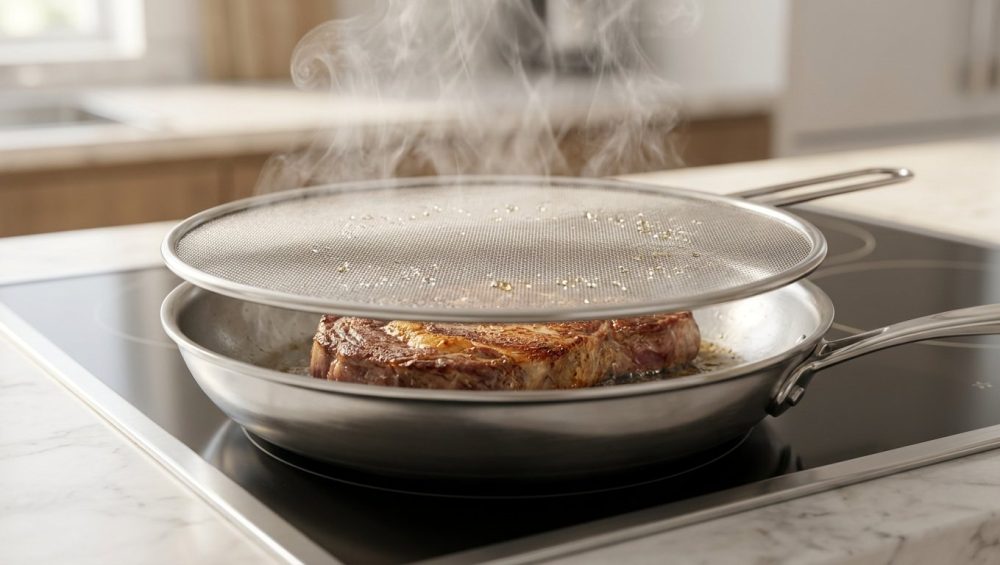
This is where the fine mesh splatter screen steps in to save your Tuesday night dinner and your sanity. Think of a splatter screen as a highly selective culinary bouncer. Its entire job is to stand at the door of your skillet, letting the good guys (steam) out while keeping the bad guys (scalding oil droplets) locked safely inside.
A high-quality splatter screen is composed of a tightly woven wire mesh. To understand how it works so effectively, we have to look at the physical size of the molecules and droplets involved. Water vapor (steam) consists of individual gaseous molecules that are incredibly tiny, lightweight, and highly energetic. They pass through the woven gaps in the metal mesh with absolutely zero resistance.
Liquid oil droplets, on the other hand, are massive by comparison. Due to the high surface tension of cooking fats, these droplets clump together into larger spheres. When they are ejected from the pan by a steam explosion, they fly upward and hit the wire mesh. The physical barrier stops them in their tracks, and the surface tension causes the oil to cling to the wire rather than passing through.
In industrial and scientific terms, mesh size is measured by the number of openings per linear inch. A standard high-performance kitchen splatter screen typically utilizes a mesh count between 60 and 100. To put that into perspective, a 60-mesh screen has openings that are roughly 250 microns wide, while a 100-mesh screen features openings around 149 microns. This microscopic sizing is the absolute sweet spot: it is tight enough to catch up to 95% of flying grease, yet open enough to allow 100% of the moisture to evaporate freely. If you want a perfectly seared fish with shatteringly crisp skin, this engineered mesh barrier is non-negotiable.
The “No-Go” Zone: Why Silicone and Cheap Metals Belong in the Trash
As your dedicated culinary advocate, I have a strict, uncompromising “no-go” rule when it comes to toxic, gimmicky, or poorly manufactured kitchenware. The market is absolutely flooded with cheap splatter screens that will do more harm than good. Let me be brutally honest: not all screens are created equal, and most of them belong in the garbage.
First on the chopping block: silicone splatter screens. I absolutely despise them. Silicone has become a trendy material because it comes in cute pastel colors and is easy to wash, but it is a catastrophic failure as a splatter guard. Unlike woven wire mesh, silicone screens are solid sheets of rubbery material with holes mechanically punched into them. Because the material is thick, the holes have to be relatively large. This means fine oil mist shoots right through them, defeating the entire purpose of the tool. Worse, the thick silicone footprint blocks a significant amount of steam, partially recreating the dreaded “steamer effect” of a solid lid. Furthermore, cheap silicone is notorious for absorbing rancid grease odors. After a few uses, your screen will smell like old fish, and it can impart a chemical, soapy taste to your food. Finally, if a silicone screen sags or accidentally touches the open flame of a gas burner, it will melt, scorch, and release toxic fumes into your home.
Next up: cheap aluminum and mystery metals. Discount stores love to sell flimsy aluminum splatter screens for five bucks. Do not buy them. Aluminum is a soft, highly reactive metal. The moment it faces the intense thermal stress of a 400°F skillet, the frame will warp, leaving massive gaps around the rim for oil to escape. Even worse, when you put an aluminum screen in the dishwasher, the alkaline detergent causes the metal to rapidly oxidize. It will emerge covered in a powdery, dark gray residue that will rub off on your hands, your countertops, and ultimately, your food.
Finally, stay far away from anything labeled “non-stick coated.” High heat, aerosolized oil, and cheap Teflon are a recipe for culinary disaster. Just like aerosol cooking sprays are ruining your nonstick pans by baking into a sticky residue, a peeling chemical coating on a splatter screen will ruin your health. You do not want flakes of mystery polymers falling into your pristine pan sauce. The only acceptable material for this tool is 100% food-grade 304 (18/8) stainless steel. Period.
How to Choose the Ultimate Splatter Screen
So, what should you actually buy? The criteria for a professional-grade splatter screen are simple, non-negotiable, and entirely based on durability, safety, and smart design.
The Core Material: 304 Stainless Steel
You must insist on 100% food-grade 304 (often labeled as 18/8) stainless steel for both the woven mesh and the structural frame. 304 stainless steel contains 18% chromium and 8% nickel, which gives it exceptional resistance to rust, corrosion, and extreme heat. If you understand the polymerization failure in carbon steel, you know that cheap metals cannot withstand intense stovetop environments without degrading. High-quality stainless steel will not warp, it will not leach chemicals, and it will survive a lifetime of heavy, aggressive use.
Structural Integrity and Frame Design
A fine mesh is completely useless if the frame holding it bends out of shape. Look for a screen that features a thick, heavy-gauge stainless steel outer rim. The mesh should be tightly tensioned across this frame, almost like a snare drum. If you press gently on the center of the mesh in the store and it sags deeply or feels loose, put it back on the shelf.
Ergonomic and Heat-Resistant Handles
Handle design is critical for your safety. You want a long handle that keeps your hand safely away from the perimeter of the hot pan. Solid stainless steel handles are incredibly durable, but they can get warm during extended cooking sessions. Some high-end models feature a stainless steel core wrapped in high-heat, food-safe silicone (only on the handle grip, not the mesh!). Avoid cheap plastic handles at all costs; if they hang over the edge of a gas burner, they will melt and fill your kitchen with acrid, toxic smoke.
The Game-Changing Feature: Resting Feet
This is the single most important design feature that separates a good screen from a truly great one. Look for a screen that has small metal pegs or “resting feet” integrated into the bottom of the rim. When you remove the screen from the pan to flip your food, the mesh will be dripping with hot grease. Resting feet allow you to set the screen down flat on your countertop without the greasy mesh actually touching your surfaces. It saves you from having to frantically wipe down your counters every single time you cook.
Mastering the Sear: A Step-by-Step Guide to Using Your Screen
Owning the right tool is only half the battle; utilizing proper technique is what transforms a stressful chore into kitchen artistry. Here is exactly how to safely achieve a flawless, restaurant-quality sear without painting your kitchen cabinets in grease.
Step 1: Eradicate Surface Moisture
As we established, water is the mortal enemy of the Maillard reaction and the primary cause of oil explosions. Before your food ever gets near the stove, you must dry it thoroughly. Use heavy-duty paper towels to pat down your steaks, chicken thighs, or fish fillets until the surface is bone-dry. If you have the time, leave your salted meat uncovered on a wire rack in the fridge for 24 hours to let the cold air naturally dehydrate the exterior.
Step 2: Precision Heat Management
Do not put cold food into a cold pan. Place your skillet on the burner and let it heat up dry. Preheat your skillet and rely on the magic of the water drop test to know exactly when it is ready. Flick a tiny droplet of water into the pan; if it immediately beads up and dances across the surface like liquid mercury (a phenomenon known as the Leidenfrost effect), your pan is perfectly heated and ready for oil.
Step 3: The Oil and the Drop
Add a high-smoke-point cooking fat—like avocado oil, clarified butter (ghee), or beef tallow—to the pan. Wait a few seconds until the oil shimmers and begins to ripple. Carefully lay your protein into the pan, dropping it away from your body so any immediate splashing is directed toward the back of the stove, not onto your shirt.
Step 4: Deploy the Screen and Step Back
The exact moment the food hits the pan, place your fine mesh splatter screen directly over the skillet. Make sure it is centered and fully covering the rim. Now, here is the hardest part for most beginners: walk away. Leave it alone. Do not constantly lift the screen to peek at the food. Every time you lift the screen, you allow grease to escape, and you drop the ambient temperature of the pan. Let the Maillard reaction do its job. Don’t guess the internal temperature by poking it with a spatula; if you think your meat thermometer is lying to you, it’s time to upgrade your gear to a highly calibrated instant-read digital probe.
Step 5: The Strategic Flip
When it is time to flip your protein, do not wave the greasy screen around the kitchen. Lift the screen straight up, hold it directly over the pan for two seconds to let any large droplets fall back in, and then smoothly transfer it to your countertop (resting on its built-in feet). Quickly flip your food with tongs or a fish spatula, and immediately replace the screen.
Beyond the Sear: Unexpected Uses for Your Splatter Screen
I am a firm believer that time is money, and kitchen space is premium real estate. I despise single-use unitaskers taking up room in my cabinets. Fortunately, a high-quality stainless steel splatter screen is a remarkably versatile workhorse. It’s just as versatile as a stainless steel bench scraper when it comes to everyday kitchen utility.
The Makeshift Cooling Rack
If you are shallow-frying chicken cutlets or making a batch of crispy latkes, you need a place for the excess oil to drain. Placing fried food directly on paper towels traps steam and makes the bottom soggy. Instead, balance your clean splatter screen over a large mixing bowl or a baking sheet, and place your fried food directly on the wire mesh. The air will circulate completely around the food, keeping the crust shatteringly crisp.
The Quick and Dirty Strainer
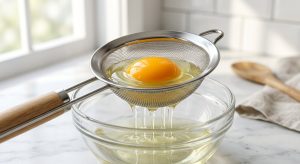
Don’t want to dig out your bulky colander just to drain a single pot of boiled potatoes or pasta? Hold your splatter screen tightly against the rim of the pot and carefully pour the water out into the sink. The fine mesh will easily hold back the food while letting the boiling water drain in seconds.
The Gentle Steamer
If you need to steam a handful of delicate vegetables or a piece of white fish, but you don’t own a bamboo steamer, your splatter screen has you covered. Place a pot of water on the stove and bring it to a simmer. Lay the splatter screen over the top of the pot. Place your food directly on the mesh, and cover the food with an inverted stainless steel mixing bowl to trap the steam.
The Emergency Sifter
Baking a cake and realize your flour is full of hard lumps? Need to dust a finished batch of brownies with an even layer of powdered sugar? If your fine mesh sieve is in the dishwasher, a clean splatter screen works perfectly as a wide-area sifter.
Maintenance and Cleaning: Keeping the Mesh Pristine
The only downside to a tool designed to catch flying grease is that, well, it gets covered in grease. If you neglect your splatter screen, that liquid fat will eventually polymerize under high heat. The lipid molecules cross-link and turn into a sticky, impossible-to-remove amber varnish. Proper maintenance is essential.
First and foremost, because you listened to me and bought a 100% 304 stainless steel screen, it is fully dishwasher safe. The absolute best way to clean your screen is to throw it into the bottom rack of your dishwasher immediately after dinner. The combination of scalding hot water and highly alkaline dishwasher detergent will strip away the grease effortlessly.
If you don’t have a dishwasher, or if you need to wash it by hand, you must use the right technique. Never use a standard kitchen sponge. The abrasive woven wire will shred your sponge to pieces in seconds, leaving tiny bits of colorful foam permanently wedged in the mesh. Instead, use a stiff-bristled nylon dish brush.
Run the screen under the hottest water your tap can produce to melt the fats. Apply a generous squirt of a heavy-duty, grease-cutting dish soap (Dawn is the undisputed king here). Scrub vigorously with your nylon brush in a circular motion, rinse thoroughly, and shake off the excess water. Just as preheating the pan changes everything for your sear, pre-soaking your screen in hot, soapy water changes everything for your cleanup. If you ever encounter stubborn, baked-on grease spots, make a thick paste out of baking soda and hot water. Smear it over the mesh, let it sit for twenty minutes to break down the polymerized fat, and then scrub it away with your brush.
Conclusion
Cooking an incredible, restaurant-quality meal on a random weeknight shouldn’t require a hazmat suit, and it certainly shouldn’t require an hour of scrubbing grease off your kitchen walls and floors. The secret to great cooking isn’t a culinary degree or a pretentious vocabulary; it’s simply understanding the basic physics of heat and moisture, and equipping yourself with the right tools to manage them.
Ditch the solid lids that steam your food into a gray, rubbery mess. Throw away the toxic silicone and flimsy aluminum garbage that clutters the aisles of discount stores. Invest in a heavy-duty, 304 stainless steel fine mesh splatter screen. It is a one-time purchase that will fundamentally transform the way you pan-fry, sear, and sauté. Reclaim your stovetop, protect your skin, and finally achieve that perfect, golden-brown crust you’ve been chasing. Now get in the kitchen and start searing—you’ve got this.