Listen to me, you impatient weekend warriors. I know exactly what you did last Tuesday. You came home exhausted, grabbed a rock-hard sweet potato from the pantry, stabbed it a few times with a fork, and threw it into the microwave for six minutes. When the timer beeped, you sliced open a dry, chalky, steaming mass of disappointment. You took one bite, sighed, and proceeded to drown the poor thing in a quarter cup of brown sugar, a handful of mini marshmallows, and enough butter to clog an artery.
You are not alone. Ignorance of basic temperature control is one of the main factors ruining your dinners on a nightly basis. But as your resident sassy sous-chef, I am here to tell you that it doesn’t have to be this way. You do not need to turn your healthy vegetable side dish into a dessert casserole just to make it palatable.
The truth is, a sweet potato already contains all the sugar it needs to taste like absolute candy. You are simply cooking it wrong. You are rushing the process. You are treating a delicate biochemical reaction like a race to the finish line, and your tastebuds are paying the price. Today, we are going to dive deep into the science of the slow roast. We are going to talk about enzymes, starches, and the exact temperature sweet spot that will transform your bland tuber into a sticky, jammy, caramelized masterpiece. Grab a glass of wine, take notes, and prepare to apologize to every sweet potato you have ever microwaved.
The Anatomy of a Disappointment: Starch vs. Sugar
To understand why your sweet potatoes taste like cardboard, we first need to understand what a sweet potato actually is. Scientifically known as Ipomoea batatas, a raw sweet potato is essentially a dense, watery ball of complex carbohydrates. In its raw state, a sweet potato is roughly 70% water and 20% to 30% starch. If you were to take a bite out of a raw sweet potato—which I highly advise against unless you enjoy the texture of a chalky carrot—you would notice that it isn’t actually sweet at all.
Starch is a polysaccharide, which is just a fancy, pretentious way of saying it is a massive chain of simple sugar molecules linked together. Because these chains are so long and complex, our human taste receptors cannot perceive them as sweet. They just taste starchy, bland, and earthy. Standard white potatoes, like your basic Russet, are also packed with starch. But unlike a Russet, the sweet potato comes equipped with a secret weapon: a built-in biochemical breakdown system.
Understanding how to manipulate raw ingredients at a molecular level is fundamental to the art of the home kitchen. Your goal as a cook is not just to apply heat until food is soft; your goal is to apply heat strategically to unlock the hidden potential inside the ingredient. For the sweet potato, that potential is locked inside those long starch chains, waiting for the right key to open the door.
Meet Your Kitchen Hero: The Amylase Enzyme
Enter the hero of our story: the amylase enzyme. Sweet potatoes are absolutely loaded with enzymes, specifically alpha-amylase and beta-amylase. Think of these enzymes as tiny molecular scissors that live inside the potato. Their sole purpose in life is to chop up those long, flavorless starch chains into smaller, sweet-tasting sugar molecules.
While alpha-amylase randomly hacks the starch chains into smaller fragments called dextrins, beta-amylase is the true star of the show. Beta-amylase acts like a precise molecular Pac-Man. It starts at the end of a starch chain and systematically snips off two-glucose units one by one. These two-glucose units form a disaccharide sugar known as maltose.
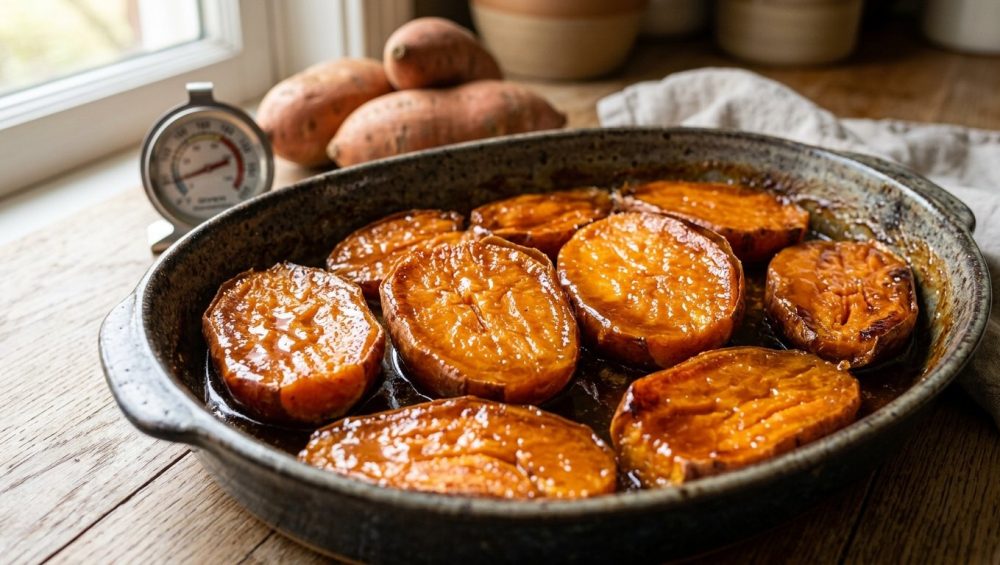
Maltose is the magic word here. While it is only about 30% as sweet as standard table sugar (sucrose), the sweet potato can generate massive, overwhelming quantities of it during the cooking process. When you see that thick, sticky, dark brown syrup oozing out of a perfectly roasted sweet potato and bubbling on the sheet pan, you are looking at pure, unadulterated maltose. If you want that rich, dessert-like side dish, you need to stop rushing your sweet potatoes and let the chemistry work.
But here is the catch: beta-amylase is a diva. It refuses to work unless the conditions are absolutely perfect.
The Thermodynamic “Sweet Spot” (135°F to 170°F)
Enzymes are proteins, and like all proteins, they are highly sensitive to temperature. If the potato is too cold, the enzymes are asleep. If the potato is too hot, the enzymes are permanently destroyed.
The magic happens in a very specific, narrow temperature window: between 135°F and 170°F (approximately 57°C to 77°C).
Here is exactly what happens as a sweet potato heats up in your oven:
- Below 135°F (57°C): The potato is warming up, but the starches are still tightly packed in hard granules. The beta-amylase is awake, but it cannot access the starch to do its job.
- 135°F to 140°F (57°C to 60°C): Gelatinization begins. The starch granules absorb the potato’s internal water, swell up, and burst open. Suddenly, the starch is exposed.
- 140°F to 170°F (60°C to 77°C): This is the golden window. The beta-amylase goes into absolute overdrive, furiously snipping the gelatinized starches into maltose sugars. The longer the internal temperature of the potato stays in this exact zone, the sweeter the final product will be.
- Above 170°F (77°C): The heat becomes too intense. The beta-amylase denatures, meaning its physical structure unravels and it dies. The sugar production halts instantly and permanently.
Therefore, the entire objective of cooking a sweet potato is to trap it inside that 135°F to 170°F window for as long as biologically possible before it inevitably gets too hot.
Why Your Current Methods Are a Culinary Crime
Now that you understand the science, you can easily see why your weeknight cooking habits are producing such tragic results. Let us review the crimes you have been committing against this noble tuber.
The Microwave Massacre
The microwave is the absolute worst thing you can do to a whole sweet potato. Microwaves work by violently exciting water molecules, generating rapid, intense heat. A potato in the microwave will blast right past the 170°F death-zone in a matter of minutes. The beta-amylase is instantly assassinated before it has time to produce even a drop of maltose. You are left with a hot, starchy, flavorless sponge.
The Boiling Blunder
Boiling is slightly better than microwaving, but it still ruins the potential of the potato. Water boils at 212°F (100°C), which is far above the enzyme’s survival limit. The potato heats up too quickly, minimizing the time spent in the sweet spot. Furthermore, boiling introduces excess water into the flesh, diluting what little flavor exists. This waterlogged environment is the exact same reason your roasted veggies turn mushy when you crowd a baking pan and trap the steam. Wet potatoes do not caramelize; they just turn to mush.
The Foil-Wrapped Fallacy
Wrapping a sweet potato in aluminum foil before baking is a classic rookie mistake. Foil traps the moisture escaping from the potato, effectively steaming it in its own juices. While it will eventually get soft, the trapped steam accelerates the internal heating process, rushing it past the enzyme window. More importantly, the wet, steamy environment completely prevents the skin from crisping and the sugars from caramelizing.
The Weekday Hack: The “Cut-Side Down” Cheat Code
I know that during the busy workweek, you want to master simple weeknight dinners without spending three hours hovering over a hot stove. You don’t always have the luxury of a slow, lazy weekend roast. When time is money, we rely on the cut-side down method.
By slicing the sweet potato in half lengthwise, you are doing two things. First, you are reducing the mass, which allows it to cook faster. Second, you are exposing a massive, flat surface area of flesh.
When you place that flat, exposed flesh directly onto a heavy, bare metal baking sheet coated with a high-heat oil (like avocado oil), magic happens. The metal conducts heat directly into the flesh. Even though the potato moves through the enzyme window relatively quickly, the direct contact with the searing hot pan triggers the Maillard reaction and intense caramelization. The small amount of maltose that is produced instantly fries in the oil, creating a thick, crispy, candy-like crust on the bottom of the potato. It takes about 35 minutes at 400°F (200°C), and it is the ultimate compromise between speed and flavor.
A Brutally Honest Intervention About Your Toxic Gear
Since we are talking about high-heat roasting and caramelizing sugars directly on metal pans, we need to have a serious talk about your equipment. It is incredibly frustrating when your cheap baking sheets keep warping the second they hit a high-temperature oven, sounding like a gunshot in your kitchen. But warping is the least of your worries.
As your trusted culinary guide, I am relentless about banishing toxic kitchen gear from your home once and for all. I have zero patience for flimsy, dark-coated, non-stick baking sheets that you bought for five dollars at a discount store. Those cheap non-stick coatings (often made with mystery PFAS chemicals) are not designed to withstand the 400°F+ temperatures required for proper caramelization. When they overheat, they degrade, peel, and off-gas toxic fumes directly into your food and your lungs.
Furthermore, you might think a quick spritz is harmless, but you are actively ruining your nonstick pans with those nasty aerosol propellants. The soy lecithin and chemical propellants in commercial cooking sprays polymerize under high heat, creating a sticky, permanent residue that destroys whatever non-stick properties the pan had left.
Throw them away. Today.
If you want to cook like a pro, you need professional gear. Invest in heavy-gauge, uncoated aluminum half-sheet pans, carbon steel roasting pans, or high-quality tri-ply stainless steel. These materials offer incredible thermal mass, meaning they hold heat efficiently and distribute it evenly across the surface of the food. Yes, it requires a bit of soaking when caramelized maltose sticks to your stainless steel baking tray, but the flavor payoff is immense, and you won’t be ingesting peeling mystery metals with your dinner.
The Definitive Slow Roast Masterclass (For the Weekend Perfectionist)
When the weekend arrives and you have the time to be an absolute perfectionist, this is the method you will use. It requires zero active effort, but it demands patience. This method utilizes the “Cold Oven Trick” to stretch the enzyme window to its absolute physical limit.
Step 1: The Prep
Wash your sweet potatoes thoroughly to remove any dirt. Do not peel them. The skin acts as a natural protective jacket that prevents the potato from drying out during the long bake. Poke them exactly three times with a fork to allow excess steam to vent, preventing a sweet potato explosion in your oven. Rub the skins lightly with a neutral, high-heat oil and a generous pinch of kosher salt. Do not wrap them in foil.
Step 2: The Cold Oven Start
Place the prepared sweet potatoes directly on a wire rack set inside a heavy-duty, uncoated sheet pan. Place the pan into a completely cold, turned-off oven.
Step 3: The Low and Slow Climb
Turn the oven on and set the temperature to 300°F (150°C). By starting in a cold oven, the potatoes heat up gradually alongside the ambient air. They will slowly creep up to 135°F, and then they will agonizingly, beautifully linger in the 135°F to 170°F sweet spot for an extended period. The beta-amylase will have a field day, converting massive amounts of starch into maltose syrup.
Step 4: The Waiting Game
Leave them in the oven for roughly two hours. I know, it sounds like an eternity. But remember, we are conducting science here. You will know they are ready when they look slightly deflated and shriveled. If you give them a gentle squeeze (with an oven mitt, please), they should offer absolutely zero resistance. They should feel like a water balloon filled with pudding.
Step 5: The Caramelization Blast
Once the potatoes are completely soft and the starches have been thoroughly converted to sugars, we need to build flavor. Turn the oven temperature up to 425°F (220°C) for the final 15 to 20 minutes. This blast of high heat will trigger the Maillard reaction on the skin and caramelize the maltose syrup that is inevitably leaking out of the fork holes.
When you pull them out, let them rest for ten minutes before slicing. You will be rewarded with a sweet potato that is impossibly creamy, intensely sweet, and entirely natural.
Advanced Sweet Potato Thermodynamics: The Sous-Vide Flex
For those of you who are insufferable culinary nerds (and I say that with the utmost affection), there is an even more precise way to hack the enzyme system: the sous-vide water bath.
Renowned food scientist Kenji López-Alt tested this exact theory for his book, The Food Lab. By vacuum-sealing sweet potatoes and dropping them into a precision temperature-controlled water bath set to exactly 150°F (65°C)—the absolute peak operating temperature for beta-amylase—he was able to hold the potatoes in the sweet spot indefinitely.
He found that holding the potatoes at 150°F for just one hour before roasting them resulted in an exponentially sweeter, more deeply caramelized final product. Because the starches had already been fully converted to sugars in the water bath, the subsequent roasting phase simply served to evaporate excess moisture and caramelize the abundant maltose. If you own an immersion circulator, this is the ultimate weekend flex to show off to your dinner party guests.
Troubleshooting Your Tuber Disasters
Even with the science laid out in front of you, things can occasionally go sideways. Here is how to troubleshoot the most common sweet potato failures.
Why is my sweet potato completely stringy?
You followed the temperature guide perfectly, but your potato is full of fibrous, unchewable strings. This is not a cooking error; it is a shopping error. As sweet potatoes age in storage, they develop tougher, more fibrous vascular tissue. Additionally, massive, oversized sweet potatoes tend to be stringier than medium-sized ones. When shopping, look for firm, medium-sized potatoes with smooth, unblemished skin. The varieties matter, too. Orange-fleshed varieties like Beauregard, Jewel, and Garnet are generally smoother and sweeter than the drier, white-fleshed varieties.
Why is black stuff oozing out of the potato and ruining my pan?
Congratulations! You have successfully activated the beta-amylase. That black, sticky substance is the maltose syrup escaping through the skin and caramelizing under the high heat of the oven. It is the visual proof that you cooked the potato correctly. If your food always sticks to the roasting pan, you probably aren’t using enough fat or letting the caramelization release naturally. To make cleanup easier, line the bottom of your heavy-duty sheet pan with a sheet of unbleached parchment paper. The syrup will pool and harden on the paper instead of bonding to your metal pan.
Why is the inside still dry and chalky?
If you used the slow-roast method and the potato is still dry, you either pulled it out of the oven too early, or you accidentally purchased a different variety of tuber. Japanese sweet potatoes (like the Satsuma-imo) and purple Okinawan sweet potatoes have a significantly lower water content and a higher starch content than standard orange American varieties. They are naturally drier and denser, possessing a texture closer to a roasted chestnut. While they are incredibly delicious and have their own unique, honey-like flavor profile, they will never achieve the wet, pudding-like consistency of a Beauregard, no matter how long you roast them.
The Final Word on Flavor
Cooking is not magic. It is just applied chemistry, thermodynamics, and a little bit of patience. You do not need a culinary degree from Le Cordon Bleu to make mind-blowing food in your standard home kitchen. You just need to understand the basic rules of the ingredients you are working with.
The sweet potato is a perfect example of how a slight adjustment in technique can yield radically different results. By throwing away the microwave, ditching the toxic non-stick gear, and respecting the temperature limits of the amylase enzyme, you can unlock flavors that you never knew existed. Stop masking your vegetables with marshmallows and brown sugar. Let the science do the heavy lifting, and I promise you, your weekend dinners will never be the same.
Now, go preheat your oven—or rather, don’t. Put the potatoes in cold, set the dial to 300°F, and let the enzymes go to work. I’ll see you in two hours.