Let’s set the scene. You have spent your entire Sunday afternoon orchestrating a beautiful, comforting dinner. The roast is resting, the gravy is simmering, and the wine is poured. You are feeling like an absolute culinary deity. All that is left to do is whip up the mashed potatoes. You drain the spuds, toss them in a bowl, grab your trusty electric hand mixer, and let it rip. You want them light, fluffy, and perfectly smooth, so you keep blending, and blending, and blending.
But when you finally drag a spoon through the bowl to serve your masterpiece, your heart drops. The potatoes do not cascade into a fluffy, cloud-like mound. Instead, they stretch. They pull. They cling to the spoon like a batch of melted mozzarella cheese or, worse, industrial spackle. You take a bite, and the texture is heavy, sticky, and completely unappetizing.
Welcome to the gluey potato phenomenon. It is a heartbreaking kitchen tragedy, and it happens to the best of us. But here is the brutal truth: it was not a lack of butter, it was not the wrong brand of milk, and it certainly was not bad luck that caused your side dish to turn to glue. It was your hand mixer.
You do not need a culinary degree to make restaurant-quality food in your home kitchen, but you do need to understand a little bit of the science behind what you are cooking. Today, we are going to dive deep into the microscopic world of the potato, uncover the violent mechanical trap of electric mixers, and teach you how to achieve flawlessly fluffy mashed potatoes every single time. Grab a glass of wine, and let’s get to work.
The Anatomy of a Potato: What You Are Actually Mashing
To understand why your potatoes are turning into wallpaper paste, we first have to understand what a potato actually is. Botanically speaking, a potato is a tuber—a swollen, underground storage stem that the plant uses to stockpile energy for the winter. That energy is stored almost entirely in the form of starch.
Starch is a complex carbohydrate, and inside the potato, it exists in two primary molecular forms: amylose and amylopectin.
- Amylose is a linear polymer made up of glucose units linked by alpha-1,4 glycosidic bonds. Because of its straight, linear shape, amylose molecules pack tightly together.
- Amylopectin, on the other hand, is a highly branched molecule linked by alpha-1,6 glycosidic bonds, making it much larger and structurally complex.
In a raw potato, these starch molecules are tightly packed inside microscopic granules, which are themselves locked inside the plant’s rigid cell walls. In this raw state, the potato is hard, crunchy, and completely indigestible to humans. But when we introduce heat and water—a process known as cooking—everything changes.
The Magic of Gelatinization
When you drop your potatoes into water and turn up the heat, a fascinating chemical process called gelatinization begins. As the internal temperature of the potato approaches 140°F (60°C), the hydrogen bonds holding the starch molecules together inside the granules begin to weaken. Water rushes in, and the granules begin to swell.
By the time the potato reaches 160°F (71°C), those tiny starch granules have absorbed so much water that they have swollen to many times their original size. The starch has transformed into a viscous, gel-like complex. At this point, the potato cells are essentially microscopic water balloons, swollen and incredibly fragile, filled with a sticky starch gel.
As the cooking continues and the temperature hits about 180°F (82°C), the pectic materials—the natural “cement” holding the individual potato cells together—begin to break down and dissolve. The cells can now easily separate from one another.
When you mash a potato perfectly, you are simply separating these intact, swollen cells from one another. The result is a fluffy, cloud-like texture that melts in your mouth. But if you rupture those fragile cells, you unleash total chaos.
The Microscopic Battlefield: Why the Hand Mixer is Your Worst Enemy
This brings us to the ultimate villain of our story: the electric hand mixer.
When you are trying to get dinner on the table on a busy weeknight, time is money. I completely understand the temptation to plug in a power tool, drop it into the pot, and let the motor do the heavy lifting. But while high-speed motorized blades are fantastic for aerating heavy cream or creaming butter and sugar, they are a weapon of mass destruction when it comes to starchy vegetables.
If you want to save your side dishes, you absolutely must ditch the hand mixer for good. Let’s look at the physics of what happens when you turn that dial.
The Violence of Mechanical Shear
A standard electric hand mixer operates anywhere from 800 to over 1,200 revolutions per minute (RPM). When you plunge those rapidly spinning metal beaters into a bowl of perfectly cooked potatoes, you are subjecting those delicate, swollen plant cells to extreme mechanical shear stress.
Remember how we established that a cooked potato cell is basically a fragile water balloon filled with a gelled starch matrix? The high-speed blades of the mixer act like microscopic lawnmowers. Instead of gently nudging the cells apart, the beaters violently slice, tear, and rupture the cell walls.
The Amylose Avalanche
When those cell walls burst open, they spill their contents into the surrounding liquid. The primary culprit that escapes is amylose. Because amylose is a long, linear chain, it is highly prone to tangling. When millions of these long starch chains are suddenly released into the bowl and aggressively whipped around by the mixer, they bind together, trapping water and forming a dense, continuous, interlocking matrix.
You are no longer looking at separated, fluffy potato cells. You have literally initiated a chemical reaction that creates industrial adhesive. The more you mix, the more cells you rupture. The more cells you rupture, the more amylose you release. The more amylose you release, the gummier, stickier, and heavier the potatoes become.
You cannot out-mix this problem. Adding more butter will not save it. Adding more milk will just turn it into a sticky soup. The structural integrity of the potato has been fundamentally destroyed by aggressive mechanical force.
Choosing Your Fighter: The Great Potato Debate
Before we even talk about the right tools to use, we have to talk about the potatoes themselves, because not all spuds are created equal. The type of potato you buy will drastically affect how easily those cells separate, and choosing the wrong one will only compound your mashing miseries. Just like knowing the culinary secrets to getting perfectly browned mushrooms requires understanding moisture control, making perfect mash requires understanding starch content.
Russet Potatoes: The Fluffy Kings
Russet potatoes (often sold as baking potatoes or Idaho potatoes) are the undisputed champions of the mashed potato world. They have a very high starch content and a very low moisture content.
Because they are so dry and starchy, their cells separate incredibly easily when cooked. You barely have to look at a boiled Russet potato for it to crumble apart. This is exactly what you want. Because they require very little physical force to break down, you are at a much lower risk of rupturing the cell walls. They also act like little sponges, eagerly soaking up all the butter and cream you throw at them.
Yukon Golds: The Buttery Middle Ground
Yukon Gold potatoes are medium-starch, medium-moisture potatoes. They are the darling of the culinary world because they possess a naturally buttery flavor and a gorgeous yellow hue. While they do not fall apart quite as effortlessly as Russets, they still mash beautifully and offer a slightly creamier, denser texture. A 50/50 blend of Russets and Yukon Golds is, in my professional opinion, the ultimate mashed potato base.
Red and Waxy Potatoes: The Danger Zone
Red potatoes, new potatoes, and fingerlings are classified as waxy potatoes. They have a very low starch content and a very high moisture content. Their cell walls are incredibly sturdy, designed to hold their shape even after prolonged boiling. This makes them fantastic for potato salads or roasting, but absolutely terrible for traditional mashing.
Because their cells do not want to separate, you have to apply significantly more mechanical force to mash them. If you try to mash waxy potatoes until they are completely smooth, you are guaranteed to rupture a massive amount of cells in the process, resulting in a sticky, gluey disaster. If you must mash red potatoes, leave the skins on and accept a chunky, rustic “smashed” texture.
The Gear Intervention: Throwing Out the Toxic Junk
Now that we understand the science, we need to talk about your kitchen equipment. As your sassy culinary guide, I have zero patience for cheap, gimmicky, or toxic kitchenware that actively sabotages your cooking. We are banishing toxic kitchen gear from your life today, and we are starting with your mashing tools.
If you open your drawer and pull out a flimsy plastic potato masher that bends when you press down on it, throw it in the trash. Heated plastic can leach endocrine-disrupting chemicals into your food, and the flexibility of the plastic means you have to work twice as hard to crush the potato, increasing the risk of over-mashing.
Similarly, if you have a cheap, non-stick coated masher that is slowly peeling black flakes of mystery chemicals into your Sunday dinner, get rid of it immediately. You wouldn’t tolerate a situation where your silicone spatulas taste like soap because of cheap materials, so do not tolerate peeling Teflon in your potatoes. You need solid, unyielding, medical-grade 18/10 stainless steel.
The Holy Grail: The Potato Ricer
If you want flawlessly smooth, Michelin-star-quality mashed potatoes without a hint of gumminess, you need to invest in a potato ricer.
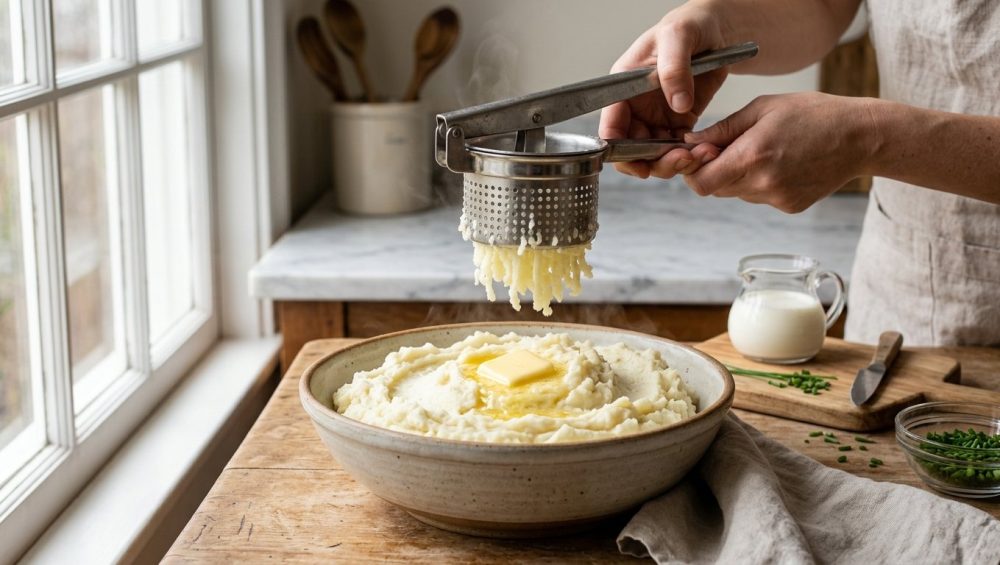
A ricer looks like a giant garlic press. It consists of a hopper where you place the cooked potato, and a plunger that forces the potato through a plate of small, perforated holes. Why is this the ultimate tool? Because it operates on the principle of extrusion rather than shearing.
When you squeeze the handles of a stainless steel ricer, the cooked potato is gently forced through the holes exactly one time. There is no repetitive beating, no spinning blades, and no aggressive friction. The potato emerges on the other side in delicate, uniform, rice-like strings. The swollen starch cells are separated cleanly and efficiently, with almost zero cellular rupture. The result is a bowl of incredibly light, airy potato shreds that are perfectly primed to absorb your dairy and fat.
The Food Mill
If you are cooking a massive Thanksgiving feast for twenty people, squeezing a ricer one potato at a time might give you a repetitive strain injury. Enter the food mill. A food mill uses a hand-cranked rotary blade to gently press food through a perforated bottom plate. It is highly efficient for large batches and, like the ricer, relies on gentle extrusion rather than violent shearing.
The Classic Stainless Steel Masher
If you don’t want to buy a specialty tool and you prefer your mashed potatoes with a little bit of rustic texture, a classic, heavy-duty stainless steel wire or perforated masher is perfectly fine. The key is to use a straight up-and-down pressing motion. Do not stir, whip, or drag the masher through the bowl. Press down to break the potato, lift up, move over, and press again. Stop the very second the potatoes are broken down.
The Definitive Masterclass: Step-by-Step to Fluffy Perfection
We have covered the botany, the chemistry, and the hardware. Now, let’s put it all together. Here is my definitive, no-nonsense, step-by-step masterclass for achieving the lightest, fluffiest mashed potatoes of your life.
Step 1: The Prep
Start with a blend of Russet and Yukon Gold potatoes. Peel them completely (unless you are going for a rustic smash, but today we are chasing silky perfection).
Cut the potatoes into uniform, one-inch to two-inch chunks. Do not leave some pieces huge and others tiny. If the sizes are uneven, the small pieces will overcook and disintegrate into the water before the large pieces are even tender in the middle. Consistency is key.
Step 2: The Cold Water Start
Place your uniform potato chunks into a large, heavy-bottomed pot. Now, pay attention to this crucial rule: cover them with cold tap water.
Do not boil the water first and drop the potatoes in. If you drop raw potatoes into boiling water, the exterior of the potato will immediately begin to gelatinize and cook rapidly. By the time the heat penetrates to the center of the potato chunk, the outside will be completely overcooked, waterlogged, and turning to mush. starting in cold water allows the temperature of the potato to rise gradually alongside the water, ensuring perfectly even cooking from edge to edge.
Add a generous handful of kosher salt to the cold water. Potatoes absorb flavor best while they are cooking, not after. The water should taste like the sea. Bring the pot to a boil over medium-high heat, then reduce it to a gentle simmer. A violent, rolling boil will smash the potatoes against each other, breaking them apart prematurely.
Step 3: The Drain and Steam-Off
Simmer the potatoes until they are completely fork-tender. There should be absolutely no resistance when you pierce them.
Drain the potatoes in a colander, but do not stop there. This is where most home cooks fail. When you drain potatoes, they are still covered in surface moisture. Water is the enemy of fluffy mashed potatoes. If your potatoes are wet, they cannot absorb butter.
Return the drained potatoes to the empty, hot pot and place it back on the stove over low heat for about two to three minutes. Gently shake the pot and watch the steam rise off the potatoes. You are evaporating the excess surface moisture. When the potatoes look dry and slightly chalky on the outside, remove them from the heat.
Step 4: The Gentle Mash
While the potatoes are still piping hot, run them through your potato ricer or food mill into a large, warm mixing bowl. Do not let the potatoes cool down before mashing them. As potatoes cool, the starch begins to retrograde and crystallize, making them difficult to mash and prone to gumminess.
If you are using a hand masher, remember the rule: straight up and down. No stirring, no whipping. Treat the potatoes with respect. Do not treat them like you are ruining your nonstick pans by aggressively scrubbing them with a metal scouring pad. Gentle, deliberate pressure is all that is required.
Step 5: The Dairy Chemistry (Warm It Up!)
While your potatoes were boiling, you should have been preparing your dairy. Never, under any circumstances, pour cold milk or cream straight from the refrigerator into your hot mashed potatoes.
Let’s look at the science again. Milk contains proteins called casein micelles. When milk is cold, these proteins cluster tightly together. When you pour cold dairy into hot potatoes, it causes a rapid drop in temperature—a thermal shock. The swollen starch granules instantly contract, squeezing out the water they just absorbed, resulting in a grainy, weeping texture.
Furthermore, butter is an emulsion of fat crystals, liquid fats, and water. Cold butter will not distribute evenly. When you melt butter, you liquefy the triglycerides.
Heat your whole milk or heavy cream in a small saucepan, and melt your butter into it. You want the mixture hot, but not boiling. The warm, liquefied triglycerides in the melted butter will easily coat the extruded potato starch granules, lubricating them so they slide past each other seamlessly. This is what creates that luxurious, silky mouthfeel.
Step 6: The Fold
Pour the hot dairy and butter mixture over your riced potatoes. Put down the whisk. Put down the mixer. Pick up a silicone spatula or a wooden spoon.
Gently fold the liquid into the potatoes. Slide the spatula down the side of the bowl, scrape the bottom, and fold the potatoes over the top of the liquid. Repeat this gentle folding motion just until the liquid is absorbed and the potatoes are creamy. The moment it comes together, stop touching it. Taste for seasoning, add more salt or white pepper if necessary, and serve immediately.
Troubleshooting: Can You Save Gummy Potatoes?
Let’s say you are reading this article in a panic because you already used the hand mixer, and your potatoes are currently sitting on the counter looking like a bowl of melted white taffy. Can you fix them?
I am going to give it to you straight: No.
Once you have applied extreme mechanical shear and ruptured millions of starch cells, the amylose has been released. You cannot put the toothpaste back in the tube. You cannot un-rupture a cell wall.
Do not try to add more milk to thin them out; you will just create a watery, gluey soup. Do not try to bake them to dry them out; you will just end up with a hot, sticky brick.
But do not despair. While they may be ruined as a fluffy side dish, they are not destined for the trash can. Chill the gummy potatoes in the refrigerator overnight. The next day, the starch will have firmed up significantly. You can mix in an egg, some grated cheese, and a handful of chives, form the mixture into patties, coat them in panko breadcrumbs, and pan-fry them in butter. The sticky amylose that ruined your mash will actually act as a brilliant binder for crispy potato croquettes or potato pancakes.
Kitchen disasters happen. Maybe you added your aromatics too early and now your garlic always burns, or maybe you over-whipped your spuds. It is all part of the learning process. The key is to understand the science so you never make the same mistake twice.
The Final Word
Cooking does not have to be a stressful, chaotic chore, and you certainly do not need to rely on aggressive power tools to force your ingredients into submission. The best food is made by working with the natural chemistry of your ingredients, not against it.
By understanding the delicate cellular structure of the potato, respecting the gelatinization process, and ditching the violent shear force of the electric hand mixer in favor of a gentle potato ricer, you have officially unlocked the secret to flawless comfort food.
We have all been there, standing over a pot of ruined food, wondering where it all went wrong. But beginner cooking mistakes are simply stepping stones to culinary mastery. Now go forth, respect the starch, warm your dairy, and show those potatoes who is boss. Cheers!