Let’s be brutally honest for a second: there are few culinary letdowns more depressing than a flaccid, soggy waffle. You’ve sacrificed your precious weekend morning, whisked until your forearm burned, and poured that golden batter into your iron with the highest of hopes. The first one comes out looking like a masterpiece—crisp, structured, and begging for a pat of butter. But by the time you’ve cooked the rest of the batch and corralled your family or guests to the table, that initial shatteringly crisp texture has devolved into a limp, chewy sponge.
We have all been there. It is the universal curse of the home brunch. But you do not need a culinary degree to fix this. You just need a basic understanding of food science, a couple of reliable beginner kitchen tools, and the willingness to completely abandon the way your mother taught you to serve breakfast.
Today, we are skipping the pretentious chef-speak and diving deep into the thermodynamic reality of homemade waffles. We are going to explore the simple food science of steam management, the chemical magic of cornstarch, and the absolute necessity of the wire cooling rack. More importantly, we are going to transform your chaotic weekend breakfast into a stress-free, intentional communal meal. Welcome to the masterclass on perfectly crispy brunch foods.
The Anatomy of a Waffle Disaster (Why They Go Limp)
To fix the problem, we first have to understand the enemy. And in the world of crispy carbohydrates, the enemy is always moisture.
The Steam Trap: Your Waffle’s Worst Enemy
When batter hits a hot waffle iron, the moisture inside rapidly heats up and turns into steam. This steam expands, creating those beautiful, fluffy air pockets inside the waffle, while the direct contact with the hot metal plates caramelizes the exterior through the Maillard reaction. So far, so good.
But the moment you open that iron, the waffle is still aggressively off-gassing steam. Its internal temperature is near boiling, and moisture is desperately trying to escape. If you take that piping hot, steaming waffle and toss it directly onto a room-temperature ceramic dinner plate, you are committing a cardinal culinary sin. The steam hits the cool, flat surface of the plate, instantly condenses back into liquid water, and is immediately reabsorbed by the bottom of your waffle. Within sixty seconds, the underside of your masterpiece is ruined.
The Stacking Sin: A One-Way Ticket to Soggy Town
If putting a hot waffle on a flat plate is a misdemeanor, stacking hot waffles on top of each other is a felony. Yet, this is exactly what most home cooks do. They pull one waffle out, toss it on a platter, and as the next one finishes, they throw it right on top.
When you stack hot waffles, you are creating a localized sauna. The steam escaping from the bottom waffle rises and saturates the waffle above it. The heat is trapped, the moisture has nowhere to go, and the crispy exterior you just spent five minutes perfecting is effectively steamed back into a state of mush. You are no longer serving a crisp breakfast pastry; you are serving a warm, damp sponge. If you want to master the art of effortless hosting, you must respect the physics of heat and moisture.
The Science of the Shatteringly Crisp Waffle
Before we even get to the cooking and holding techniques, we have to talk about the batter. You cannot hold a crisp edge if your batter isn’t formulated to create one in the first place.
Cornstarch: The Secret Ingredient You’re Ignoring
If you are using a standard recipe that relies entirely on all-purpose flour, you are setting yourself up for a dense, chewy result. All-purpose flour is packed with proteins that form gluten when mixed with liquid. While gluten is fantastic for giving bread its chewy structure, chewiness is the exact opposite of what we want in a waffle.
Enter cornstarch. Cornstarch is a pure carbohydrate extracted from the endosperm of the corn kernel. It contains zero gluten. When you substitute a portion of your all-purpose flour with cornstarch—typically a ratio of three parts flour to one part cornstarch—you are effectively diluting the protein content of your dry ingredients. Less protein means less gluten development.
But cornstarch does more than just inhibit gluten. As it heats up in the waffle iron, the starch molecules absorb moisture, swell, and eventually lock into a rigid, crispy matrix as the exterior dehydrates. This creates a delicate, shatteringly crisp crust that holds its structure significantly longer than a purely flour-based batter. It is the exact same scientific principle that makes Asian fried chicken so incredibly crunchy.
The Hydration Station: Moisture Control in Batter
Another crucial element of your batter is the fat source. Most traditional recipes call for melted butter. Butter is undeniably delicious, but it is also about 15 to 20 percent water. If you are struggling with soggy waffles, try swapping out half of your melted butter for a neutral vegetable oil. Oil is 100 percent fat, meaning you are introducing less water into the batter while still coating the flour proteins to prevent excess gluten formation.
The Meringue Method: Whipping Your Whites
If you have the time—and since this is a weekend project, you should make the time—separate your eggs. Mix the egg yolks into your wet ingredients, but whip the egg whites in a separate bowl until they form soft peaks. Gently fold these whipped whites into your final batter just before cooking.
This technique introduces millions of tiny air bubbles into the mix. When these bubbles hit the heat of the iron, they expand rapidly, creating a lighter, airier interior structure. A lighter interior means less dense, wet batter inside the waffle, which in turn means less internal moisture to turn into steam and ruin your crust later.
The Hardware: Ditching Toxic Gear for Good
I am going to get on my soapbox for a moment because this is a non-negotiable rule in my kitchen. If you are still using a scratched, peeling, $15 non-stick waffle maker you bought a decade ago, throw it in the trash right now. I have zero patience for toxic cookware, and you should be actively avoiding toxic kitchen gear for the safety of your family.
The Truth About Cheap Non-Stick Waffle Irons
The vast majority of budget waffle makers are coated with PTFE (Polytetrafluoroethylene), commonly known by the brand name Teflon. Historically, the manufacturing of these coatings involved PFOA, a toxic “forever chemical” linked to a laundry list of severe health issues. While PFOA was phased out, the industry simply replaced it with other PFAS (per- and polyfluoroalkyl substances) that are proving to be just as concerning.
The regulatory landscape is finally catching up to this reality. As of 2025 and 2026, several progressive states—including Minnesota, Colorado, Maine, and Connecticut—have enacted strict bans prohibiting the sale of cookware containing intentionally added PFAS [1]. Minnesota’s groundbreaking Amara’s Law, which took effect on January 1, 2025, specifically targets items with nonstick PFAS coatings on food contact surfaces [2]. Colorado and Maine followed suit with sweeping bans effective January 1, 2026 [1]. These aren’t just gentle suggestions; these are enforceable laws acknowledging that cooking our food on synthetic forever chemicals is a fundamentally bad idea [1].
When you heat a cheap PTFE waffle maker to the high temperatures required for a crispy crust, that coating can degrade. If the surface is scratched or peeling, those chemicals are leaching directly into your breakfast.
What to Look For in a Safe Waffle Maker
Invest in a waffle maker that utilizes a safe, non-toxic surface. High-quality ceramic coatings are an excellent, PFAS-free alternative that still provide a reliable non-stick experience. Alternatively, look for traditional cast iron waffle makers. Yes, they require seasoning and a bit more maintenance, but they will literally outlive you and produce a crust that a cheap plastic appliance could only dream of.
The Aerosol Spray Warning
While we are discussing hardware, step away from the commercial cooking sprays. Those convenient little aerosol cans are loaded with soy lecithin and chemical propellants. When exposed to the high heat of a waffle iron, these propellants polymerize and bake onto the surface, creating a sticky, impossible-to-remove residue. Over time, this residue builds up, completely destroying the non-stick properties of your iron. If you are serious about protecting your non-stick surfaces, brush your iron lightly with melted butter or a high-smoke-point oil using safe silicone spatulas or a high-heat pastry brush. Never use aerosol cooking sprays on your precious cooking surfaces.
The Master Technique: The Wire Cooling Rack
Now that we have a scientifically optimized batter and a safe, high-quality iron, we arrive at the most critical step of the entire process: the holding method. This is where the battle for crispiness is won or lost.
Convection is Your Best Friend
As we established earlier, putting a hot waffle on a flat surface causes steam to condense, ruining the crust. The solution is simple: 360-degree airflow.
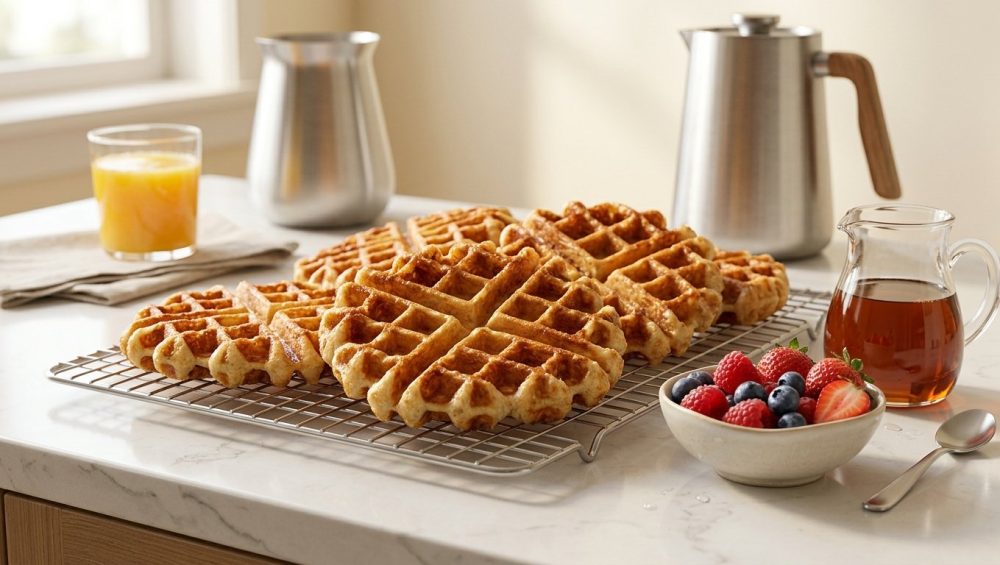
When you remove a waffle from the iron, it must immediately go onto a wire cooling rack. By elevating the waffle, you allow the escaping steam to dissipate into the air rather than becoming trapped against a solid surface. The air circulating beneath the waffle helps the exterior cool slightly and set into a firm, rigid crust.
The Oven-Hold Method for a Crowd
If you are cooking for a family or hosting a brunch, you cannot serve one waffle at a time while everyone else stares at you. You need a holding strategy.
Preheat your oven to 200°F (or up to 225°F if your oven runs cool) [3]. This temperature is crucial. It is hot enough to keep the waffles pleasantly warm, and just above the boiling point of water (212°F), which encourages any residual surface moisture to evaporate rather than condense [3]. However, it is not so hot that it will continue to bake or dry out the interior of the waffle.
Take one or two heavy-duty baking sheets and place a wire cooling rack inside each one. Place this entire setup into the preheated oven. As each waffle comes out of the iron, transfer it directly to the wire rack in the oven.
Crucial Rule: Place the waffles in a single, uncrowded layer. Do not let them overlap, and whatever you do, do not cover them with aluminum foil [4]. Covering them traps the steam, which defeats the entire purpose of this meticulous setup [4]. By holding them on a wire rack in a warm oven, you are ensuring that the tenth waffle is just as hot and shatteringly crisp as the first.
Executing the Mindful Waffle Bar
Cooking the perfect waffle is only half the battle. The other half is serving it in a way that allows you, the host, to actually enjoy your own gathering. I am a massive advocate for hosting mindful gatherings. This means rejecting the chaotic, frantic energy of playing short-order cook while your friends and family eat without you.
The Mindful Waffle Bar is an intentional, communal dining strategy designed to front-load the work and create a relaxed, interactive experience for your guests.
Eliminating the Bottlenecks
The primary bottleneck of any waffle breakfast is the iron itself. You can only produce one or two waffles every five minutes. If you have six people at the table, someone is going to be waiting a half-hour to eat.
By utilizing the oven-hold method described above, you completely eliminate this bottleneck. You can wake up an hour before your guests, peacefully brew your coffee, and methodically cook the entire batch of waffles. Because you are storing them correctly on wire racks in a 200°F oven, they will happily sit there for 30 to 45 minutes without degrading in quality. By the time everyone gathers in the kitchen, the cooking is completely finished. You have successfully mastered eliminating kitchen bottlenecks.
Curating the Toppings Spread
A waffle bar is only as good as its accoutrements. Because you aren’t chained to the waffle iron while people are eating, you have the time to curate a beautiful, expansive toppings spread.
Do not just throw a plastic bottle of fake maple-flavored high-fructose corn syrup on the table. Elevate the experience.
The Sweet Zone:
- Real Maple Syrup: Grade A Dark Color, Robust Taste. Warm it gently in a small saucepan before serving. Cold syrup on a hot waffle instantly drops the temperature of the food.
- Compotes: A quick berry compote takes ten minutes. Toss frozen blueberries, a squeeze of lemon juice, and a pinch of sugar into a pot and simmer until it thickens.
- Whipped Cream: Make it from scratch. Heavy cream, a dash of vanilla extract, and a tiny bit of powdered sugar. Whip it right before serving.
- Texture: Toasted chopped pecans, sliced almonds, or a high-quality granola add an essential crunch that contrasts beautifully with the soft interior of the waffle.
The Savory Zone:
- Fried Chicken: If you want to go all out, crispy chicken tenders turn a breakfast waffle into a decadent brunch centerpiece.
- Bacon and Cheddar: Offer sharp cheddar cheese and crumbled, thick-cut bacon.
- Hot Honey: A drizzle of chili-infused honey is the ultimate bridge between sweet and savory.
Organize these toppings in small, aesthetically pleasing bowls with their own dedicated serving spoons. By setting this up on a kitchen island or a sideboard, you empower your guests to build their own perfect plate. You get to pour yourself a mimosa, sit down, and actually participate in the conversation.
Troubleshooting Common Waffle Woes
Even with the best techniques, things can occasionally go sideways. Here is how to troubleshoot the most common waffle disasters.
Why Your Waffles Stick (Even on Good Irons)
There is nothing more demoralizing than opening your iron to find your waffle has split completely in half, with the top crust glued to the lid and the bottom crust cemented to the base.
If this happens, it is usually due to one of three reasons:
- Lack of Fat in the Batter: Your batter needs enough internal fat to help release it from the plates. If you skimped on the oil or butter, the batter will cling to the metal.
- The Iron Wasn’t Hot Enough: You must preheat your iron fully. The batter needs to sear on contact. If you pour batter onto a lukewarm iron, it will slowly bake and fuse to the surface. Wait for the indicator light, and if you want to be certain, flick a tiny drop of water onto the plates. It should instantly sizzle and dance.
- You Opened It Too Early: Patience is a virtue. If you open the iron before the crust has fully formed and set, the structural integrity of the waffle will fail, and it will tear. A good rule of thumb: watch the steam. When the aggressive billowing of steam slows down to a gentle wisp, the waffle is usually ready.
The Dense and Chewy Dilemma
If your waffles look beautiful but taste like heavy, dense bread, you have overworked the gluten. When mixing your wet and dry ingredients, you must use a light hand. Whisk them together until they are just combined. It is perfectly fine—in fact, it is preferred—to have small lumps of flour remaining in the batter. If you beat the batter until it is perfectly smooth, you have developed too much gluten, and your waffles will be tough.
Additionally, check the expiration date on your leavening agents. Baking powder and baking soda lose their potency over time. If your baking powder is a year old, it is not going to provide the lift necessary to create a light, airy interior.
Reheating Leftovers
If you happen to have leftover waffles, do not put them in the refrigerator. The humid environment of the fridge will accelerate staling. Instead, let them cool completely on a wire rack at room temperature, then place them in a freezer-safe zip-top bag with small squares of parchment paper between each waffle to prevent sticking.
When you want a quick weekday breakfast, do not microwave them. The microwave will turn them into rubber. Pop the frozen waffle directly into a standard toaster or a toaster oven. The direct, intense heat will revive the crispy exterior while gently warming the interior, giving you a near-perfect waffle on a Tuesday morning with zero effort.
The Final Bite: Reclaiming Your Weekend Brunch
Cooking should not be an exercise in frustration, and hosting should never feel like a punishment. By understanding the simple physics of steam, respecting the chemistry of cornstarch, and utilizing the brilliant simplicity of the oven-hold method, you have effectively conquered the soggy waffle.
You now possess the knowledge to ditch the toxic gear, elevate your ingredients, and serve a flawless, shatteringly crisp breakfast to a crowd without breaking a sweat. The Mindful Waffle Bar isn’t just about better food; it is about reclaiming your time, your sanity, and the joy of sharing a meal with the people you care about. Now, go preheat that iron, whip those egg whites, and enjoy your weekend. You’ve earned it.