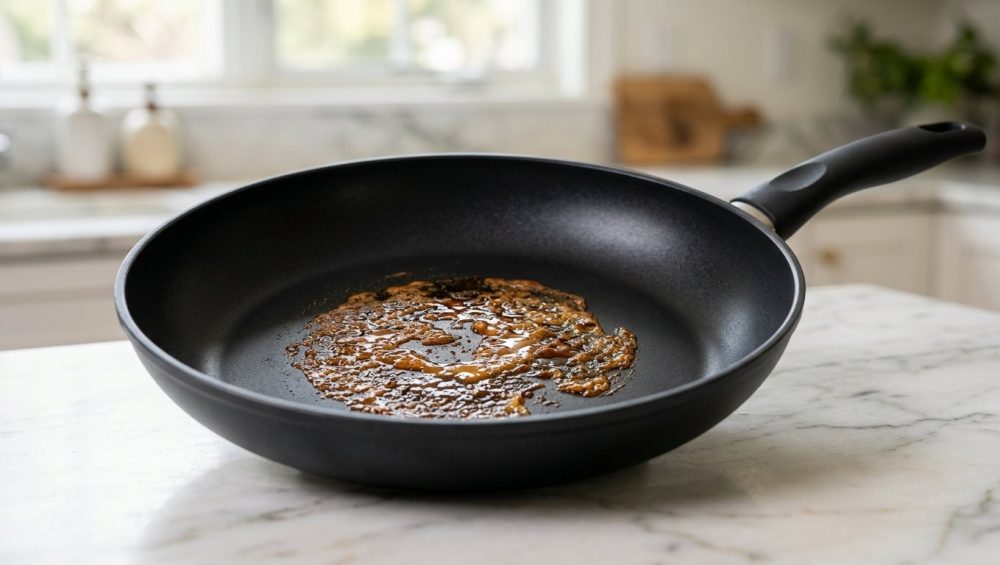
Listen up, weekend culinary warriors and everyday home cooks. We need to have a serious, brutally honest conversation about that shiny, expensive nonstick skillet sitting on your stove right now. You know the one. You bought it a few months ago, mesmerized by the marketing promises that you could fry an egg without a single drop of fat and it would magically slide right onto your plate. For the first two weeks, it was an absolute dream. You felt like a culinary genius. But today? Today, you are aggressively scraping a mangled, rubbery layer of scrambled eggs off the bottom of that exact same pan with a plastic spatula, wondering how you managed to destroy it so quickly.
You probably blame yourself. You assume you had the heat too high, or you used the wrong detergent, or you just don’t have the magic touch required to maintain nice things. I am here to tell you to stop beating yourself up. While user error is definitely a thing in the kitchen, the real reason your cooking spray ruins nonstick pans is hiding in plain sight, sitting right there in your pantry. It is that hyper-convenient, aerosol can of commercial cooking spray.
I have zero patience for pretentious chef-speak, but I firmly believe that anyone can cook like an absolute expert if they are armed with the right knowledge. And part of that knowledge is understanding that the food industry has sold us a massive lie in the name of “convenience.” That innocent-looking can of aerosol spray is actively sabotaging your cookware, slowly coating it in an invisible, impenetrable layer of polymerized gunk that completely neutralizes the nonstick properties of your expensive pans.
If you want to protect your kitchen investments, save money, and stop eating a bizarre cocktail of chemical propellants, it is time to throw that can in the garbage. Let’s dive deep into the fascinating, slightly horrifying science of what happens when aerosol sprays hit a hot pan, why your cookware is begging for mercy, and what you should be using instead to get perfectly slick, professional-level results in your home kitchen.
The Billion-Dollar Aerosol Lie: What Are We Actually Spraying?
To understand the sheer scale of this problem, we have to look at the numbers. The global aerosol cooking spray market is an absolute juggernaut, valued at roughly $4.8 billion in 2024 and projected to skyrocket anywhere from $7.6 billion to over $13.6 billion by the 2030s. Millions of consumers buy these cans every single day, convinced they are making a healthy, low-calorie choice. But to fully grasp the danger of aerosol cooking sprays, we have to read the ingredient label—a step most home cooks skip when they are rushing to get a weeknight dinner on the table.
When you press the nozzle on a can of commercial cooking spray, you are not just getting a fine mist of pure, unadulterated vegetable oil. If it were just oil, we wouldn’t be having this conversation. You are actually dispensing a highly engineered chemical cocktail designed to forcefully eject liquid from a pressurized can and spread it evenly without foaming.
Propellants: The Gas Station in Your Pantry
First, let’s talk about how the oil actually gets out of the can. Commercial sprays rely on hydrocarbon propellants. If you look closely at the fine print on the back of the can, you will likely see ingredients like butane, isobutane, and propane. Yes, you read that correctly. The exact same highly flammable gases used to fuel your outdoor camping stove and your backyard barbecue grill are being used to shoot oil onto your morning frying pan.
While the FDA classifies these propellants as Generally Recognized as Safe (GRAS) for food contact because they theoretically dissipate into the air upon release, it is still a jarring reality. You are essentially spraying a highly combustible gas into your kitchen environment. More importantly for your cookware, these propellants do not always burn off completely cleanly, especially if you spray the pan while it is already sitting over a hot gas burner—a massive safety hazard that can cause flare-ups and leave microscopic chemical residues on your cooking surface.
Dimethyl Silicone: The Anti-Foaming Agent
Have you ever wondered why the oil from a spray can doesn’t instantly bubble and foam aggressively when it hits a hot surface? You can thank dimethyl silicone (also known as dimethylpolysiloxane) for that. This is a synthetic polymer—a type of silicone oil—added specifically as an anti-foaming agent.
While deemed safe for consumption in trace amounts, dimethyl silicone is also widely used in cosmetics, industrial lubricants, and textile finishing agents. When exposed to the high, repetitive thermal stress of daily cooking, these silicone derivatives can begin to leave a microscopic film on your cookware. It is completely unnecessary for everyday cooking and just adds another layer of synthetic buildup to your pan’s surface.
Soy Lecithin: The Ultimate Kitchen Villain
Finally, we arrive at the main antagonist of our story: soy lecithin. If you take away only one piece of information from this masterclass, let it be this. Soy lecithin is an emulsifier. In the context of an aerosol can, oil and liquid propellants naturally want to separate. Soy lecithin is added to force them to play nicely together, ensuring that you get an even, consistent spray every time you press the nozzle.
Lecithin itself is a naturally occurring phospholipid, commonly extracted as a byproduct of refining soybean oil. In foods like chocolate and baked goods, it is harmless and actually helps create smooth, creamy textures. But when soy lecithin is subjected to the direct, searing heat of a frying pan, it undergoes a radical chemical transformation. It becomes the exact reason your pan is currently sitting in the sink, soaking in soapy water, while you question your life choices.
Polymerization: How Cooking Spray Turns into Kitchen Superglue
Let’s get into the thermodynamic science of why your cookware is failing. When soy lecithin is heated past a certain temperature threshold, it doesn’t just evaporate, and it doesn’t just burn away cleanly into ash. Instead, it polymerizes.
Polymerization is a chemical process where relatively small molecules combine chemically to produce a very large chainlike or network molecule, called a polymer. In the culinary world, we actually rely on the polymerization of fats to season raw cast iron and carbon steel skillets. When you bake oil onto a cast iron pan, the fatty acid chains oxidize and cross-link, forming a hard, slick, protective plastic-like coating that bonds to the porous iron. That is exactly what you want on a cast iron skillet.
But on a modern nonstick pan? It is an absolute death sentence.
The Thermodynamics of a Ruined Pan
When you spray a nonstick pan with commercial aerosol spray, you are coating it in a fine mist of oil and soy lecithin. As the pan heats up, the lecithin molecules begin to oxidize and cross-link. Because the mist is so incredibly fine, it heats up much faster than a standard pour of liquid oil. Within seconds, the lecithin polymerizes, baking itself directly onto the surface of your pan.
This creates a yellowish-brown, incredibly sticky, varnish-like residue. Unlike the hard, smooth seasoning on a cast iron pan, polymerized lecithin on a nonstick surface forms a gummy, tacky film. It acts like culinary superglue. Once this layer forms, it acts as a barrier between your food and the actual nonstick coating of the pan. Your eggs aren’t sticking to the Teflon; they are sticking to the baked-on layer of soy lecithin.
Why PTFE and Ceramic Coatings Hate Emulsifiers
To understand why this is so catastrophic, you have to understand how nonstick pans work. Traditional nonstick pans are coated with PTFE (Polytetrafluoroethylene), famously known by the brand name Teflon. PTFE is incredibly dense and has one of the lowest coefficients of friction of any known solid material. Ceramic pans, on the other hand, use a sol-gel (solution-gelation) process to create a smooth, silica-based, sand-derived surface that mimics the slickness of PTFE without the use of “forever chemicals” (PFAS).
Both of these coatings rely on their microscopic smoothness to prevent food from adhering. When your ceramic pan lost its non-stick finish seemingly overnight, it wasn’t because the ceramic disappeared; it was because the microscopic pores of the sol-gel coating became clogged with polymerized lecithin.
Because nonstick pans are inherently delicate, you cannot use abrasive steel wool or harsh scouring pads to aggressively scrub away this gummy residue without permanently scratching and destroying the underlying nonstick layer. You are caught in a trap: the pan is sticky because of the spray, but the only way to physically remove the spray is to destroy the pan.
The “No-Go” Rule on Toxic Gear and Compromised Pans
As a seasoned home cook who prioritizes both efficiency and health, I have a strict rule about banishing toxic kitchen gear from my house. I absolutely despise cheap, peeling, compromised cookware. If your nonstick pan has reached the point where the coating is physically flaking off into your food, you must throw it away immediately.
The Danger of Scratched PTFE
When polymerized cooking spray builds up, people naturally tend to scrub harder. They grab the abrasive side of the sponge, or worse, a metal spatula, and go to war with the sticky brown residue on the edges of the skillet. This friction inevitably scratches the PTFE coating.
Once PTFE is scratched, it begins to flake. While ingesting small flakes of cold PTFE is generally considered inert by health agencies, the real danger lies in heating a compromised pan. When traditional Teflon pans are heated beyond 500°F (260°C), the PTFE begins to break down and release toxic fumes, a phenomenon that can cause “polymer fume fever” in humans and is famously lethal to pet birds. A scratched, degraded pan is more susceptible to uneven heating and thermal degradation, which is exactly why your frying pans keep warping and losing their finish in the first place.
The Financial Drain of the “Convenience” Spray
Let’s talk about the economic absurdity of aerosol cooking sprays. Time is money, yes, but actual money is also money. A standard can of commercial cooking spray costs around $4 to $6. When you buy that can, you are primarily paying for the pressurized tin, the butane propellant, the dimethyl silicone, and the soy lecithin. The actual volume of usable, high-quality cooking oil inside that can is shockingly low.
You are paying a massive premium for a product that is actively designed to ruin your $50 to $150 nonstick skillets. Replacing a high-quality nonstick pan every six months because it became irrevocably gunked up with lecithin is a massive drain on your wallet. It is a cycle of manufactured obsolescence that you have the power to break today.
The Sassy Sous-Chef’s Guide to Rescuing a Gunked-Up Pan
If you are reading this and staring guiltily at a skillet that has a weird, sticky, yellowish-brown ring around the inner edges, do not panic. Before you throw it in the trash, we need to perform a diagnostic touch test. Run your fingers along the surface of the pan once it is completely clean and dry. If the surface feels physically scratched, gouged, or the coating is actively peeling away to reveal the bare aluminum underneath, the pan is dead. Say your goodbyes.
However, if the surface feels intact but has a tacky, gummy texture that grips your finger like a weak adhesive, you are dealing with polymerized soy lecithin. Because you cannot use harsh abrasives, we have to use chemistry to defeat chemistry.
The Baking Soda Boil Method
To break down the polymerized fat without scratching the delicate PTFE or ceramic coating, you need a gentle alkaline solution and thermal energy.
- The Mixture: Fill the affected pan with about two inches of water. Add half a cup of standard baking soda (sodium bicarbonate).
- The Boil: Place the pan on the stove and bring the water to a gentle, rolling simmer. Do not use maximum heat; a medium simmer is perfect. Let it bubble away for 15 to 20 minutes.
- The Lift: The alkaline nature of the baking soda, combined with the heat, will slowly begin to saponify and lift the polymerized grease from the microscopic pores of the nonstick coating.
- The Wipe: Turn off the heat and let the water cool until it is safe to handle. Dump the water and use a soft, non-abrasive microfiber cloth or a standard sponge to gently wipe away the loosened gunk. Wash thoroughly with mild dish soap.
This method works wonders for mild to moderate buildup. And instead of letting aerosol mist coat your kitchen, use a fine mesh splatter screen to manage grease when you are actually cooking your meals. It keeps your stovetop pristine without relying on chemical anti-foaming agents.
What to Use Instead: Safe, Effective Alternatives to Aerosol Sprays
Now that we have established that aerosol cooking spray is the enemy of the home cook, what are we supposed to use? When discussing weekday meals, I rigorously prioritize efficiency and shortcuts. I am not going to tell you to spend twenty minutes meticulously massaging oil into a pan with a hand-woven artisan cloth. We need fast, effective, non-toxic solutions.
The Mighty Oil Mister
If you love the convenience of a spray, a reusable oil mister is one of those tools every beginner needs to save money and protect their cookware. These are inexpensive glass or stainless steel bottles equipped with a manual pump mechanism.
You fill the bottle with your own high-quality, 100% pure oil—like cold-pressed avocado oil, light olive oil, or grapeseed oil. You pump the cap a few times to build up internal air pressure, and then you press the nozzle to release a perfect, continuous mist of pure oil. There is no butane, no propane, no silicone, and absolutely no soy lecithin. It is just pure, unadulterated fat and standard atmospheric air. It takes two seconds, costs pennies per use, and will never leave a polymerized gummy residue on your skillets.
The “Just Pour and Wipe” Method
If you don’t want to buy another kitchen gadget, the absolute best, most foolproof method for preserving a nonstick pan is the pour-and-wipe technique.
Pour a dime-sized drop of pure liquid oil directly into the center of your cold pan. Take a folded paper towel and quickly wipe the oil across the entire interior surface of the skillet. This creates an ultra-thin, microscopic layer of fat that is perfectly distributed, mimicking the exact effect of an aerosol spray but without any of the destructive chemical emulsifiers. It takes roughly three seconds, and you can toss the paper towel directly into the compost bin. Time is money, and this method is practically free.
Butter and Solid Fats
Do not underestimate the power of real, high-quality butter or ghee. Unlike commercial sprays, butter is a natural emulsion of butterfat, milk solids, and water. When you melt a small pat of butter in a preheating nonstick pan, the water evaporates, and the fat coats the surface beautifully. It provides vastly superior flavor to any “butter-flavored” aerosol spray (which usually just relies on artificial flavorings and more chemicals) and will wash away effortlessly with warm water and mild soap.
Proper Heat Management: The Ultimate Nonstick Hack
Swapping out your cooking spray is only half the battle. If you want your nonstick pans to last for years instead of months, you have to master your stovetop. The pan isn’t just sticking because of the lecithin; it is sticking because you are actively abusing the thermal limits of the cookware.
The Myth of High Heat on Nonstick
Nonstick pans are designed for low to medium heat. Period. I do not care what the infomercial told you; you should never, ever blast a PTFE or ceramic pan on maximum heat.
When you expose a nonstick pan to high heat, several disastrous things happen simultaneously. First, the nonstick coating begins to degrade on a molecular level. Second, any fat you have placed in the pan—even pure, high-quality avocado oil—will instantly reach its smoke point, breaking down into free radicals and polymerizing onto the surface. High heat accelerates the exact sticky residue problem we are trying to avoid.
If you want to put a hard, aggressive sear on a ribeye steak, you should be using cast iron, carbon steel, or heavy-clad stainless steel. In fact, the same reason food sticks to your stainless steel skillets is usually due to improper heat management and a lack of preheating. Keep your nonstick pans reserved for delicate proteins: eggs, fish fillets, pancakes, and crepes.
Preheating: The Make-or-Break Moment
One of the biggest rookie mistakes in the kitchen is the “cold pan, cold oil, cold food” tragedy. If you dump cold ingredients into a cold pan and then turn on the heat, the food will heat up at the exact same rate as the metal, giving the proteins ample time to chemically bond with the surface of the pan before the oil can create a protective barrier.
You must preheat your pan gently. Place your nonstick skillet on the burner over medium-low heat for about 60 to 90 seconds. Once the pan is gently warmed, add your pure oil or butter. Let the fat heat up for a few seconds until it shimmers. Only then should you add your food.
While you shouldn’t get a nonstick pan smoking hot, you can utilize the water drop test to gauge temperature on your other bare-metal pans to ensure they are perfectly preheated before adding fats. By managing your heat correctly, you ensure that the thin layer of pure oil acts as a perfect, frictionless barrier between your food and the pan, requiring zero help from chemical propellants.
Conclusion: Reclaiming Your Skillet and Your Sanity
Cooking at home should not be a frustrating battle against sticky pans and ruined breakfasts. You do not need a culinary degree to make mind-blowing food, but you do need to stop falling for the convenience traps set by the processed food industry.
Aerosol cooking sprays are a brilliant feat of chemical engineering, but they have absolutely no place in a modern home kitchen that utilizes nonstick cookware. The propellants belong in camping stoves, the dimethyl silicone belongs in cosmetics, and the soy lecithin belongs in chocolate bars—not baked onto your $80 ceramic skillet.
By ditching the toxic aerosol cans, investing in a simple reusable oil mister, and respecting the thermal limits of your cookware, you will extend the life of your pans by years. You will save money, eliminate unnecessary chemicals from your diet, and finally experience the frictionless joy of a perfectly cooked omelet sliding effortlessly onto your plate. Transforming your chaotic dinner prep into a peaceful daily habit requires the right tools and the right techniques. So throw out the spray, grab some real oil, and let’s get back to actual cooking.