Ever spent three hours simmering a massive weekend chili, dumped in a small fortune’s worth of cumin, coriander, and chili powder, only to taste it and realize it somehow tastes like… absolutely nothing? Or worse, does it taste like dusty, stale sawdust floating in tomato water?
You grab the salt shaker. You squeeze a lemon. You stare into the abyss of your Dutch oven, wondering why your food never has that deep, resonant, restaurant-quality flavor. You start questioning your life choices and assuming you just don’t have the “gift” of cooking.
Spoiler alert: It has nothing to do with your talent, and you certainly don’t need a culinary degree to fix it. The culprit is a lot simpler. You are committing one of the most common rookie kitchen mistakes out there. You are dumping raw, dry spices directly into water-based liquids.
Listen to me, my beautiful, well-intentioned weekend warriors. Spices are not magical fairy dust. You cannot just sprinkle them into a simmering pot of watery soup and expect them to instantly release their soul. To get that mind-blowing, complex flavor, you have to wake them up. You have to bloom them.
Today, we are going to strip away the mystery and dive deep into the brutally honest, highly scientific, and incredibly simple magic of blooming spices in hot oil. Grab a coffee (or a glass of wine, I won’t judge), and let’s fix your food.
The Dusty Spice Dilemma: Why Your Food Tastes Like Nothing
Most home cooks treat their spice rack like an afterthought. You buy a jar of paprika, use it once for deviled eggs on Thanksgiving, and let it sit in a cabinet directly above your stove for three years. If your spices turn into hard bricks, you have already lost the battle. Throw them away.
But let’s assume you are doing everything right. You bought fresh, high-quality spices. You ground them yourself. You add a generous tablespoon to your simmering curry sauce. And yet, the dish still tastes powdery, flat, and aggressively mediocre. Why? Because you ignored the fundamental laws of physics and chemistry.
Spices are essentially tough little plant vaults. Inside those vaults are the essential oils that contain all the flavor and aroma you are desperately trying to extract. If you just toss those vaults into a cold or watery environment, the doors stay locked. The spices simply hydrate, swell up, and create a gritty, muddy texture on your palate. To unlock the vault, you need two things: heat and fat.
The Chemistry of Flavor: Why Water is the Enemy of Spices
Let’s get a little nerdy for a second, but I promise to keep it highly relevant to your dinner. The aromatic compounds responsible for the scent and flavor of your spices—like the citrusy pine notes in rosemary, the warm depth of cloves, or the sharp green scent of coriander—are organic molecules. Specifically, we are talking about terpenes, phenols, aldehydes, and esters.
Here is the most critical scientific fact you will learn today: These flavor compounds are non-polar.
Water is a polar solvent. Fat is a non-polar solvent. Because the flavor molecules in spices are non-polar, they are hydrophobic—they literally repel water. When you drop a tablespoon of raw cumin into a simmering pot of watery tomato sauce, the water simply cannot extract the flavor. The spices just sit there, suspended in the liquid, tasting exactly like what they are: dry, ground-up bark and seeds.
But blooming them in oil changes the entire molecular structure of your dish. Hot fat acts as the ultimate solvent. When spices hit warm oil, the heat ruptures their cellular walls, allowing the non-polar fat to rush in, dissolve those rich essential oils, and carry them evenly throughout every single bite of your food. In fact, scientific analysis has shown that blooming ground spices in oil can increase measurable aroma intensity by a staggering 300% compared to dry-toasting or boiling.
The Magic of Blooming: What It Is and Why It Works
I have zero patience for pretentious recipe jargon that overcomplicates a simple weeknight dinner. So let’s call it what it is: blooming is just frying your spices in fat.
The Ancient Roots of Tadka
While Western cooking is just starting to catch on to the science of fat-soluble flavor extraction, this technique has been the absolute bedrock of South Asian cuisine for thousands of years. In India, this practice is known as tadka, chaunk, baghaar, phoron, or thalimpu, depending on the region.
Tadka is not a garnish; it is a controlled chemical reaction. It is the practice of tempering whole and ground spices in hot ghee or oil to awaken their essential oils before adding them to a dish (or pouring them over a finished dish like dal). The ancient Ayurvedic practitioners understood this long before modern chemistry proved it: cooking spices in fat not only unlocks their flavor but actually makes their nutritional compounds and antioxidants more bioavailable for your body.
The Maillard Reaction in Spices
You probably know that searing a steak creates a delicious brown crust thanks to the Maillard reaction—a chemical reaction between amino acids and reducing sugars under high heat. But did you know spices undergo a Maillard reaction, too?
When spices hit oil that is heated to around 350°F (180°C), the high temperature triggers this browning process, creating entirely new, deeply savory flavor molecules called pyrazines. This is why bloomed spices taste nutty, smoky, and complex, while raw spices taste harsh and astringent. Water boils at 212°F (100°C), which is nowhere near hot enough to trigger a Maillard reaction. This is precisely why boiling your spices will never, ever yield the depth of flavor that frying them will.
The Sassy Sous-Chef’s No-Nonsense Guide to Blooming Spices
Alright, enough theory. Let’s get our hands dirty. Blooming spices is incredibly simple, but it requires focus. You are dealing with high heat and tiny particles; the line between “intoxicatingly fragrant” and “bitter, burnt trash” is about five seconds long. Here is exactly how to execute this technique flawlessly every single time.
Step 1: Choose Your Fat Wisely
You need a fat with a high smoke point that can handle the heat without breaking down and tasting acrid.
- The Gold Standard: Ghee (clarified butter). Ghee has a smoke point of around 480°F (250°C) because the milk solids have been removed. It adds a rich, nutty flavor that complements spices perfectly.
- The Neutral Everyday Heroes: Avocado oil, grapeseed oil, or refined peanut oil. These let the pure flavor of the spices shine without adding their own competing tastes.
- The Traditional Alternatives: Mustard oil or coconut oil, which add incredible regional authenticity and depth to specific curries and dals.
- The Absolute “Do Not Use”: Extra virgin olive oil or whole butter. Olive oil will smoke and turn bitter at these temperatures, and the milk solids in whole butter will instantly burn, ruining your entire dish.
Step 2: The Right Gear (And My “No-Go” Rule on Toxic Pans)
If you have been reading my articles for more than five minutes, you know I am fiercely dedicated to banishing toxic kitchen gear from your home. I absolutely despise cheap, lightweight, peeling non-stick pans.
When you heat a mysterious, chemical-coated non-stick pan to 350°F and above, that coating can begin to degrade, off-gassing toxic fumes into your kitchen and leaching chemicals into your food. Furthermore, thin, cheap pans have terrible heat retention, creating hot spots that will scorch your spices instantly.
You need safe, durable, heavy-bottomed cookware. For a proper bloom, a small, heavy-gauge stainless steel skillet or a well-seasoned set of carbon steel pans are your best friends. They distribute heat evenly, allowing you to control the temperature and toast your spices gently and consistently. If you are doing a dedicated Indian tadka, you can even invest in a small, specialized tempering pot (a tadka pan), which has a deep bowl shape to minimize splattering.
Step 3: The Order of Operations (Whole vs. Ground)
You cannot just dump all your spices into the oil at the same time. Different ingredients have different moisture contents and surface areas, meaning they burn at wildly different rates. Grinding a spice shatters its cellular walls and increases its surface area by up to 40 times, making it incredibly vulnerable to burning.
Here is the scientifically optimized sequence:
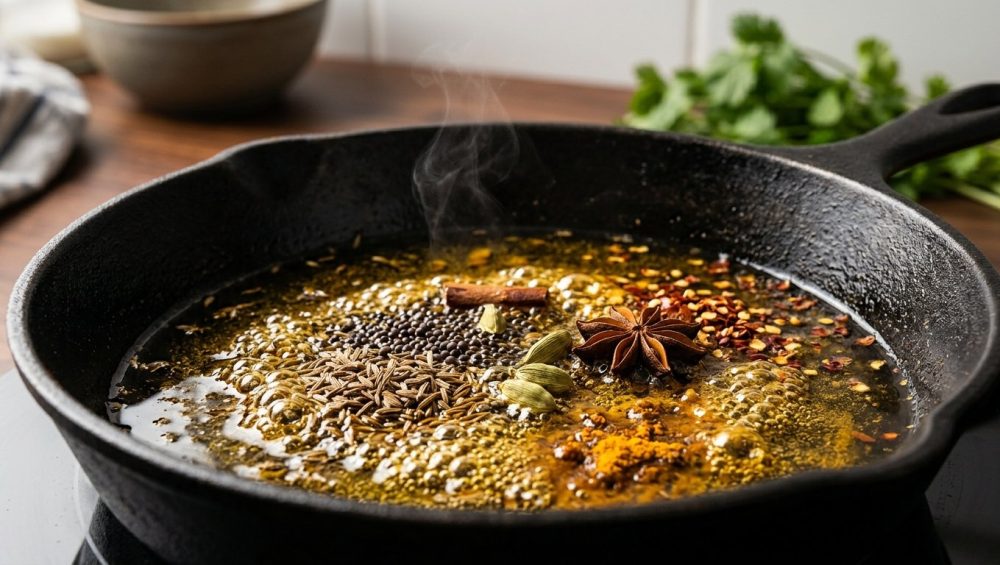
- Dense Whole Spices First: Mustard seeds, cumin seeds, coriander seeds. These take the longest to extract and can handle the highest heat (350°F to 375°F). Mustard seeds literally need this high heat to activate a compound called allyl isothiocyanate, which gives them their signature sharp, pungent flavor. Wait until you hear them visibly pop and sputter.
- Tough Aromatics Second: Dried red chilies, cinnamon sticks, cloves, and cardamom pods. These will puff up and release their essential oils (like eugenol in cloves) into the fat.
- Fresh Aromatics Third: Minced garlic, ginger, fresh chilies, or curry leaves. Be careful—the water in these fresh ingredients will cause the oil to aggressively spit and hiss.
- Ground Spices Last (The 15-Second Rule): Ground turmeric, paprika, cumin powder, or cayenne. Ground spices should be added at a much lower temperature (around 275°F to 300°F). You should only let them sizzle for 15 to 30 seconds. The moment they hit the oil, they will release their fat-soluble compounds. If you leave them in the hot oil for a minute, they will turn into bitter ash.
Step 4: The Temperature Sweet Spot
You don’t need a laser thermometer to nail the temperature; you just need your eyes and your nose.
Heat your oil over medium heat. Look for the “shimmer.” When the oil forms tiny ripples across the surface and moves fluidly like water, it is ready. Do not wait for the oil to smoke! If your oil is smoking, it is already too hot, and your spices will burn on contact.
Drop a single cumin seed into the oil. If it sinks and does nothing, the oil is too cold, and the spices will just greedily absorb the fat and turn soggy. If it instantly turns black and smells like a campfire, the oil is too hot. If it immediately dances, bubbles, and releases a gorgeous, nutty aroma, you have hit the sweet spot.
Time is Money: Weeknight Blooming Hacks
I love a good weekend culinary project, but when it is 6:30 PM on a Tuesday, you are exhausted, and you are dangerously close to ordering a $40 lukewarm pizza, efficiency is paramount. Truly breaking your takeout habit requires you to cook smart, not hard.
You do not need to pull out three different pans to execute a perfect spice bloom when you are throwing together simple weeknight dinners.
The One-Pot Cheat Code
Instead of doing a separate tadka at the end of your dish, build the flavor foundation right in your main pot.
- Heat a generous glug of oil in your Dutch oven or skillet.
- Add your chopped onions and sauté until translucent.
- Push the onions to the edge of the pan, creating a clear pool of hot oil in the center.
- Drop your ground spices (chili powder, cumin, smoked paprika) directly into that hot oil pool.
- Let them sizzle and bloom for 30 seconds until your kitchen smells incredible.
- Immediately dump in your liquid (crushed tomatoes, broth, or coconut milk).
This is called the “Emergency Brake” technique. The sudden introduction of a cold, water-based liquid instantly drops the temperature of the pan, stopping the spices from frying and completely eliminating the risk of burning them. You just built a massive, restaurant-quality flavor base in a single pot in under a minute.
Batch Prep: Making Aromatic Oils
If you want to save even more time, make a batch of infused spice oil on Sunday. Heat a cup of neutral oil, gently fry a handful of crushed garlic, chili flakes, and cumin seeds until fragrant, then let it cool and store it in a glass jar. You now have a potent, fat-soluble flavor bomb that you can drizzle over roasted vegetables, scrambled eggs, or hummus all week long. It takes five minutes to make and makes you look like an absolute culinary genius.
Fixing Common Blooming Disasters
We all make mistakes. I learned to cook by setting off the smoke detector so many times my neighbors thought I was running a barbecue pit in my apartment. Here is how to handle the inevitable hiccups.
Disaster 1: The Bitter Burn
If you turn your back for five seconds to check a text message and your spices turn black and smell acrid, stop. Do not add them to your dish. Do not tell yourself, “It’ll blend in.” It won’t. Burnt spices contain destroyed, bitter organic compounds that will aggressively ruin an entire pot of soup or curry.
Throw the burnt spices in the trash. Wipe the pan out with a paper towel. (And please, do not leave your skillet soaking in a sink full of soapy water for three days, ruining your cast iron in the process). Just cut your losses, heat up some fresh oil, and start over. Spices are cheap; ruining a $30 batch of short rib chili is a tragedy.
Disaster 2: The Splatter Zone
When you add fresh ingredients like minced garlic, ginger, or curry leaves to hot oil, the water inside them rapidly turns to steam, causing the oil to violently pop and splatter. This is normal physics, but it hurts when it hits your forearm.
- The Fix: Always pat fresh ingredients dry with a paper towel before adding them to hot fat. Keep a splatter screen or a slightly ajar lid handy to shield yourself. And use a pan with higher sides if you are nervous.
Disaster 3: The Clump and Dump
If your ground spices immediately clump into a weird, greasy paste and don’t smell like anything, your oil was too cold. The spices absorbed the fat without actually undergoing the thermal activation required to release their volatile oils.
- The Fix: Turn the heat up slightly and keep stirring. As the oil comes up to temperature, you will see the paste begin to sizzle and thin out, and the aroma will finally hit your nose.
Elevating Your Weekend Culinary Projects
When Saturday rolls around and you actually have the time and energy to pour yourself a glass of wine and put on some music, you can truly embrace the art of the kitchen. This is when you should experiment with the traditional double-tadka method.
Many authentic Indian recipes call for blooming spices twice. You bloom your robust, earthy spices (like cumin, black cardamom, and cinnamon) at the very beginning of the cooking process to build a deep, foundational flavor in the cooking fat. Then, right before serving, you execute a second, lightning-fast tadka in a separate small pan using delicate, highly volatile ingredients like fresh curry leaves, mustard seeds, and a pinch of garam masala. You pour this sizzling, aromatic oil directly over the finished dish at the table. The hot fat hits the food, releasing a massive cloud of fragrance that hits your guests’ noses before they even take a bite. It is pure culinary theater, and it is glorious.
The Final Verdict on Flavor
You do not need a pantry full of truffles, saffron, and imported caviar to make mind-blowing food. You just need to understand how to treat the ingredients you already have. Spices are locked treasure chests of flavor, and hot fat is the key.
Stop boiling your spices. Stop treating them like an afterthought. Take the extra thirty seconds to sizzle them in a little bit of warm oil, and watch as your weeknight chilis, weekend curries, and basic soups transform from flat, powdery disappointments into rich, vibrant masterpieces.
Now go turn on your stove, heat up some oil, and make something delicious. Just don’t forget to turn on the exhaust fan.